In Colombia, those who believe in peace with justice rejoice

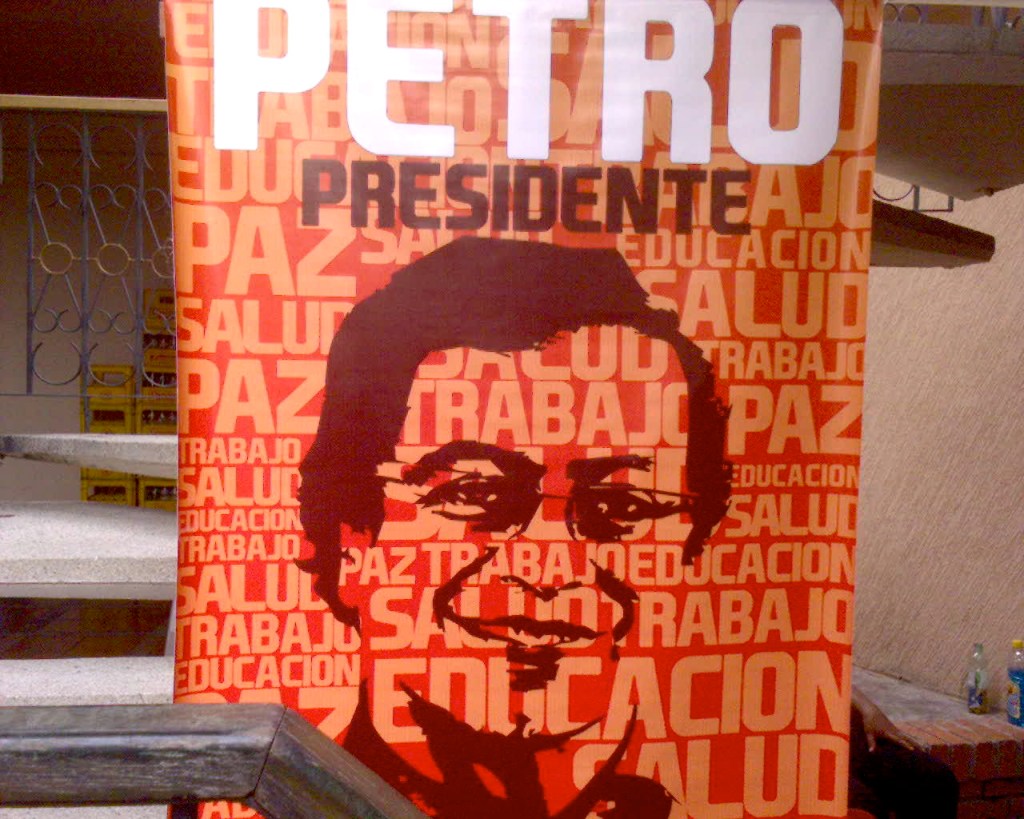
A Gustavo Petro campaign poster from 2010.

On a winter evening about 20 years ago – I am sorry that I cannot be more precise – Bill Fairbairn and I met in Toronto with a Colombian congressman and one of his aides. Bill worked for the Inter-Church Committee on Human Rights in Latin America (ICCHRLA), and I served on its board. And I can’t remember if this meeting was before or after mid-2001 when the work of ICCHRLA was folded (partially) into KAIROS. We were in what I think we used to call the Blue Room of Deer Park United Church in Toronto where the offices of ICCHRLA and later KAIROS were located.

I do remember the congressman, Gustavo Petro, and his earnest search for international allies in the struggle to end Colombia’s civil war and to obtain a measure of social justice to the oppressed majority.

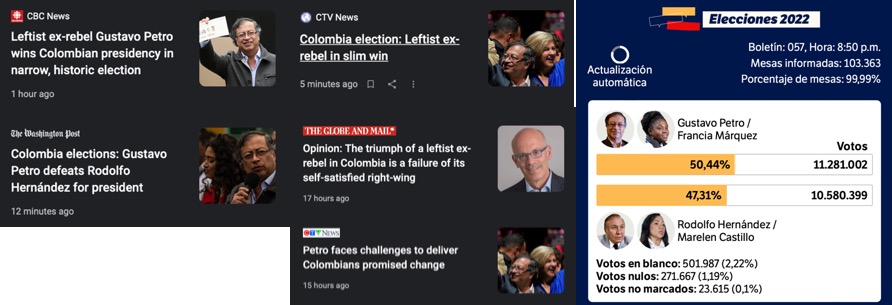
Two decades later, Petro is weeks away from being sworn in as Colombia’s first president from a party of the left. His victory results from the mobilization of young and new voters from parts of Colombia that are always ignored, especially the Caribbean and Pacific coasts. 

Celebrating victory (left); voters from the margins propelled Petro to power.

A large measure of credit goes to his running mate, the environmental activist and lawyer Francia Márquez, 40. She will become the country’s first Afro-Colombian to hold executive office. This election was the first time voter turnout topped 60 per cent, according to the International Institute for Democracy and Electoral Assistance (IDEA).

I met Petro again in August 2004 in Caracas, Venezuela. We were staying in the same hotel and both of us were observers of a referendum that opponents hoped would remove President Hugo Chávez from power. During Petro’s three campaigns to become president, along with his congressional and senate races, and the 2011 drive that made him mayor of Bogotá, right-wing politicians tagged him as castrochavista (as if that were a bad thing). They decried his youthful involvement in the M-19 guerrillas. They had made peace with the government in 1990. Petro, unlike many former fighters who laid down their weapons, survived the waves of selective assassinations that sought to eliminate them from political life.

Victory this past Sunday by Gustavo Petro, 62, in Colombia’s presidential election offers hope for reviving a peace process stalled these past four years by President Iván Duque, protegé of former president Álvaro Uribe – the fiercest guardian of the ways that things have always been done by those with power in Colombia.

Petro defeated Rodolfo Hernández, a millionaire conservative who was frequently compared to Donald Trump.

This election (like recent ones in Chile, Honduras and Peru) is also firm rejection of Canadian and U.S. foreign policy that for the past 20 years has paid lip service to the search for peace, but always protected the interests of those who control land and natural resources. Before Conservative Prime Minister Stephen Harper won his majority in Parliament in 2011, Canada negotiated a free trade agreement with Colombia that as a sop to the Liberal party contained a mechanism for a toothless human rights impact assessment. Colombia was also the key regional ally in setting up the “Lima Group,” the attempt by Washington and Ottawa to isolate Venezuela when most members of the Organization of American States refused to play along.

After the victories by Hugo Chávez in December 1998 in Venezuela and Luiz Inácio (Lula) da Silva in Brazil in 2002, some of us starting talking about a “pink tide” sweeping across Latin America (forgetting perhaps that tides also recede). Now the tide is back, this time stronger than before. In Brazil, Lula is again leading the polls in anticipation of the election later this year.

The road ahead for Petro will be difficult, just as it has been for Pedro Castillo in Peru since his victory a year ago. The opposition will set traps and take advantage of every misstep. In this third attempt to win power, Petro proposed pension, tax, health and agricultural reforms. He would change how Colombia fights drug cartels and start new talks with remaining guerrilla fighters. But his coalition has only about 15 per cent of the seats in Congress, which will force him to make deals, limit some reforms or abandon others. Parts of the U.S. government (military and intelligence agencies) will not be friendly, and Canada (because of influence by resource-extraction companies) may not be either.

Summit of the Americas: U.S. can’t break old habits

That the White House announced Canada’s planned response to the flow of refugees in Central America said a lot to me about the way the Biden administration mishandled the Summit of the Americas, held in Los Angeles last week.

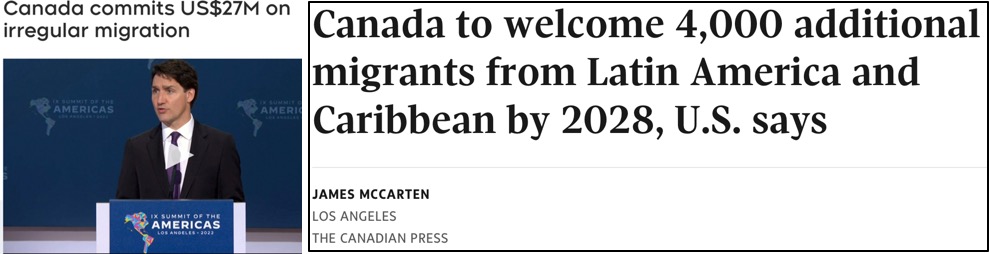
Canada will welcome 4,000 additional migrants from Latin America and the Caribbean, the White House announced on June 10. That number is insignificant compared to the size of the challenge: 

  • Mexico reported apprehending 307,679 undocumented migrants in 2021. About one-third were deported; another third sought asylum in Mexico. The main countries of origin of those apprehended were Honduras (41%), Guatemala (26%), El Salvador (8%), Haiti (6%), Brazil (5%), Nicaragua (5%), Cuba (2%), and Venezuela (1%). None of the leaders of Mexico, Honduras, Guatemala or El Salvador chose to attend the summit – and Nicaragua, Cuba and Venezuela were told by Biden not to come. It’s hard to solve problems when you’re not talking to people who can do something about them.
  • As of February in the United States, about 164,000 (Reuters) or “just under 179,000” (Axios) migrants are currently in alternatives-to-detention programs managed by Immigration and Customs Enforcement  (ICE). This is “roughly double the total on Sept. 30, 2020, before Biden took office,” Reuters reported, and doesn’t include dependents – or the people actually held in detention.

The White House announcement of Canada’s support included commitments from other countries on migration issues, and was reported by Canadian Press in an article widely shared in Canadian media (CBC, CTV, the Globe and Mail, among others).

“The agreement also includes a pre-existing Canadian commitment to bring in an additional 50,000 agricultural workers this year from Mexico, Guatemala and the Caribbean.” (Those are temporary workers whose rights are limited.)

To its credit, the government (via the Prime Minister’s Office, not Global Affairs Canada) also announced an additional $118 million for “progressive initiatives” aimed at improving the lives of people where they already live in Latin America and the Caribbean. That includes $67.9 million to promote gender equality; $31.5 million in health and pandemic response spending; $17.3 million on democratic governance and $1.6 million for digital access and anti-disinformation measures. It will also spend $26.9 million to address “irregular migration and forced displacement” in the hemisphere.

Washington “still trying to dictate” to neighbours

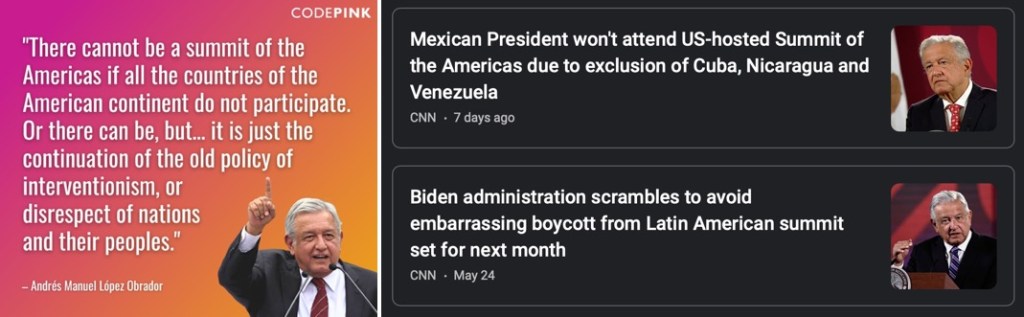
But it was the exclusions and boycotts that drew most attention. Because Venezuela, Cuba and Nicaragua were excluded by the host country, Mexico, Honduras, Bolivia and some Caribbean leaders chose to stay away. Leaders of Guatemala and El Salvador did not attend because of issues with U.S. treatment of allegations of corruption and abuses of human rights in their countries. In the end only about 20 of potentially 35 heads of state or government attended.

Apparently modelling the art of understatement, Reuters reported: “Hosting the Summit of the Americas in Los Angeles, Biden sought to assure the assembled leaders about his administration’s commitment to the region despite nagging concerns that Washington, at times, is still trying to dictate to its poorer southern neighbours.”

The presence of the unelected prime minister of Haiti, Ariel Henry, drew fire. During a panel discussion on “journalistic freedom,” U.S. Secretary of State Antony Blinken had the good grace to seem embarrassed when challenged over Henry’s presence. As Alterpresse pointed out, “not only does Henry govern without a mandate in violation of the Haitian Constitution, he is also implicated in serious crimes, including the death of a Haitian journalist in February 2022 by Haitian police.” (Two other journalists had been killed in January in a gang attack.)

In the tradition of each Summit of the Americas (including the teargas summit in Quebec City in 2001), a People’s Summit was held, gathering more than 250 community organizations, social movements, trade unions and other progressive groups. “In the ‘richest country in the world,’ 140 million live in or near poverty. The US government is addicted to militarism and war and will spend over $800 billion in 2022, on death and destruction,” said the final declaration. “Instead of preparing for war, society must be organized to meet human needs. We want a future without evictions, police violence and mass incarceration, deportations, sanctions, and blockades. We say: no more!”

Perceptions of the Ukraine war in the Global South and Reflections on Peace

Too few of us are talking about peace – or about dialogue and diplomacy – these days. As U.S. journalist Katherine vanden Heuvel writes, it’s time to challenge conventional views on the war in Ukraine.

On a humid evening at the end of May, I spoke with a local parish group convened by Toronto members of Development and Peace/Caritas Canada. I talked more than I usually do about my faith and about the teachings in our religious traditions about peace: “Blessed are the peace-makers,” the artisans of peace.
Not everyone sees this war in the same way. Whether every perception is correct is not the point. At their root is a reluctance to take sides in what looks like a conflict between the empires.

At the same time, Russia’s invasion draws from the tsarist past to violate Ukraine’s sovereignty and right to self-determination. It is also strengthening Ukrainians’ sense of identity and nationhood. Changes should be negotiated without military threats and consented to in free and fair referendums. The 2014-15 Minsk Accords might have offered a way forward.

“Many people think that it is better that the winners be those who oppose U.S. imperialism, which leads them to support Russia or China, or occasionally, Iran or any other nation that opposes the western powers,” writes Raúl Zibechi, the Uruguayan observer of Latin America’s social movements. “Social movements should oppose war so as to deepen their own agenda: strengthening their ‘territorial roots so as to exercise autonomy and self-government, building other worlds that are new and different from the capitalist, patriarchal and colonial world.”
Adolfo Pérez Esquivel, the Argentinean winner of the 1980 Nobel Peace Prize, says there are no “just wars.” But he adds that there are “just causes.” I think of the revolutionary struggles in Central America in the 1980s, but those did not bring about the social changes people hoped for (largely because the United States supplied weapons and mercenaries to the far-right forces), and tens of thousands of people died.
On the left is the garden were six Jesuits, their housekeeper and her daughter were murdered by a death squad in November 1989 at the University of Central America in San Salvador. On the right are Rev. Miguel Tomás Castro of Emmanuel Baptist Church in San Salvador and a group of student leaders in the ongoing effort to build a “culture of peace.”

The “peace” that Central Americans, together with others across the Global South, ended up with after the wars has advanced a model of development that impoverishes, excludes and drives people from their land. Even the new development proposals from the U.S. and Mexican governments are inadequate in the face of political-economic devastation and climate change. Hondurans, at least, at this moment, have a shot at something better. But their military (and its U.S. backers) may not tolerate real, meaningful change. The way forward must be different from the ways of the past.

The current war in Ukraine, in addition to the human and material costs of fighting, is having ripples far beyond the two countries directly involved. Not just higher energy prices, but the likelihood of food shortages. Russia and Ukraine have been responsible for more than a quarter of the world’s wheat exports and for large quantities of barley, corn and vegetable oil too.

I have been critical of the use of sanctions. Sanctions, as we see now in the case of Russia, are warfare by other means. (You can track the imposition of sanctions here.)

With regard to sanctions, it’s not the world against Russia. As Zhou Xiaoming has written, few non-Western countries have answered the U.S. call to isolate Russia economically, fearing the impact of disruptions to global production and trade on their own people. And countries that have already felt the effects of US sanctions and have no desire to inflict them on others.

This time, I am not exactly against the use of economic measures. Over the short-term, targeted measures seem reasonable. Between now and the onset of winter, their impact on civilians will need to be measured and their effectiveness evaluated. Space for diplomacy, public health and science, however, should remain open, including the Arctic Council and the International Space Station. 

What happened to our peace movement? NATO expanded, and seems likely to expand still further.

What should we do now?

We should do what we who believe in peace do in every other armed conflict: call for peace, withdrawal, dialogue, diplomacy. 

  • Support the refugees – and those Russians who dissent from Putin’s war. Indeed: support ALL refugees, wherever they are. By mid-2021, an unprecedented 82.4 million people around the world have been forced to flee their homes. Among them are 26.4 million refugees, around 42 per cent of whom are under the age of 18. 
  • Support humanitarian efforts by Development and Peace/Caritas Canada, the churches and agencies that are part of the global ACT Alliance, and other reputable organizations.
  • Revive conversations on common security and mutual understanding and increase official development assistance to 0.7 per cent of gross national income. These are investments in security and sustainability for all.
  • Whatever happens in Ukraine, keep nuclear weapons out
  • Support debt relief: Since the fall of the Soviet Union, Ukraine has borrowed more than $125 billion from international financial institutions, which pushed the sell-off of public enterprises and rewarded oligarchs and the super-rich with every loan they made. But being under attack doesn’t mean you can catch a break from international lenders. In 2022, unless loans are forgiven or suspended, Kyiv will spend $6.2 billion paying down foreign debt. Nearly half of that will go to the International Monetary Fund. 
The Hill Times, April 27, 2022. See as well a piece by Beth Woroniuk in iPolitics: “The world’s response to the invasion in Ukraine is only the latest example that ‘old school’ approaches to conflict resolution are not working. It is the time to bring anti-racist and decolonial analysis to international relations. It is time to ask questions about whose voices matter. This includes going beyond the warriors and including people who have a vested interest in stopping the guns for good, including women building peace at local, national and international levels.”

Early on in the conflict, it seemed that Pope Francis had potential as a mediator because of his pretty good relationship with Patriarch Kirill. But Kirill, like Putin, seems tied to a view of history – the Kievan Rus, the ancient state that converted to Christianity in 988 – that would subsume Ukraine into Russia. Meanwhile, the Ukrainian Orthodox Church has largely broken with the Moscow Patriarchate.
Can churches that have fomented division in the past now lead the way in showing they can live with diversity?

The horrible thing about making peace is that you have to talk with your enemies. Diplomacy is a tool for doing that.

Deliver us from evil, deliver our leaders from evil and grant us peace in our day.