Summit of the Americas: U.S. can’t break old habits

That the White House announced Canada’s planned response to the flow of refugees in Central America said a lot to me about the way the Biden administration mishandled the Summit of the Americas, held in Los Angeles last week.
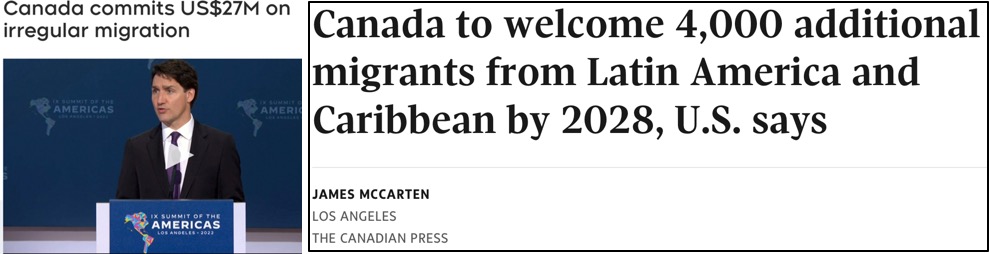
Canada will welcome 4,000 additional migrants from Latin America and the Caribbean, the White House announced on June 10. That number is insignificant compared to the size of the challenge: 

  • Mexico reported apprehending 307,679 undocumented migrants in 2021. About one-third were deported; another third sought asylum in Mexico. The main countries of origin of those apprehended were Honduras (41%), Guatemala (26%), El Salvador (8%), Haiti (6%), Brazil (5%), Nicaragua (5%), Cuba (2%), and Venezuela (1%). None of the leaders of Mexico, Honduras, Guatemala or El Salvador chose to attend the summit – and Nicaragua, Cuba and Venezuela were told by Biden not to come. It’s hard to solve problems when you’re not talking to people who can do something about them.
  • As of February in the United States, about 164,000 (Reuters) or “just under 179,000” (Axios) migrants are currently in alternatives-to-detention programs managed by Immigration and Customs Enforcement  (ICE). This is “roughly double the total on Sept. 30, 2020, before Biden took office,” Reuters reported, and doesn’t include dependents – or the people actually held in detention.

The White House announcement of Canada’s support included commitments from other countries on migration issues, and was reported by Canadian Press in an article widely shared in Canadian media (CBC, CTV, the Globe and Mail, among others).

“The agreement also includes a pre-existing Canadian commitment to bring in an additional 50,000 agricultural workers this year from Mexico, Guatemala and the Caribbean.” (Those are temporary workers whose rights are limited.)

To its credit, the government (via the Prime Minister’s Office, not Global Affairs Canada) also announced an additional $118 million for “progressive initiatives” aimed at improving the lives of people where they already live in Latin America and the Caribbean. That includes $67.9 million to promote gender equality; $31.5 million in health and pandemic response spending; $17.3 million on democratic governance and $1.6 million for digital access and anti-disinformation measures. It will also spend $26.9 million to address “irregular migration and forced displacement” in the hemisphere.
Washington “still trying to dictate” to neighbours

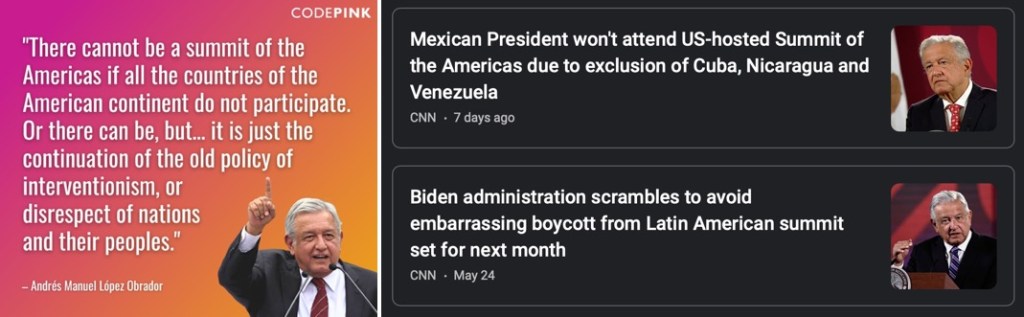
But it was the exclusions and boycotts that drew most attention. Because Venezuela, Cuba and Nicaragua were excluded by the host country, Mexico, Honduras, Bolivia and some Caribbean leaders chose to stay away. Leaders of Guatemala and El Salvador did not attend because of issues with U.S. treatment of allegations of corruption and abuses of human rights in their countries. In the end only about 20 of potentially 35 heads of state or government attended.

Apparently modelling the art of understatement, Reuters reported: “Hosting the Summit of the Americas in Los Angeles, Biden sought to assure the assembled leaders about his administration’s commitment to the region despite nagging concerns that Washington, at times, is still trying to dictate to its poorer southern neighbours.”

The presence of the unelected prime minister of Haiti, Ariel Henry, drew fire. During a panel discussion on “journalistic freedom,” U.S. Secretary of State Antony Blinken had the good grace to seem embarrassed when challenged over Henry’s presence. As Alterpresse pointed out, “not only does Henry govern without a mandate in violation of the Haitian Constitution, he is also implicated in serious crimes, including the death of a Haitian journalist in February 2022 by Haitian police.” (Two other journalists had been killed in January in a gang attack.)

In the tradition of each Summit of the Americas (including the teargas summit in Quebec City in 2001), a People’s Summit was held, gathering more than 250 community organizations, social movements, trade unions and other progressive groups. “In the ‘richest country in the world,’ 140 million live in or near poverty. The US government is addicted to militarism and war and will spend over $800 billion in 2022, on death and destruction,” said the final declaration. “Instead of preparing for war, society must be organized to meet human needs. We want a future without evictions, police violence and mass incarceration, deportations, sanctions, and blockades. We say: no more!”

Perceptions of the Ukraine war in the Global South and Reflections on Peace

Too few of us are talking about peace – or about dialogue and diplomacy – these days. As U.S. journalist Katherine vanden Heuvel writes, it’s time to challenge conventional views on the war in Ukraine.

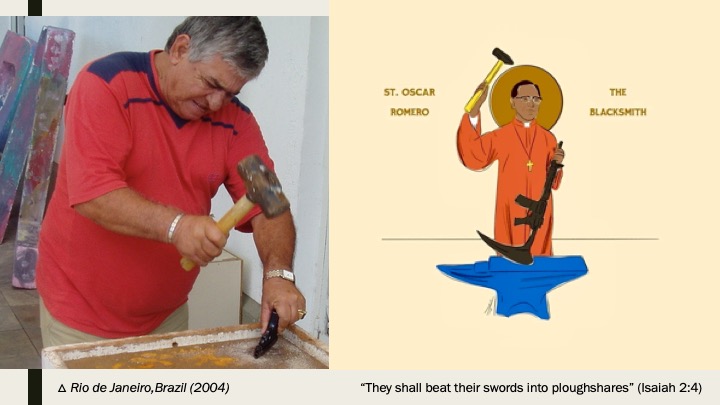
On a humid evening at the end of May, I spoke with a local parish group convened by Toronto members of Development and Peace/Caritas Canada. I talked more than I usually do about my faith and about the teachings in our religious traditions about peace: “Blessed are the peace-makers,” the artisans of peace.
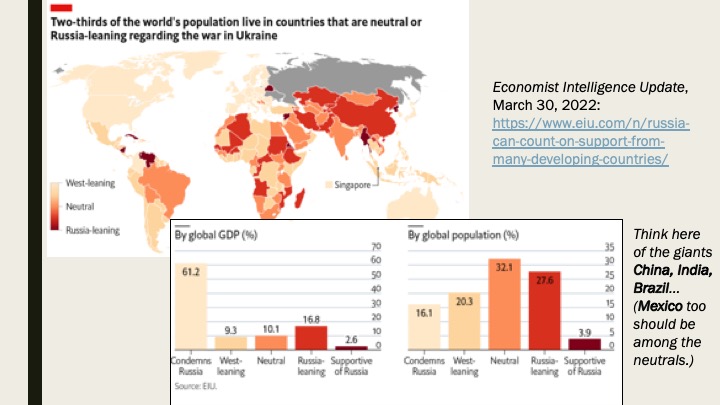
Not everyone sees this war in the same way. Whether every perception is correct is not the point. At their root is a reluctance to take sides in what looks like a conflict between the empires.

At the same time, Russia’s invasion draws from the tsarist past to violate Ukraine’s sovereignty and right to self-determination. It is also strengthening Ukrainians’ sense of identity and nationhood. Changes should be negotiated without military threats and consented to in free and fair referendums. The 2014-15 Minsk Accords might have offered a way forward.

“Many people think that it is better that the winners be those who oppose U.S. imperialism, which leads them to support Russia or China, or occasionally, Iran or any other nation that opposes the western powers,” writes Raúl Zibechi, the Uruguayan observer of Latin America’s social movements. “Social movements should oppose war so as to deepen their own agenda: strengthening their ‘territorial roots so as to exercise autonomy and self-government, building other worlds that are new and different from the capitalist, patriarchal and colonial world.”
Adolfo Pérez Esquivel, the Argentinean winner of the 1980 Nobel Peace Prize, says there are no “just wars.” But he adds that there are “just causes.” I think of the revolutionary struggles in Central America in the 1980s, but those did not bring about the social changes people hoped for (largely because the United States supplied weapons and mercenaries to the far-right forces), and tens of thousands of people died.
On the left is the garden were six Jesuits, their housekeeper and her daughter were murdered by a death squad in November 1989 at the University of Central America in San Salvador. On the right are Rev. Miguel Tomás Castro of Emmanuel Baptist Church in San Salvador and a group of student leaders in the ongoing effort to build a “culture of peace.”

The “peace” that Central Americans, together with others across the Global South, ended up with after the wars has advanced a model of development that impoverishes, excludes and drives people from their land. Even the new development proposals from the U.S. and Mexican governments are inadequate in the face of political-economic devastation and climate change. Hondurans, at least, at this moment, have a shot at something better. But their military (and its U.S. backers) may not tolerate real, meaningful change. The way forward must be different from the ways of the past.

The current war in Ukraine, in addition to the human and material costs of fighting, is having ripples far beyond the two countries directly involved. Not just higher energy prices, but the likelihood of food shortages. Russia and Ukraine have been responsible for more than a quarter of the world’s wheat exports and for large quantities of barley, corn and vegetable oil too.

I have been critical of the use of sanctions. Sanctions, as we see now in the case of Russia, are warfare by other means. (You can track the imposition of sanctions here.)

With regard to sanctions, it’s not the world against Russia. As Zhou Xiaoming has written, few non-Western countries have answered the U.S. call to isolate Russia economically, fearing the impact of disruptions to global production and trade on their own people. And countries that have already felt the effects of US sanctions and have no desire to inflict them on others.

This time, I am not exactly against the use of economic measures. Over the short-term, targeted measures seem reasonable. Between now and the onset of winter, their impact on civilians will need to be measured and their effectiveness evaluated. Space for diplomacy, public health and science, however, should remain open, including the Arctic Council and the International Space Station. 

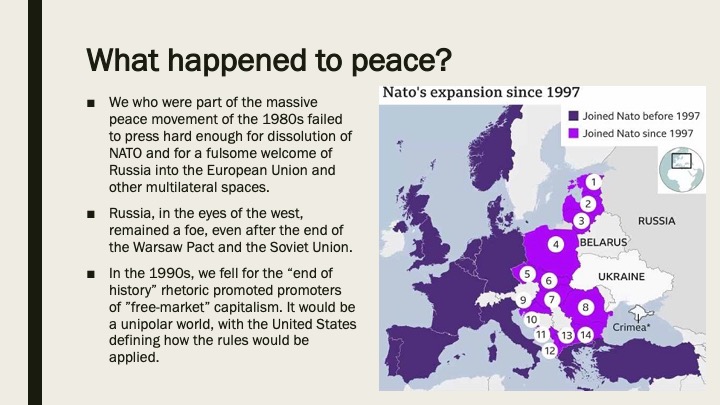
What happened to our peace movement? NATO expanded, and seems likely to expand still further.

What should we do now?

We should do what we who believe in peace do in every other armed conflict: call for peace, withdrawal, dialogue, diplomacy. 

  • Support the refugees – and those Russians who dissent from Putin’s war. Indeed: support ALL refugees, wherever they are. By mid-2021, an unprecedented 82.4 million people around the world have been forced to flee their homes. Among them are 26.4 million refugees, around 42 per cent of whom are under the age of 18. 
  • Support humanitarian efforts by Development and Peace/Caritas Canada, the churches and agencies that are part of the global ACT Alliance, and other reputable organizations.
  • Revive conversations on common security and mutual understanding and increase official development assistance to 0.7 per cent of gross national income. These are investments in security and sustainability for all.
  • Whatever happens in Ukraine, keep nuclear weapons out. 
  • Support debt relief: Since the fall of the Soviet Union, Ukraine has borrowed more than $125 billion from international financial institutions, which pushed the sell-off of public enterprises and rewarded oligarchs and the super-rich with every loan they made. But being under attack doesn’t mean you can catch a break from international lenders. In 2022, unless loans are forgiven or suspended, Kyiv will spend $6.2 billion paying down foreign debt. Nearly half of that will go to the International Monetary Fund. 
The Hill Times, April 27, 2022. See as well a piece by Beth Woroniuk in iPolitics: “The world’s response to the invasion in Ukraine is only the latest example that ‘old school’ approaches to conflict resolution are not working. It is the time to bring anti-racist and decolonial analysis to international relations. It is time to ask questions about whose voices matter. This includes going beyond the warriors and including people who have a vested interest in stopping the guns for good, including women building peace at local, national and international levels.”

Early on in the conflict, it seemed that Pope Francis had potential as a mediator because of his pretty good relationship with Patriarch Kirill. But Kirill, like Putin, seems tied to a view of history – the Kievan Rus, the ancient state that converted to Christianity in 988 – that would subsume Ukraine into Russia. Meanwhile, the Ukrainian Orthodox Church has largely broken with the Moscow Patriarchate.
Can churches that have fomented division in the past now lead the way in showing they can live with diversity?

The horrible thing about making peace is that you have to talk with your enemies. Diplomacy is a tool for doing that.

Deliver us from evil, deliver our leaders from evil and grant us peace in our day.

Fanning the fires of hope in Chiapas, still

There was one time when I was glad to see the riot place arrive: Sunday afternoon, February 19, 1995 in San Cristóbal de Las Casas, Chiapas. 

For more than a week, Maya Indigenous people of the Chiapas highlands had protected their cathedral, the seat of Bishop Samuel Ruiz. On that Sunday afternoon, the feared attack had become real as a larger group of about 400 “auténticos coletos” (denoting descendants of the European settlers in the city) hurled stones: the settlers saw the Indigenous people as interlopers, the ones who had no business in the heart of their city.

The defenders stood three deep in scraggly lines surrounding the cathedral. They held flowers. Men, women and children, old and young, Indigenous and Mestizo, Mexican and foreign, held marigolds, lilies and carnations and wore white ribbons across their chests as they faced the attack. They endured the attack, holding blankets over their heads and trying to duck the stones. The woman next to me whispered prayers and repeatedly blessed the rock-throwers: “God, forgive them.”

The mob tried for more than an hour to storm into the cathedral and the diocesan office next to it. Finally, the riot squad arrived and traced a line between the two groups. The people on the steps cheered; the mob dispersed. In the meantime, at least five people, including two reporters, had been injured. 

For 10 days, ever since Mexican President Ernesto Zedillo pledged to capture the leaders of the rebel Zapatista army (EZLN), the people of this diocese had maintained a vigil around the cathedral and diocesan office. That building also housed the National Mediation Commission (CONAI), chaired by Bishop Ruiz and in session at the time of the attack.

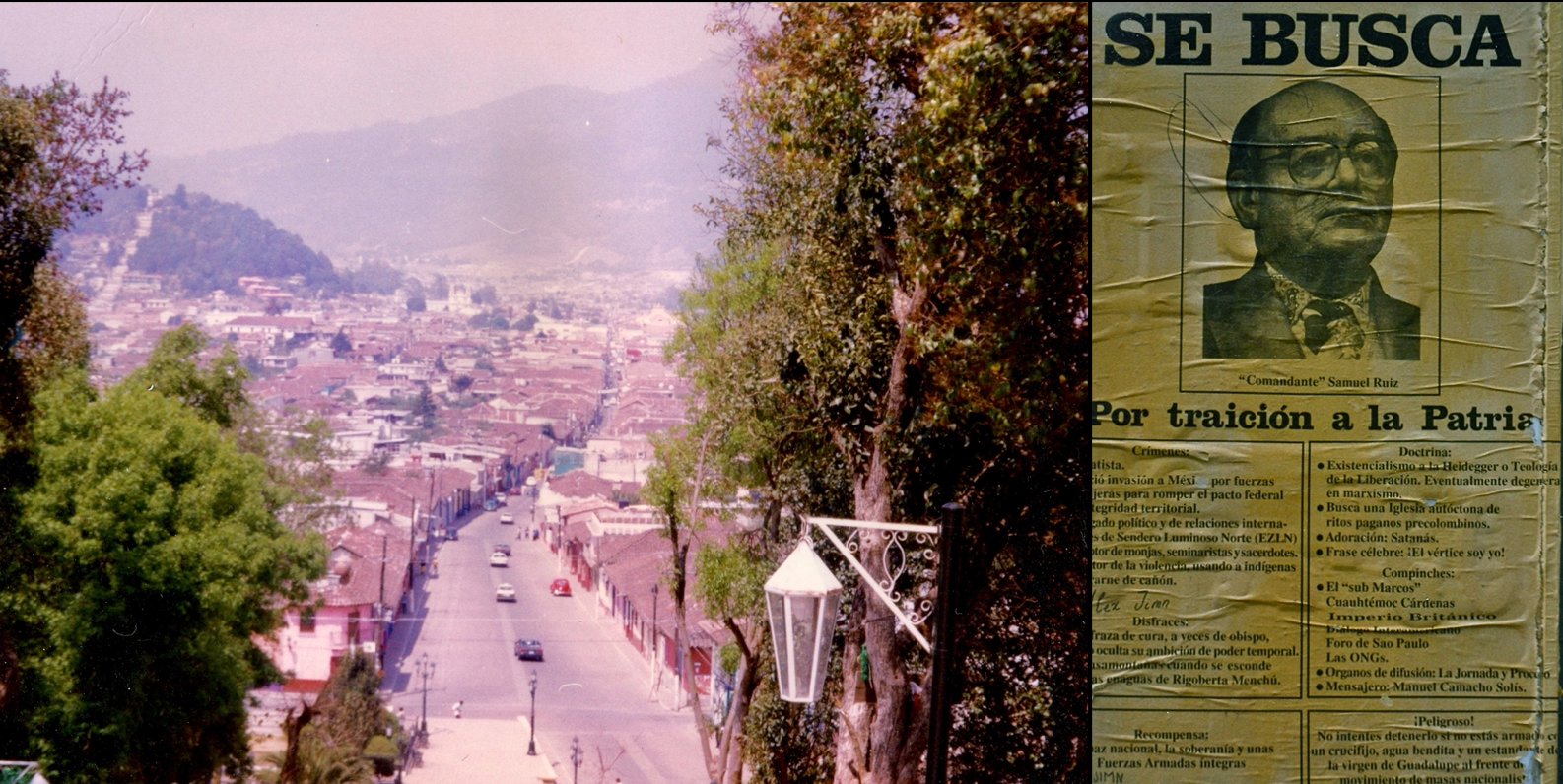
Left: a view of San Cristóbal de Las Casas. Right: a “wanted” poster that describes Bishop Ruiz variously as a traitor, existentialist, liberation theologian and Marxist – typical of the charges laid against him by his opponents over many years.

For more than a year, Ruiz had been at the centre of ecclesial and political controversies over his decades-long advocacy for and with Indigenous and impoverished people in Chiapas and his role as a mediator between the government and the Zapatistas. The EZLN uprising had begun on January 1, 1994, the day that the North America Free Trade Agreement (NAFTA) came into effect.

Zedillo failed to capture Zapatista leaders, but instead arrested people who worked for community development organizations (notably Jorge Santiago of DESMI, Economic and Social Development of Mexican Indigenous Peoples). His army also achieved what it considered to be better strategic positions near the Zapatista communities. 

Over the subsequent year, CONAI’s mediation work continued and bore fruit: on February 16, 1996, the government and EZLN representatives signed an Agreement on Indigenous Culture and Rights in San Andrés Sakamch’en. It was not a comprehensive peace deal, but rather the first step in a planned process to address Indigenous rights in Chiapas and beyond. “It was the first time in Mexican history that the state had sat down with Indigenous people to hear their demands,” wrote La Jornada columnist Magdalena Gómez recently. Later that year, the National Indigenous Congress (CNI) was created and continues its work today.

But from the government side, nothing happened! The first agreement has not been implemented; worse, the government negotiators essentially sabotaged a second round that was to address issues of democracy and justice, leading the EZLN to suspend the dialogue on September 4, 1996. It has not been renewed. The EZLN continues to press its cause in multiple public fora in Mexico and far beyond, and the communities persist in building a fairly successful example of Indigenous autonomy. 

Sadly, even the somewhat more progressive government of Andrés Manuel López Obrador, in power now for more than three years, has failed to move beyond what Gómez called “recycled, low-intensity, neo-Indigenous” policies of individual support and mega-projects without reference to the San Andrés Accords. 

A year ago, the Fray Bartolomé de Las Casas Human Rights Centre in San Cristóbal said the San Andrés Accords persist as a framework and reference for the people of Chiapas. “The people who struggle will continue to fan the fire of hope, and history will give an account of this, because despite the war of extermination, the construction of autonomy gives light and fire to women and men throughout the world.”

Parts of this post are adapted from two of my articles published in Catholic New Times, March 5 and 19, 1995.

“I give you a flower,” says a t-shirt from Yajalón, Chiapas.