
When protests broke out on Sunday, July 11, President Miguel Díaz-Canel went to the streets of San Antonio de los Baños, southwest of Havana, to talk with protesters about their grievances—something the presidents of Colombia, Chile, Ecuador, Brazil, Guatemala and Haiti never did despite months of protests in their countries.
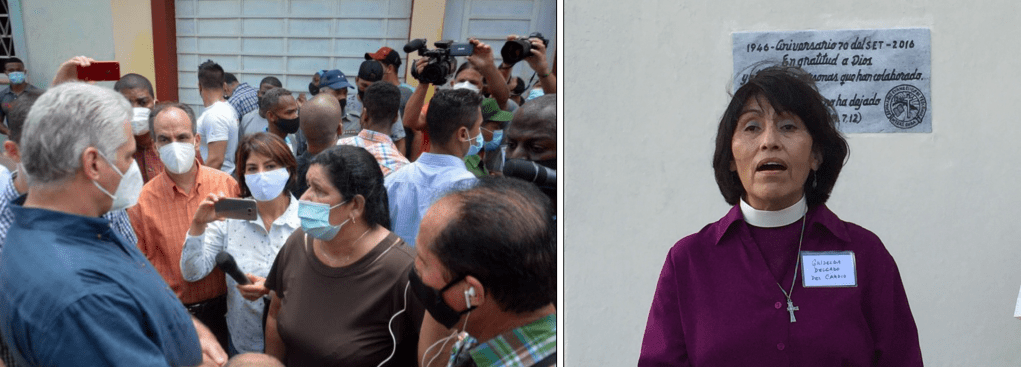
In the wake of the protests, Cuba’s churches called for dialogue. The Catholic bishops warned against “a rigidity and hardening of positions” and encouraged “mutual listening.” The bishop of the Episcopalian (Anglican) Church, María Griselda Delgado, said: “There will always be divergences, diverse opinions, different thoughts; there is the richness and integrity of being a People. It is necessary to raise the value of dialogue to seek understanding.” (Several of the church statements are posted in English on a Facebook site related to the Presbyterian Church U.S.A.) On Aug. 6, the Cuban Council of Churches and leaders of its member churches met with President Díaz-Canel, along with the Student Christian Movement and other ecumenical groups.
Like many Canadians, I made my first visit to Cuba as a tourist. That was in 1992, at the height of the “special period” when Cubans faced hardship as a result of the collapse of the Soviet Union, and sought new ways to engage with the rest of the world.
From 2000 to 2019, I had the privilege of visiting the country almost every year. For two decades on behalf of The United Church of Canada, I worked alongside Cuban churches and their ecumenical organizations (the Cuban Council of Churches, the Evangelical Seminary of Theology in Matanzas, the Christian Centre for Reflection and Dialogue in Cárdenas, and the Martin Luther King Memorial Centre in Havana).
Canadians visited Cuba; Cubans came to Canada. The relationships were lively: rooted in love and mutual respect, and not immune from political and religious controversies. We learned together and taught one another in formal and informal settings—academic exchanges (faculty and students), congregational twinning, and participation together in international settings (World Social Forum, Hemispheric Social Alliance, World Council of Churches, ACT Alliance, and others). And we worked with U.S. churches to help maintain and strengthen their ties with Cuban churches in the face of official U.S. hostility to Cuba. My occasional conversations with Cuban government staff and politicians were friendly and informative.
All of those efforts are about building bridges, sharing stories, promoting dialogue. We could even find common ground with the government of Canada’s “constructive engagement” policy approach to Cuba and, for many years, collaborate in official development assistance projects.
And so, I welcome the voices of those Cuban churches that work in favour of dialogue and realistic approaches to solving problems.
Theology in Revolution
For the Cuban churches, the years following the Cuban Revolution were challenging. The new government was suspicious of churches that had aligned themselves historically with the elites or that operated as “missions” that were dependent on U.S. support. The government restricted religious activity. Many ministers and priests left the country, though there was more enthusiasm for the revolution among lay people. Atheism became official state policy and religious believers were discriminated against in employment and education.

Some among those who stayed—or, as in the case of Presbyterian theologian Sergio Arce Martínez, returned—developed a “theology in revolution” in the 1960s. Arce was concerned not with a God “up there,” but rather with God “down here” as experienced in human history, especially in the revolution against poverty, exclusion and imperialism. Christians from other parts of the world attended the 1966 Tricontinental Congress in Havana, and then the Cultural Congress held in Havana in January 1968. That event was attended by several Catholic priests whose declaration was read aloud by Fidel Castro at the closing.
Elsewhere, other processes were underway: the Roman Catholic Church’s II Vatican Council (1962-65) and the meeting of Latin American bishops in Medellín in 1968; the growth of Christian base communities; Priests for the Third World in Argentina in 1966; the World Conference on Church and Society, held in Geneva in 1966, that identified the close relationship between peace and justice; and emergence of the National Organization for Social Integration (ONIS) in Peru in 1968, the Golcanda group in Colombia, also in 1968, and Christians for Socialism in Salvador Allende’s Chile in 1971. All of these currents—including the Cuban Revolution itself—influenced each other and played a role in the articulation of liberation theology by Gustavo Gutiérrez and others in the early 70s. The confluence of those processes, plus the Catholic Church’s articulation of the “preferential option for the poor” in the late 70s, and patient work by Christians in Cuba to overcome the revolutionary government’s early distrust of organized religion, resulted in the Communist Party’s decision in 1991 to drop its requirement that party members be atheists. More Cuban Christians began to attend worship and join churches.
Use and abuse of organized religion
The U.S. government has made no secret of its intent to use religious groups to subvert the Cuban Revolution. Most blatant in this regard was the May 2004 Report to President G.W. Bush by the Commission for Assistance to a Free Cuba, chaired by then-Secretary of State Colin Powell. The commission promised to use religious organizations in “building a free Cuba.” It also proposed to “differentiate the leadership of the Cuban Council of Churches” from its members (p.64).
Read now, almost two decades later, the report is as ludicrous as other Orwellian lies from the Bush era, like the ones about weapons of mass destruction in Iraq or that Afghans would welcome foreign invaders.
Even so, you can see the effects of the approach in the attacks today on the Cuban Council of Churches in responses to its social media posts.
With graver consequences, networks of conservative Christians oppose gender equity, same-sex marriage and Trans rights as if they were attacks on the “traditional family.” Any criticism of the fundamentalist view draws charges from the U.S. government that Cuba is attacking religious freedom. (I’ll look at LGBTI rights in a future post.)
In facing the alignment of fundamentalist Christian religion with right-wing politics, Cuba is not alone. Across Latin America and beyond, many of these groups seek to use state power to impose their narrow moral agenda. I have written about this phenomenon previously (in the context of Colombia) here.
Next week: Unwrapping development, Cuban-style; LGBTI rights and inclusion; and something along the lines of “how to confront imperialism without losing your soul.”
Boston’s archbishop, Cardinal Sean Patrick O’Malley, met Sept. 9 with Cuban President Miguel Díaz-Canel, and with scientists who developed Cuba’s Covid vaccines.
 Unwrapping Development