Disappointment and fury in the wake of failed climate talks—and hope for the road ahead

by Jim Hodgson

“I am infuriated to come home to the aftermath of six typhoons that have struck the Philippines in the space of just four weeks with basically zero gains from COP29,” said Patricia Mungcal, a young climate advocate who serves as humanitarian manager with the National Council of Churches in the Philippines. 

“I will be telling thousands of Filipino families who were devastated by these strong typhoons that world leaders have left us to suffer the heaviest impacts of the climate crisis and disregarded our demands for finance and reparations. This failure to address loss and damage is a grave disregard of our human dignity and rights. We charge this failure of COP29 to the moral bankruptcy of the rich, polluting nations.”

News from Philippines and (right) Patricia Mungcal (screenshot from WCC video)

At the recent climate conference in Baku, Azerbaijan, world leaders failed miserably in their response to the climate crisis and its consequences. Of the $1.3 trillion of climate finance that independent experts estimate will be required annually by 2030, the UN climate conference agreed to provide just $300bn every year – by 2035 (Progressive International newsletter, Dec. 3).

Meanwhile, governments around the globe (including Canada) are still ploughing billions of dollars into fossil fuel subsidies to shelter citizens from higher energy costs, but that comes with a fiscal burden and impedes the goal of reducing overall use.

And Philippines had six typhoons. In the Canadian Rockies, Jasper townsite burned—just days after I had written about climate disasters in British Columbia.

What is to be done?

More often now, we are seeing the connection between the climate crisis and the growing indebtedness of the so-called “highly indebted poor countries” (HIPC). And proposals for a new international financial architecture are once again getting attention. 

In June, Pope Francis pressed leading economists and world finance ministers to support new mechanisms to ease foreign debt, lamenting that “poorly managed globalization” has deprived millions of people of a “dignified future.”

Ecological debt and foreign debt are two sides of the same coin that mortgages the future,” the pope said. “For this reason, dear friends, the Holy Year of 2025, to which we are heading, calls us to open our minds and hearts to be able to untie the knots of the ties that strangle the present, without forgetting that we are only custodians and stewards, not masters.”

The focus of this Jubilee Year is gaining ecumenical and inter-faith support. In Canada, KAIROS will lead a Canadian Ecumenical Jubilee campaign, in step with global debt relief efforts. “These are inspired by the Jubilee tradition from the Book of Leviticus. Rooted in faith, Jubilee calls for the release of debts, liberation from servitude, and the return of seized lands—principles that resonate deeply in today’s world,” says KAIROS. This campaign aims to:

  • Cancel unjust debts. 
  • Establish a UN-led mechanism for debt resolution. 
  • Prevent future cycles of crippling debt.

The 2025 meeting of G7 (leaders of the richest countries) will be held June 15-17 in Kananaskis, Alberta (southwest of Calgary).
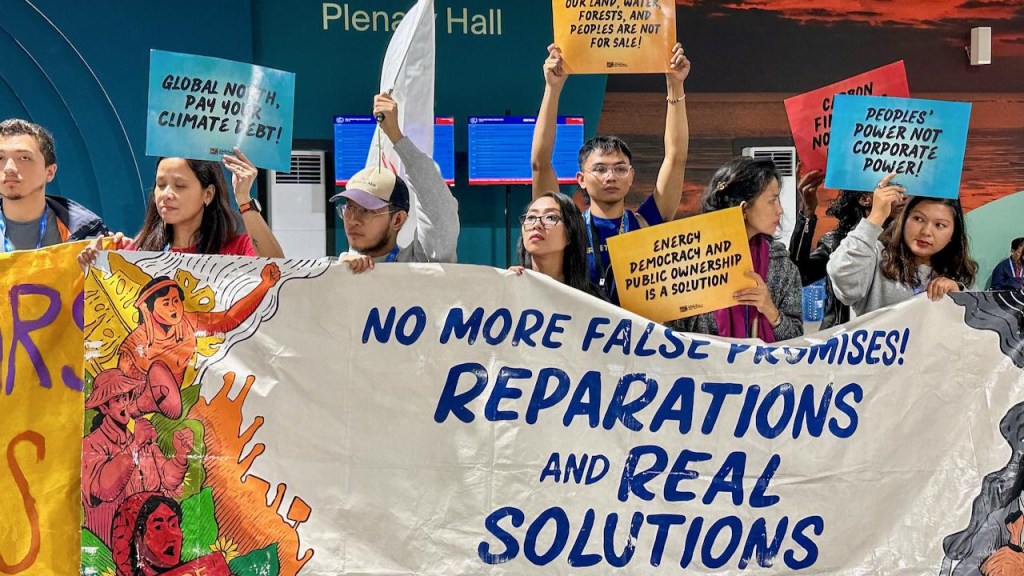
Confronting threats to the living planet.” Photo: Valter Muniz, WCC)

A “Manual for Mutiny”

The global Progressive International network, meanwhile, is presenting a Program of Action on the Construction of a New International Economic Order. It speaks of a “polycrisis”—the combination of the “old crises of debt, dependency and under-development” combined now with “an accelerating crisis of climate to threaten not only the developmental prospects of the South—but also, in the case of many small island states, their very existence.”

The Program of Action offers nearly three dozen measures across five broad sections: to leverage the South’s natural wealth, labor power, and collective voice in order to extract concessions from Northern partners; to bolster the sovereign development agenda by building Southern alternatives to Northern institutions; and to pool Southern knowledge, resources, and ingenuity in service of a whole that is greater than the sum of its parts.

To that, I would add: Systemic failure demands system change.

What you can do

Keep an eye on KAIROS, of course, and on Development and Peace-Caritas Canada for ways to get involved in the new Jubilee campaigns.

I also want to share with you some suggestions from Katharine Hayhoe, a Canadian atmospheric scientist whose research focuses on understanding the impacts of climate change on people and the planet.

“For climate action to happen at scale, conversations have to move beyond international summits to what’s happening in our communities, our workplaces, and our organizations. And there, change isn’t something we wait for. It’s something we catalyze,” she wrote after COP29.

She suggests starting conversations “about climate solutions where you work or study. Ask what your organization is already doing, and what more it could do—and share that with people around you, particularly those who can make decisions.”

That will be especially important as Canadians vote in a federal election in 2025, and as one party opts for simplistic slogans over serious conversations about climate policy.

World Council of Churches: for peace, against sanctions, and sexuality talks continue

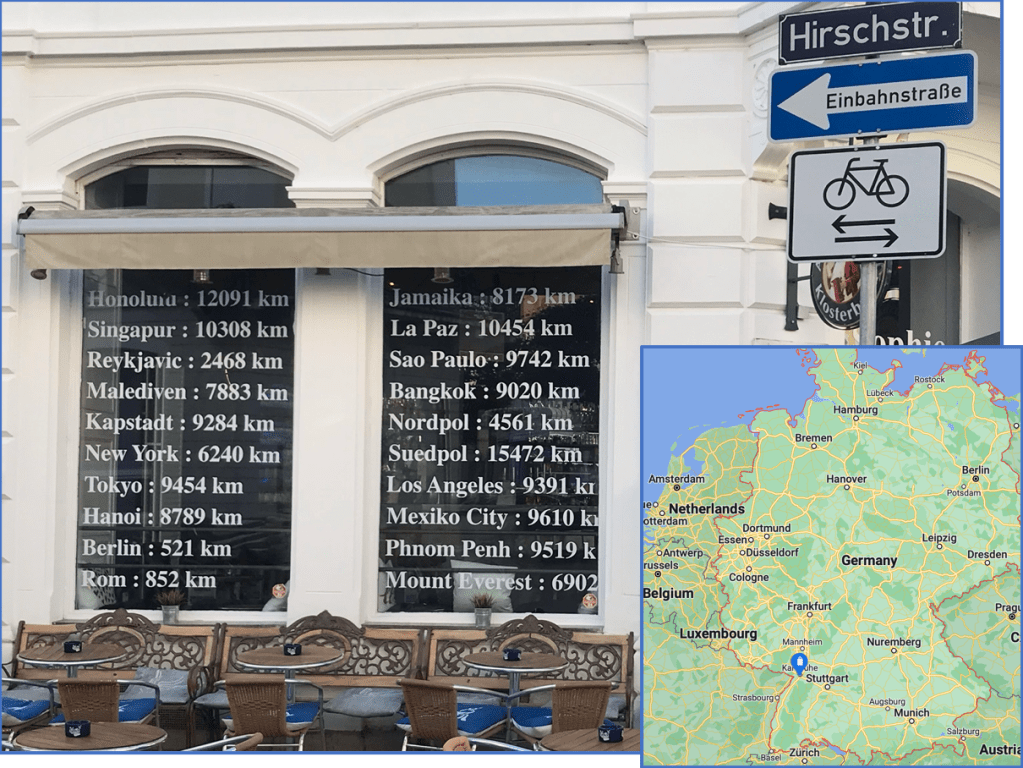
From this small city in southwest Germany, impacts of the WCC Assembly may be felt from Cape Town (9,284 km) to to Phnom Penh (9,519 km).

KARLSRUHE – As sometimes happens in large gatherings, I found myself on a single track in this Assembly of the World Council of Churches. For several years, I have participated in Rainbow Pilgrims of Faith, a global coalition that has accompanied the WCC work on sexuality (specifically) and gender justice (generally). 

Here in Karlsruhe, I led the group’s media work: blog posts, news releases and a few interviews. My colleagues managed more direct forms of engagement with delegates and other participants through an information booth and in various panels and workshops. 

At the same time, 660 delegates and more than 2,000 other participants from all parts of the world worked to shape ecumenical priorities for the next eight years or so.

Signs are positive that WCC will continue work on sexuality (sexual orientation, gender identity and expression), but that was just one thread in a tapestry of concerns addressed here.

There are many documents and scores of news releases to pour over, but two stand out for me. 

One, the more theological or spiritual of the two, is A Call to Act Together. For inspiration, it drew from the last book of the Bible, Revelation, and its themes of human suffering at work in the world: war, death, disease, and famine. “We were conscious of their manifestations in the world today. In their wake come injustice and discrimination, where those who have power often use it to oppress others rather than to build inclusion, justice, and peace.”

The message continues: “As the climate emergency accelerates, so does the suffering experienced by impoverished and marginalized people.”*

A sign of peace in Toronto’s distillery district.

The second document, The Things That Make For Peace, is also worthy of attention. It is longer and more focused on policy options.

“We understand that making peace involves addressing racism, xenophobia, antisemitism, hate speech and other forms of hatred of the other (all of which have increased and intensified during these years, in large part encouraged by populist nationalist movements); crisis and competition for essential resources for life; economic injustice and inequality in the marketplace; interstate conflicts and re-emergence of war; and the raising of the spectre of nuclear war.”

It is specific about Russia’s invasion of Ukraine and other armed conflicts – from Colombia to Eritrea and Ethiopia – calling for a global ceasefire “as an urgent moral imperative.”

Particularly close to my heart are sections that call for “support for the churches and peoples of Syria, Cuba, Venezuela and Zimbabwe in the midst of oppression due to international sanctions that affect these populations’ human rights and dignity.” 

Syria is an important case in point, the document says. “International and unilateral sanctions are contributing to worsening the humanitarian situation, harming a civilian population already made vulnerable by war. Moreover, sanctions are damaging the historical multicultural and multi-religious fabric of the Syrian society, forcing Christians and other indigenous groups to flee the country.”

The document calls for the removal of Cuba from the U.S. list of countries that sponsor terrorism and to “accompany the churches as prophetic voices of peace, hope, cooperation and mutual respect.”

* There is a third, equally-impressive document that I found later: The Living Planet: Seeking a Just and Sustainable Global Community. The document calls governments to “practical actions… to meet the pressing need to avert ecological disaster.”

Debt, vaccines, climate: from “blah-blah” to meaningful change on a global scale

This year, global network of organisations (including KAIROS Canada) sponsored Global Days of Action for Justice and Debt Cancellation during the last two weeks of October to focus attention on the intersections of debt, climate and pandemic.

In the wake of G20 summit in Rome and as the global climate meeting in Glasgow gets underway, those of us who hold out hope for an international system that can produce meaningful change are disappointed by failures both on debt cancellation and vaccine distribution—and working for better results on climate issues.

“Political games while the world burns” was the assessment by the European Network on Debt and Development (Eurodad) after the annual meetings Oct. 11-17 of the World Bank and International Monetary Fund.

Back in April 2020, when pandemic lockdowns still were a novelty, the G20 announced a debt service suspension initiative (DSSI). But the Jubilee Debt Campaign says that the DSSI has suspended less than a quarter of debt payments for a very limited group of 46 countries.

Tim Jones, Head of Policy at Jubilee Debt Campaign, said: “The failure to make banks, hedge funds and oil traders take part in the G20’s flagship debt suspension scheme has made a mockery of this initiative. Tens of billions of dollars have flooded out of lower income countries at a time when they were desperately needed to protect lives and livelihoods.”

The campaign also cited research showing that 34 countries spend five times more on debt payments than climate change mitigation or adaptation.

Vaccine sharing

Meanwhile, about 82 countries cannot meet the World Health Organization (WHO) target of 40 per cent Covid-19 vaccination coverage by end of the current year. The global vaccine-sharing arrangement known as COVAX has delivered only about 400 million doses to about 140 low- and middle-income countries.

On Oct. 28, WHO and other aid groups called on the G20 to fund a new, a U.S. $23.4 billion plan to bring vaccines, tests and drugs to impoverished countries in the next year.

During the G20 summit in Rome two days later, Canada announced it will donate 10 million Moderna vaccines and deliver 200 million doses by the end of next year. The new promise comes despite abject failure of the last set of promises: Canada delivered only 3 million doses out of a planned 40.7 million does announced at the G7 summit last June.

On average, the G20 countries have vaccinated about 55 per cent of their eligible populations, reported The Globe and Mail. Globally, the figure is 38 per cent, and in Africa, only seven per cent.

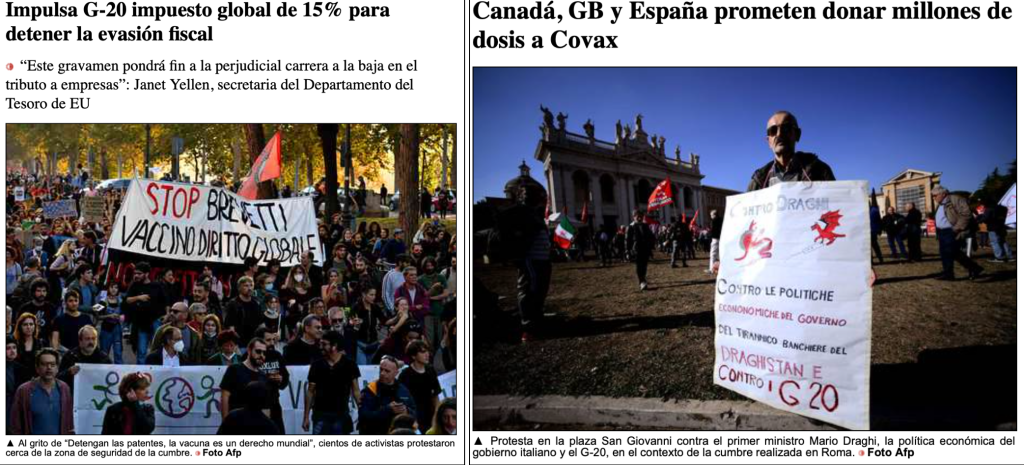
Today in La Jornada, Mexico City: Headlines acknowledge an agreement to impose a 15-per-cent global tax on transnational corporations and new promises to donate vaccines. Photos show protests. Carrying signs that condemned “profiting from the pandemic” (left), protesters in Rome drew attention to vaccine nationalism and called for an end to patent protection for vaccines: “a global right.” And (right) protesting economic policies of the Italian government and G20.

Sharing costs of climate change

A day before being shuffled out his job as Canada’s environment minister, Jonathan Wilkinson joined German and British counterparts in a news conference Oct. 25 to announce “significant progress” in getting commitments from rich countries to boost financing for climate change adaptation and mitigation in the developing world. 

At the Copenhagen summit 12 years ago, wealthy countries pledged channel U.S. $100 billion each year to fund this effort. That level was never achieved.

The plan announced by Wilkinson, together with Germany’s Jochen Flasbarth and the U.K.’s Alok Sharma—the COP26 president-designate—would see U.S. $500 billion flow over the five years 2021-25.

Access to climate finance has been a critical issue for many developing countries, and failure to meet past goals had become “a matter of trust,” the ministers said.

A report posted on the COP26 presidency’s website does not show the commitments of individual countries, noting, for example, that the Biden administration in Washington “will work closely with Congress” to achieve U.S. commitments.Moreover, about 70 per cent of the funds would be in the form of loans, not grants, and part of the funding would come too from the private sector.


Equitable financing—based on recognition that the wealthy countries foster an economic system that uses carbon-intensive technology to exploit of the planet’s resources—is part of the challenge everyone on the planet faces as the Glasgow COP gets underway.

But underlying the struggles over who pays is the issue of holding to the 2015 Paris commitment to limit the carbon-induced temperature rise to 1.5 degrees above pre-industrial levels. As “environmental icon” David Suzuki said on CBC Radio this morning, if we love our children and grand-children—and if we love participating with all of this planet’s life and generosity—we’ll stop adding more carbon to the atmosphere.

Many of Canada’s faith-based organizations have come together in an initiative called For the Love of Creation to mobilize education, reflection, action and advocacy for climate justice. The United Church of Canada has shared its accredited status at the COP with other members, and together they formed an ecumenical delegation to work “virtually” at the summit. You can follow the delegation’s activities at COP26 by following #FLCCOP26, #UCCanCOP26 on Facebook and Instagram.