Global allies stand with El Salvador’s water defenders

by Jim Hodgson

The global allies that united to accompany communities in El Salvador in their defence of water  resources against a Canadian mining company are working together again to defend five community leaders and to ensure that a national ban on open-pit mining stays in place.

Thursday, Jan. 11 marks one year since Antonio Pacheco and four colleagues were arrested in and near Santa Marta in northern Cabañas. 

On Jan. 5, 185 academics and lawyers, and 13 organizations from 21 countries sent an open letter to the Salvadoran Attorney General calling for the case against the five to be dropped. 

The five water defenders were FMLN combatants during the 1980-1992 civil war in El Salvador and are protected, the lawyers argue, by El Salvador’s internationally-recognized Peace Agreement and the National Reconciliation Law, both signed in 1992.

The lawyers’ letter says that Salvadoran prosecutors lack evidence, but the men – released from jail in September – still face charges of murder, unlawful deprivation of liberty, and unlawful association, alleged crimes that took place 33 years ago within the context of the civil war.

Rallies to support the Santa Marta Five are happening on Wednesday, Jan. 10 in person at the above-named locations at 4 PM local time. 

Water protectors in El Salvador say the arrests are politically motivated and a strategy to demobilize strong community opposition to mining as the government of President Nayib Bukele seeks to end the 2017 national prohibition of metals mining.

“The selective violation of the National Reconciliation Law to muzzle key leaders of the anti-mining movement while stifling any meaningful attempt to bring the largest perpetrators of human rights violations during the civil war – the Salvadoran military – to justice is a telling sign of the political motivations behind this case,” says the lawyers’ letter.

The perpetrators of the largest massacres of the civil war and of several high-profile assassinations have never been prosecuted in El Salvador. A series of massacres in northern Cabañas in late 1980 and in 1981 that led the people of Santa Marta and nearby communities to flee across the Lempa River into a six-year exile in Honduras have scarcely been investigated.

Late last year, an international delegation visited Santa Marta and other parts of El Salvador to look more deeply at the charges against the Santa Marta Five and the broader context of human rights violations in El Salvador. Their report “State of Deception: Fact Finding Report on the Detained Santa Marta Water Defenders, Mining, and the State of Human Rights under the Bukele Administration, will be released Thursday, Jan. 11.  

The report will show how Bukele has – in the words of Manuel Perez-Rocha of the Institute for Policy Studies – “reduced the independence of the judiciary, violated basic human rights, suspended civil liberties, and upended the rule of law.”

The United Church of Canada (my previous employer) has two funded partners in El Salvador. In 2019, when Emmanuel Baptist Church recognized its long relationship with the United Church, two colleagues from the Santa Marta Association for Economic and Social Development (ADES) travelled from Cabañas to San Salvador to join our celebration. Shown here are: Antonio Pacheco, the ADES executive director (one of the five men arrested a year ago); Kathy Brett, a member of the United Church’s executive; former Moderator Jordan Cantwell; ADES President Vidalina Morales; and Jim Hodgson, Latin America program coordinator at that time.

Human rights groups including Amnesty International have documented severe abuses of human rights under the guise of overcoming street-gang violence. Says Amnesty: “As of October 2023, local victims movements and human rights organizations had recorded more than 73,800 detentions, 327 cases of forced disappearances, approximately 102,000 people imprisoned – making El Salvador the country with the world’s highest incarceration rate – a rate of prison overcrowding of approximately 236%, and more than 190 deaths in state custody.”

Among the most recently-targeted is Rubén Zamora, the 81-year-old former politician and diplomat who was, for many, the public face of the coalition of groups aligned against the government during the civil war. Zamora was a Christian Democrat who left his party in 1980 over its alliance with the armed forces. He was a member of congress in the early 90s, and ran for the FMLN as its presidential candidate in 2004. 

After a life-long career in politics, Rubén Zamora served as El Salvador’s ambassador to the United States in 2013-14, and then served until 2019 as ambassador to the United Nations.

Absurdly, he is accused of helping to cover up one of the high-profile massacres – El Mozote in 1981, when about 1,000 people were murdered, the largest single massacre of civilians in modern Latin American history – by being a member of congress when the abysmal 1993 amnesty law was approved. But Zamora opposed that law and refused to add his signature to it once it was approved by other legislators. (That law was overturned by the Supreme Court in 2016.)

ADES and other Cabañas organizations that support the Santa Marta Five have also called for support to Zamora. There is also an on-line petition that you can sign.
Fake criminal charges, mining justice and solidarity in El Salvador

My friend Antonio Pacheco, renowned leader of a community development group in northern El Salvador, was arrested with five other men on Jan. 11 and charged in connection with a war-time death that happened more than 30 years ago. They are also charged with “illicit association,” the accusation that has led to detention of more than 60,000 alleged gang members by the government of President Nayib Bukele. 

The charges, say friends and allies, have nothing to do with achieving justice for any of the 75,000 people who died during the civil war, and everything to do with the government’s drive to re-open metals mining in El Salvador in the wake of its Bitcoin cryptocurrency failure.

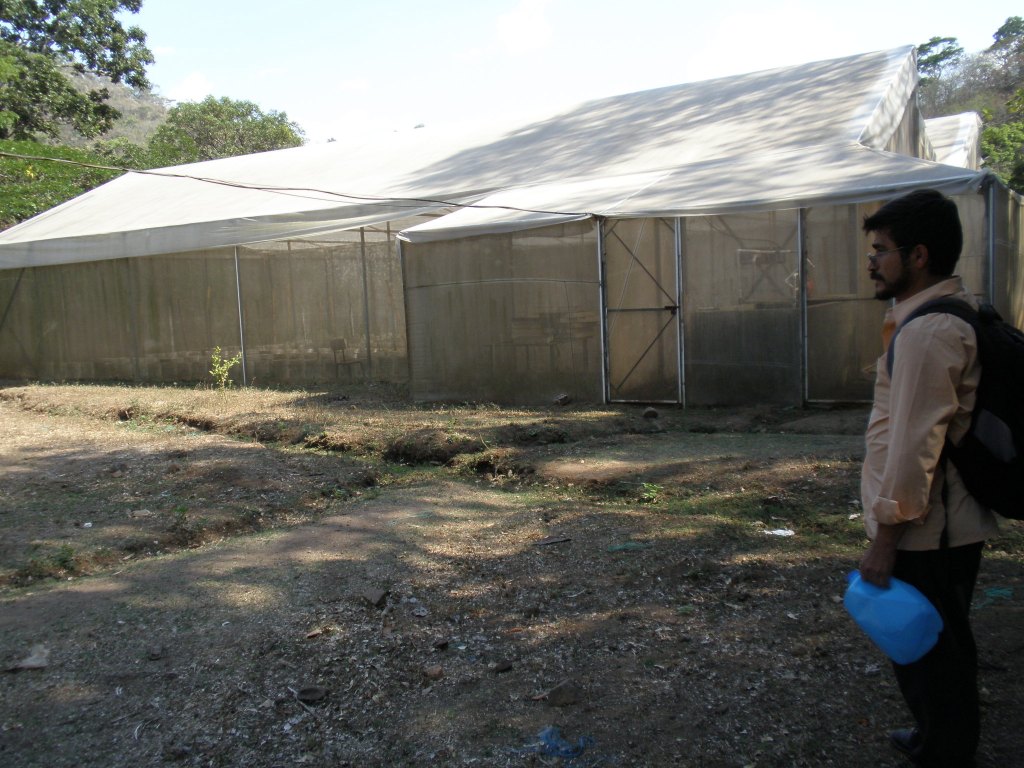
Antonio Pacheco observes an ADES greenhouse in Santa Marta in 2009. Photo: Jim Hodgson

Pacheco and members of the Santa Marta Development Association of El Salvador (ADES) were leaders in the successful effort to stop a gold mining project in Cabañas department, and part of El Salvador’s National Roundtable on Metals Mining that achieved a ban on metals mining in 2017. 

During the civil war in the 1980s, Santa Marta was targeted by the Salvadoran military and most residents fled to Honduras. Successive Salvadoran governments have not investigated the dozens of cases of human rights violations documented by the people of Santa Marta against the armed forces (including the Lempa River massacre in 1980, where 30 people were murdered and 189 others disappeared). 

The arrests last week drew global attention, including articles in The Guardian, the German news service DW and TeleSUR, and solidarity statements from the U.S. Institute for Policy Studies, the Honduran group COPINH, the U.S. Sister Cities network, and others. “Antonio Pacheco has struggled almost his entire life to build a country that seeks social, economic and cultural well-being and who is a friend to the causes of the Honduran people,” said COPIHN (the organization led by Bertha Cáceres until her murder in 2016).

I came to know Antonio, ADES and many other people the rural communities of northern Cabañas during the 20 years of my work with The United Church of Canada. I wrote about him several times, including a profile published in the United Church’s Mandate magazine in February 2011:

“A Life-Long Passion” (excerpt)

A child grows up in El Salvador in the 1960s. He asks: “Mamá, why are there poor people?”

Decades later, the question still animates Antonio Pacheco, executive director of ADES….

“I hardly ever talk about this,” Antonio said, smiling over his coffee in the food court below the United Church general council office in Toronto. “I had this intense curiosity. I asked lots of questions. I read, and read some more. I read the Bible, or tried to.”

In the sixties and seventies, Christians in Latin America began creating “base communities” to provide space for questions like those of Antonio and to share the Word of God among neighbours.

“One word caught my attention: solidarity. I began to understand why Jesus was taken to the cross,” Antonio said. 

“By the time I was 11, I understood that I wanted to work for the people. I wanted to be a doctor so that I could help.”

But as Antonio entered high school in the mid-seventies, El Salvador was in political upheaval. The base communities and church leaders became targets of repression. Antonio emerged as a leader of the student movement in his high school in San Salvador, and joined the revolutionary movement in 1977. Political and education work took him to Santa Marta for the first time in 1979, and by 1982 as the civil war raged, Antonio worked with the community directly in its education efforts. But aerial bombing grew so intense that the entire community fled into exile in Honduras in the mid-1980s.

It was after the return to Santa Marta in October 1987 that Antonio’s community development work really began to bear fruit. Even though a final peace accord was not achieved until 1992, the people of Santa Marta sought and found international help to rebuild. The United Church of Canada and the Anglican Primate’s World Relief and Development Fund were among the first partners. In 1993, ADES was born to secure and manage development funds. Antonio has served as executive director since 1998.

Today, formal education is one of Santa Marta’s great successes…. ADES continues to lead in agricultural development and training in northern Cabañas, but a number of programs have spun off in varying degrees of autonomy: a micro-credit program for market workers, a community radio station in nearby La Victoria, and an AIDS education program for rural youth that works on both sides of the border.

Now in the 2020s, ADES is working with support from the United Church and the Manitoba Council for International Co-operation to expand ecological agricultural practices in Cabañas.

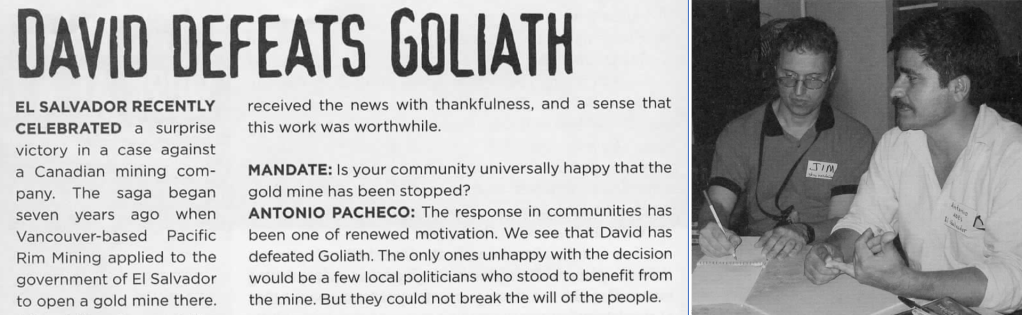
“David defeats Goliath”

With the mining victories in 2016 and 2017, Mandate published a short interview that I did with Antonio. At the end, I asked what he would say to Canadians about their responsibility to regulate their mining companies

“The Canadian people should be aware that Canadian companies operating outside the country have practices that fail to respect the human rights of the people in communities, and that they fail to repair damage to the environment. For those reasons, it is necessary and urgent that their actions abroad be regulated in Canada.”

Left: Mandate, February 2017. Right: Jim Hodgson with Antonio Pacheco, August 2006. Photo: Presbyterian World Service & Development.

Summit of the Americas: U.S. can’t break old habits

That the White House announced Canada’s planned response to the flow of refugees in Central America said a lot to me about the way the Biden administration mishandled the Summit of the Americas, held in Los Angeles last week.

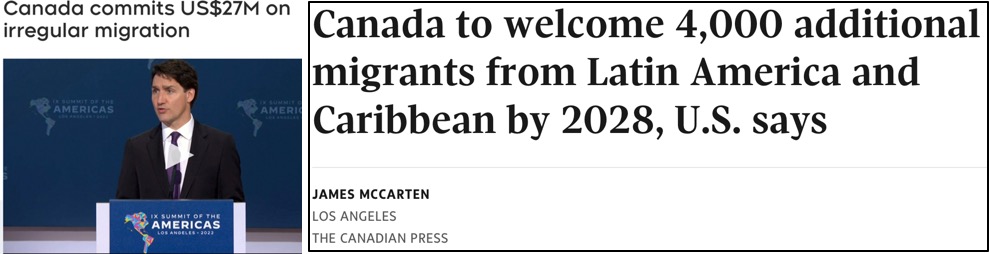
Canada will welcome 4,000 additional migrants from Latin America and the Caribbean, the White House announced on June 10. That number is insignificant compared to the size of the challenge: 

  • Mexico reported apprehending 307,679 undocumented migrants in 2021. About one-third were deported; another third sought asylum in Mexico. The main countries of origin of those apprehended were Honduras (41%), Guatemala (26%), El Salvador (8%), Haiti (6%), Brazil (5%), Nicaragua (5%), Cuba (2%), and Venezuela (1%). None of the leaders of Mexico, Honduras, Guatemala or El Salvador chose to attend the summit – and Nicaragua, Cuba and Venezuela were told by Biden not to come. It’s hard to solve problems when you’re not talking to people who can do something about them.
  • As of February in the United States, about 164,000 (Reuters) or “just under 179,000” (Axios) migrants are currently in alternatives-to-detention programs managed by Immigration and Customs Enforcement  (ICE). This is “roughly double the total on Sept. 30, 2020, before Biden took office,” Reuters reported, and doesn’t include dependents – or the people actually held in detention.

The White House announcement of Canada’s support included commitments from other countries on migration issues, and was reported by Canadian Press in an article widely shared in Canadian media (CBC, CTV, the Globe and Mail, among others).

“The agreement also includes a pre-existing Canadian commitment to bring in an additional 50,000 agricultural workers this year from Mexico, Guatemala and the Caribbean.” (Those are temporary workers whose rights are limited.)

To its credit, the government (via the Prime Minister’s Office, not Global Affairs Canada) also announced an additional $118 million for “progressive initiatives” aimed at improving the lives of people where they already live in Latin America and the Caribbean. That includes $67.9 million to promote gender equality; $31.5 million in health and pandemic response spending; $17.3 million on democratic governance and $1.6 million for digital access and anti-disinformation measures. It will also spend $26.9 million to address “irregular migration and forced displacement” in the hemisphere.

Washington “still trying to dictate” to neighbours

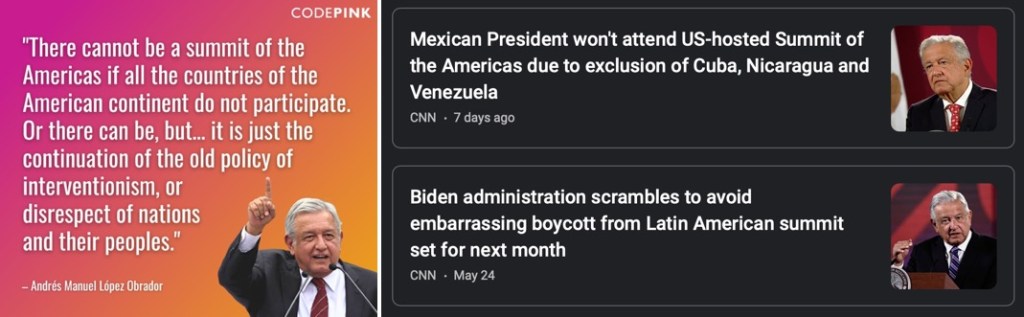
But it was the exclusions and boycotts that drew most attention. Because Venezuela, Cuba and Nicaragua were excluded by the host country, Mexico, Honduras, Bolivia and some Caribbean leaders chose to stay away. Leaders of Guatemala and El Salvador did not attend because of issues with U.S. treatment of allegations of corruption and abuses of human rights in their countries. In the end only about 20 of potentially 35 heads of state or government attended.

Apparently modelling the art of understatement, Reuters reported: “Hosting the Summit of the Americas in Los Angeles, Biden sought to assure the assembled leaders about his administration’s commitment to the region despite nagging concerns that Washington, at times, is still trying to dictate to its poorer southern neighbours.”

The presence of the unelected prime minister of Haiti, Ariel Henry, drew fire. During a panel discussion on “journalistic freedom,” U.S. Secretary of State Antony Blinken had the good grace to seem embarrassed when challenged over Henry’s presence. As Alterpresse pointed out, “not only does Henry govern without a mandate in violation of the Haitian Constitution, he is also implicated in serious crimes, including the death of a Haitian journalist in February 2022 by Haitian police.” (Two other journalists had been killed in January in a gang attack.)

In the tradition of each Summit of the Americas (including the teargas summit in Quebec City in 2001), a People’s Summit was held, gathering more than 250 community organizations, social movements, trade unions and other progressive groups. “In the ‘richest country in the world,’ 140 million live in or near poverty. The US government is addicted to militarism and war and will spend over $800 billion in 2022, on death and destruction,” said the final declaration. “Instead of preparing for war, society must be organized to meet human needs. We want a future without evictions, police violence and mass incarceration, deportations, sanctions, and blockades. We say: no more!”