In April 2024, I welcomed the formation of Haiti’s transitional council (known as the CPT). It was the product of negotiations among a broad spectrum of Haitian political parties and civil society organizations, including the business sector.
Within a month, fractures that would block steps toward a new election became apparent. And efforts to create conditions for an election were undermined by a rapid and ongoing increase in neighbourhood-based gang violence – despite the presence of UN-backed soldiers and police.
The mandate of the CPT expired on Saturday, Feb. 7, which also happened to be the 40th anniversary of the fall of the Duvalier family dictatorship.
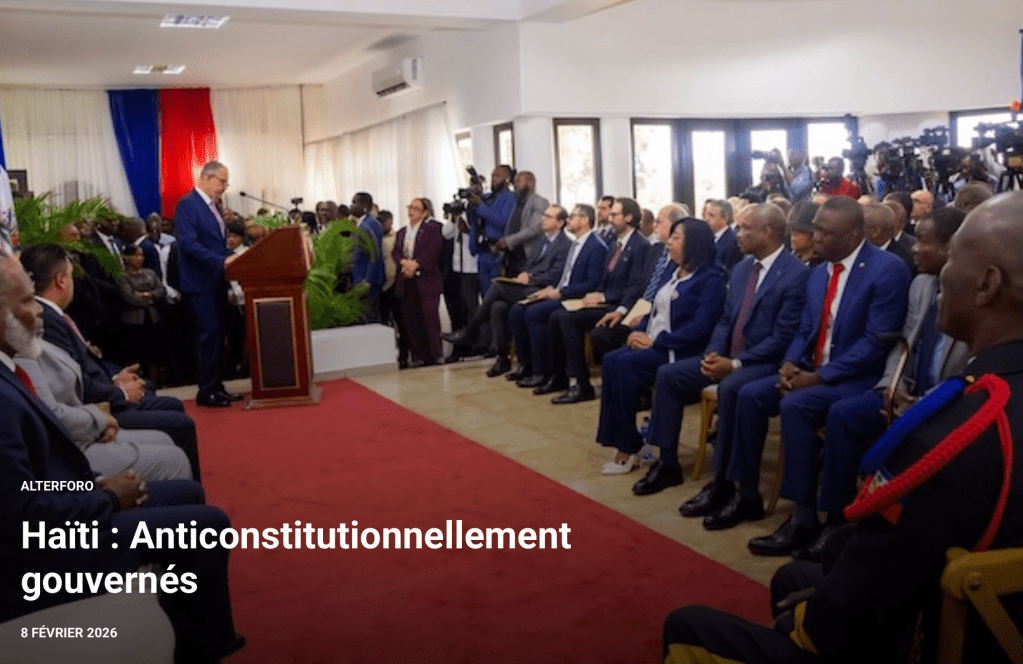
The transition ceremony Feb. 7: Haitians are “anti-constitutionally governed” (AlterPresse)
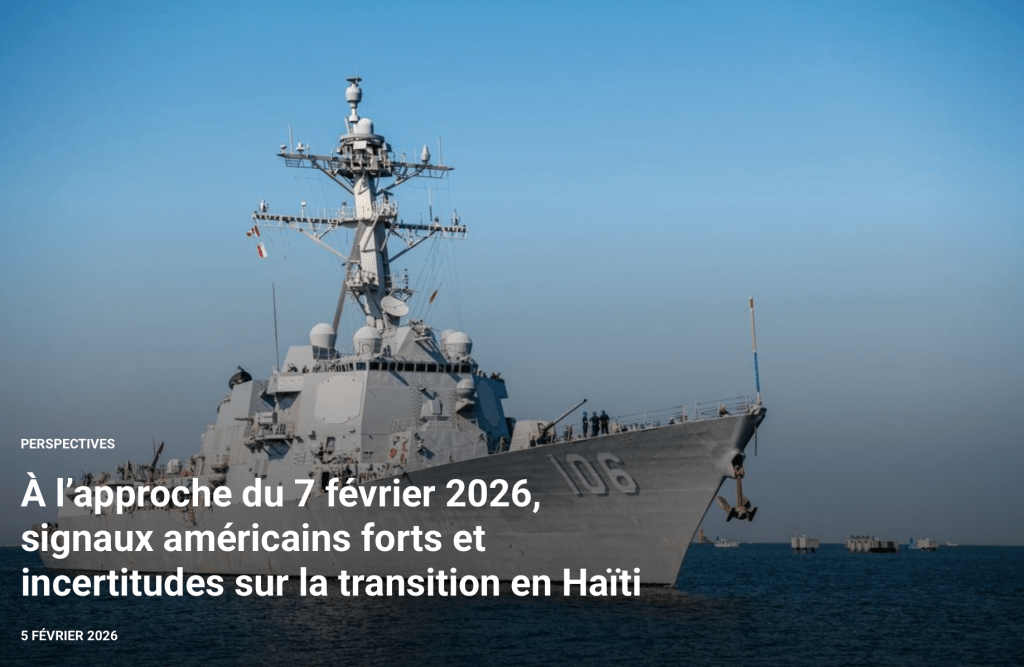
A U.S. warship and two Coast Guard ships sit in the Port-au-Prince harbour and a military plane was on the ground at the international airport. As many as 1.4 million people are displaced by gang violence. The political in-fighting rages.
In moments like this, I try to look at a variety of media sources to understand what is going on. The one I trust most is AlterPresse, a civil society initiative that emerges from among the groups that have worked for decades for a better future for people afflicted by poverty and violence. Haitian elites and their neoliberal allies abroad, meanwhile, seem determined again to impose a new totalitarian state, which is a predator state (like that of Duvalier) safe only for the rich and their cronies.
In the absence of any elections, Prime Minister Alix Didier Fils-Aimé (a businessman named to the post by the CPT in November 2024) will hold on to power beyond the CPT’s expiry. He will rule like former de factoPrime Minister Ariel Henry did from July 2021 through February 2024: a head-of-government without a head-of-state or Parliament.
Accountability? Only to the foreign governments that have backed him: the United States, France and Canada.
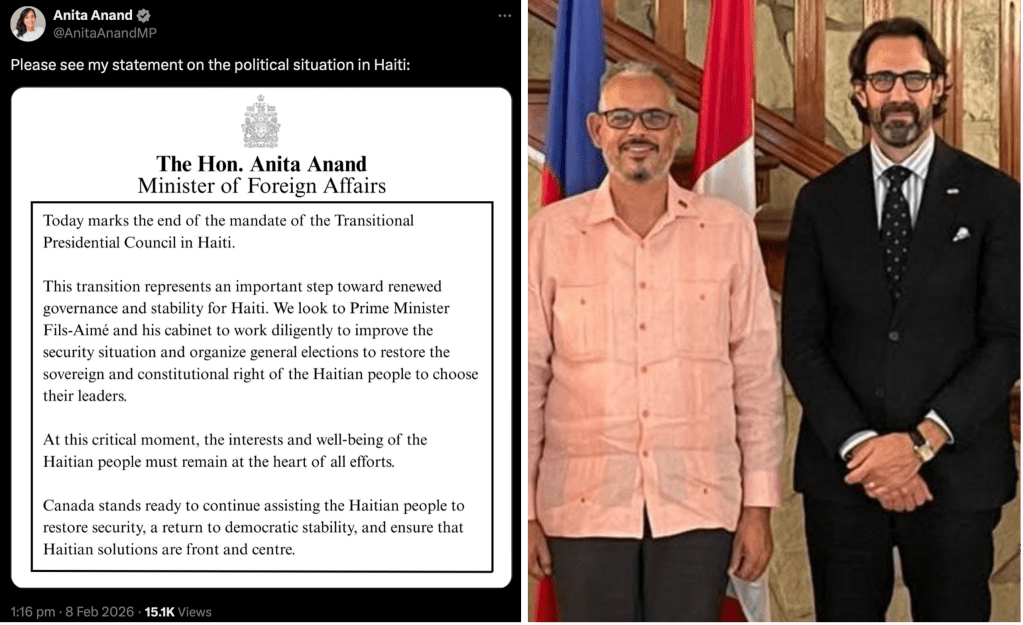
Left: Statement by Foreign Affairs Minister Anita Anand. Right: Prime Minister Alix Didier Fils Aimé and Canadian ambassador to Haiti André François Giroux (Le Nouvelliste).
In several recent public statements, U.S. authorities affirmed their support for Fils-Aimé. He is presented as the key figure capable of ensuring institutional continuity. They particularly emphasize his role in building a Haiti that is “strong, prosperous, and free.”
But it is those ships in the Port-au-Prince harbour that remind Haitians that pleasant statements barely mask the history of U.S. hard power in Haiti.
AlterPresse: strong signals from the United States and uncertainty about the transition in Haiti.
“The naval presence appears to provide the latest proof of Washington’s willingness to use the threat of force to shape politics in the Western Hemisphere,” Diego Da Rin, an analyst with the International Crisis Group, told AP News. Arrival of the ships comes during a months-long build-up of U.S. military force in the Caribbean – already used against Venezuela on Jan. 3.
An essential historical overview
Gotson Pierre, editor at AlterPresse, wrote Feb. 5 (text is translated and lightly-edited for clarity and length):
For many observers, these developments cannot be understood without a historical overview of relations between Haiti and the United States. This history is marked by repeated interventions, both military and political.
From the occupation of 1915 to 1934, with its devastating human, economic, and institutional consequences, to the [interventions in 1994 and 2004], and including the massive deployment of troops in 2010 following the earthquake, the United States has played a central role in major Haitian crises. Added to this are non-military political interventions, notably during the 2010-2011 elections, and more recently, the case of former Prime Minister Ariel Henry.
Many analysts also believe that regional bodies such as the Caribbean Community (CARICOM) and the Organization of American States (OAS) operate within a framework heavily influenced by Washington.
Haiti maintains a complex relationship with the United States, characterized by geographical proximity, strategic interdependence, and asymmetrical power dynamics. This proximity … continues to influence the country’s political trajectory.
On the eve of February 7, 2026, amid institutional uncertainties, increased international pressure, and a reinforced military presence, the equation remains unresolved. The coming days will reveal whether these signs signal a simple continuation within established frameworks or a new phase of political realignment under strong external influence.
The UN Security Council adopted a resolution last week that authorizes deployment of 5,500 troops to Haiti to replace the understaffed and underfunded Multinational Security Support Mission (referred to as MMAS in Haiti). The new Gang Suppression Force (FRG) has a mandate to “neutralize, isolate, and deter” gangs, secure infrastructure, and support institutional stability.
On Aug. 26, UN Secretary General António Guterres warned that humanitarian efforts in Haiti are “shamefully overlooked and woefully underfunded.” On Sept. 30, Volker Türk, the UN high commissioner for human rights, welcomed creation of the FRG and said: “Efforts to restore security must be anchored in respect for human rights and go hand in hand with the reconstruction of the rule of law.”
Politico called the vote to create the FRG a “win” for the Trump administration. That alone should raise concern among the rest of us.
The UNSC decision came days after a police-directed drone attack on an alleged gang leader’s birthday party, where he was handing out presents to local children. At least eight children were killed.
Since June 2024, Haiti has been governed by a transitional council (CPT). Leadership rotates among a wobbly coalition from different sectors of Haitian society. It includes the civil society-led Montana Accord network (named for the hotel where their accord was signed). Earlier, the Montana group had offered a “passarelle” or series of steps for an interim government as a way to move to new elections. (The terms of all Haitian politicians expired in 2023.) The CPT might have been able to move forward on that process, but Haiti is afflicted by a rising tide of gang violence that some argue is at least partly driven by Haiti’s richest people.
In August, leadership of the CPT passed to Laurent Saint-Cyr, a former head of the American Chamber of Commerce in Haiti. At the same time, the prime minister is his fellow businessman Alix Didier Fils-Aimé.
To my suspicious mind, this means Haiti has returned to the same power structure that prevailed after 2011 under presidents Michel Martelly and Jovenel Moïse, and then the unelected leadership of Prime Minister Ariel Henry through early 2024 – men all backed by the United States, Canada, France and a powerful local oligarchy that has blocked every effort to ease Haiti’s inequality and to advance social goals, including education, health care, housing and public infrastructure.
(Bear with me, please: you can read more of my own analysis towards the end of this piece.)
First, the news
According to the UN, at least 1.3 million Haitians remain internally displaced due to violence, with 5.7 million facing food insecurity. About 3,100 people were killed in violent incidents between January and June this year, and at least 2,300 grave violations against children have been recorded.
The UNSC resolution to create the Gang Suppression Force (known as FRG in French: Force de Répression des Gangs) was proposed in August by Panama and the United States. The resolution passed Sept. 30 with 12 votes in favour and none against. Permanent Security Council members China and Russia, along with rotating member Pakistan, abstained from the vote.
It replaces the MMAS, created just two years ago by the UN to support Haitian police forces, but never adequately funded. The new force would raise the personnel ceiling from 2,500 in the current mission to 5,550 personnel will grow from 2,500 to 5,550 personnel, with a UN Support Office providing logistical support amidst Haiti’s intersecting security, humanitarian, and political crises. But it will not be answerable to any Haitian authority, not even the Haitian National Police.
Currently, it appears the new FRG would include the United States, Bahamas, Canada, El Salvador, Guatemala, Jamaica, and Kenya—in effect a reboot of the MMAS.
Memories of a previous UN intervention: UN trucks parked near Cap-Haïtien in February 2005 (Jim Hodgson photo).
Responses
Approval of the FRG was welcomed by the Caribbean regional group CARICOM, and the Organization of American States – even though the new OAS secretary-general, Albert Ramdin, had in June advocated dialogue with the gangs. That idea was rejected by the CPT.
The Canadian government had earlier announced contribute $60 million toward gang-suppression efforts in Haiti. Mark Richardson, a Global Affairs Canada director general for the Caribbean, recently told the House of Commons foreign affairs committee that it is “too early” to have conversations about whether Canadian troops would be part of the new UN mission.
After the UN vote, U.S. Ambassador Henry Wooster pressed the CPT to hold elections:
🕊️ Context: follows the UN Security Council’s green light for the deployment of the Gang Repression Force (FRG).
🇺🇸 U.S. position: call for a clear plan and timetable for free and credible elections in Haiti.
🧭 Stated objective: to prevent the transition from dragging on and to encourage the restoration of democratic institutions.
⚖️ Political challenge: Washington wants to link security stabilization to an inclusive and supervised electoral process.
🕰️ Next steps: consultations between the Haitian government and international partners on implementation of the FRG and of an electoral timetable.
More critical views are offered by the Haïti Liberté newspaper. One article describes the rationale offered by China and Russia for not vetoing the resolution. It adds that Guyana, Algeria, Sierra Leone, and Somalia sought to insert language that called for “full respect for the sovereignty and political independence of Haiti,” but their proposal was rejected by the U.S. Denmark, Greece, South Korea, and Slovenia “advocated for strengthening the text with language on compliance with international law, including international human rights law,” but “the US apparently consistently supplemented these additions with the qualifier ‘as applicable’.”
The same article quotes Haïti Liberté director Berthony Dupont questioning proposed use of the UN regular budget for operational and logistical support of this force.
“In the context of the [UN]’s financial crisis, caused largely by the irresponsible actions of its largest contributor [the U.S.], expecting significant funding to support a new initiative that exists only on paper, and which lacks a sustainable foundation and clear prospects, is naive, to say the least. Let us put it straight: if that contributor failed to provide the funds it promised for the MMAS, what guarantee do we have that anything will be different this time?”
In Port-au-Prince, the human rights group Collectif Défenseurs Plus told Alterpresse that it recognizes that “international assistance has become inevitable” in the face of an overwhelmed HNP and unprecedented violence. But it demands guarantees: accessible accountability mechanisms, zero tolerance for any human rights violations, and uncompromising support for Haitian institutions.
“The Haitian crisis is above all political,” the collective insists, warning that the FRG must not become a crutch for a power lacking legitimacy, but rather create a space for an inclusive transition and transparent elections.
Between hopes for restored security and fears of another international failure, the success of the FRG will depend as much on its ability to break the criminal grip as on the will of Haitian actors to rebuild a credible state. As the Defenders Plus Collective emphasizes, “security is a right, and so is sovereignty.”
How might Haiti be better served?
“While it is important to address the consequences of gang violence, influential foreign actors in Haiti should do more to address its root causes,” writesRoromme Chantal, a political science professor at l’Université de Moncton.
“To this end, research demonstrates that conflict resolution such as the one in Haiti should be approached in a manner that allows for the participation of local groups (official authorities, civil society representatives, grassroots organizations), providing them, if necessary, with the funding, logistical means, and technical capacity to implement carefully targeted programs.”
My thoughts
I find myself thinking again of anthropologist Michel-Rolph Trouillot. He wrote a book called State Against Nationin the years following the end of the Duvalier dictatorship. He argued that the Haitian state is relatively autonomous from the nation: all problems are turned into political problems, but the state – much less the political class – is not the same as the society. If we listen, we may find that the Haitian people have a project that is different from that imagined in the proposed solutions that focus too narrowly on the state. In another book, Silencing the Past, he argued that historical narratives are often silenced: even the truth about Haiti’s revolution, history’s most successful slave rebellion that made Haiti the “first nation to embrace an equity and human rights approach by permanently banning the slave trade from the first day of its existence.”
If anyone were listening, they might find that Haitians are more interested in communal solutions and local democracy. This would be something more akin to the “mandar obedeciendo” (to rule by obeying the bases, the grassroots) advocated by the Zapatistas in southern Mexico than whatever Haitian elites and their neoliberal allies abroad are proposing, which seems a lot like “duvalierisme sans Duvalier” – reproduction of a totalitarian state, a predator state: one that is safe only for the rich.
Separate incidents of use of explosive drones by the U.S. military to attack alleged Venezuelan drug-traffickers and by Haitian police to attack local gang leaders may have Canadian connections.
The Canadian ecumenical coalition Project Ploughshares reported Monday (Oct. 6) that a Canadian-made high-tech camera system was used to attack two boats that the United States said were carrying drugs. CBC News analysed the Ploughshares report, compared it to product manuals and previously released videos and spoke with former military and defence industry experts, concluding that it is highly likely Canadian tech was involved in surveillance during the operations.
Project Ploughshares and CBC reports on the U.S. attacks and their Canadian connection. The full Ploughshares report is here.
“There has to be more human rights oversight,” said Kelsey Gallagher, a senior researcher with Project Ploughshares. “We are seeing Canadian weapons being misused.” Founded in 1976, Project Ploughshares is the peace research institute of the Canadian Council of Churches.
Global Affairs Canada told CBC that it is “aware of the U.S. operation and is monitoring the situation.”
The United States has said it used drones three times to attack boats it alleges were carrying drugs, but provided no evidence of drug-trafficking. The Ploughshares report shows that the U.S. military used a Canadian-made L3Harris WESCAM MX-Series sensor system for tracking and surveillance of boats that were struck as they sailed from Venezuela in the first two of three strikes reported last month.
Al Jazeera news service said the drones used in the operation were supplied by Canadian police. Successive Canadian governments have long maintained programs of assistance and training to Haitian police.
Months earlier, Global Affairs Canada told CBC that it was “concerned” about reports of extrajudicial executions, a violation of international human rights law. GAC did not clarify if Ottawa knew of cases in which Canadian-provided drones had been used for lethal purposes in Haiti. It said Haiti had agreed that the equipment provided would not be used “to commit or facilitate any violation of international humanitarian law or international human rights law.”
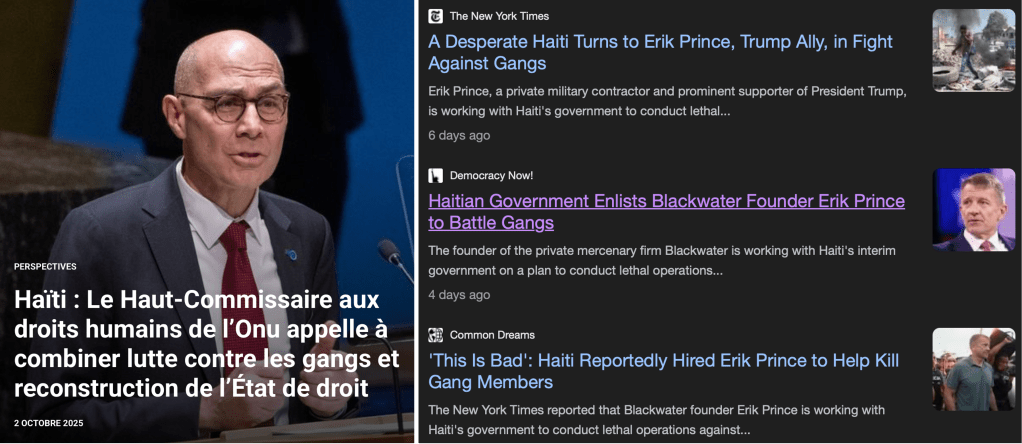
On Oct. 2, UN Human Rights Commissioner Volker Türk said Haiti’s use of lethal force against gangs was disproportionate and likely unlawful.
Volker Türk (left); Google News headlines in June regarding Erik Prince and his new role in fighting the gangs of Haiti.
Speaking in Geneva to the UN Human Rights Council, Türk said police units had summarily executed 174 people for alleged gang affiliation this year while government drone strikes against alleged gang members in Port-au-Prince had killed at least 559 people to date, including 11 children.
“Most of these drone strikes are likely unlawful under international human rights law,” Türk added.
Canada is legally bound to ensure that its export of military goods does not contribute to violations of international law. Compared to ongoing controversy over Canada’s arms exports to Israel – often shipped via the United States – Canada’s indirect involvement in these drone incidents in the Caribbean may be relatively limited, but seem to reveal a pattern of disregard for human rights consequences of commercial deals in our neoliberal world.
In March this year, the Haitian government hired Vectus Global, a company run by Blackwater founder Erik Prince, to operate drones.
Two days after the drone strike on the birthday party, the UN Security Council approved a new Gang Suppression Force for Haiti. I’ll share more about that (and Canada’s contribution) in days ahead.



 Unwrapping Development