Haitian claim for slavery reparations at the heart of a UN forum

by Jim Hodgson

A United Nations forum on the historic wrongs committed against people of African descent is building momentum in favour of an international tribunal on atrocities dating back to the transatlantic trade of enslaved people.

When the UN Permanent Forum on People of African Descent (PFPAD) held its third session in less than two years in Geneva in mid-April, African and Caribbean governments together with civil society organizations pressed forward with plans to create a tribunal that would be similar to that which oversaw the Nuremberg trials of Nazi war criminals after World War II.

Proponents say such a tribunal would help establish legal norms for international and historical reparations claims.

Supporters include many members of the Caribbean Community (CARICOM), made up of 15 member states, and the African Union (AU), which includes 55 states—and Antonio Guterres, the UN General Secretary. “We call for reparatory justice frameworks, to help overcome generations of exclusion and discrimination,” he said March 25.

Supporters argue that Western countries and institutions that continue to benefit from the wealth slavery generated should be held accountable, particularly given ongoing legacies of racial discrimination. Opponents say that contemporary states and institutions should not be held responsible for historical slavery.

The World Council of Churches was among faith-based and civil society organizations that came together at the PFPAD forum to examine what states and other actors may do to redress the historic exploitation and harms that Africans and people of African descent have suffered. (You can learn more here about global ecumenical efforts to overcome racism, discrimination and xenophobia.)

Righting the wrongs in Haiti

Given that Haiti’s claim for reparations is among the strongest, the voices of Haitian civil society groups and their diaspora counterparts were heard at the PFPAD forum. 

Those groups used the forum to put a spotlight on the crucial role that Haiti played in the struggle to end slavery. “To recognize the historic context is essential to understand the unique position of Haiti in the global struggle for justice and egality,” they said in a statement before the forum. Participating groups—including the Montana Accord network and of the Haitian-American Foundation for Democracy (HAFFD)—said they strongly approve calls for reparations to Haiti.

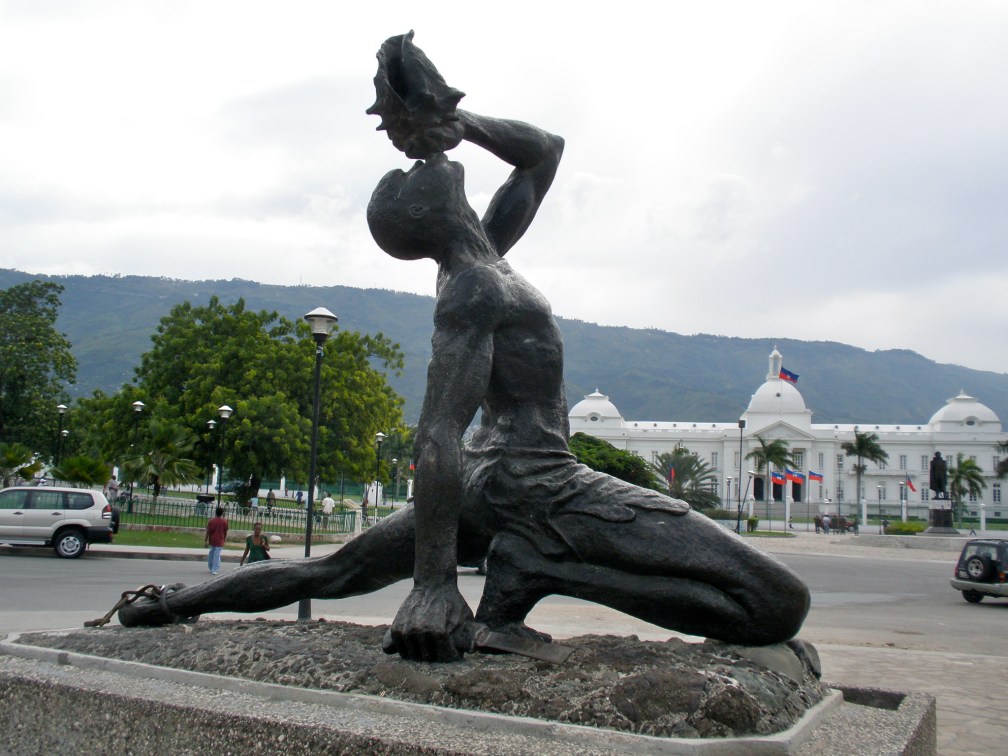
Le Marron Inconnu, and in the background, the National Palace before the 2010 earthquake.

Haiti was born as an independent nation in 1804 after the enslaved people revolted against their French colonial masters. The values of “liberté, égalité et fraternité,” expressed in the triumph of the French Revolution in 1789, resonated among slaves in Saint-Domingue, France’s richest colony. In 1804, the world’s first successful slave rebellion resulted in the birth of the Republic of Haiti. 

Beginning in 1825, France squeezed an “independence debt” from Haiti that adds up to at least $21 billion in today’s dollars. That estimate comes from The New York Times, but backers of the reparations claim say the amount is much higher.

“It’s $21 billion plus 200 years of interest that France has enjoyed so we’re talking more like $150 billion, $200 billion or more,” Jemima Pierre, professor of Global Race at the University of British Columbia, told Reuters.

Despite the obvious injustice of that debt, France continues to resist pressure to join in reparations. In August 2010, about 100 prominent academics, authors, and human rights activists signed on to an open letter to then-President Nicolas Sarkozy, arguing that the case for repayment was “morally, economically, and legally unassailable.” France dismissed the petition, pointing to its record of delivering other aid to Haiti and not addressing the legitimacy of the debt.

“What’s important is that it’s time that France recognises this and we move forward,” Haitian civil society activist Monique Clesca told Reuters. France, whose development agency has given hundreds of millions of dollars in aid to Haiti, has previously referred to a “moral debt” owed to Haiti.

From Palenque, Chiapas, Latin American leaders call for migration solutions

In recent weeks, my partner and I took a long drive from British Columbia through the western United States and then almost the length of Mexico to arrive in Chiapas.

While people who migrate northwards either for seasonal work or for more permanent refuge from poverty, violence and impacts of climate change were on our minds and in the news, at least some of the people we met alongside us in gas stations and cafés were seasonal workers heading home for the winter. 

Migration, my friends, is normal. In southern Texas and northern Mexico, we encountered thousands of monarch butterflies as they headed for Michoacán. And here in Chiapas, the migratory birds are arriving daily.

At around the time of our trip, leaders of ten nations of Latin America and the Caribbean – frustrated by slow progress with the United States (and other northern countries) in advancing meaningful human development and managing the flow of people – gathered in the historic Maya city of Palenque, Chiapas, and proposed some ways forward.

Photo from the Office of the President of Mexico

Led by Mexico, the governments of Belize, Colombia, Costa Rica, Cuba, El Salvador, Haiti, Honduras, Panama and Venezuela signed the Palenque Declaration on Oct. 22 and called for solutions. (A representative of the newly-elected government in Guatemala also joined the talks.)

In the declaration, presented by the Mexican Foreign Minister, Alicia Bárcena, the leaders described several structural causes of migration: internally political, economic, social factors and the effects of climate change. But they also pointed to “external factors such as unilateral coercive measures of an indiscriminate nature – dictated from the United States – that negatively affect entire populations and, to a greater extent, the most vulnerable people and communities.”

They urged the United States to lift the sanctions imposed on Cuba and Venezuela that help drive the exodus. Such sanctions are against international law and, as the migration flow shows, they have impacts beyond the countries to which they are applied.

The document also proposed undertaking efforts to modify the financial architecture of debt; to close social gaps to as to reduce the impulse to migrate; push for measures aimed at increasing agricultural activity to promote food self-sufficiency in the region; and to promote intraregional trade and investment for socioeconomic development.

The signatory nations stressed that measures must be taken to confront transnational organized crime, human trafficking and corruption, as well as promote joint cooperation in security matters.

They called for destination countries to “adopt immigration policies and practices in line with the current reality of our region and abandon those that are inconsistent and selective, to avoid arbitrarily producing both ‘call effects’ and ‘deterrent effects’ – advantages given to certain countries for political reasons while nationals of other countries are blocked.

They encouraged destination countries to widen their regular migration pathways, with emphasis on labour mobility and promotion of re-integration and safe return of temporary workers to their homes.

The declaration makes special mention of Haiti, and called on nations to support efforts by the United Nations and others to re-establish conditions for human security so that the political, economic and social situation may be normalized, and to focus on sustainable development. (The presence of the Haitian president at the gathering angered some of the Haitian migrants camped out in the centre of Palenque, reported La Jornada.)

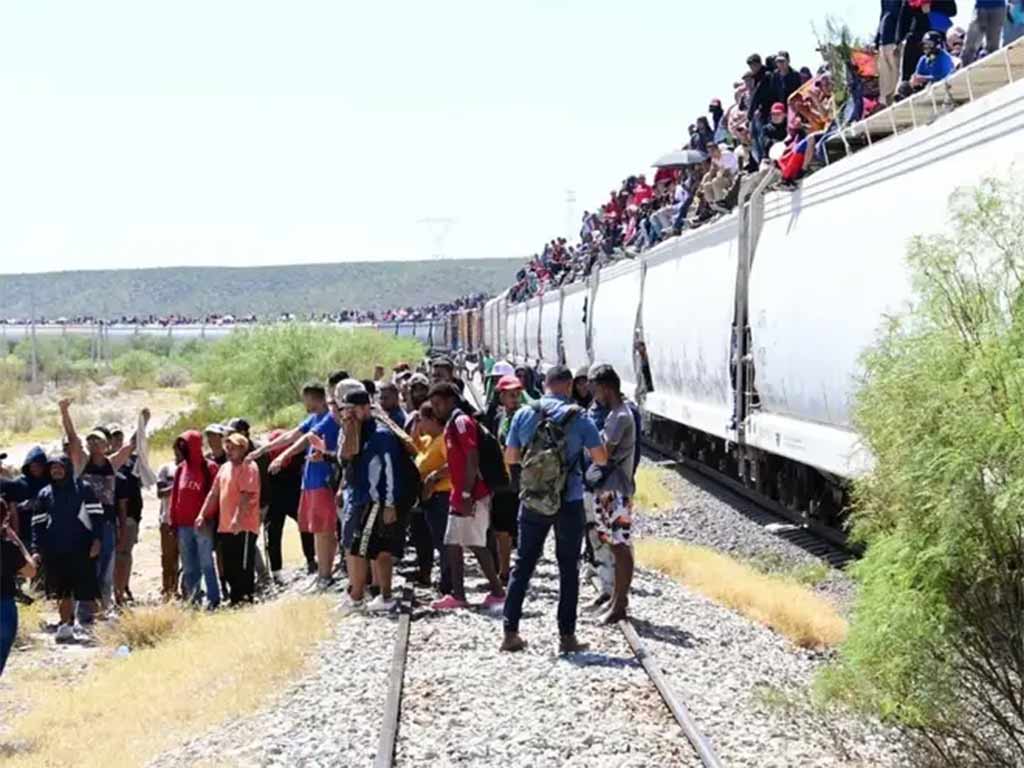
Undated photo from Prensa Latina.

The declaration’s emphasis on economic drivers of migration did not satisfy everyone. Eunice Rendón of the Mexican advocacy group Agenda Migrante told Courthouse News Service that while insecurity was mentioned as a factor driving migration, “it’s not one of the causes, it’s the principal cause,” Rendón said.

“People go because the gang members threaten to kill them, because they try to forcibly recruit them,” she said. (Some might argue that the lack of education and employment opportunities are drivers as well in recruitment for organized crime.)

Meanwhile, migration dramas continue. On Nov. 9, authorities reported that they found found 123 Central and South American migrants trapped in a trailer in Matehuala, San Luís Potosí (less than a week after we passed through there). And than 400,000 migrants have crossed the Darien Gap from Colombia into Panama in 2023, according to the Panamanian government, up from 250,000 in 2022.

Haiti will get support for its police. What it needs is a new government.

by Jim Hodgson

Now that the United Nations Security Council (UNSC) has approved deployment of a multinational force to Haiti, Haitian politicians and civil society organisations (CSOs) and their allies abroad respond with an array of positions.

UN Security Council (Alterpresse)

A new transitional government is urgently needed, says Pierre Espérance of Haiti’s National Human Rights Defense Network (RNDDH). Writing in the New York Times, Espérance called for renewed negotiations among CSOs and politicians (none of whom are elected) towards change.

“The talks should specify what qualifications are required for an individual to join the transitional government — and, critically, what would be disqualifying, to avert yet another criminal takeover.

“It wouldn’t be an easy task. But a new government formed along these lines would begin to bring long-awaited accountability to the police, as well as branches of government like the judiciary. Gangs would not disappear, but they would eventually exert less power and lose some of the vast territory they now control.”

Haiti has a “transition council” named by the interim government of the unelected prime minister, Ariel Henry. Head of the council is Mirlande Hyppolite Manigat, a constitutional law professor, presidential candidate in 2010, and widow of a man who was one of the 1988 coup-era presidents. 

At a news conference held in the presence of Henry and government ministers, Manigat expressed concern over Haiti’s “accelerated tumble” and said she saw the UNSC’s decision as an “expression of will to take charge of the deplorable situation” in which the country lives. 

“The country is going badly,” Manigat said. “It’s our fault that the UNSC has adopted this resolution.” “Velvet glove, iron hand,” responded Gotson Pierre, founding editor of Alterpresse, of Manigat’s comments. “Ariel Henry, serait-il sous pression?” [Is Henry under pressure?]

James Beltis, a member of the Montana Accord, the group made up of CSOs and opposition politicians that has its own transition proposal, called authorization of the mission a “setback.”

“We seem to be stuck with the same solution we’ve been using for the past 30 years” (referring to military interventions in 1994 and 2004), he told the Washington Post. “From a political perspective, this appears to be support for the current government.”

Beltis was also cited by the Haitian Times: “There is no possibility for Montana [political parties] to cohabit with Ariel Henry while he remains as prime minister.”

Past foreign interventions in Haiti and especially the one that followed the removal in February 2004 of President Jean-Bertrand Aristide are remembered for sexual abuse by UN soldiers and the introduction of a cholera epidemic that infected 800,000 people and took almost 10,000 lives.

This time, emphasis is placed on support to the Haitian National Police (PNH). The force will be led by Kenya (which has its own policing issues), with support from Bahamas, Jamaica and Antigua and Barbuda. The mission would be reviewed after nine months and be funded by voluntary contributions, with the United States promising up to $200 million.

Global Affairs Canada (GAC) said this country is likely to deploy RCMP officers to Haiti to act as trainers in the multinational intervention, promising an added emphasis on preventing sexual violence. 

The RCMP will be “focused on technical training,” GAC’s Lisa Vandehei told the Senate Foreign Affairs Committee Oct. 5. She said they would probably train agents of the PNH in “very specialized” technical areas using a model where each trained agent would continue to teach other Haitian peers. Vandehei leads an inter-departmental task group on Haiti.

From Jan. 1 through Aug. 15 this year, at least 2,439 people had been killed and a further 902 injured. In addition, 951 people were  kidnapped. Meanwhile, ever-larger numbers of Haitians are choosing to leave any way they can. (UN’s Office of the High Commissioner for Human Rights) Headlines and photos about recent attacks from Alterpresse.

Will it work?

Kenyan police “don’t know the turf, don’t speak the language,” said Amy Wilentz, author of The Rainy Season: Haiti Since Duvalier and a professor at the University of California, Irvine. She told CBS News the mission was “unlikely to be a success.”

“First, it’s too small,” Wilentz said of the projected 10,000-person deployment. “There are an estimated 20,000 active gang members in Port-au-Prince, and they are heavily armed. So in combat, the Kenyans will be outmanned and perhaps outgunned.”

Other critics are even more severe. “It is not ‘solidarity’ with the people of Haiti to respond to the unconstitutional request formulated by a dictatorial government, put in place and maintained by the same ‘international community’ that now redoubles its support contrary to the legitimate demands of a huge range of Haitian social, political and humanitarian organisations,” says a new statement by Latin American CSOs in 17 countries, among them Jubileo Sur/Américas.

“We reject the new invasion of Haiti!” “For a Haiti that is dignified, sovereign and free of all occupation.” (Partial text of poster announcing the new Latin American civil society declaration.)

“It is to once again disregard the sovereignty and self-determination of the Haitian people with their demands and proposals to resolve this crisis generated by the same long-standing foreign intervention.

“It is not ‘support’, to continue to ignore the people of Haiti, ignoring their denunciations that link Ariel Henry, the current de facto government and its ‘international protectors’, led by the US, with the proliferation of the armed gangs that these same actors now intend to control through this new invasion.”

In comments made after the UNSC vote, several members of the council, including China and Brazil, reiterated the necessity of a strong Haitian government. 

“This force is being considered as just one instrument to help stabilize the security situation in the country,” said Brazil’s UN ambassador, Sérgio França Danese. “This is just a first step in what we hope will be the direction in terms of assuring those security considerations that will allow the political process to go forward.”

“It is a condition that is necessary but, of course, not enough.”

China’s U.N. ambassador Zhang Jun said that while Beijing “appreciates Kenya’s willingness” to lead the mission, “without a legitimate, effective, and responsible government in place, any external support can hardly have any lasting effects.”

The UNSC expanded a UN arms embargo to include all gangs, a measure China wanted. Haitian officials have said guns used by gangs are believed to be mostly imported from the United States. The embargo previously only applied to specific individuals.