Cops, robbers and intervention talk in Haiti

by Jim Hodgson

A few nights ago, I watched the British actress Joanna Lumley in conversation with a group of homeless 14- and 15-year-old boys in Port-au-Prince. This was a scene in her 2019 documentary, “Hidden Caribbean,” about her travels in Cuba and Haiti.

I found myself thinking about similar conversations that I have had with teens in Mexico, Haiti, El Salvador and elsewhere: What about the gangs?

“They defend us,” said the teenage son of a woman I knew in La Estación, a neighbourhood where the train station used to be and near where I lived in Cuernavaca, Mexico, in the late ’90s. 
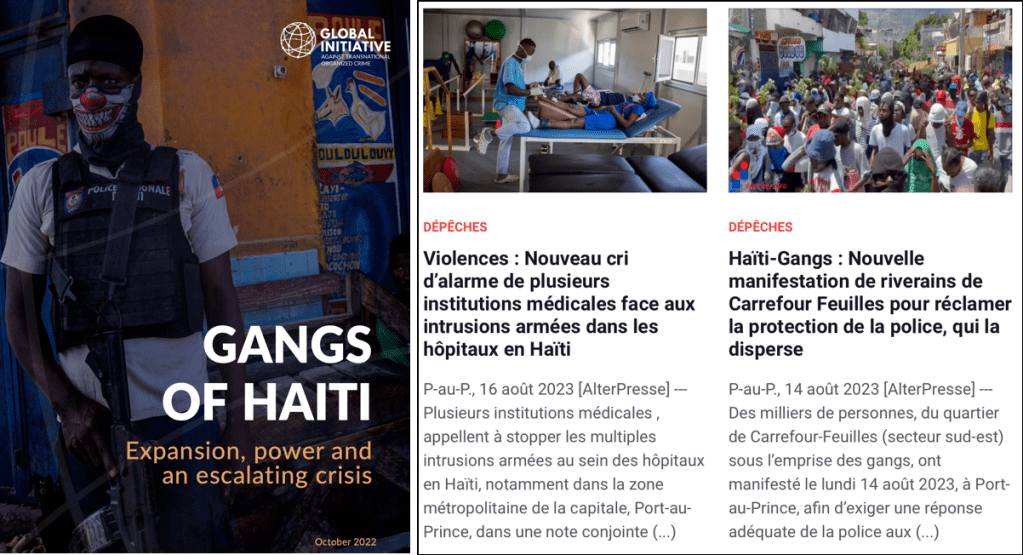
Global Initiative Against Transnational Organized Crime report, Gangs of Haiti. And headlines about gang violence from Alterpresse, an excellent alternative media site in Port-au-Prince. 

I’m not an expert on the sociology of gangs, but it seems to me that for unschooled, unemployed adolescent youth, they might provide a sense of team and friendship that in other places would be provided through schools, organized sports and other activities. And no doubt, there are people who manipulate younger people into activities to “defend” their barrio, and those then become fronts for extortion, drug-trafficking and kidnapping. (You can read more about the sociology of gangs of Haiti here and here.)

Criminal gangs are blamed for extreme levels of violence in and around Port-au-Prince, the Haitian capital. Their actions become justification for calls from the United Nations, Human Rights Watch and others for an international intervention – this time with police forces.

A “robust use of force” by a multinational police deployment is required to restore order in Haiti and to disarm the gangs, UN secretary general Antonio Guterres said in a report to the Security Council Aug. 15. Such a force may be led by Kenya, and also involve police forces from several Caribbean nations.

“The longer that we wait and don’t have this response, we’re going to see more Haitians being killed, raped and kidnapped, and more people suffering without enough to eat,” said Ida Sawyer of Human Rights Watch a few days earlier.
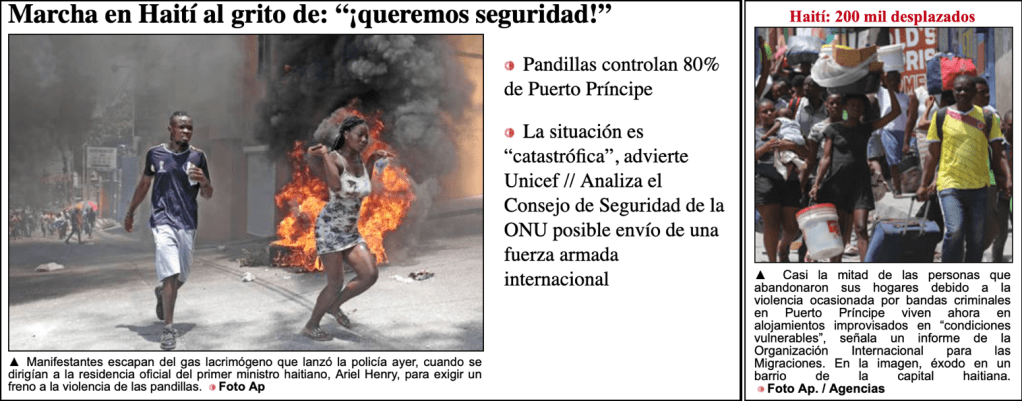
Headlines and photos from Mexico’s La Jornada daily newspaper: “Gangs control 80% of Port-au-Prince;” “200,000 displaced.”

By all accounts, the situation in Port-au-Prince is dire. On Aug. 17, Haitian aid groups backed by the International Rescue Committee (IRC) said they were temporarily shutting down operations, including some mobile health clinics, in the face of violence. Over the previous weekend, according to the UN, nearly 5,000 people fled their homes from areas around Carrefour Feuilles, Port-au-Prince. They are added to about 200,000 people displaced from their homes so far this year.

And more than 350 people are said to have been killed in lynchings by vigilantes since April.

You might think it’s progress that international actors are talking about police interventions rather than full-out military interventions after those have already failed in Haiti more than once. But decades of financial support and training of Haitian police (much of both coming from Canadafailed to overcome corruption and incompetence. 

Much of this could have been avoided. Three years ago, a viable set of proposals emerged from a coalition of civil society groups – the Montana Accord, named for the hotel where their accord was signed. They offered a “passarelle” or series of steps for an interim government as a way to move to new elections. If the imperial powers – Canada, the US and France – had backed those proposals instead of Ariel Henry (the unelected “prime minister”) things might be different today. 

Beyond the external powers, part of the problem is that the six richest families in Haiti don’t give a damn about the people or the violence, and prefer the current mess to a stronger and more effective state. 
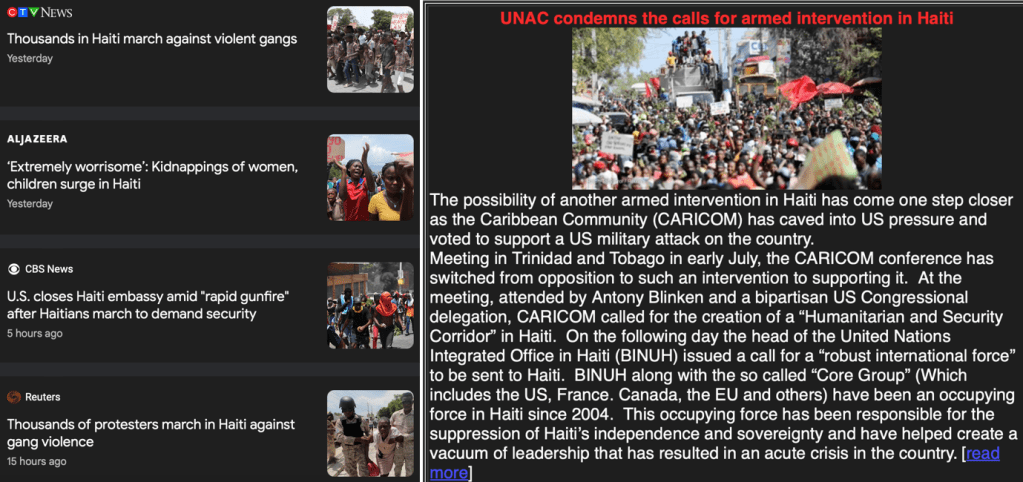
Recent headlines about the crisis in Haiti; a statement by the United National Antiwar Coalition (UNAC) condemning calls for armed intervention.

For now, the civil society groups continue to insist that theirs is the best way forward. There are various tables of negotiations to try to find a way forward. Some involve members of the Montana group and the acting prime minister. 

I think too that, for the sake of peace, the gang leaders, who perceive themselves as defenders of their communities, may need to be reckoned with as political actors, not mere criminals. In July, Tom Hagan, a U.S. Catholic priest, said he had worked out an agreement with four gang leaders in the Cité Soleil neighbourhood. They committed themselves “before God” to “work to put an end to the violence and to bring peace to all peoples.” In the past, bishops have enabled similar agreements in El Salvador and in Guerrero state, Mexico.

I made my first visit to Haiti in 1984, when the dictator Jean-Claude Duvalier was still in power, and I’ve been back countless times since then. High points for me were in August 1987, when a massive popular movement seemed capable of wresting power from the military, and in December 1990 with the election of Jean-Bertrand Aristide as president. What gives me hope is still the capacity of Haitian popular movements – workers, farmers, women, students – to organise and re-organise themselves for change, small and large.

What’s going on now in Haiti is a tragic mess that could have been prevented with some courage and imagination from the international community. In the first year or so after the 2010 earthquake, it seemed to me that the UN, foreign and Haitian NGOs, and the government of René Préval were working together toward a Haitian state that would be strong enough to deliver health, education, transportation, security, even land reform and other public services. But that was not the outcome sought by the United States and Haitian elites.
Haiti: another military intervention looms large

by Jim Hodgson

Haitians (whose own proposals for building a better country are persistently ignored) once again face an illegitimate government, one that has proposed a foreign intervention force to quell gang violence and to keep itself in power. 

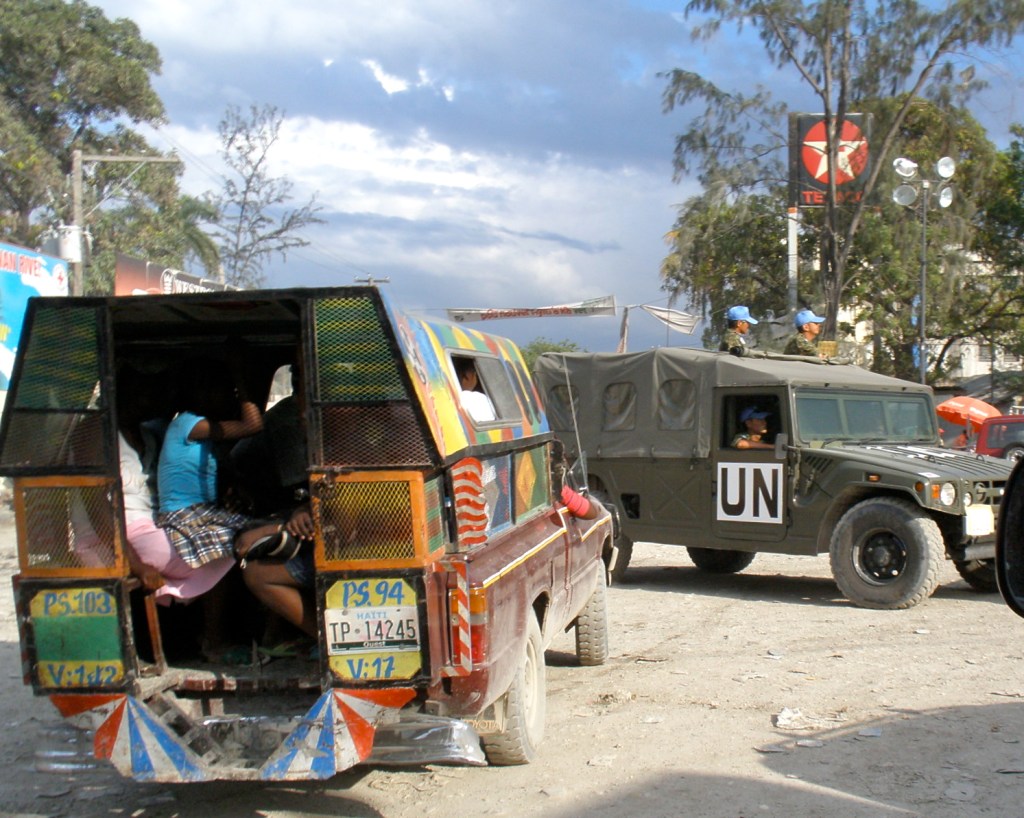
Haiti and the UN: another crossroads. Photo: Jim Hodgson, April 14, 2010, Port-au-Prince.

In reporting by many journalists from the global north, popular protest against the government, increased fuel prices, corruption and intervention is blended with reports of actions by the street gangs.

On Friday, Oct. 21, the UN Security Council approved its resolution authorizing a foreign military intervention and imposing sanctions on only one of Haiti’s gang leaders. (One might ask: when do gang leaders travel? Where do they go? Which banks do they use? Who sells them their weapons?)

The new intervention propositions emerged from the UN general secretary and Haiti’s “interim” prime minister: as if such interventions had worked in 1915, 1994, or 2004 to resolve the problems of people impoverished by the same imperial powers who are now invited to return.

Those powers misunderstand the present crisis. They can’t tell the difference between protest against the unelected government of Prime Minister Ariel Henry and the criminal activity of gangs. On Oct. 15, the United States and Canada delivered armoured vehicles for use by Haitian police.

Worse, the great powers continue to ignore the specific civil society proposals for a way forward that are contained in the “Montana Accord”  (named for the hotel where the group met). The group told a visiting U.S. delegation that it opposes foreign military intervention.

Cholera – never really eliminated after being brought to Haiti by support staff to soldiers in a previous UN force – is back. There are proposals to bring vaccines, but Haiti was able to deliver COVID vaccines to just a few more than three per cent of the population. Only 41 per cent of Haitian children are vaccinated against measles and 51 per cent are fully vaccinated against polio. Effective management of the cholera outbreak would require some sort of humanitarian truce, and that would require negotiations with the gang leaders – pretty much anathema to the imperial powers who seem more inclined to use force.

The current debates over the legitimacy of the government, possibilities for new elections, getting back on track with humanitarian aid and a reasonable development agenda are addressed in a new letter to U.S. President Joe Biden by four U.S. senators and nine members of the House of Representatives.

Recalling “decades of US meddling in Haiti’s internal affairs,” the group lauded the Montana Accord, which proposes a transition period that will ultimately result in elections, adding:

“None of these weighty issues can be addressed effectively in isolation. Neither free and fair elections, nor effective delivery of humanitarian assistance, are possible until the violence is quelled. Yet the Haitian police conspire with the gangs, and past U.S. efforts to build a professional, accountable police force have failed. The violence can only be quelled by Haitian authorities acting consistently with the rule of law through impartial judicial processes.”

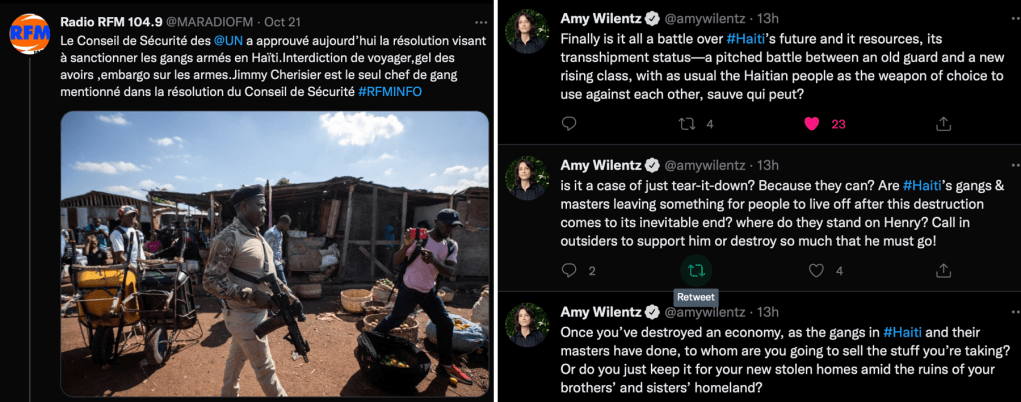
News of the UN Security Council resolution (left); earlier, Amy Wilentz, a noted U.S. writer on Haitian events, expressed her doubts about intervention proposals.

I’ll share a short reading list with you:

Edwidge Danticat (my favourite Haitian writer) in The New Yorker: “The Fight for Haiti’s Future.” The United States and its allies should withdraw their support support for Henry and the Parti Haïtien Tèt Kale (P.H.T.K.), the Haitian Bald-Head Party. “During the Party’s decade in power, Haitians have consistently taken to the streets to protest against P.H.T.K. leaders’ ineffectiveness and corruption, and to demand accountability for the funds misused, misappropriated, and pilfered through Venezuela’s oil-purchasing program, Petrocaribe. Accountability never came.”

If you read French and would welcome regular updates on what is going on in Haiti, I would encourage you to sign up for Info-Haïti. This is the monthly bulletin of Concertation pour Haïti, a Montreal-based coalition of civil society organizations. Write to: communications@aqoci.qc.ca or follow the Concertation on Twitter at: @haiti_pour. 

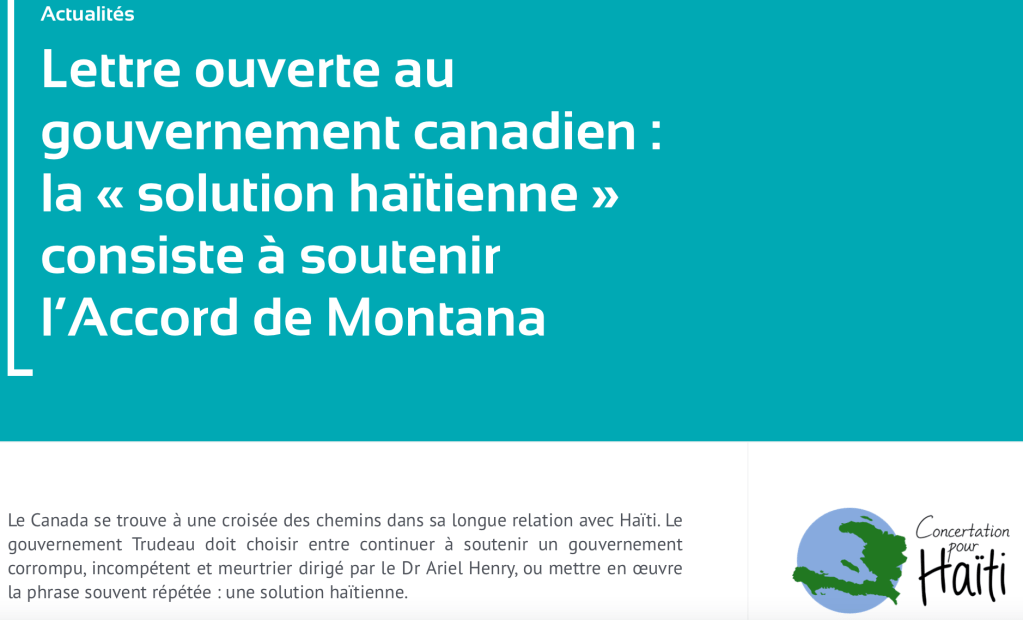
On Oct. 20, members of the Concertation produced their own letter to the government of Canada with recommendations for a way forward. “Canada must now stop supporting the government of Ariel Henry and put its full weight behind this coalition, which offers the only viable proposal for a transition that would allow Haitians to organize free and fair elections. To continue to support the current Prime Minister is to condemn the country to corruption, impunity, the continued domination of gangs, and ever-worsening food insecurity.”

A former U.S. ambassador to Haiti, Dan Foote, has warned that if the U.S. moves forward with the UN plan to send armed forces into Haiti, the result will be a predictable catastrophe.

And The New York Times has managed to produce pretty useful lesson plans for teachers about Haitian history and culture.

Summit of the Americas: U.S. can’t break old habits

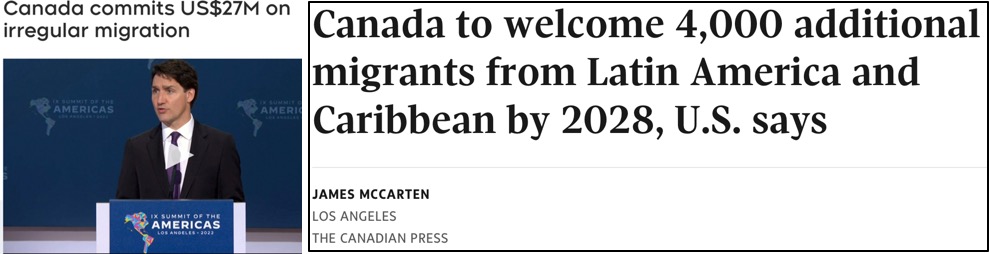
That the White House announced Canada’s planned response to the flow of refugees in Central America said a lot to me about the way the Biden administration mishandled the Summit of the Americas, held in Los Angeles last week.

Canada will welcome 4,000 additional migrants from Latin America and the Caribbean, the White House announced on June 10. That number is insignificant compared to the size of the challenge: 

  • Mexico reported apprehending 307,679 undocumented migrants in 2021. About one-third were deported; another third sought asylum in Mexico. The main countries of origin of those apprehended were Honduras (41%), Guatemala (26%), El Salvador (8%), Haiti (6%), Brazil (5%), Nicaragua (5%), Cuba (2%), and Venezuela (1%). None of the leaders of Mexico, Honduras, Guatemala or El Salvador chose to attend the summit – and Nicaragua, Cuba and Venezuela were told by Biden not to come. It’s hard to solve problems when you’re not talking to people who can do something about them.
  • As of February in the United States, about 164,000 (Reuters) or “just under 179,000” (Axios) migrants are currently in alternatives-to-detention programs managed by Immigration and Customs Enforcement  (ICE). This is “roughly double the total on Sept. 30, 2020, before Biden took office,” Reuters reported, and doesn’t include dependents – or the people actually held in detention.

The White House announcement of Canada’s support included commitments from other countries on migration issues, and was reported by Canadian Press in an article widely shared in Canadian media (CBC, CTV, the Globe and Mail, among others).

“The agreement also includes a pre-existing Canadian commitment to bring in an additional 50,000 agricultural workers this year from Mexico, Guatemala and the Caribbean.” (Those are temporary workers whose rights are limited.)

To its credit, the government (via the Prime Minister’s Office, not Global Affairs Canada) also announced an additional $118 million for “progressive initiatives” aimed at improving the lives of people where they already live in Latin America and the Caribbean. That includes $67.9 million to promote gender equality; $31.5 million in health and pandemic response spending; $17.3 million on democratic governance and $1.6 million for digital access and anti-disinformation measures. It will also spend $26.9 million to address “irregular migration and forced displacement” in the hemisphere.

Washington “still trying to dictate” to neighbours

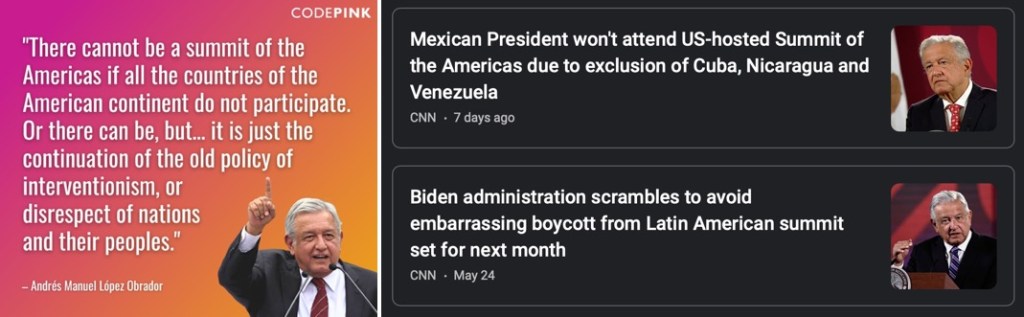
But it was the exclusions and boycotts that drew most attention. Because Venezuela, Cuba and Nicaragua were excluded by the host country, Mexico, Honduras, Bolivia and some Caribbean leaders chose to stay away. Leaders of Guatemala and El Salvador did not attend because of issues with U.S. treatment of allegations of corruption and abuses of human rights in their countries. In the end only about 20 of potentially 35 heads of state or government attended.

Apparently modelling the art of understatement, Reuters reported: “Hosting the Summit of the Americas in Los Angeles, Biden sought to assure the assembled leaders about his administration’s commitment to the region despite nagging concerns that Washington, at times, is still trying to dictate to its poorer southern neighbours.”

The presence of the unelected prime minister of Haiti, Ariel Henry, drew fire. During a panel discussion on “journalistic freedom,” U.S. Secretary of State Antony Blinken had the good grace to seem embarrassed when challenged over Henry’s presence. As Alterpresse pointed out, “not only does Henry govern without a mandate in violation of the Haitian Constitution, he is also implicated in serious crimes, including the death of a Haitian journalist in February 2022 by Haitian police.” (Two other journalists had been killed in January in a gang attack.)

In the tradition of each Summit of the Americas (including the teargas summit in Quebec City in 2001), a People’s Summit was held, gathering more than 250 community organizations, social movements, trade unions and other progressive groups. “In the ‘richest country in the world,’ 140 million live in or near poverty. The US government is addicted to militarism and war and will spend over $800 billion in 2022, on death and destruction,” said the final declaration. “Instead of preparing for war, society must be organized to meet human needs. We want a future without evictions, police violence and mass incarceration, deportations, sanctions, and blockades. We say: no more!”