Jujuy, Argentina: “Despite pain and loss, the people always win”

by Jim Hodgson

In Jujuy, northwest Argentina, a struggle is playing out that shows how right-wing political forces repeatedly apply repression to hold on to power even as democratic space continues to open across most of Latin America.

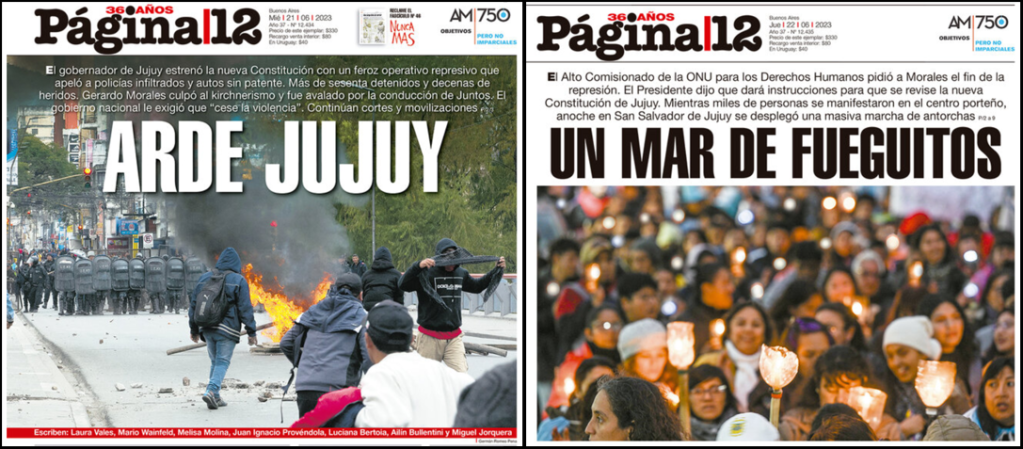
Front pages June 21 and 22 of a Buenos Aires daily, Página 12: “Jujuy burns” and “A sea of candles”

The most recent flare came after teachers went on strike to press their demand for salary increases amidst Argentina’s 114-per-cent inflation rate. Jujuy provincial governor Gerardo Morales responded by rushing through changes to the province’s constitution that restrict freedoms of assembly, protest and speech. The constitutional changes came without approval of the province’s Indigenous peoples.

 “We have received reports of events that could constitute an improper use of force against individuals in the context of the demonstrations,” said Jan Jarab of the South America regional office of the United Nations’ High Commissioner for Human Rights. In a letter addressed to the governor, he also questioned “the handling of the recent demonstrations by the security forces, as well as about some of the provisions of the approved provincial constitutional reform text.”

“Despite pain and loss, the people always win.” Canadian trade unions, solidarity groups and Common Frontiers joined together June 22 to send a message of solidarity.

Amnesty International also denounced those changes, and called for on the Jujuy government to cease the “excessive use of force against those exercising their right to peaceful protest, which has resulted in hundreds of people being injured in recent days.”

President Alberto Fernández responded to the continued unrest in Jujuy by saying he will seek to have the reforms to the provincial constitution struck down as unconstitutional.

Morales has used excessive measures before, notably in the case of Indigenous leader Milagro Sala, imprisoned since Jan. 16, 2016, after a protest. Sala is leader of the Movimiento Tupac Amaru, and led the creation of “workers’ neighbourhoods” that allowed workers to live for the first time in houses that they owned and to have access to schools and health centres.

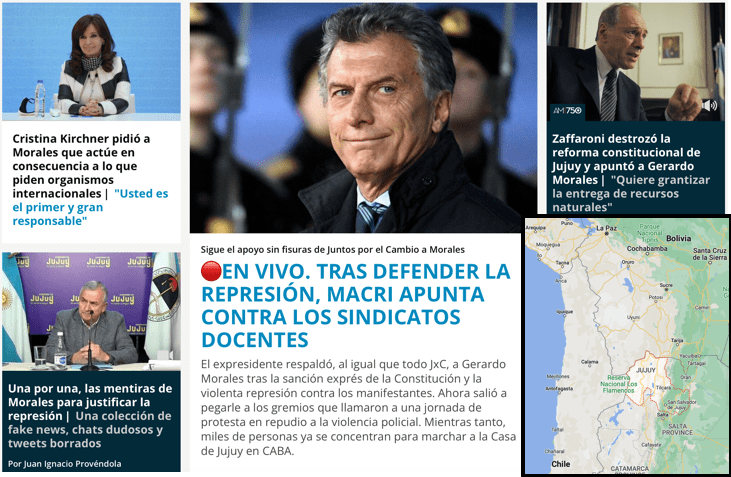
Página 12 headlines describe different positions on the Jujuy conflict. Inset (bottom right): map showing the location of Jujuy in northwest Argentina.

The drama in Jujuy plays out against the backdrop of Argentina’s volatile political calendar. The two-term Jujuy governor is the presidential candidate of one of the conservative parties, the Unión Civic Radical (UCR). The UCR is part of the centre-right coalition, Juntos por el Cambio “Together for Change”) which also includes former president Mauricio Macri. 

That coalition, however, is fractured now by the emergence of Javier Milei, a libertarian economist, as a candidate who has drawn support from the right and from sectors of the centre-left dissatisfied with the current administration of Fernández and his vice-president, Cristina Fernández de Kirchner (triple-digit inflation and a deteriorating economic situation).

Primary elections will be held on Aug. 13 for parties that opt to choose candidates by that system. The general election is to be held Oct. 22, and a presidential run-off would follow Nov. 19 if necessary.

In a move that surprised many observers, the president and vice-president and other leaders of their Unión por la Patria (UP) coalition came together June 23 to back a single candidate and slate headed by Economy Minister Sergio Massa.

Along with the national political context, a second factor driving the repression is the presence of lithium in Jujuy (which borders the lithium-producing regions of northern Chile and southern Bolivia). Lithium is used in batteries for electronic vehicles. 

A recent visit to the region by film-maker James Cameron was manipulated by Jujuy’s governor to give a positive spin to lithium mining operations undertaken despite Indigenous opposition.

Cameron, the director of Avatar and Titanic, said later: “Ironically, the outcome of this is that I am now aware of the problem and we will now assist through my foundation with the issue of Indigenous rights with respect to lithium extraction.”

A third factor in the present conflict is the region’s history of 480 years of colonial exploitation and Indigenous resistance

A recent statement by archeologists and anthropologists declares their solidarity with the Indigenous people of Jujuy. “And without community territory, rights to the land and the possibility of social protest against diversion from that vision, there is no equality, inter-culturality, or social peace.”

In Mexico, 43 students missing for eight years: not forgotten and still making headlines

By now, you might not remember the murders and forced disappearances of the “normalistas” – education  students who were training to be rural teachers in the state of Guerrero in southern Mexico. 

On the night of Sept. 26, 2014, students from the Ayotzinapa Normal School were attacked in Iguala, Guerrero, after they had commandeered buses to travel to Mexico City for a protest over the Oct. 2, 1968, massacre of student protesters at Tlatelolco plaza in Mexico City.

In Iguala, six people – including three students – were killed in the assault, 25 were injured and 43 students were abducted and presumably murdered later. Leading suspects are members of the Mexican army who worked alongside municipal officials and drug-traffickers who were trying to move opium gum (or semi-processed heroin) on one of the buses that was taken.

As the eighth anniversary approaches, a series of events reveals more about what happened as well as efforts by people tied to the former government of Enrique Peña Nieto to maintain the cover-up. 

Left: La Jornada front page today: protests over judicial decisions, military cover-up. Right: remembering the 43 students in Tepoztlán, Morelos, December 2014.

First the news:

  • On Aug. 18, the report of the Commission for Truth and Access to Justice (appointed by the current government of President Andrés Manuel López Obrador) published its report, stating that the students’ disappearance was a “state-sponsored crime.” The report accuses Col. José Rodríguez Pérez, commander of the 27th infantry battalion located in Iguala, of giving the order to murder the missing students. He was arrested on Sept. 15.
  • By pointing to army collusion, the new report denounced the version offered by 2015 by the Peña Nieto administration that the students were killed by a local drug gang after being abducted by municipal cops acting on the orders of Iguala’s corrupt mayor, and that their bodies were incinerated at a dump in the nearby town of Cocula – which is not to say that those officials do not share part of the responsibility for the crimes. Following the report, Peña Nieto’s  attorney-general, Jesús Murillo Karam, was arrested for obstruction in administration of justice in the case. Another official whose arrest has been sought, Tomás Zerón de Lucio,head of Peña Nieto’s Criminal Investigation Agency, left Mexico and is hiding in Israel
  • Among the many stories that emerged from the report is that of one of the students, Julio César López Patolzin, a former soldier now revealed to have been an army spy infiltrated into the school. Even though he was in touch with his supervisors up to the night of the disappearances, the army made no effort to extricate him from among the other students, making him a victim along with the others. 
  • Despite the truth commission report, a judge assigned to the case by the former government has ordered the release of at least 121 police officers and government officials previously charged, including some of the municipal officials and accused drug-traffickers. The district court judge, Samuel Ventura Ramos, is located in Matamoros, Tamaulipas (in northeastern Mexico, close to the U.S. border).
  • Federal prosecutors are now bringing charges against the judge, and President López Obrador demanded Friday (Sept. 23) to know why the cases are not taken up again. “What has that to do with justice? Who chose that judge? And why is the Ayotzinapa case, which has to do with Guerrero, attended to by a judge in Tamaulipas?”

What does all this mean?

When looking at the news these days, it’s important to keep in mind that part of the game plan of globalized capitalism is to show the state as ineffective, whether against the COVID pandemic, inflation, or protecting human rights and public security.

In Mexico, where the present government is attempting to transform the system into one more amenable to the impoverished majority, economic power and some instruments of political and judicial power are still held by old elites. 

Moreover, the system as implemented over the past 30 years has made the students and their cultures redundant, wrote Alejandro Nadal of the Centre for Economic Studies at El Colegio de Mexico. Industrialized agriculture is privileged over traditional small-holder farms. “That is to say, there is no place for campesinofarmers who aspire to a dignified life in freedom. The youth of Ayotzinapa rebelled and the established powers responded,” Nadal wrote in La Jornada.

And, who are those powers? Again we see, as we have repeatedly over the past two decades of a stepped-up “war on drugs,” we see the collusion of a drug cartel (this one is called Guerreros Unidos, or United Warriors) with politicians and other state actors.

“The war on drugs has never controlled drug trafficking and has always been about social control,” wrote Laura Carlsen, director of the director of the Americas Program of the Center for International Policy. “Now it’s Mexico’s youth that are paying the price of that duplicity.”

I lived and worked in Mexico from 1994 to 2000. I was based in the city of Cuernavaca, about 90 km south of Mexico City in the state of Morelos and about 50 km north of the border with Guerrero. We frequently visited a Nahua Indigenous community near Taxco, Guerrero. If you take the libre (the two-lane, non-toll highway) towards Acapulco, you pass through Iguala.

During those years, I made several visits to the city of Tlapa in the eastern part of the state. I came to know the Tlachinollan human rights centre and once spent an afternoon near Olinalá talking with a group of rural teachers. Their option for the poor was absolute and inspiring.

The students reflected the context from which they emerged and to which they would have returned as teachers: impoverished and exploited rural Mexico. Their work was heroic.

The latter paragraphs of this text are adapted from a piece I wrote in a previous Unwrapping Development blog format in October 2014, days after the disappearances.

At the intersections of Queer, Trans and Indigenous in Guatemala

Fernando Us (left) and Mónica Chub (right).

As my 15-day visit in Guatemala came to an end in early May, I had the chance to meet Fernando Us, Maya Kiché human rights defender and self-described sexual dissident. Fernando hails from a village in Uspantán municipality, Quiché department, that is not far (though accessed via a different road) from the had village I visited in the company of a team from Breaking The Silence and the Highlands Committee of Peasant Farmers (CCDA).

Fernando, who among other activities is a Mayan spiritual leader, met me on a Sunday afternoon in a downtown café located between the National Palace and the San Sebastian church where Bishop Juan Gerardi was assassinated in 1998. Religion and politics would become prominent themes in our friendship: fundamentalist religious groups very nearly scored a victory with an anti-LGBTI “life and family law,” but after an international outcry, congress finally voted in March to table the bill

Back home in Toronto two days after I had met Fernando, I was trying to catch up on news from CCDA. I came across a news article that quoted people from CCDA and Mónica Chub, a Trans woman and Maya Q’eqchi’ rights defender with whom Fernando and I would be working just a few weeks later. CCDA leaders and Mónica had attended a demonstration May 11 in Cobán, capital of the Alta Verapaz department, demanding freedom for prisoners accused of crimes they could not have committed. At the same time, high levels of violence against Trans women persist in Guatemala.

In early June, in partnership with Dignity Network and InterPares, I had the privilege of accompanying Mónica and Fernando during their days in Toronto. Together with Olowaili Green, an Indigenous film-maker from northern Colombia who is lesbian, their visit to Toronto followed participation in the Canada Pride Human Rights Conference, held in Winnipeg May 27-June 5.

In Toronto, there were public presentations at Glad Day Books and the San Lorenzo Church (an Anglican parish serving mostly Spanish-speaking people). At San Lorenzo, part of the conversation was about spirituality and the churches.

Fernando, whose father was a Catholic lay catechist murdered by a death squad in 1980, called on churches to distance themselves from those fundamentalist churches that “demonize” Mayan spiritual leaders

In June 2020 in Petén department, Domingo Choc Che, 55, a Maya Q’eqchi’ expert on traditional herbal medicine, was tortured and burned alive by people who accused him of witchcraft. In June this year, Adela Choc Cuz, a member of the Q’eqchi’ Maya Ancestral Council of the El Estor municipality, Izabal department, was kidnapped with her daughter. They too were accused of witchcraft, but both were released.

On their final day in Toronto, I talked more with Fernando and Mónica about the intersections of Indigenous and LGBTIQ+ identities in Guatemala.

Fernando: I think there is a sort of accumulation of oppressions within the structural racism that is found in Latin America – all of America – racism as an ideology of racial superiority that has permeated since the time to the Spanish conquest and is maintained to this day. 

What does that mean for Indigenous people? Displacement, loss of land, situations of poverty. In a country like Guatemala, there is a lot of cultural diversity and also biodiversity. The Indigenous people live on land that is not as good for cultivation. We have less access to running water and to education, and therefore less access to good jobs.

In that context, to be gay, or to be a person of diverse sexuality or queer, means another form of oppression and vulnerability. In the face of racism, you have fewer opportunities, but if you are part of that sexual diversity, your possibilities and conditions of life are even more limited.

Mónica: When we talk about inclusion in social struggles, we’re talking about many different struggles. When we talk about LGBTIQ+ rights where we live, it’s like we’re talking about the territories from which we struggles in ways that are separate from other struggles, like those going on in the cities. We realize that these social struggles are connected, but what we live in our territories is what we embody collectively, the theft our Q’eqchi’ land, the criminalization of land defenders: those events make us reflect and embody together with all our companions. There are members of our community who face repression, but we realize we are in a difficult context, one of vulnerability, racism and discrimination. 

Part of our community is hidden, and needs to hide. But to confront that situation, some of us have to be visible.

Jim: These situations of criminalization of land defenders, the political prisoners: what is going on now in the struggles for land?

Mónica: We embody those situations. As defenders, we too are diverse. Think of the people who are criminalized and condemned to years in prison. In any moment, they could criminalize us, we who are defenders of diversity, imprison us, persecute us. It’s very important to have solidarity. The colour of our organizational flag doesn’t matter. This is collective humanitarian work.

Fernando: The claims for land and natural resources are historic. The Indigenous people have built their claims around land issues. In Guatemala, Indigenous peoples have been forced from their land, or they have land that is not good for cultivation, and the conditions in which the land was taken are not very clear in legal terms. In effect, in recent years, the aggression and attacks against those who reclaim the land have increased.

I am from a village in Uspantán that is called Macalajau, more up in the mountains. Even though I have not lived there, I maintain a relationship with the community. It feels like a town that is growing. There’s more business, and it’s more culturally diverse now. But I think that outside the village, conditions of access to water are limited. There’s malnutrition. Access to primary education is still a problem, especially for Indigenous children. And because of lack of opportunities, some people, especially young people, migrate to the United States.

Mónica: Our people are being forced from their homes and communities. Why? Because our presence is not convenient for the land-owners, the ranchers, the hydro-electricity developers who want to take over Mother Nature and the ancestral lands of our communities. What they do is to force our people out. They’re forced to flee, risking their lives, walking to another place to seek refuge. We continue to see this. They criminalize people who defend their land, condemning them unjustly. That’s what is going on in the territory from which I come.

San Miguel de Uspantán, Quiché

My posts about people and issues in Guatemala, May through August 2022, are in different spaces. Here they are in chronological order:

Unwrapping Development:

Breaking The Silence:

Unwrapping Development

  • At the intersections of Queer, Trans and Indigenous in Guatemala [above]