“The narco conquest of Indigenous land is like all the other conquests”

In September 1987, during my first visit to Mexico, I took a train through the Sierra Tarahumara from Chihuahua city to Creel and then along the rim of the spectacular Copper Canyon (left) to Los Mochis on the Pacific coast in Sinaloa state. (Now the same trip is a fancier tourist excursion, the Chepe Express.)

The murders last month in the Sierra Tarahumara of Mexico’s Chihuahua state of two Jesuit priests sparked grief and tension among Indigenous people, the Catholic church and various levels of Mexican government. The priests were Javier Campos Morales, 79, and Joaquín Mora Salazar, 81, known respectively as Gallo and Morita. A third person killed with them, Pedro Heliodoro Palma, was described as a tourist guide. Their bodies were taken by the killers, who were said by police to be linked to the Sinaloa cartel.

Mexican Jesuits recognized “with humility” that in a country with more than 100,000 disappeared people, they were fortunate to recover the bodies of their brothers within 72 hours of their disappearance. “A search that was coordinated among three levels of government reflects intense attention and action are likely not accessible to the immense majority of families whose cases do not gain public attention.”

In the last 30 years, 70 Catholic priests have been murdered in Mexico, including seven during the current presidency of Andrés Manuel López Obrador (known as AMLO). The motives, wrote sociologist Bernardo Barranco in La Jornada, are multiple: theft, kidnapping, extorsion, passion and politics. I would add incidental contact with drug-traffickers who, in this case, seem to have been chasing someone who sought refuge in the church in Cerocahui, municipality of Urique, where the Jesuits have carried out ministry among the Rarámuri Indigenous people in the Sierra Tarahumara. 

In 2006, then-President Felipe Calderón launched a military-led offensive against the drug cartels in an attempt to curb their violent turf wars. Instead, the violence became worse. 

In the town of Creel, in southwest Chihuahua, on Aug. 16, 2008, gunmen opened fire on a group of young people who were participating in a barefoot family race. One of them was carrying his baby in his arms. Some of the youth were related to the town’s mayor but had no link to organized crime. Thirteen people, including the baby, died. 
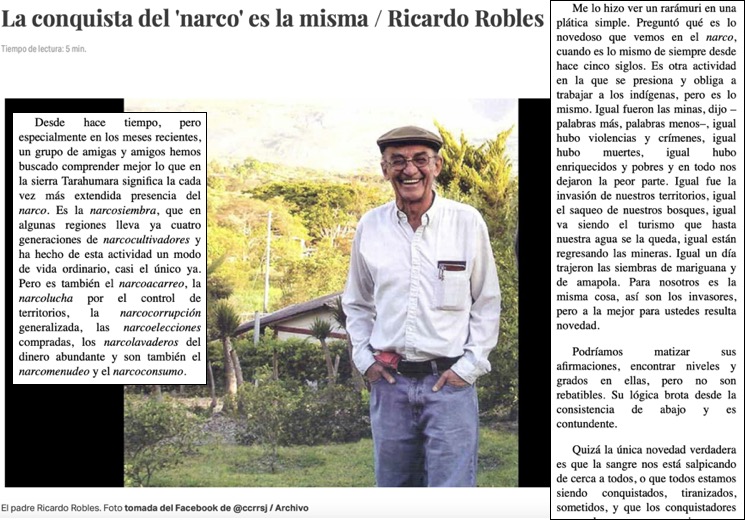
A few weeks later, Jesuit Fr. Ricardo Robles wrote: 

For a while now, but especially in recent months, a group of friends and I have been trying to better understand the significance of the evermore extended presence of the narco in the Sierra Tarahumara. It’s the narco-planting, that in some areas has seen four generations of narco-cultivators and has made this way of life become ordinary, indeed almost the only lifestyle now. But it is also the narco-transportation, the narco-struggle for control of territories, the generalized narco-corruption, including paid-for narco-elections, the abundant narco-money-launderers and the small narco-traffickers and narco-consumers. 

What is new in what we are seeing with the narco? A Rarámuri friend said it is the same thing they have seen for five centuries. “It’s another activity in which Indigenous people are pressured and obliged to work. It was the same with the mines,” he said. “There was the same violence and crime, the same deaths, the same enrichment and impoverishment and in everything we were left with the worst part. The same with the invasion of our territories, the same with the theft of our forests, the same with tourism that even takes our water, the same with the return of the mines. The same when one day they brought the planting of marijuana and poppies. For us it’s the same thing. This is how invasions are, but perhaps for you this seems new.”  

Perhaps all that is truly new is that now the blood is spattered on all of us, that we are all being conquered, tyrannized and forced to submit.

The Spanish conquistadores, hungry for gold and other precious minerals, arrived in the Rarámuri territory in 1589. The Jesuit religious order followed in 1608. They were expelled from the Spanish colony and 19th-century Mexico, but returned after 133 years in 1900 with the intention of educating the Indigenous people. La Jornada journalist Luis Hernández Navarro writes that after facing about 40 years of resistance, the Mexican Jesuits finally began to learn from the Rarámuri. By the 1960s, they had set aside their western notions and moved closer to the Rarámuri cosmovision. The Rarámuri converted the Jesuits “from being carriers of a doctrine into disciples, from being do-gooders into friends of the men and women of the Sierra Tarahumara, and companions in their secular resistance and defence of their freedom and autonomy.” Hernández adds that the two Jesuits killed in June had “accompanied the Rarámuri people who were subjects of their own history and not objects for colonization.”

In 2017, one of Hernández’s own La Jornada colleagues, Miroslava Breach, was murdered after documenting the expansion of organized crimes and its links with political institutions in Chihuahua. The image on the right is from the Committee to Protect Journalists. By the end of June, at least 10 journalists had been killed in Mexico this year.

At the funeral June 25 of the slain priests, Fr. Javier Ávila Aguirre, the Jesuit who serves at Creel, called on President López Obrador during his homily to look again at his approach to public security. “Our tone is peaceful but loud and clear. We call for actions from government that end impunity. Thousands of people in pain and without voice clamour for justice in our nation. Hugs are no longer enough to cover the bullets.”

In his daily news conference on June 30, the president responded: “Those expressions of ‘hugs are not enough.’ What would the priests have us do? That we resolve problems with violence? That we disappear everyone? That we bet on war?”

The point, however, made by human rights groups and some religious leaders, is that after nearly four years AMLO’s approach to the drug war has not produced a noticable reduction in violent attacks on civilians – or priests or journalists. While the president says he is working on the “causes of violence” – poverty, marginalization, exclusion – what people want is protection now. 

The issues raised by the Jesuits and human rights groups should not be seen as normal political attacks on an incumbent politician, but rather contributions in a search for real solutions. 

Bernardo Barranco, the sociologist-columnist cited above, told a La Jornada colleague in an interview that churches are present in places where the state is absent, and that they could have a mediating role. He pointed to the state of Guerrero where, for example, Bishop Salvador Rangel of Chilpancingo-Chilapa negotiated in 2018 with organized crime so as to end the assassination of local candidates and to permit the population to vote. 

Such conversations may not lead to solutions in every instance, but it’s clear that new ideas and less defensive dialogue are needed if Mexico is to find a way forward.

And North American narco-consumers need to say NO to illegal drugs, at least for the sake of solidarity with victims of narco-violence.
In Colombia, those who believe in peace with justice rejoice

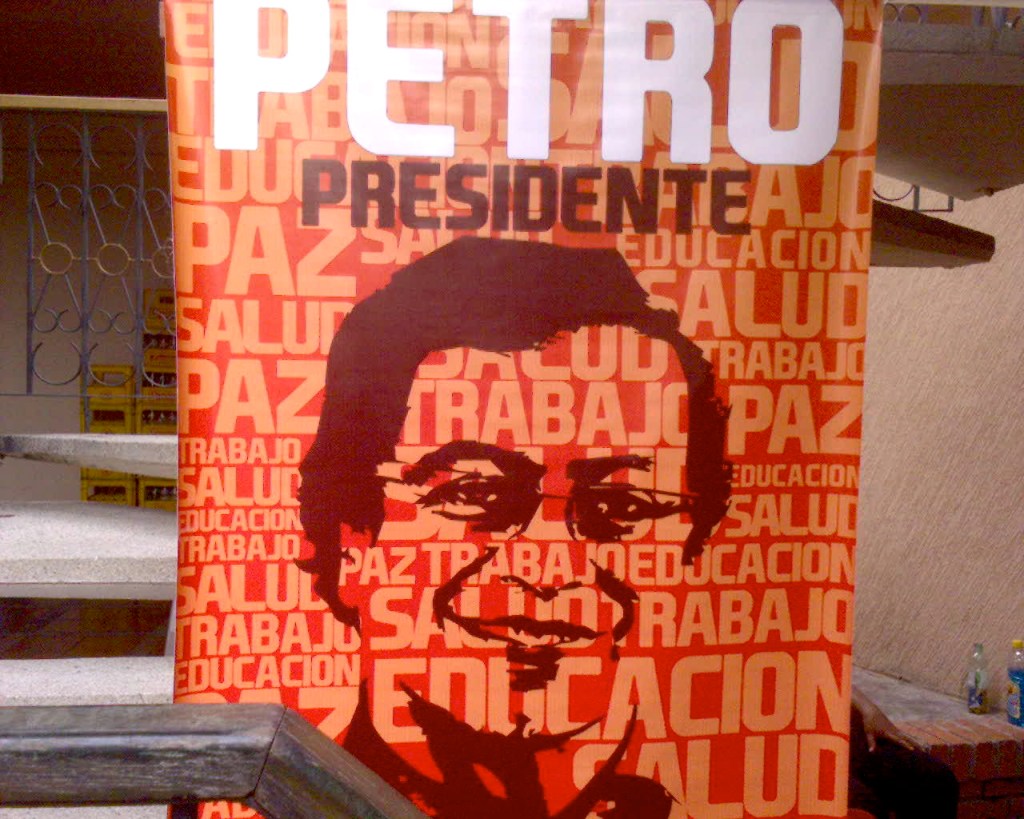
A Gustavo Petro campaign poster from 2010.

On a winter evening about 20 years ago – I am sorry that I cannot be more precise – Bill Fairbairn and I met in Toronto with a Colombian congressman and one of his aides. Bill worked for the Inter-Church Committee on Human Rights in Latin America (ICCHRLA), and I served on its board. And I can’t remember if this meeting was before or after mid-2001 when the work of ICCHRLA was folded (partially) into KAIROS. We were in what I think we used to call the Blue Room of Deer Park United Church in Toronto where the offices of ICCHRLA and later KAIROS were located.

I do remember the congressman, Gustavo Petro, and his earnest search for international allies in the struggle to end Colombia’s civil war and to obtain a measure of social justice to the oppressed majority.

Two decades later, Petro is weeks away from being sworn in as Colombia’s first president from a party of the left. His victory results from the mobilization of young and new voters from parts of Colombia that are always ignored, especially the Caribbean and Pacific coasts. 

Celebrating victory (left); voters from the margins propelled Petro to power.

A large measure of credit goes to his running mate, the environmental activist and lawyer Francia Márquez, 40. She will become the country’s first Afro-Colombian to hold executive office. This election was the first time voter turnout topped 60 per cent, according to the International Institute for Democracy and Electoral Assistance (IDEA).

I met Petro again in August 2004 in Caracas, Venezuela. We were staying in the same hotel and both of us were observers of a referendum that opponents hoped would remove President Hugo Chávez from power. During Petro’s three campaigns to become president, along with his congressional and senate races, and the 2011 drive that made him mayor of Bogotá, right-wing politicians tagged him as castrochavista (as if that were a bad thing). They decried his youthful involvement in the M-19 guerrillas. They had made peace with the government in 1990. Petro, unlike many former fighters who laid down their weapons, survived the waves of selective assassinations that sought to eliminate them from political life.

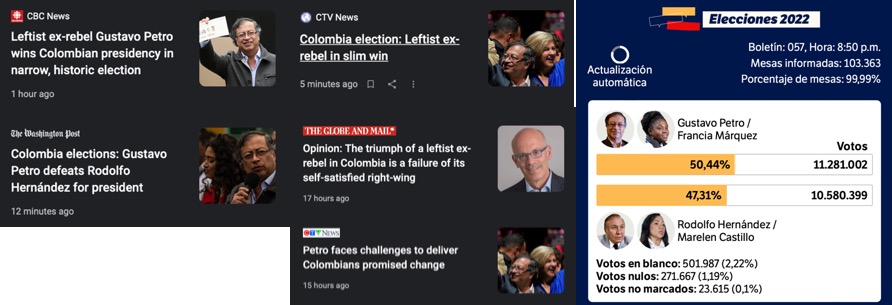
Victory this past Sunday by Gustavo Petro, 62, in Colombia’s presidential election offers hope for reviving a peace process stalled these past four years by President Iván Duque, protegé of former president Álvaro Uribe – the fiercest guardian of the ways that things have always been done by those with power in Colombia.

Petro defeated Rodolfo Hernández, a millionaire conservative who was frequently compared to Donald Trump.

This election (like recent ones in Chile, Honduras and Peru) is also firm rejection of Canadian and U.S. foreign policy that for the past 20 years has paid lip service to the search for peace, but always protected the interests of those who control land and natural resources. Before Conservative Prime Minister Stephen Harper won his majority in Parliament in 2011, Canada negotiated a free trade agreement with Colombia that as a sop to the Liberal party contained a mechanism for a toothless human rights impact assessment. Colombia was also the key regional ally in setting up the “Lima Group,” the attempt by Washington and Ottawa to isolate Venezuela when most members of the Organization of American States refused to play along.

After the victories by Hugo Chávez in December 1998 in Venezuela and Luiz Inácio (Lula) da Silva in Brazil in 2002, some of us starting talking about a “pink tide” sweeping across Latin America (forgetting perhaps that tides also recede). Now the tide is back, this time stronger than before. In Brazil, Lula is again leading the polls in anticipation of the election later this year.

The road ahead for Petro will be difficult, just as it has been for Pedro Castillo in Peru since his victory a year ago. The opposition will set traps and take advantage of every misstep. In this third attempt to win power, Petro proposed pension, tax, health and agricultural reforms. He would change how Colombia fights drug cartels and start new talks with remaining guerrilla fighters. But his coalition has only about 15 per cent of the seats in Congress, which will force him to make deals, limit some reforms or abandon others. Parts of the U.S. government (military and intelligence agencies) will not be friendly, and Canada (because of influence by resource-extraction companies) may not be either.

¿Dónde están? Saturday in Guatemala City

As I prepare for a journey with friends to an area that was afflicted by the violence and repression in Guatemala’s long civil war, I’ve been walking a lot in the capital city – and taking some photos.
Reminders of the war are everywhere.
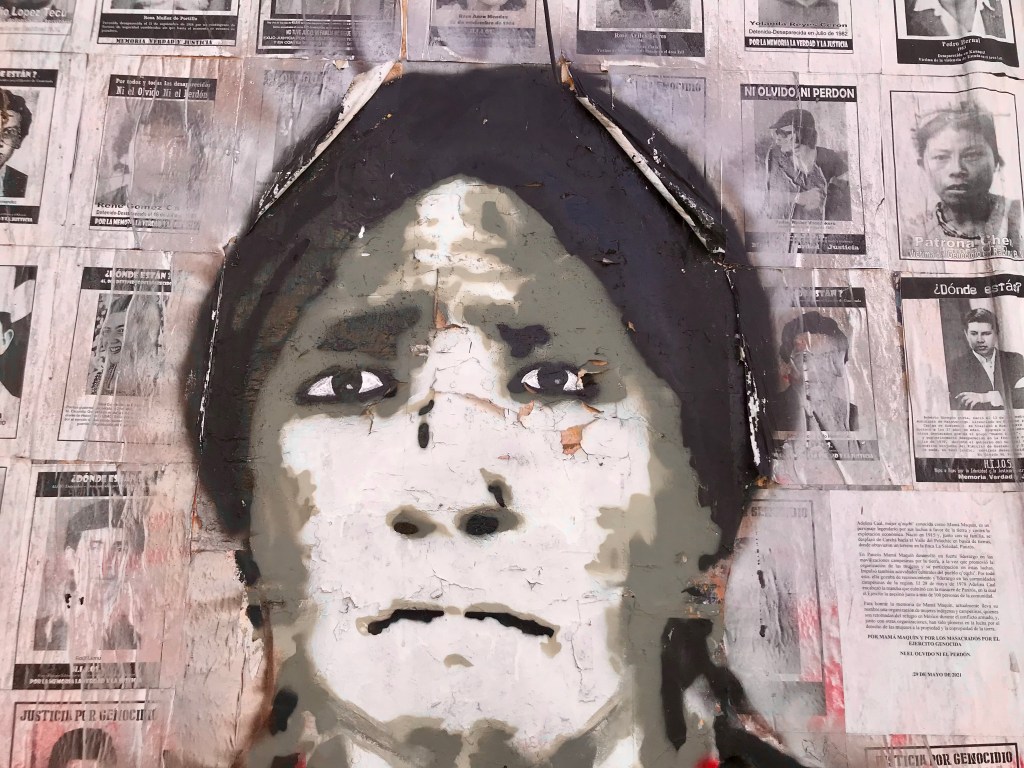
One of the places I pass frequently is the ruined building shown above. It’s at 7ª Avenida and 4ª  Calle in Zona 2, a kilometre or so north of the city’s main plaza. I don’t know what the building was used for (and if I ever learn, I’ll correct this post), but today it is plastered with posters about the murdered and the disappeared. I found other posters on 6ª Avenida just a few blocks away. Here below are some stories that I have been able to piece together that will give you a sense of what Guatemalans faced in those horrific years.
Adelina Caal, a Kekchi woman known as Mamá Maquín, was legendary for her struggles for the land and against economic exploitation. She was born in 1915, and together with her family moved from Carchá to the Polochic River valley in search of land. They obtained a piece of land on a farm called La Soledad, Panzós.
At Panzós, Mamá Maquín developed strong leadership in rural mobilizations for access to land, while promoting the organization and participation of women. She also promoted cultural activities of the Kekchi people. For all this, she enjoyed recognition and leadership in the campesino communities of the region. On May 29, 1978 Adelina Caal led the march that culminated in the Panzós massacre. 
The Panzós massacre was the machine-gunning of Kekchi Indigenous people carried out on May 29, 1978, by members of the Guatemalan Armed Forces. Including Mamá Maquín, at least 53 men, women and children died – the message in the photo above says 100 – and another 47 were wounded.
To honour the memory of Mama Maquín, an organization of Indigenous and campesina women bears her name. They had returned from refuge in Mexico during the armed conflict, and, together with other organizations, have been pioneers in the fight for women’s right to ownership and co-ownership of land.

The large poster on the left shows Marco Antonio Molina Theissen. He was 14 years old when he was taken from his family’s home on October 6, 1981. He is one about 5,000 children who are among the 50,000 people who were disappeared in the years of conflict: those in addition to the 200,000 killed. About a week before Marco Antonio disappeared, his sister Emma Guadalupe – a member of a labour-focused youth organization – had been detained. After beatings, sexual assaults, interrogations and torture, she escaped from the military base in Quetzaltenango where she had been held. The forced disappearance of Marco Antonio is considered a reprisal for Emma’s escape and for the family’s political activity. 
The large poster on the right shows Jorge Alberto Rosal Paz y Paz, a 28-year-old agronomist in the eastern department of Zacapa. On Aug. 12, 1983, he was driving between the cities of Zacapa and Teculután when he was stopped by men in an army jeep. Though dressed in civilian clothing, witnesses said they were soldiers because of the jeep and the heavy weapons they were carrying. 
This is Gustavo Adolfo Meza Soberanis, medical doctor and surgeon, member of the Organización del Pueblo en Armas (ORPA), kidnapped by the army in Ciudad Nueva, Zona 2, on September 7, 1983. His is one of the cases recorded by the army in its infamous “Diario Militar,” which also shows that he was executed on February 7, 1984. But there is no indication of what was done with the body. Hence the question, ¿Dónde estás? Where are you?