I feel some relief this morning by two newsletters from U.S. activists that arrived in my email.
One is from “Stop The Coup 2025,” a campaign to fight Project 2025 (the Republicans’ plan for the next Trump administration). It has a toolkit for community organizers that includes a section, “Spotlight on Risk Preparedness/Criminalization/Underground Survival Tips.”It discusses the importance of organizations and individuals taking steps now to prepare and assess their vulnerability to Project 2025’s agenda and learning from LGBTQIA+ activists in other places who have been forced to live and organize under the radar due to state-sanctioned criminalization.
Here’s a bit more information about Project 2025:
Project 2025 has a radical anti-democracy, anti-diversity, anti-gender agenda to:
systematically dismantle the federal government – a soft coup
give the next Republican president new “supreme powers” – an autocracy
use Executive Orders to “legally” reverse many of our civil rights
use the military to help clamp down on domestic dissent
criminalize & erase gender & LGBTQIA+ identity from government protection
reverse racial equality, attack diversity, and reverse environmental gains
replace secular education with Christian theocracy and a pro-life agenda
recruit and train 20,000 conservatives for government jobs
Use “Schedule F” to remove 50,000 civil servants
Require government “Loyalty Pledges” to an extremist right-wing agenda
Reverse historic US defense policy of deterrence to offense
Require US foreign policy, USAID to align with pro-life agenda
LAUNCH THEIR 180-DAY ADMINISTRATION TAKEOVER ON January 20, 2025
The other newsletter that brought hope to my inbox today came from Codepink, the U.S. network of feminist peace activists. I’ve worked with them in the past to counter the harm caused by U.S. sanctions in Venezuela, Cuba and elsewhere, and some of my colleagues have worked with them for peace in the Korean peninsula and the Middle East. Part of the message today:
We don’t want to waste your time with platitudes about how everything will be okay or even talk about the breakdown of the election. We think it’s more useful to go off what we know for certain now: Donald Trump is going to be president in January.
But, a majority of Americans oppose U.S. support for Israel, and don’t want their tax dollars funding weapons that murder innocent people and destroy the earth. A greater majority of Americans oppose the U.S. starting new wars. It’s okay to feel deflated and discouraged, but don’t forget that the people are on our side – all we have to do is reach them.
We will continue to do what we have always done: educate by exposing horrific violence carried out by those in power, activate a movement for peace, and cultivate local communities that represent the world we want to live in. Solidarity is our best friend. Finding new and creative ways to scratch at power is our path forward.
Political signs of the times at a rest stop near Junction, Texas.
Last time, and this time: concern for rights of refugees
Back in 2016, I was in Antofagasta, Chile, when I learned that Donald Trump had defeated Hillary Clinton and won the U.S. election. The news was unexpected, just like now.
I was in Chile’s far north to meet and show solidarity with Chilean Methodists who were working with migrants who had come from Colombia and other parts of Latin America and the Caribbean, including Haiti.
Indeed, a great deal of my personal and professional life has been devoted to work with refugees and other people who are forced to flee their homelands because of various political, economic and environmental causes.
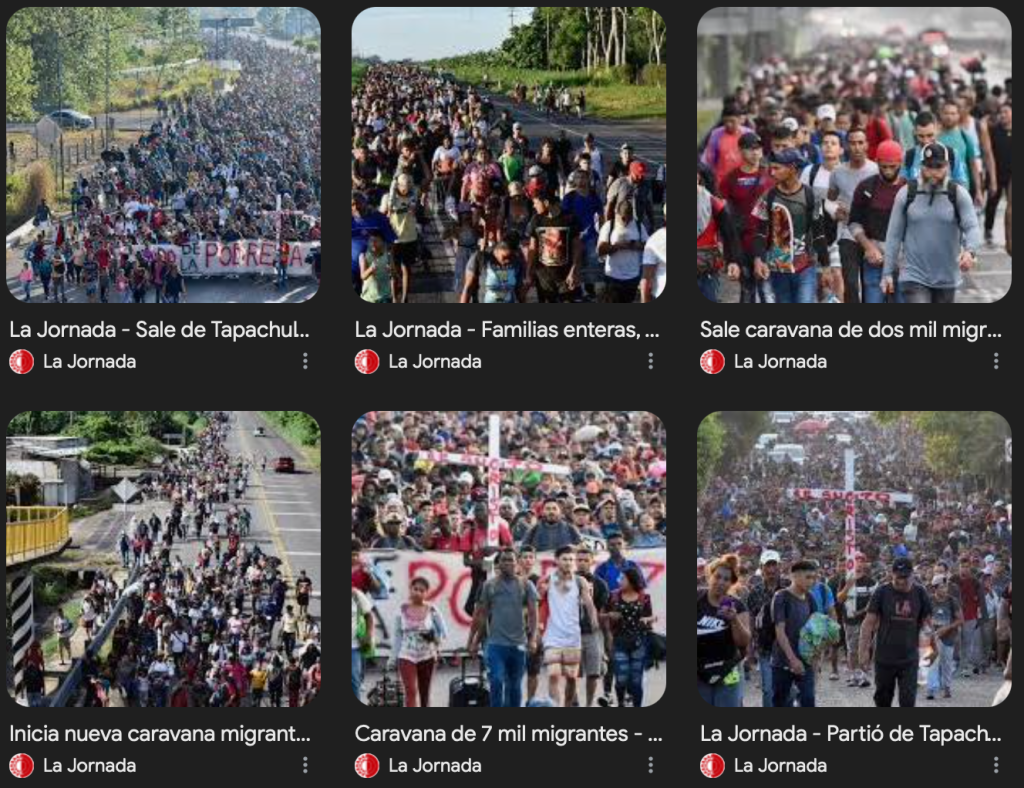
Caravans of migrants from many countries continue to cross Chiapas on their way north, holding out hope that they might score a formal U.S. refugee application before January 20 when Trump, who promises mass deportations, will take power. (Images: La Jornada, Mexico).
Now I am in north-western Chiapas, having crossed in recent weeks several of the “red states” where support for Trump is strong.
In the wake of the election, pundits point out that Trump weaponized ‘fake news.’ He played to machismo and racists and to people who haven’t a clue what being Trans even means. That he won over a smart, articulate, experienced woman of colour after being convicted of crimes and successfully sued for sexual assault is an indictment of U.S. democracy.
Some, including Sen. Bernie Sanders, point as well to the Democratic Party establishment which again defended the status quo. “It should come as no surprise that a Democratic Party which has abandoned working class people would find that the working class has abandoned them.”
As ever, don’t expect the Democratic Party to save us. Now is the time for grassroots action.
For Natasha Lennard, writing in The Intercept, the answer is radical action from the grassroots:
“Far-right policies and parties tend to win the day when so-called centrists take up conservative platforms to purportedly capture disaffected white voters and thus keep the far-right at bay; the upshot is treating conservative nationalism as the fulcrum of all politics. This is what the Harris campaign did, particularly when it came to immigration. At best, as with Britain’s currently ruling Labour Party, the Tories might have lost, but right-wing politics have been reconfigured as the normalized center.”
In Mexico, the new year began with a series of highly-publicized murders and beatings of Trans women. The violence, sadly, is not rare: Mexico follows only Brazil with the highest numbers of murders of LGBTQIA+ people each year. The fact that they’re being talked about at all is what’s unusual.
Two of the women who were killed were active in party politics. A woman beaten by her fiancé is a well-known social media “influencer,” Paola Suárez. The incidents are reminders of the breach between much-improved legal protection for LGBTQIA+ people in most of Latin America, and the harsh realities of day-to-day life where many men still hold to old ways. More on that below.
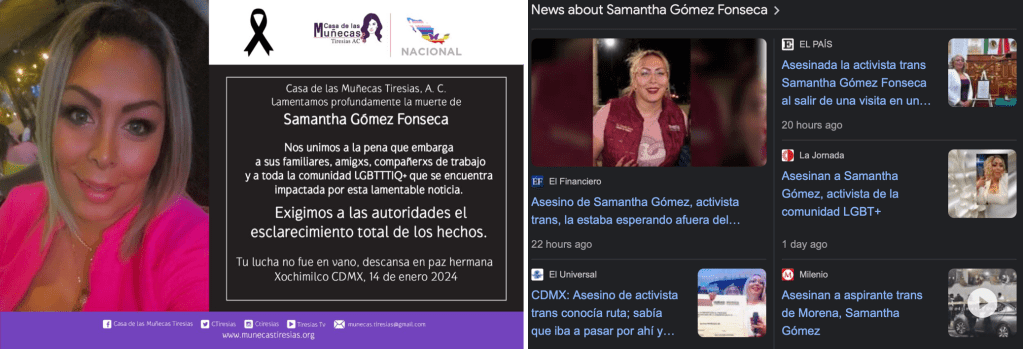
The assassination of Samantha Gómez Fonseca came the day before a planned march by Trans women in Mexico City.
Samantha Gómez Fonseca, 37, had launched a campaign for a seat in the national Senate as a member of the ruling MORENA (Movement for National Regeneration) party. She was shot and killed on Jan. 14 in the street after a prison visit in the Xochimilco area in the south end of Mexico City.
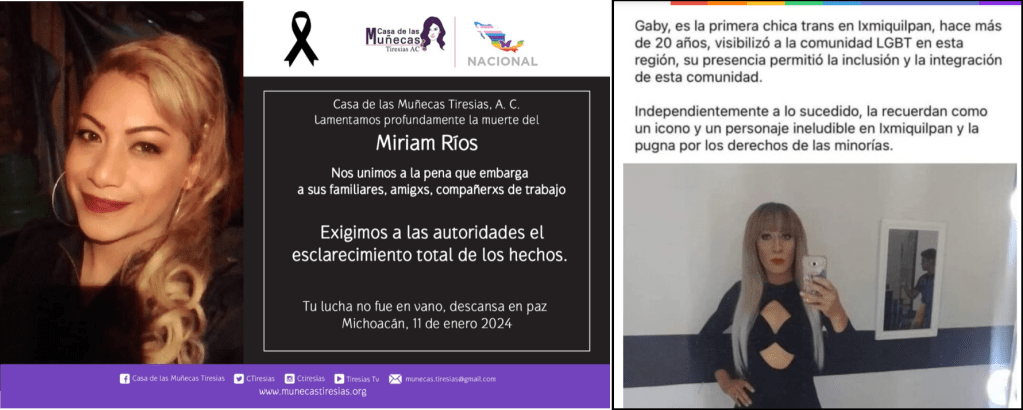
Miriam Noemí Ríos, part of the Citizens’ Movement party (MC) in Michoacan state, was shot and killed Jan. 11 in Zamora, Michoacan. She was a candidate for the municipal council in nearby Jacona.
Miriam Ríos (left) is remembered in Michoacán state. In Hidalgo, Gaby is remembered as the first Trans woman to come out in Ixmilquilpan more than 20 years ago.
“What is going on in Mexico?” demanded Salma Luévano Luna, a Trans woman who is a member of the national Chamber of Deputies for the MORENA.
“Why do we have four violent deaths of Trans women already this year? They’re killing us.
“This is what I am talking about when I say that hate speech is the entry point for hate crimes. For this, I demand justice for Samantha and all of my sisters. Enough. Not one more.”
Luévano had been in the news just days early after President Andrés Manuel López Obrador had referred to her as “a man in a dress.” He apologized a day later, and she accepted the apology, but the incident still rankles among Trans activists.
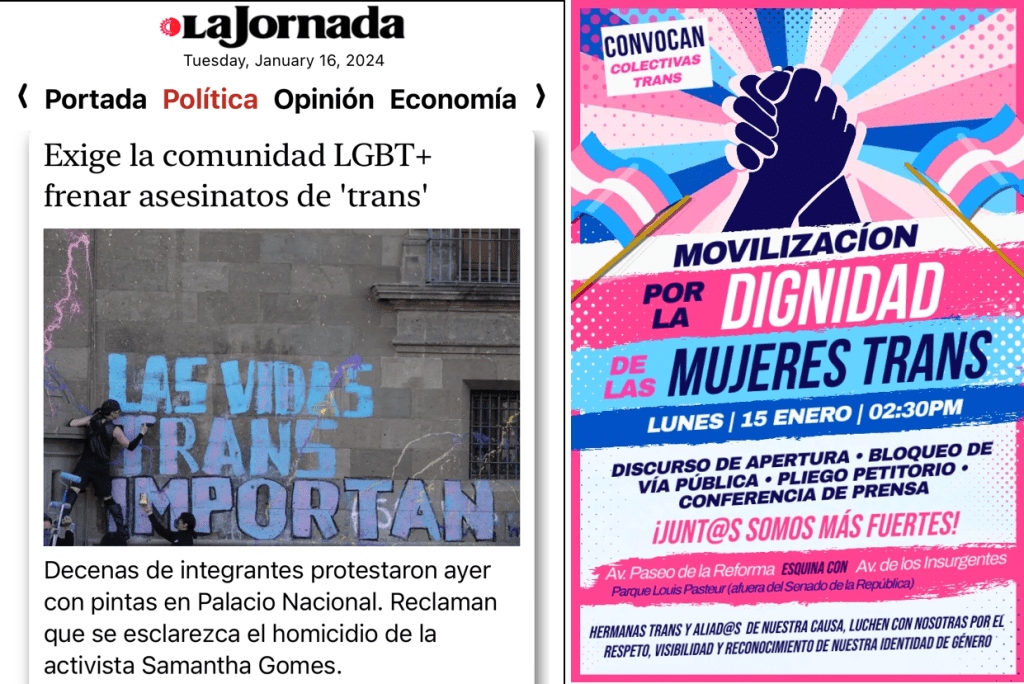
The words of the prophets are written on the walls of the National Palace: “Trans Lives Matter.” Thegraffiti was created during the Jan. 15 Trans mobilization.
Others killed in the first two weeks of the year included Gaby Ortiz, whose body was found beside a rural highway near Ixmiquilpan, Hidalgo. In Coatzalcoalcos, Veracruz, the bodies of Vanessa, a Trans woman and her partner (whose name is not given) were found in their home. The Arcoiris organization points to two more: a Trans woman whose name is not known found shot in the back and dead Jan. 13 in Tlaquepaque, Jalisco, and a person identified as 35-year-old Fabián Kenneth Trejo, who died Jan. 14 in the Álvaro Obregón area of Mexico City.
“All of the victims, known and unknown, deserve justice,” said the Human Rights Commission of Mexico City in a statement Jan. 15. The commission called on authorities to investigate in ways that take seriously their gender identity and political activities “so that truth be known, leading to sanctions that are necessary for the transformation of the structural conditions that will allow LGBTTTIQA+ populations to live free from violence.”
From 2007 through 2022, a total of 590 Trans people were murdered in Mexico. That’s an average of 53 each year.
Unfortunately, few violent crimes in Mexico result in criminal charges, especially if the victim is from a marginalised group. In July last year, Ulises Nava, the head of a sexual diversity unit at the University of Guerrero in Chilpancingo was shot and killed while attending a LGBTQIA+ conference in Aguascalientes. In November, Mexico’s first openly non-binary magistrate and prominent activist Ociel Baena was killed; the body of their partner, Dorian Herrera, was found at their side. Police have treated the crime as one of passion. But activists, including Salma Luévano, the member of the Chamber of Deputies cited above, are sceptical.
“To be Trans is to transgress the social order,” say the authors of fascinating essay, International Borders and Gender Borders, about the experiences of Central American Trans people among the migrants who are passing northward through Mexico. Trans people, they write, “challenge the heteronormativity of social and religious ways of thinking and being,” with all of their patriarchal norms and values. That system imposes a “binary, heteronormative” set of rules that try to restrict “each person within parameters that dictate gender roles, sexual orientation, and the spaces and tasks that are designated for each biological sex.”
That essay brought to mind two writers whose work is available in English. Neither is Trans, but both helped to shape my own thinking about gender, borders and identities.
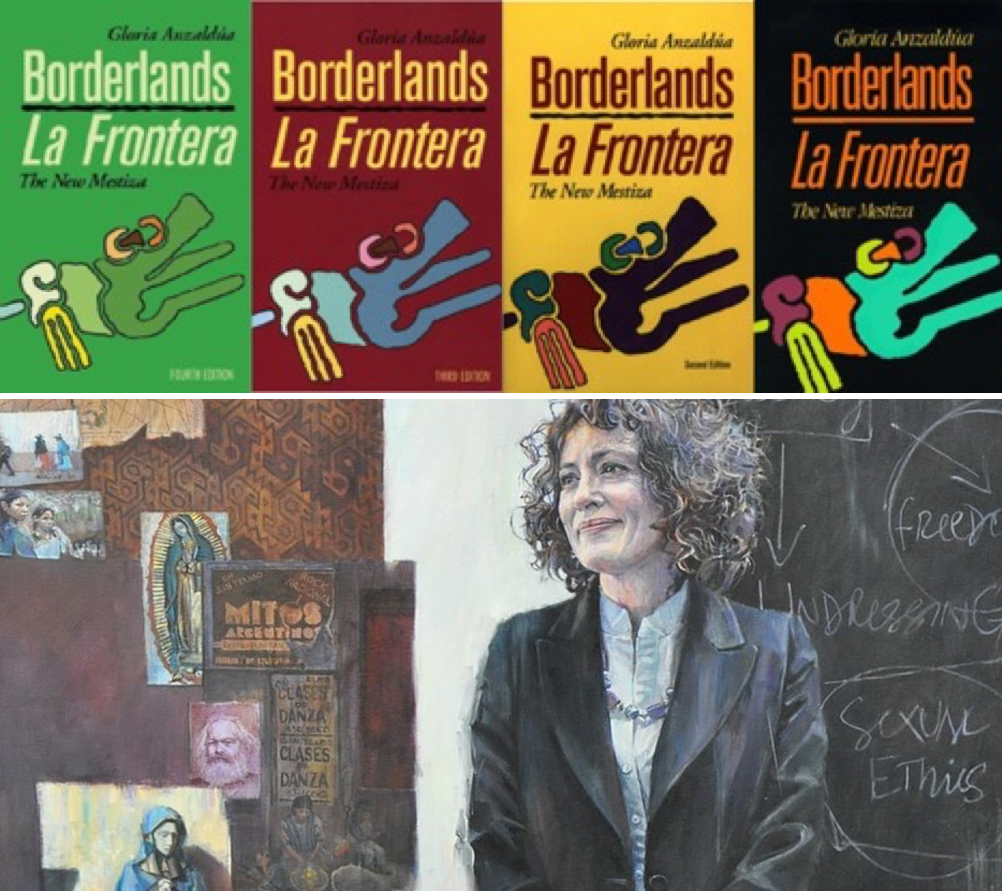
Borderlands (above); a portrait of Marcella Althaus-Reid by Scottish artist David Martin hangs in a classroom at New College School of Divinity at the University of Edinburgh.
When I was living in Cuernavaca in the late 1990s, friends recommended the work of the Chicana lesbian writer Gloria E. Anzaldúa (1942-2004), particularly Borderlands/La Frontera: The New Mestiza (1987). Born in Texas, she lived her life across the U.S. southwest. Some of her gems, retrieved from the internet (as my copy of the book is in Canada and I am in Mexico):
“Culture is made by those in power- men. Males make the rules and laws; women transmit them.”
And:
“This land was Mexican once,
was Indian always,
and is.
And will be again.”
I would also suggest reading work by or about Marcella Althaus-Reid (1952-2009), who challenged the foundations of patriarchal Christian theology with her “indecent theology.” A hint: “All theology is sexual theology.” Here’s a good introduction from Kittredge Cherry.
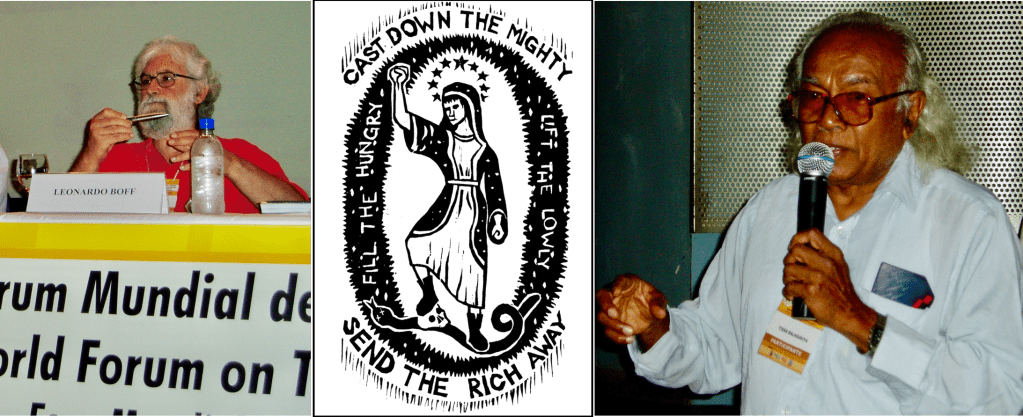
Centre: Ben Wildflower‘s image of Mary and her words in the Magnificat (Luke 46-55). Among speakers at the 2005 World Forum on Theology and Liberation in Porto Alegre, Brazil, were Brazilian theologian Leonardo Boff (left) and Sri Lankan theologian Tissa Balasuriya (right), both reprimanded by the Vatican in previous decades.
Jim Hodgson
Why write about the death of a former pope and cardinal in a blog about development? Because his condemnation of several liberation theologians in the 1980s and later were attacks on the most vigorous and coherent critique of contemporary development practice – or the ways inequality and exploitation are either maintained or overcome – to emerge from Christians in the late 20th century. And whatever good he may have done will always be overshadowed by the harsh treatment of some of our era’s finest theologians by Ratzinger during his leadership of the Vatican’s Congregation for the Doctrine of the Faith (CDF).
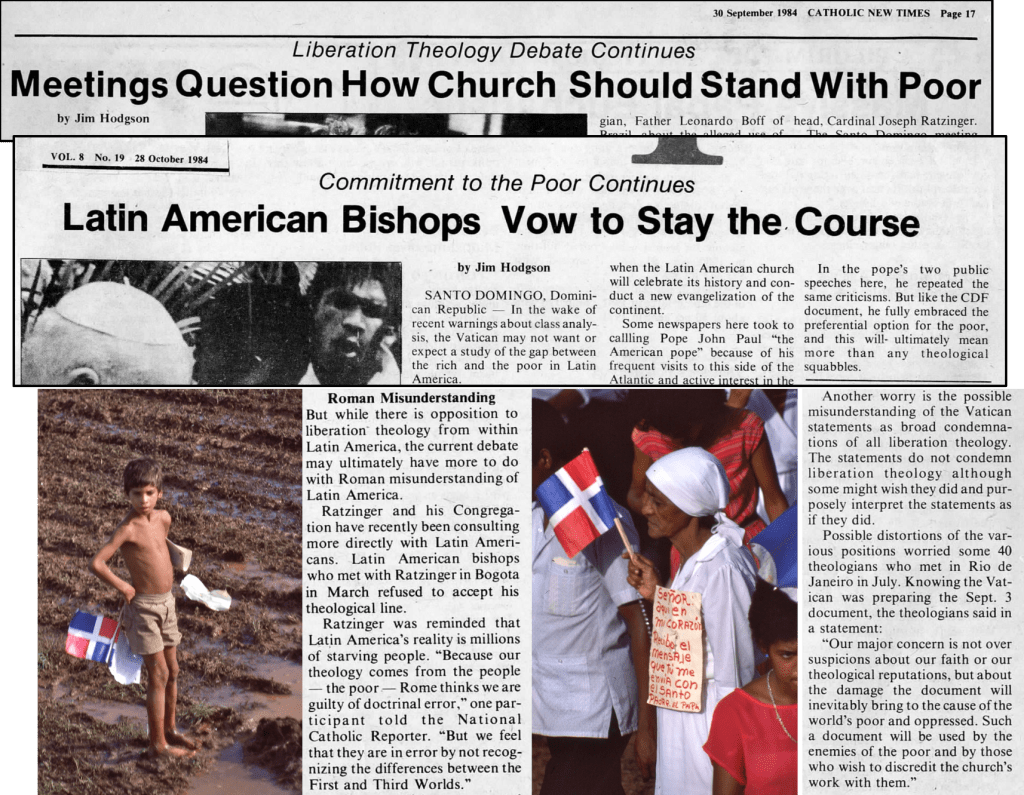
When I came to Toronto in early 1984 to work with Catholic New Times, one of my “beats” was to cover the ways the Vatican was contending with liberation theology and its advocates. Over time, such scrutiny was imposed on feminists, defenders of LGBTI people, and advocates of respect for religious pluralism – and continued into Benedict’s pontificate. (Other writers elsewhere are recalling too his role in covering up clerical sexual abuse.)
Over the years, I have had the privilege of meeting many of those who were reprimanded by Ratzinger and his CDF successors. Some found solidarity in the global ecumenical movement and join events like the World Forum on Theology and Liberation, an event held every couple of years since 2003 alongside the World Social Forum.
The central tenet of liberation theology – the preferential option for the poor – is now enshrined in Catholic social teaching. Debates continue, of course, about what we mean by “the poor” as new (and not-so-new) theological “subjects” emerge among those who are marginalized from patriarchal power in churches and beyond, and by political and economic structures that persist. And it’s important to remember that not all of those censured by the CDF had come under scrutiny because of their option for the poor, but also because of their analysis of power in the church (Leonardo Boff), relationships with other religions (Tissa Balasuriya, Roger Haight), rights of women (Ivone Gebara), ecology (Matthew Fox), or defence of sexual and gender minorities (Raymond Hunthausen, Jeannine Gramick, Robert Nugent), among others.
My single encounter with Cardinal Ratzinger came on April 23, 1986 when he spoke to a crowd of about 6,000 people at the old Varsity Arena at the University of Toronto. Outside, members of the Canadian Catholics for the Ordination of Women protested. The event was sponsored by Frank Stronach’s multinational auto parts company, Magna International. The crowd, made up mostly of conservative Catholics, welcomed his criticism of “theologians who abuse their authority as teachers.”
I saw Ratzinger as an obstacle, a foe, and was disheartened when he was chosen to be pope in 2005.
Pope Benedict: Christian witness to love opens new paths for justice
On a Saturday morning in November 2007, I slipped in to a pew in Havana’s Santísima Trinidad Anglican Cathedral to reflect on the social teaching of Pope Benedict XVI.
The ecumenical lay education centre known as ISEBIT had welcomed Archbishop Luigi Bonazzi, the Apostolic Nuncio in Cuba to speak to students. (Bonazzi would later serve as nuncio in Canada and is now the nuncio in Albania.)
In the context of a class on International Development Cooperation, in which students had been debating issues of humanitarian aid, Don Luigi began his reflection based on Benedict’s first encyclical, Deus Caritas Est(God is Love).
With Don Luigi’s guidance, I found myself surprised and then intrigued by the pontiff’s approach. “Being Christian,” Benedict wrote in the opening to his encyclical, “is not the result of an ethical choice or a lofty idea, but the encounter with an event, a person, which gives life a new horizon and a decisive direction.”
For Benedict, the heart of Christian faith is in the simple statement, “God is love.” There are many implications: from the nature of God (“God is love” / “Love alone is” / “love makes being” / “love remains”) to “ways to address needs that require love” and “the need of humans for the witness of Christian love that is inspired by faith” and “the charitable action of the church.”
There is a complex challenge here to those of us who react to what we perceive to be simplistic acts of charity by proclaiming the need for justice. Justice, for Benedict (and Don Luigi), cannot be “over” love: but Christian witness to love opens new paths for justice.
At this point, various aspects of Catholic social teaching find their place:
each person is understood within a community of people, overcoming the idea of enemy;
affirmation of the human person as subject, not object, not instrument;
encouragement of people to participate passionately for the common good;
the church does not seek power over the state, but to avoid that politics in the “polis” (city) becomes about power, not service; all of our ideas are needed so that the “polis” can function;
the church participates “partially” in political life for the sake of a just society.
A student asked about social justice. Don Luigi responded: “Given these commitments, the church participates truly in the building of a just society. It participates and cannot not participate.”
When we truly love, we cannot help but get involved.
Later, Pope Benedict would write Caritas in Veritate (“Charity in Truth”), a 144-page encyclical that is mostly about our collective economic life (with digressions). Its essence is the “principle of gratuitousness” – that being itself is a divine gift, including economic life. “The market is the economic institution that permits encounter between persons” as “economic subjects” who choose to trade goods and services of equivalent value. That, he says, involves trust and fraternity. The market used justly is an application of charity, which is the virtue Benedict believed to be at the core of all things, not “an added extra” tagged on with other activities.
This and other teachings prompted Cardinal Michael Czerny, the Canadian who is prefect of the Vatican Dicastery for Promoting Integral Human Development, to praise Benedict’s embrace of “integral human development,” a phrase used decades earlier by Pope Paul VI. “To develop truly, authentically, people need to treat each other as the siblings we really are, freely and generously and openly,” he told the Globe and Mail after Benedict’s death Dec. 31.
But the debates won’t stop. Ratzinger’s leadership in the CDF failed to model ways of loving or of constructive theological dialogue. By the time of Benedict’s resignation in 2013, the Catholic Church had endured more than 35 years of top-heavy efforts to close the windows that had been opened by the Second Vatican Council (1962-65). That Pope Francis has allowed some breezes to blow in dusty corridors is a sign of hope for those of us who still insist that God’s love is for ALL, that the powerful must be brought down from their thrones, and the poor lifted up (Luke 1:46-55).
Some of my 1984 articles focused on the gaps between Roman understanding of authority and Latin Americans’ perceptions of their own reality. Theological reflection followed action by people to transform their reality, and gave rise to questions of how churches should accompany the poor (and other marginalised groups) in their struggles for justice. (I have added the colour photos I took of people attending a mass celebrated in October 1984 by Pope John Paul II at a racetrack near Santo Domingo, Dominican Republic.)




 Unwrapping Development