Unwrapping ecumenical diakonia: What are we talking about here?

Oct. 4, 2017

I confess there were moments in the first day-and-a-half of this Ecumenical Strategic Forum when I found myself lost in a cloud of words: diakonia, ecumenical diakonia, prophetic diakonia, sustainable development, peace, service, sharing, healing, reconciliation, faith-based/rights-based/justice-based….

All good. Clearly the hardest word for most is diakonia—that New Testament word that refers to service—but every kind of service from the specific sort of trying to help people in need to simply serving the tables. Many Christian denominations have deacons, or diaconal ministers. Sometimes that is a liturgical function: assisting the priest in the celebration of the Eucharist. In some Baptist churches that I know, a deacon is a member of the board who assists with Communion. In the United Church of Canada, diaconal ministers are “commissioned as a distinct from but equal stream within the order of ministry.” In the Anglican Church of Canada the office of “deacon” is sometimes a stepping-stone toward priesthood (transitional diaconate), but there are also those who are ordained to life-long vocational diaconal ministry. In a similar way, the Roman Catholic Church since Vatican II has revived the “permanent diaconate” for teachers and preachers of the Gospel. They also preside at celebrations of baptism, funerals, matrimony, and visit the infirm, the imprisoned, and people in need. The United and Anglican churches have a joint training centre for diaconal ministry in Winnipeg: the Centre for Christian Studies. In our table group discussion, it was clear that there is a similar mix of applied meanings in churches around the world. 

But the World Council of Churches and the ACT Alliance are reviving the New Testament concept of diakonia as a sort of common vision or theological basis for churches’ engagement in action for sustainable development. 

The WCC Vancouver Assembly 1983 affirmed diakonia: “the church’s ministry of sharing, healing and reconciliation, is of the very nature of the Church.” 

Despite differences in the ways the word is used in diverse contexts, there is acceptance of the concept in this gathering. Diakonia can be understood as a worldwide movement of those committed to the vision of Christian service, action, and justice-making. What seems to be more challenging is what we mean when we talk about some related concepts.

One challenge was around talk of holding “faith-based and rights-based” action together. The argument for diakonia was accepted as a faith basis for action, but “rights-based” smacked of non-governmental organization jargon for something that lacked a theological basis, or which carried overtones of western imperial notions that failed to respect traditions and collective identities. Later, someone spoke of “justice-based” action. Later still, a speaker made a pretty fierce defence of human rights, saying that the 1948 Universal Declaration of Human Rights was inspired as much by global faith traditions as it was by Western enlightenment notions of individual human rights.

Where participants came together most strongly was in response to very concrete descriptions of struggle. Fr. James Ovet Latango of the South Sudan Council of Churches—a partner of KAIROS Canada—spoke of his young country’s struggle to overcome violence and its lingering traumas. And my friend Jenny Neme of the Mennonite peace ministry Justapaz in Colombia spoke of her country’s struggle for peace with justice—gender justice and economic justice. Churches that support those values find themselves actively opposed by well-financed megachurches that operate with a very different set of values. 

Hospitality and Visitation

Late in the evening of the first day, I sat with friends after a good supper. One of the ecumenical elders was with us. He talked about the essence of diakonia being “hospitality and visitation.” These are ministries that each of us carries out in our “private” lives with minimal resources: receiving friends in need; visiting people who are sick or imprisoned. 

Someone asked: “Isn’t visitation part of mission?”

The response: “It’s visitation. Not invasion.” 

After a few moments, the distinction softened a bit and friendship resumed. The point of visitation is that we do it without an agenda: we’re not proselytizing or really expecting anything of the other. We visit (or we welcome) simply because we know it is the right thing to do.

Official development and a liberation agenda

(Sept. 15, 2011)

Political debate in Canada about the future of this country’s development assistance programs is what pushed me to start writing about development.

Canada’s aid program has its roots in the 1950s. Cold War competition and fruitful interaction with a generation of new leaders in the Commonwealth led Canada into new relationships with many newly independent “developing nations.”

In 1960, the External Aid Office was created. In 1968, near the end of a period when Canadian governments found new roles in social policy, health care, human rights and international development, the Canadian International Development Agency (CIDA) was created to administer the bulk of Canada’s official development assistance (ODA) programs.

CIDA’s aim is“to manage Canada’s support and resources effectively and accountably to achieve meaningful, sustainable results and engage in policy development in Canada and internationally, enabling Canada’s effort to realize its development objectives. CIDA works in concert with its development partners, fragile states and countries in crisis, countries of focus, and the Canadian population and institutions.”

“God is Good,” says the broken-down water truck in Delmas, Port-au-Prince (2011)

Initially, CIDA administered the bulk of Canada’s ODA program in Africa, the Middle East, the Americas, and Asia. “In 1995, CIDA took on the responsibility of administering Canada’s official assistance (OA) programs in Central and Eastern Europe, and the former Soviet Union (countries in transition) by supporting democratic development and economic liberalization.”

A liberation agenda

Some in the north sought to participate in official development programs while maintaining both a lively critique of the programs and advancing a liberation agenda. As the Canadian Interchurch Fund for International Development (ICFID*—an ancestor of KAIROS) was formed in 1973, its member churches provided a definition of development that served the churches for the next 25 years or so:

“Development is a process of continuous change by which any country, any specific population, or sector of population in its natural, cultural, or social milieu and at a definite stage in history, within a framework of international relations, seeks liberation, both material and spiritual, by:

  • transforming its structures of production;
  • establishing new social relationships;
  • acquiring for itself adequate political and administrative institutions;
  • recreating or strengthening its own culture for the purpose of achieving a better quality of life.”

* ICFID: Robert Fugere, “The Interchurch Fund for International Development,” in Christopher Lind and Joe Mihevc, eds. (1994), Coalitions for Justice, Ottawa: Novalis, p. 220.

Development and Liberation

(Sept. 14, 2011)

Back in the 1960s, there was a kind of fervour to extend what had been learned from the post-war reconstruction of Europe to the so-called Third World. The United Nations declared successive “Decades of Development.”

Churches were part of the movement. In 1967, Pope Paul VI issued his development encyclical, Populorum Progressio (On the Development of Peoples) with its famous affirmation: “Development is the new name for peace.” He rejected unequivocally the basic precepts of capitalism, including unrestricted private property, the profit motive, and reliance on free trade in a world economy. He emphasized the right of poorer nations to the aid of wealthier nations.

Protestant and Orthodox churches met in Geneva in 1966 for a World Conference on Church and Society. They identified the close relationship between peace and justice: threats to peace do not arise only from military power, but also from hunger, oppression and injustice.

Even as governments, churches and non-governmental organizations (NGOs) embraced development programs, it was already clear that there were divergent views of what was intended by “development.”

Development as an ideology

Leaders in the global South saw that their nations’ poverty was a consequence of the wealth of other nations. People from India to Mexico questioned the so-called “green revolution,” seeing that it damaged small farmers and the ecology. In Latin America, there were warnings about desarrollismo—development as an ideology that only furthered the interests of traditional elites. We do well to remember that the landmark book by Gustavo Gutiérrez, A Theology of Liberation,* is a critique of what was wrong with development in Latin America in the 1960s.

In the face of “aseptic” development policies that gave “a false picture of a tragic and conflictual reality,” Gutiérrez insisted that development find its true place in “the more universal, profound, and radical perspective of liberation.”

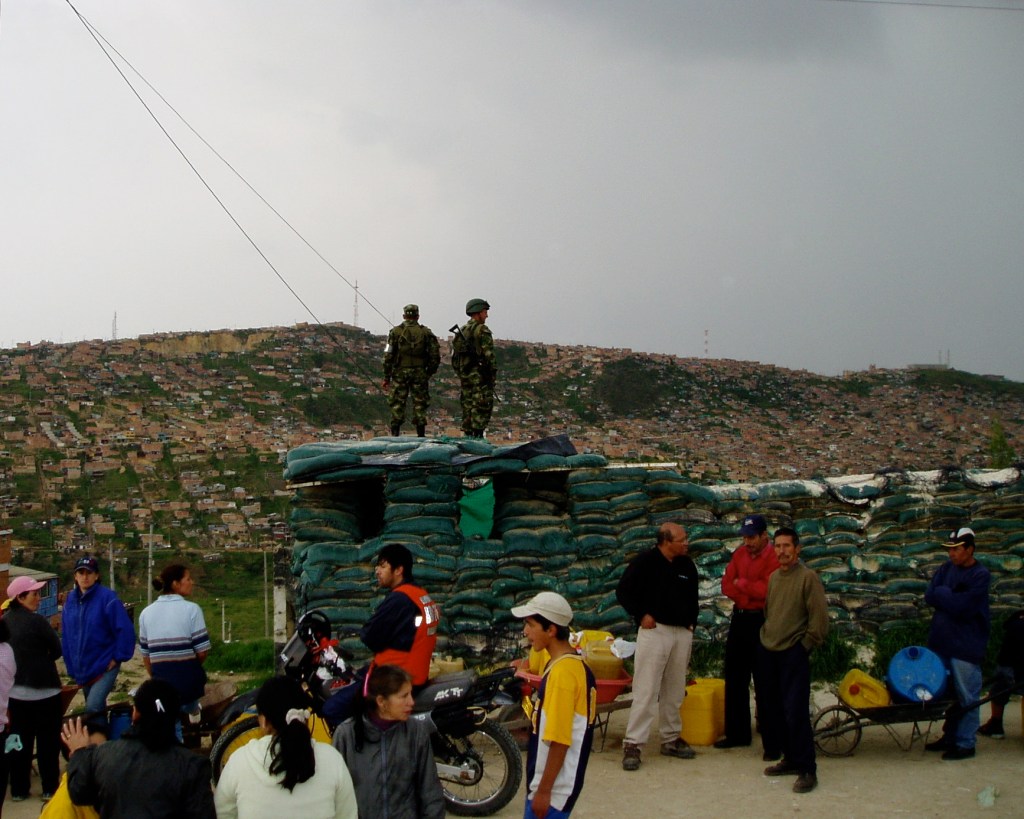
Soldiers watch over water distribution near Bogotá (2007)

For him, theological reflection begins with the real context of people’s lives—the poverty experienced in the lives of most Latin Americans. Liberation expressed “the aspirations or oppressed peoples and social classes, emphasizing the conflictual aspect of the economic, social and political processes which puts them at odds with wealthy nations and oppressive classes.” The biblical paradigm is the Hebrew story of escape from slavery in Egypt (told in Exodus).

For Gutiérrez, as for liberation and other contextual theologians who have followed, liberation is both political and religious, or both historical and salvific. Our practice of liberation from oppression is also the practice of salvation: liberation and the growth of the Reign of God “are directed toward complete communion of [humanity] with God and of men [and women] among themselves.”

* Bibliography – Gutiérrez, Gustavo (1973). A Theology of Liberation. Maryknoll, N.Y.: Orbis. (Ch. 2 and 9). Originally published in 1971 as Teología de la liberación, Perspectivas, by CEP, Lima.