Almost a decade later, truth still elusive in case of the 43 students in Guerrero, Mexico 

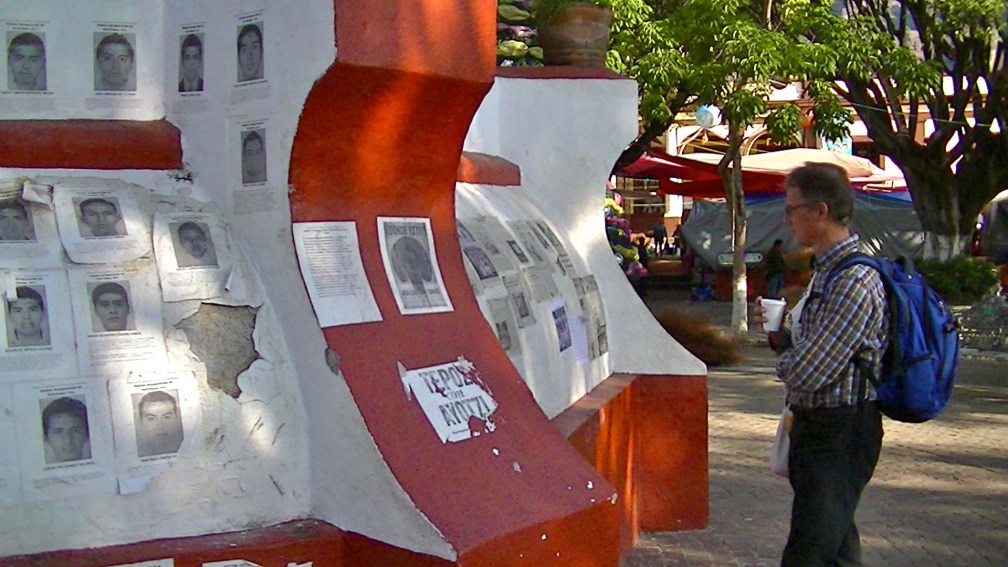
They’ve been gone for almost 10 years now, those 43 education students who were taken one night in Iguala, Guerrero. Hypotheses abound but despite promises and investigations, the crime is not solved. 

But there are new revelations about the cover-up orchestrated at the highest levels of the Mexican state in weeks after the disappearance (see below).

President Andrés Manuel López Obrador (known popularly as AMLO) has done many good things as he nears completion of his six-year term. But his failure to press finally for the full truth of the Mexican army’s involvement in the disappearance of the students who attended the Ayotzinapa teachers training school stains his record. 

“A decade of failure,” says a headline in the Mexico City daily newspaper, La Jornada. Students, teachers and family members say their struggle will continue.

During a march in Mexico City on Monday, Aug. 27, Luz María Telumbre, mother of one of the disappeared students, told a reporter that she would be among the parents who would meet the president again the following day. This time, she said, it will be to say: “’thanks for nothing’ because we’re still walking, shouting in the streets for justice and truth.”

Another mother, Joaquína García, said “it isn’t fair that we should be in the streets for 10 years seeking justice and we still don’t know anything about the boys.” She added that she wants to tell the next president, Claudia Sheinbaum, “that we will not stop struggling until we find them and that as a woman and mother, we hope she will understand us.”

On the night of Sept. 26, 2014, students from the Ayotzinapa Normal School were attacked in Iguala, Guerrero, after they had commandeered buses to travel onward to Mexico City for a protest over the Oct. 2, 1968, massacre of student protesters at Tlatelolco plaza in Mexico City.

In Iguala, six people—including three students—were killed in the assault, 25 were injured and 43 students were abducted and presumably murdered later. Leading suspects are members of the Mexican army who worked alongside municipal officials and drug-traffickers who were trying to move opium gum (semi-processed heroin) on one of the buses that was taken.

What happened before?

One afternoon in the late 1990s, I accompanied a group of students from Canada and the United States to a meeting with rural teachers in the mountains near Tlapa in northeast Guerrero.

These teachers spoke for communities afflicted by poverty, military incursions and the drug war. They taught their students in Spanish as well as in Nahuatl or one of the other Indigenous languages spoken in the area. They dedicated their lives to strengthening rural communities through the education of children. They were convinced that people needed to be able to organize themselves and demand that their rights be respected so that things would begin to change.

“The rural teachers colleges are among the only means of social mobility within the reach of young people from campesino communities,” wrote Luis Hernández Navarro, opinion editor at La Jornada, back in 2011. “Through them, they have access to education, housing, food and later, with luck, a job they are qualified to do.” 

The first time I that I can recall hearing of the Ayotzinapa school was in January 2008, when Blanche Petrich, another La Jornada journalist, came to Toronto to support work by Canadian churches in defense of refugees from Mexico. She told us:

“To describe the panorama of repression in Guerrero, it’s enough to follow the route of the popular movement. ‘Wherever there is organization, protest, defense of human rights, mobilization of roadblocks, there is repression, irregular apprehensions and arrest warrants,’ we’re told by the [Tlachinollan] human rights organization in the La Montaña area, led by Abel Barrera. That is, the campesinos who oppose the taking of their lands for a dam in La Perota, close to Acapulco, the ecologists who resist cutting of trees in the Petatlán sierra, the laid-off workers of a government office in the state capital of Chipalcingo, the community leaders of Xochistlaguaca, the students at the normal school in Ayotzinapa: they all suffer persecution.”

And what’s new?

Through an access to information request, journalists obtained new information about the cover-up that was orchestrated after the abductions by high ranking authorities in the government during meetings presided over by then-President Enrique Peña Nieto and attended by then-Attorney General Jesús Murillo Karam and other officials. Their “historic truth” version—since proven false—contended that local police turned the students over to a drug gang which murdered them, burned the bodies at a garbage dump, and put the remains into a river.

AP photo and story (left) about revelations by a former senior official; a tweet by the Fábrica de Periodismo about the cover-up led by high officials of the previous Mexican government.

Tomás Zerón, former head of investigations for Mexico’s Attorney General’s Office, is now a fugitive hiding in Israel, beyond the reach of the Mexican justice system. But in 2022, he answered questions posed in writing by Alejandro Encinas, then Mexico’s Interior Undersecretary for Human Rights.

Appointed by AMLO’s government, Encinas chaired the Commission for Truth and Access to Justice in the Ayotzinapa Case (COVAJ). The commission included family members and their advisors. Their report, published in August 2022, said federal, state and municipal politicians, along with the armed forces and local police, knew what had happened. 

But that report and a subsequent one in September 2023 have been undermined by the refusal of President López Obrador to accept its conclusions and his accusations against the human rights groups that accompany the families, including Tlachinollan and the Jesuit-backed Miguel Augustín Pro Human Rights Centre.

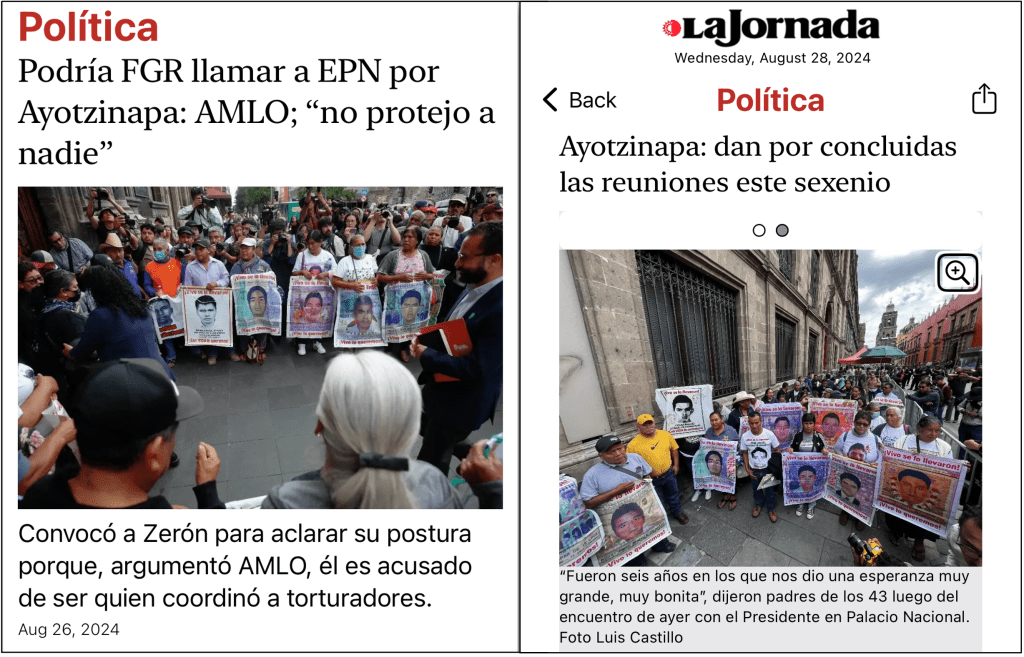
Left: La Jornada story Tuesday with headlines (adding my own details): federal prosecutors may call former president Ernesto Peña Nieto to testify about Ayotzinapa; AMLO: “I don’t protect anybody.” Below the photo, the text says that AMLO has also called on Zerón “to clarify his position because he is accused of coordinating the torturers.” Right: story today about the last of the parents’ meetings with AMLO.

After a meeting Tuesday (Aug. 27) with the president, the parents said it was the last one they would hold with him before he leaves office Oct. 1. 

“We ended badly,” said their lawyer, Vidulfo Rosales of Tlachinollan. He added that while in the first three years of this government, they saw clear good will to get to the truth, in 2022, the situation changed. “This is when we touched the sensitive fibres of the Mexican Army; we could advance no further. There was a break, a crisis, including in the relationship, the dialogue.”

“This government, unfortunately, could not give us truth and justice,” he added.

Mexico celebrates Presidenta Sheinbaum

by Jim Hodgson

For the first time, Mexicans have chosen a woman to be their president. She is Claudia Sheinbaum, 61, a climate scientist who previously served as mayor of Mexico City. 

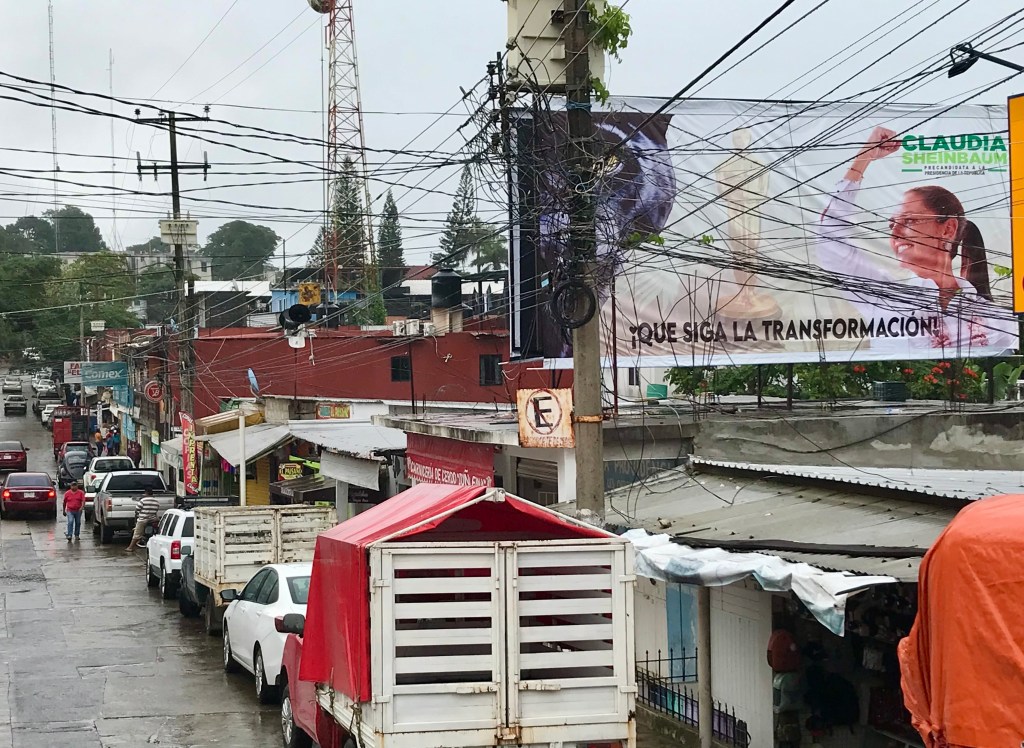
“The transformation continues!” A campaign billboard promotes the campaign of Claudia Sheinbaum in the southern state of Chiapas. The slogan refers to the ‘Fourth Transformation‘ of Mexican political institutions and the economy begun by her predecessor, Andrés Manuel López Obrador.

That a woman is president is no minor detail. It was only in the middle of the last century that women in Mexico won the rights to vote and to run for public office. Even now, only 14 of 193 nations have women in power as presidents or prime ministers.

Sheinbaum can be expected to continue the generally progressive approaches taken by her predecessor, Andrés Manuel López Obrador (known as AMLO). Her leading opponent was businesswoman and former senator Xóchitl Gálvez, candidate of a centre-right coalition. 

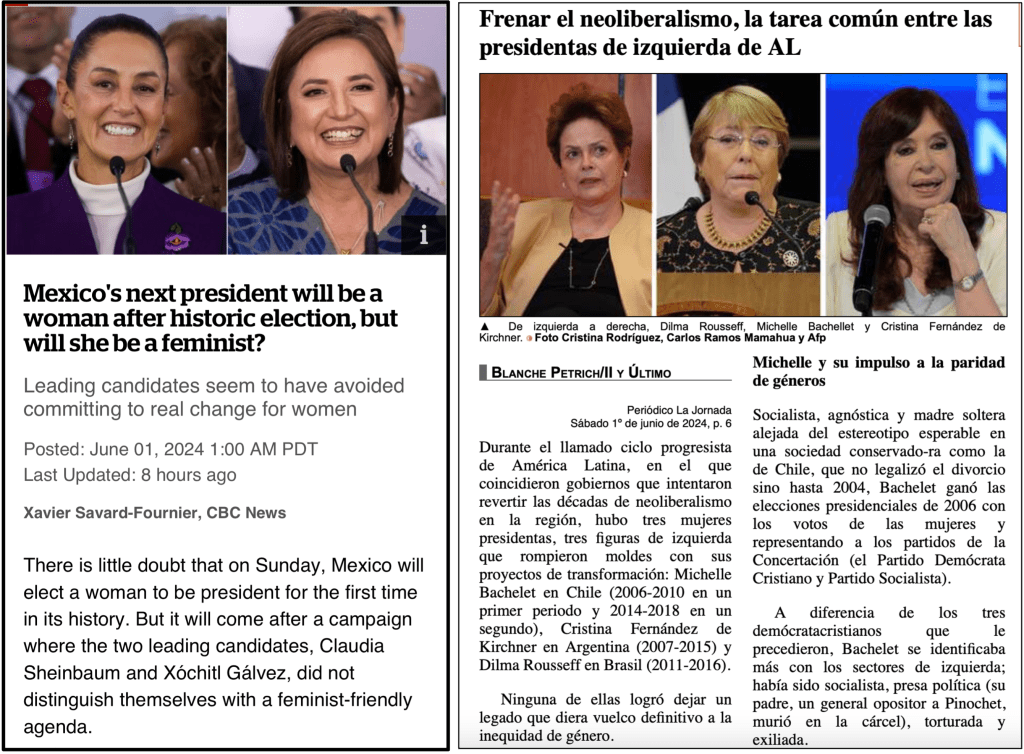
CBC News report days earlier said that neither Sheinbaum nor Gálvez actually committed themselves to “real change for women” on issues such as pay equity, reproductive rights, or violence against women. 

One of Mexico’s leading journalists, Blanche Petrich, wrote that three women (Michelle Bachelet in Chile, Cristina Fernández in Argentina, and Dilma Rousseff in Brazil) who were representative of the progressive “pink wave” governments in Latin America did not “leave a legacy that would definitively reverse gender inequality.” 

A CBC News report on the quality of feminism represented by Mexico’s two leading candidates, and Blanche Petrich’s review in La Jornada of past experiences of women as presidents in Latin America.

Bachelet, notes Petrich, once said: 

“What does it mean to be a woman in public office? Is it to be the same as a man, but with a skirt? No. When a woman arrives alone in politics, the woman changes. When many women arrive in politics, politics change. And clearly, one of the challenges and needs of our democracy is to improve the quality of politics.”

In the Mexican election, Sheinbaum and Gálvez tended to address issues of concern to women within a range of economic, social and criminal justice proposals. Framed this way, there were sharp differences between the two.

Sheinbaum will continue to give priority to social programs, pensions and scholarships that benefit the least advantaged, as well as concentrating on investment in infrastructure to support industries that create jobs. The approach by Gálvez was that of conservatives everywhere: keep taxes—and wages—low and let the market take care of the rest (though she did promise to maintain AMLO’s social programs).

At her victory celebration late Sunday night, Sheinbaum affirmed her movement’s commitment to democracy. “By conviction, we will never make an authoritarian or repressive government. We will also respect political, social, cultural and religious freedoms, and gender and sexual diversity.”

Regarding criminal justice issues (which media tend to subsume under the heading “security”), Mexico obviously has serious problems. At least 34 candidates were killed during the election period that included national as well as some state and municipal elections. 

There are still about 30,000 homicides per year, though the government says the number has been dropping by about five per cent per year. 

AMLO tried to turn back the violence unleashed by one of his predecessors. In 2006, then-President Felipe Calderón, with backing from the United States, launched a military-led offensive against the drug cartels to curb their violent turf wars. Instead, the violence became much worse. 

AMLO promoted an approach he called “abrazos no balazos”–hugs not bullets. It meant addressing the social roots of violence by giving people the education and other resources they need to avoid being drawn into the drug-trafficking cartels and their systems of power. Over the long term, the approach should lead to reduced levels of violence.

But it has been controversial and is subject to manipulation, even in mainstream media like The New York Times, and has led to threats of military intervention from various U.S. politicians, including the presumptive Republican nominee, Donald Trump. 

Even within the AMLO-Sheinbaum coalition, there is agitation. When Eduardo Ramírez–a former AMLO opponent who, like too many others, opportunistically shifted loyalties–celebrated his victory as governor of Chiapas Sunday night, he said: “There will be hugs, but no impunity.”

Trans women in Mexico say: “They’re killing us”

by Jim Hodgson

In Mexico, the new year began with a series of highly-publicized murders and beatings of Trans women. The violence, sadly, is not rare: Mexico follows only Brazil with the highest numbers of murders of LGBTQIA+ people each year. The fact that they’re being talked about at all is what’s unusual.

Two of the women who were killed were active in party politics. A woman beaten by her fiancé is a well-known social media “influencer,” Paola Suárez. The incidents are reminders of the breach between much-improved legal protection for LGBTQIA+ people in most of Latin America, and the harsh realities of day-to-day life where many men still hold to old ways. More on that below.

The assassination of Samantha Gómez Fonseca came the day before a planned march by Trans women in Mexico City.

Samantha Gómez Fonseca, 37, had launched a campaign for a seat in the national Senate as a member of the ruling MORENA (Movement for National Regeneration) party. She was shot and killed on Jan. 14 in the street after a prison visit in the Xochimilco area in the south end of Mexico City. 

Miriam Noemí Ríos, part of the Citizens’ Movement party (MC) in Michoacan state, was shot and killed Jan. 11 in Zamora, Michoacan. She was a candidate for the municipal council in nearby Jacona. 

Miriam Ríos (left) is remembered in Michoacán state. In Hidalgo, Gaby is remembered as the first Trans woman to come out in Ixmilquilpan more than 20 years ago.

“What is going on in Mexico?” demanded Salma Luévano Lunaa Trans woman who is a member of the national Chamber of Deputies for the MORENA. 

“Why do we have four violent deaths of Trans women already this year? They’re killing us.

“This is what I am talking about when I say that hate speech is the entry point for hate crimes. For this, I demand justice for Samantha and all of my sisters. Enough. Not one more.” 

Luévano had been in the news just days early after President Andrés Manuel López Obrador had referred to her as “a man in a dress.” He apologized a day later, and she accepted the apology, but the incident still rankles among Trans activists. 

The words of the prophets are written on the walls of the National Palace: “Trans Lives Matter.” The graffiti was created during the Jan. 15 Trans mobilization.

Others killed in the first two weeks of the year included Gaby Ortiz, whose body was found beside a rural highway near Ixmiquilpan, Hidalgo. In Coatzalcoalcos, Veracruz, the bodies of Vanessa, a Trans woman and her partner (whose name is not given) were found in their home. The Arcoiris organization points to two more: a Trans woman whose name is not known found shot in the back and dead Jan. 13 in Tlaquepaque, Jalisco, and a person identified as 35-year-old Fabián Kenneth Trejo, who died Jan. 14 in the Álvaro Obregón area of Mexico City. 

“All of the victims, known and unknown, deserve justice,” said the Human Rights Commission of Mexico City in a statement Jan. 15. The commission called on authorities to investigate in ways that take seriously their gender identity and political activities “so that truth be known, leading to sanctions that are necessary for the transformation of the structural conditions that will allow LGBTTTIQA+ populations to live free from violence.”

From 2007 through 2022, a total of 590 Trans people were murdered in Mexico. That’s an average of 53 each year. 

Unfortunately, few violent crimes in Mexico result in criminal charges, especially if the victim is from a marginalised group. In July last year, Ulises Nava, the head of a sexual diversity unit at the University of Guerrero in Chilpancingo was shot and killed while attending a LGBTQIA+ conference in Aguascalientes. In November, Mexico’s first openly non-binary magistrate and prominent activist Ociel Baena was killed; the body of their partner, Dorian Herrera, was found at their side. Police have treated the crime as one of passion. But activists, including Salma Luévano, the member of the Chamber of Deputies cited above, are sceptical

“To be Trans is to transgress the social order,” say the authors of fascinating essay, International Borders and Gender Borders, about the experiences of Central American Trans people among the migrants who are passing northward through Mexico. Trans people, they write, “challenge the heteronormativity of social and religious ways of thinking and being,” with all of their patriarchal norms and values. That system imposes a “binary, heteronormative” set of rules that try to restrict “each person within parameters that dictate gender roles, sexual orientation, and the spaces and tasks that are designated for each biological sex.”

That essay brought to mind two writers whose work is available in English. Neither is Trans, but both helped to shape my own thinking about gender, borders and identities.

Borderlands (above); a portrait of Marcella Althaus-Reid by Scottish artist David Martin hangs in a classroom at New College School of Divinity at the University of Edinburgh.

When I was living in Cuernavaca in the late 1990s, friends recommended the work of the Chicana lesbian writer Gloria E. Anzaldúa (1942-2004), particularly Borderlands/La Frontera: The New Mestiza (1987). Born in Texas, she lived her life across the U.S. southwest. Some of her gems, retrieved from the internet (as my copy of the book is in Canada and I am in Mexico):

“Culture is made by those in power- men. Males make the rules and laws; women transmit them.”

And:

“This land was Mexican once,

was Indian always, 

and is. 

And will be again.”

I would also suggest reading work by or about Marcella Althaus-Reid (1952-2009), who challenged the foundations of patriarchal Christian theology with her “indecent theology.” A hint: “All theology is sexual theology.” Here’s a good introduction from Kittredge Cherry