Guadalupe, Tonantzin and roses in December

by Jim Hodgson (from a text published on Dec. 11, 2011 in a previous version of this blog site)

One of the people that I used to visit in Cuernavaca was Doña Guadalupe, an elderly woman who lived with her many beautiful cats in the Patios de la Estación neighbourhood, near the former train station and Casino de la Selva hotel.

To make a living, she made tortilla cloths (including the one shown here) and other embroideries that she sold to visitors who came from the Cuernavaca Centre for Intercultural Dialogue on Development (CCIDD) where I worked in the mid and late 90s. This image shows the Virgin of Guadalupe, for whom our friend was named. (She died in July 2000, just before I returned to Canada.)

Tonight, six million people will fill the streets around Mexico City’s Guadalupe basilica (shown below). Many will have travelled on foot, by bicycle and in trucks and buses, to get there. Most sleep in the street. All expect to get in to the basilica to greet La Virgen on her feast day.

Inside, there will be a succession of Masses and celebrity stars in a televised variety show. What you don’t see on television is the flood of people whose focus is not on centre stage. And those who can’t get to Mexico City are celebrating across Mexico and increasingly, throughout the Americas and beyond.

It’s the confluence of different spiritualities around The Feast of Our Lady of Guadalupe. And there are different ways of telling the story. But let me give you a basic outline.

The Virgin Mary is believed to have appeared to an Indigenous man, Juan Diego, on three occasions in December 1531, 10 years after Spain’s conquest of the Aztec empire. She encountered him on a hill known as Tepeyac, on the north edge of Mexico City—formerly Tenochtitlan, the Mexica (or Aztec) capital). The hillside was associated with the worship of Tonantzin, a mother of gods in the Mexica faith.

Mary spoke to Juan Diego in Nahuatl, the language of the Aztecs that is still spoken by about three million people in central Mexico. She addressed him with an honorific title and asked him to tell the bishop that she wanted a church built on the site. When the bishop later asked Juan Diego for proof that she had made this request, Juan Diego returned to Tepeyac. Mary told him to gather roses in his cloak and to take them to the bishop.

When Juan Diego unrolled his cloak to reveal the roses to the bishop, the cloak itself was emblazoned with the image of Mary, dressed as a dark-skinned Aztec princess, standing in front of the sun and on top of a crescent moon.

In the apparitions, Mary called herself Tecuatlaxopeuh, a Nahuatl word which means “one who drives away those who eat us.” The Spanish called her Guadalupe, after a popular devotion to Mary in Estremadura, Spain.

“Flowers of life in the crude winter”

The message was understood to be an affirmation of the Indigenous people in the midst of their defeat and oppression. It’s another one of those stories (like that of Jesus born in a stable in Bethlehem under Roman occupation) that tell of God’s action at the margins, among the poor, away from power.

The hillside where Mary appeared, Tepeyac, is the focal point of popular religiosity in Mexico and all of the Americas, wrote Fr. Miguel Concha of the Dominican religious order in Mexico. (Fr. Miguel passed away in January 2023.)

“There is no greater moral and religious strength that unites so many people precisely because of what she represents,” he wrote in La Jornada newspaper Jan. 23, 1999.

“She is a Marian symbol, it’s true, but she has connotations that go beyond what the institutional church holds forth in its doctrines. Guadalupe is the product of the synthesis that the poor developed from what Christianity offers, bringing that together with the essence of the oldest indigenous religious traditions,” wrote Concha.

“To come today to Tepeyac to proclaim from here the commitment of the church in the face of the third millenium is to assume the trajectory of those who, like Juan Diego, are the bearers of the few flowers of life which still survive in this crude winter which is imposed on humanity.”

Images on the church in Santa Marta, Cabañas department, El Salvador: Guadalupe and Saint Oscar Romero.

Development and the faith of the people

Why is a blog about development dealing with Latin American celebrations of the Virgin Mary? Aside from being in the midst of the Advent and Christmas season, when Mary’s central role in the Jesus story is celebrated, it seems to me that a lot of development activities are carried out as (apparently) benevolent foreign interventions. People come from some place else to build a school. Experts lead an agricultural project. Funds are shared from North to South in support of some cause or other.

At their best, these activities represent cross-cultural cooperation. Southern partners make the key decisions; Northern partners are but a supporting cast; solidarity grows.

At their worst, zealous to promote a better pig or construction technique, foreign development workers (like bad missionaries) feel no need to understand local cultures or practices.

One time, we accompanied Doña Guadalupe on a visit to her huesera, a healer of bones and their aches. In small barrels, the huesera had a spectacular collection of different varieties of beans, in all their many colours—seed varieties disparaged by the agro-industrialists with their monocrops.

A bit of time spent in friendship and solidarity with Guadalupe showed me vividly how Indigenous people and small farmers are the keepers of seeds and of the wisdom and knowledge that we will need to survive the warm decades to come.

From Palenque, Chiapas, Latin American leaders call for migration solutions

In recent weeks, my partner and I took a long drive from British Columbia through the western United States and then almost the length of Mexico to arrive in Chiapas.

While people who migrate northwards either for seasonal work or for more permanent refuge from poverty, violence and impacts of climate change were on our minds and in the news, at least some of the people we met alongside us in gas stations and cafés were seasonal workers heading home for the winter. 

Migration, my friends, is normal. In southern Texas and northern Mexico, we encountered thousands of monarch butterflies as they headed for Michoacán. And here in Chiapas, the migratory birds are arriving daily.

At around the time of our trip, leaders of ten nations of Latin America and the Caribbean – frustrated by slow progress with the United States (and other northern countries) in advancing meaningful human development and managing the flow of people – gathered in the historic Maya city of Palenque, Chiapas, and proposed some ways forward.

Photo from the Office of the President of Mexico

Led by Mexico, the governments of Belize, Colombia, Costa Rica, Cuba, El Salvador, Haiti, Honduras, Panama and Venezuela signed the Palenque Declaration on Oct. 22 and called for solutions. (A representative of the newly-elected government in Guatemala also joined the talks.)

In the declaration, presented by the Mexican Foreign Minister, Alicia Bárcena, the leaders described several structural causes of migration: internally political, economic, social factors and the effects of climate change. But they also pointed to “external factors such as unilateral coercive measures of an indiscriminate nature – dictated from the United States – that negatively affect entire populations and, to a greater extent, the most vulnerable people and communities.”

They urged the United States to lift the sanctions imposed on Cuba and Venezuela that help drive the exodus. Such sanctions are against international law and, as the migration flow shows, they have impacts beyond the countries to which they are applied.

The document also proposed undertaking efforts to modify the financial architecture of debt; to close social gaps to as to reduce the impulse to migrate; push for measures aimed at increasing agricultural activity to promote food self-sufficiency in the region; and to promote intraregional trade and investment for socioeconomic development.

The signatory nations stressed that measures must be taken to confront transnational organized crime, human trafficking and corruption, as well as promote joint cooperation in security matters.

They called for destination countries to “adopt immigration policies and practices in line with the current reality of our region and abandon those that are inconsistent and selective, to avoid arbitrarily producing both ‘call effects’ and ‘deterrent effects’ – advantages given to certain countries for political reasons while nationals of other countries are blocked.

They encouraged destination countries to widen their regular migration pathways, with emphasis on labour mobility and promotion of re-integration and safe return of temporary workers to their homes.

The declaration makes special mention of Haiti, and called on nations to support efforts by the United Nations and others to re-establish conditions for human security so that the political, economic and social situation may be normalized, and to focus on sustainable development. (The presence of the Haitian president at the gathering angered some of the Haitian migrants camped out in the centre of Palenque, reported La Jornada.)
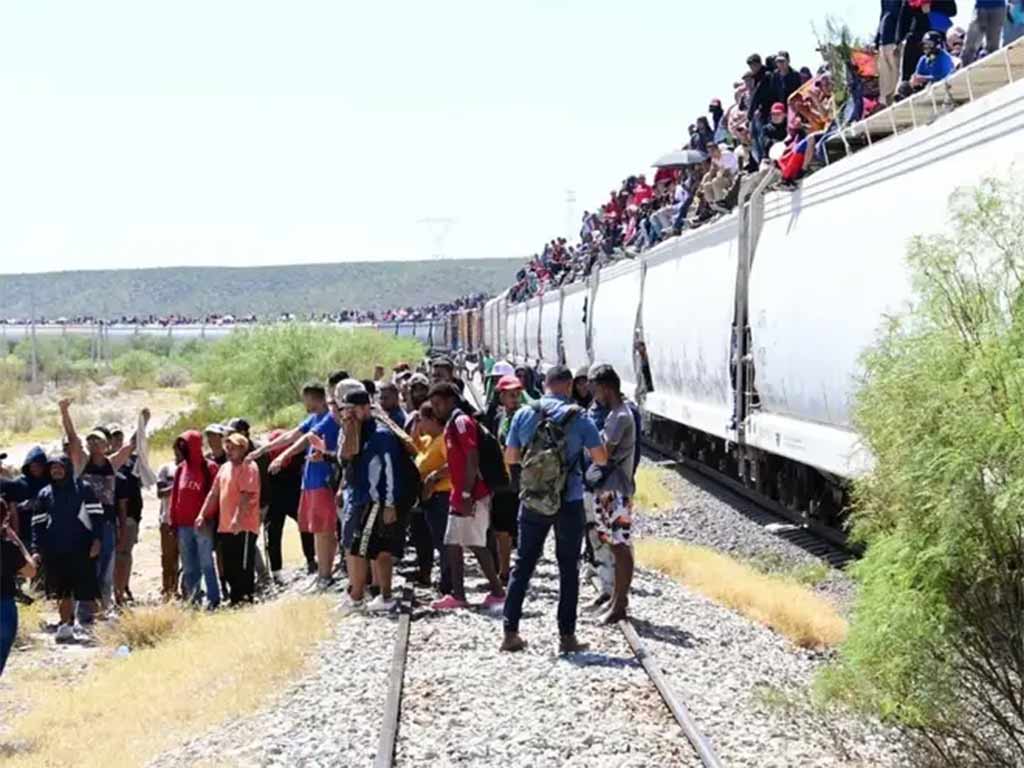
Undated photo from Prensa Latina.

The declaration’s emphasis on economic drivers of migration did not satisfy everyone. Eunice Rendón of the Mexican advocacy group Agenda Migrante told Courthouse News Service that while insecurity was mentioned as a factor driving migration, “it’s not one of the causes, it’s the principal cause,” Rendón said.

“People go because the gang members threaten to kill them, because they try to forcibly recruit them,” she said. (Some might argue that the lack of education and employment opportunities are drivers as well in recruitment for organized crime.)

Meanwhile, migration dramas continue. On Nov. 9, authorities reported that they found found 123 Central and South American migrants trapped in a trailer in Matehuala, San Luís Potosí (less than a week after we passed through there). And than 400,000 migrants have crossed the Darien Gap from Colombia into Panama in 2023, according to the Panamanian government, up from 250,000 in 2022.
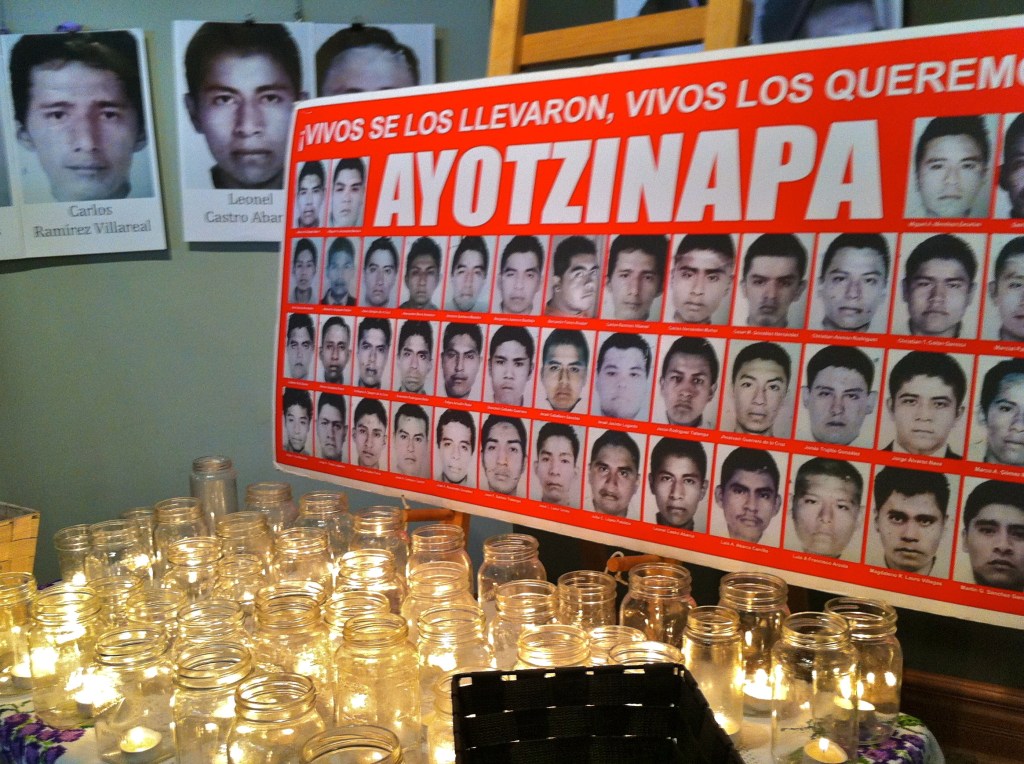
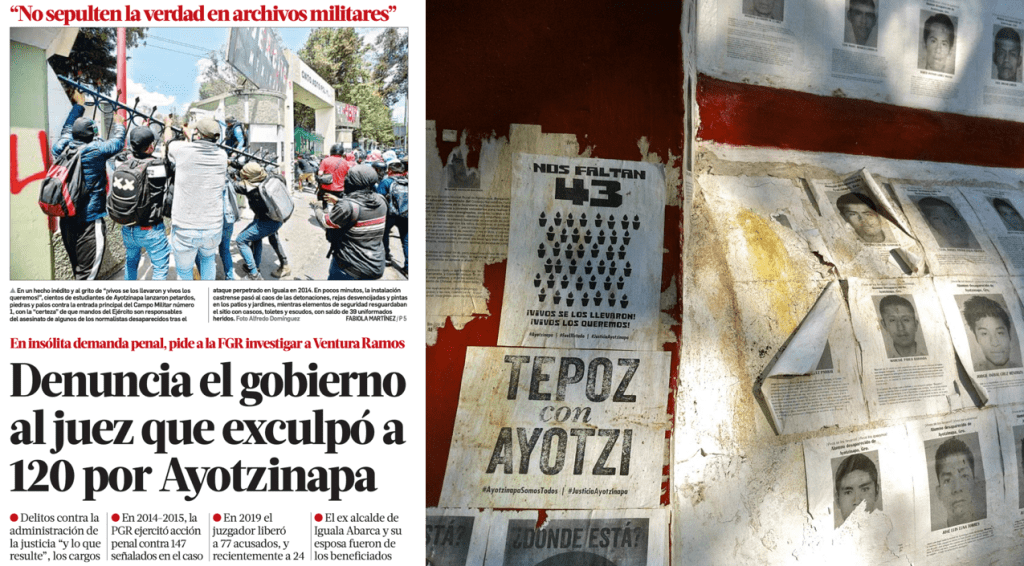
In Mexico, 43 students missing for eight years: not forgotten and still making headlines

By now, you might not remember the murders and forced disappearances of the “normalistas” – education  students who were training to be rural teachers in the state of Guerrero in southern Mexico. 

On the night of Sept. 26, 2014, students from the Ayotzinapa Normal School were attacked in Iguala, Guerrero, after they had commandeered buses to travel to Mexico City for a protest over the Oct. 2, 1968, massacre of student protesters at Tlatelolco plaza in Mexico City.

In Iguala, six people – including three students – were killed in the assault, 25 were injured and 43 students were abducted and presumably murdered later. Leading suspects are members of the Mexican army who worked alongside municipal officials and drug-traffickers who were trying to move opium gum (or semi-processed heroin) on one of the buses that was taken.

As the eighth anniversary approaches, a series of events reveals more about what happened as well as efforts by people tied to the former government of Enrique Peña Nieto to maintain the cover-up. 

Left: La Jornada front page today: protests over judicial decisions, military cover-up. Right: remembering the 43 students in Tepoztlán, Morelos, December 2014.

First the news:

  • On Aug. 18, the report of the Commission for Truth and Access to Justice (appointed by the current government of President Andrés Manuel López Obrador) published its report, stating that the students’ disappearance was a “state-sponsored crime.” The report accuses Col. José Rodríguez Pérez, commander of the 27th infantry battalion located in Iguala, of giving the order to murder the missing students. He was arrested on Sept. 15.
  • By pointing to army collusion, the new report denounced the version offered by 2015 by the Peña Nieto administration that the students were killed by a local drug gang after being abducted by municipal cops acting on the orders of Iguala’s corrupt mayor, and that their bodies were incinerated at a dump in the nearby town of Cocula – which is not to say that those officials do not share part of the responsibility for the crimes. Following the report, Peña Nieto’s  attorney-general, Jesús Murillo Karam, was arrested for obstruction in administration of justice in the case. Another official whose arrest has been sought, Tomás Zerón de Lucio,head of Peña Nieto’s Criminal Investigation Agency, left Mexico and is hiding in Israel
  • Among the many stories that emerged from the report is that of one of the students, Julio César López Patolzin, a former soldier now revealed to have been an army spy infiltrated into the school. Even though he was in touch with his supervisors up to the night of the disappearances, the army made no effort to extricate him from among the other students, making him a victim along with the others. 
  • Despite the truth commission report, a judge assigned to the case by the former government has ordered the release of at least 121 police officers and government officials previously charged, including some of the municipal officials and accused drug-traffickers. The district court judge, Samuel Ventura Ramos, is located in Matamoros, Tamaulipas (in northeastern Mexico, close to the U.S. border).
  • Federal prosecutors are now bringing charges against the judge, and President López Obrador demanded Friday (Sept. 23) to know why the cases are not taken up again. “What has that to do with justice? Who chose that judge? And why is the Ayotzinapa case, which has to do with Guerrero, attended to by a judge in Tamaulipas?”

What does all this mean?

When looking at the news these days, it’s important to keep in mind that part of the game plan of globalized capitalism is to show the state as ineffective, whether against the COVID pandemic, inflation, or protecting human rights and public security.

In Mexico, where the present government is attempting to transform the system into one more amenable to the impoverished majority, economic power and some instruments of political and judicial power are still held by old elites. 

Moreover, the system as implemented over the past 30 years has made the students and their cultures redundant, wrote Alejandro Nadal of the Centre for Economic Studies at El Colegio de Mexico. Industrialized agriculture is privileged over traditional small-holder farms. “That is to say, there is no place for campesinofarmers who aspire to a dignified life in freedom. The youth of Ayotzinapa rebelled and the established powers responded,” Nadal wrote in La Jornada.

And, who are those powers? Again we see, as we have repeatedly over the past two decades of a stepped-up “war on drugs,” we see the collusion of a drug cartel (this one is called Guerreros Unidos, or United Warriors) with politicians and other state actors.

“The war on drugs has never controlled drug trafficking and has always been about social control,” wrote Laura Carlsen, director of the director of the Americas Program of the Center for International Policy. “Now it’s Mexico’s youth that are paying the price of that duplicity.”

I lived and worked in Mexico from 1994 to 2000. I was based in the city of Cuernavaca, about 90 km south of Mexico City in the state of Morelos and about 50 km north of the border with Guerrero. We frequently visited a Nahua Indigenous community near Taxco, Guerrero. If you take the libre (the two-lane, non-toll highway) towards Acapulco, you pass through Iguala.

During those years, I made several visits to the city of Tlapa in the eastern part of the state. I came to know the Tlachinollan human rights centre and once spent an afternoon near Olinalá talking with a group of rural teachers. Their option for the poor was absolute and inspiring.

The students reflected the context from which they emerged and to which they would have returned as teachers: impoverished and exploited rural Mexico. Their work was heroic.

The latter paragraphs of this text are adapted from a piece I wrote in a previous Unwrapping Development blog format in October 2014, days after the disappearances.