Summit of the Americas: U.S. can’t break old habits

That the White House announced Canada’s planned response to the flow of refugees in Central America said a lot to me about the way the Biden administration mishandled the Summit of the Americas, held in Los Angeles last week.
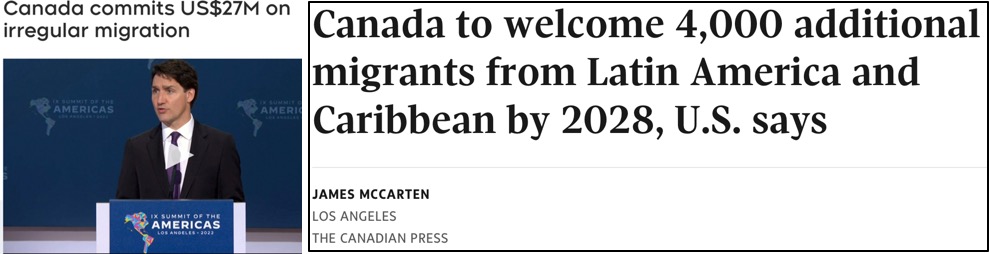
Canada will welcome 4,000 additional migrants from Latin America and the Caribbean, the White House announced on June 10. That number is insignificant compared to the size of the challenge: 

  • Mexico reported apprehending 307,679 undocumented migrants in 2021. About one-third were deported; another third sought asylum in Mexico. The main countries of origin of those apprehended were Honduras (41%), Guatemala (26%), El Salvador (8%), Haiti (6%), Brazil (5%), Nicaragua (5%), Cuba (2%), and Venezuela (1%). None of the leaders of Mexico, Honduras, Guatemala or El Salvador chose to attend the summit – and Nicaragua, Cuba and Venezuela were told by Biden not to come. It’s hard to solve problems when you’re not talking to people who can do something about them.
  • As of February in the United States, about 164,000 (Reuters) or “just under 179,000” (Axios) migrants are currently in alternatives-to-detention programs managed by Immigration and Customs Enforcement  (ICE). This is “roughly double the total on Sept. 30, 2020, before Biden took office,” Reuters reported, and doesn’t include dependents – or the people actually held in detention.

The White House announcement of Canada’s support included commitments from other countries on migration issues, and was reported by Canadian Press in an article widely shared in Canadian media (CBC, CTV, the Globe and Mail, among others).

“The agreement also includes a pre-existing Canadian commitment to bring in an additional 50,000 agricultural workers this year from Mexico, Guatemala and the Caribbean.” (Those are temporary workers whose rights are limited.)

To its credit, the government (via the Prime Minister’s Office, not Global Affairs Canada) also announced an additional $118 million for “progressive initiatives” aimed at improving the lives of people where they already live in Latin America and the Caribbean. That includes $67.9 million to promote gender equality; $31.5 million in health and pandemic response spending; $17.3 million on democratic governance and $1.6 million for digital access and anti-disinformation measures. It will also spend $26.9 million to address “irregular migration and forced displacement” in the hemisphere.
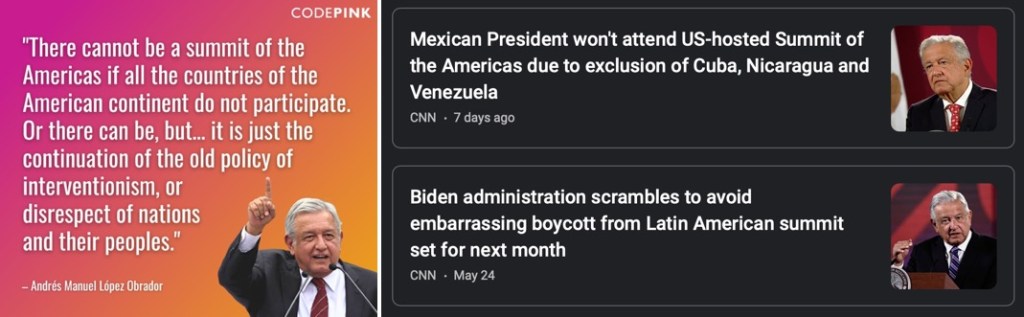
Washington “still trying to dictate” to neighbours

But it was the exclusions and boycotts that drew most attention. Because Venezuela, Cuba and Nicaragua were excluded by the host country, Mexico, Honduras, Bolivia and some Caribbean leaders chose to stay away. Leaders of Guatemala and El Salvador did not attend because of issues with U.S. treatment of allegations of corruption and abuses of human rights in their countries. In the end only about 20 of potentially 35 heads of state or government attended.

Apparently modelling the art of understatement, Reuters reported: “Hosting the Summit of the Americas in Los Angeles, Biden sought to assure the assembled leaders about his administration’s commitment to the region despite nagging concerns that Washington, at times, is still trying to dictate to its poorer southern neighbours.”

The presence of the unelected prime minister of Haiti, Ariel Henry, drew fire. During a panel discussion on “journalistic freedom,” U.S. Secretary of State Antony Blinken had the good grace to seem embarrassed when challenged over Henry’s presence. As Alterpresse pointed out, “not only does Henry govern without a mandate in violation of the Haitian Constitution, he is also implicated in serious crimes, including the death of a Haitian journalist in February 2022 by Haitian police.” (Two other journalists had been killed in January in a gang attack.)

In the tradition of each Summit of the Americas (including the teargas summit in Quebec City in 2001), a People’s Summit was held, gathering more than 250 community organizations, social movements, trade unions and other progressive groups. “In the ‘richest country in the world,’ 140 million live in or near poverty. The US government is addicted to militarism and war and will spend over $800 billion in 2022, on death and destruction,” said the final declaration. “Instead of preparing for war, society must be organized to meet human needs. We want a future without evictions, police violence and mass incarceration, deportations, sanctions, and blockades. We say: no more!”

Fanning the fires of hope in Chiapas, still

There was one time when I was glad to see the riot place arrive: Sunday afternoon, February 19, 1995 in San Cristóbal de Las Casas, Chiapas. 

For more than a week, Maya Indigenous people of the Chiapas highlands had protected their cathedral, the seat of Bishop Samuel Ruiz. On that Sunday afternoon, the feared attack had become real as a larger group of about 400 “auténticos coletos” (denoting descendants of the European settlers in the city) hurled stones: the settlers saw the Indigenous people as interlopers, the ones who had no business in the heart of their city.

The defenders stood three deep in scraggly lines surrounding the cathedral. They held flowers. Men, women and children, old and young, Indigenous and Mestizo, Mexican and foreign, held marigolds, lilies and carnations and wore white ribbons across their chests as they faced the attack. They endured the attack, holding blankets over their heads and trying to duck the stones. The woman next to me whispered prayers and repeatedly blessed the rock-throwers: “God, forgive them.”

The mob tried for more than an hour to storm into the cathedral and the diocesan office next to it. Finally, the riot squad arrived and traced a line between the two groups. The people on the steps cheered; the mob dispersed. In the meantime, at least five people, including two reporters, had been injured. 

For 10 days, ever since Mexican President Ernesto Zedillo pledged to capture the leaders of the rebel Zapatista army (EZLN), the people of this diocese had maintained a vigil around the cathedral and diocesan office. That building also housed the National Mediation Commission (CONAI), chaired by Bishop Ruiz and in session at the time of the attack.

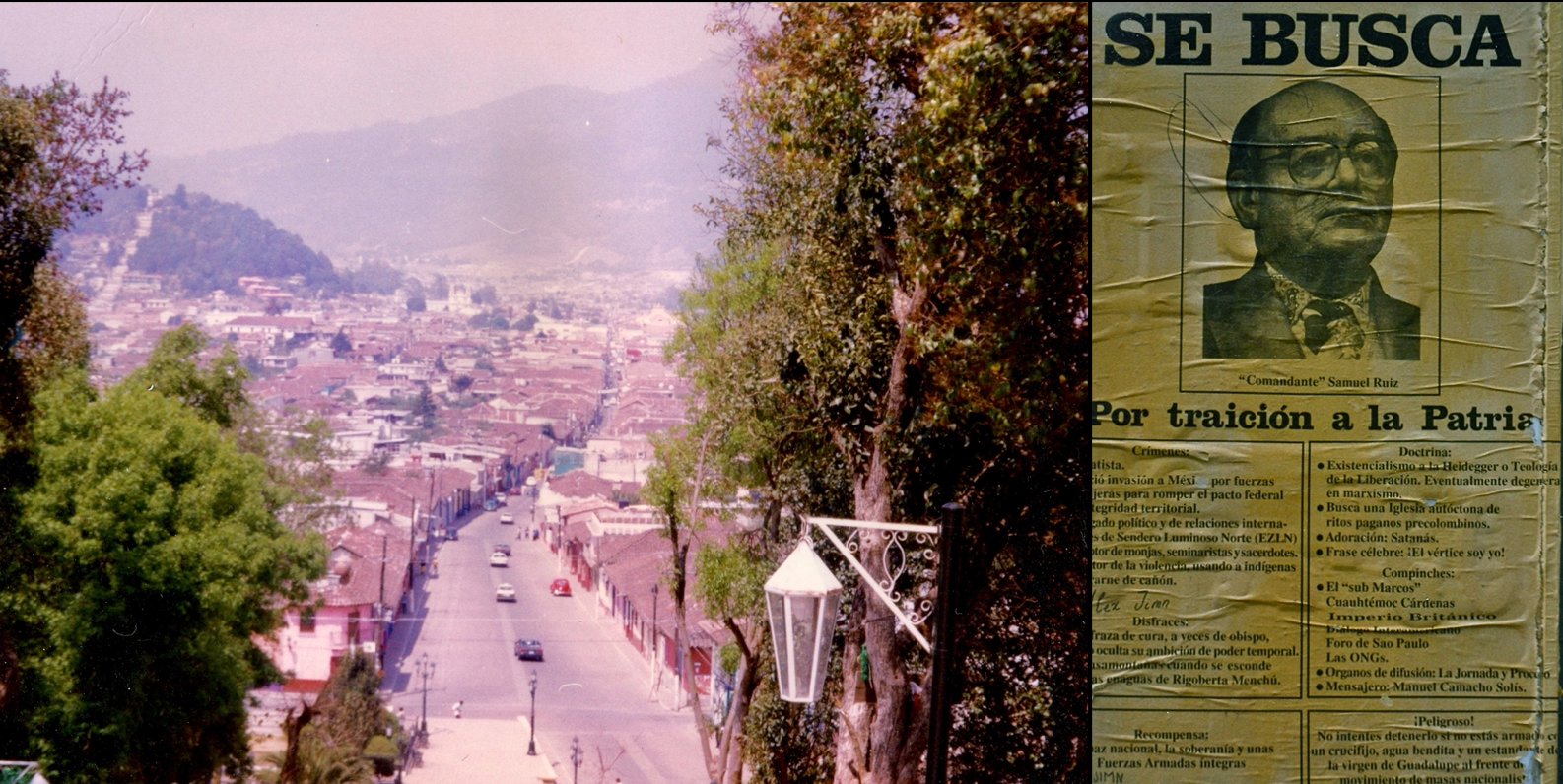
Left: a view of San Cristóbal de Las Casas. Right: a “wanted” poster that describes Bishop Ruiz variously as a traitor, existentialist, liberation theologian and Marxist – typical of the charges laid against him by his opponents over many years.

For more than a year, Ruiz had been at the centre of ecclesial and political controversies over his decades-long advocacy for and with Indigenous and impoverished people in Chiapas and his role as a mediator between the government and the Zapatistas. The EZLN uprising had begun on January 1, 1994, the day that the North America Free Trade Agreement (NAFTA) came into effect.

Zedillo failed to capture Zapatista leaders, but instead arrested people who worked for community development organizations (notably Jorge Santiago of DESMI, Economic and Social Development of Mexican Indigenous Peoples). His army also achieved what it considered to be better strategic positions near the Zapatista communities. 

Over the subsequent year, CONAI’s mediation work continued and bore fruit: on February 16, 1996, the government and EZLN representatives signed an Agreement on Indigenous Culture and Rights in San Andrés Sakamch’en. It was not a comprehensive peace deal, but rather the first step in a planned process to address Indigenous rights in Chiapas and beyond. “It was the first time in Mexican history that the state had sat down with Indigenous people to hear their demands,” wrote La Jornada columnist Magdalena Gómez recently. Later that year, the National Indigenous Congress (CNI) was created and continues its work today.

But from the government side, nothing happened! The first agreement has not been implemented; worse, the government negotiators essentially sabotaged a second round that was to address issues of democracy and justice, leading the EZLN to suspend the dialogue on September 4, 1996. It has not been renewed. The EZLN continues to press its cause in multiple public fora in Mexico and far beyond, and the communities persist in building a fairly successful example of Indigenous autonomy. 

Sadly, even the somewhat more progressive government of Andrés Manuel López Obrador, in power now for more than three years, has failed to move beyond what Gómez called “recycled, low-intensity, neo-Indigenous” policies of individual support and mega-projects without reference to the San Andrés Accords. 

A year ago, the Fray Bartolomé de Las Casas Human Rights Centre in San Cristóbal said the San Andrés Accords persist as a framework and reference for the people of Chiapas. “The people who struggle will continue to fan the fire of hope, and history will give an account of this, because despite the war of extermination, the construction of autonomy gives light and fire to women and men throughout the world.”

Parts of this post are adapted from two of my articles published in Catholic New Times, March 5 and 19, 1995.

“I give you a flower,” says a t-shirt from Yajalón, Chiapas.

After 24 years, Acteal is still an open wound in Chiapas

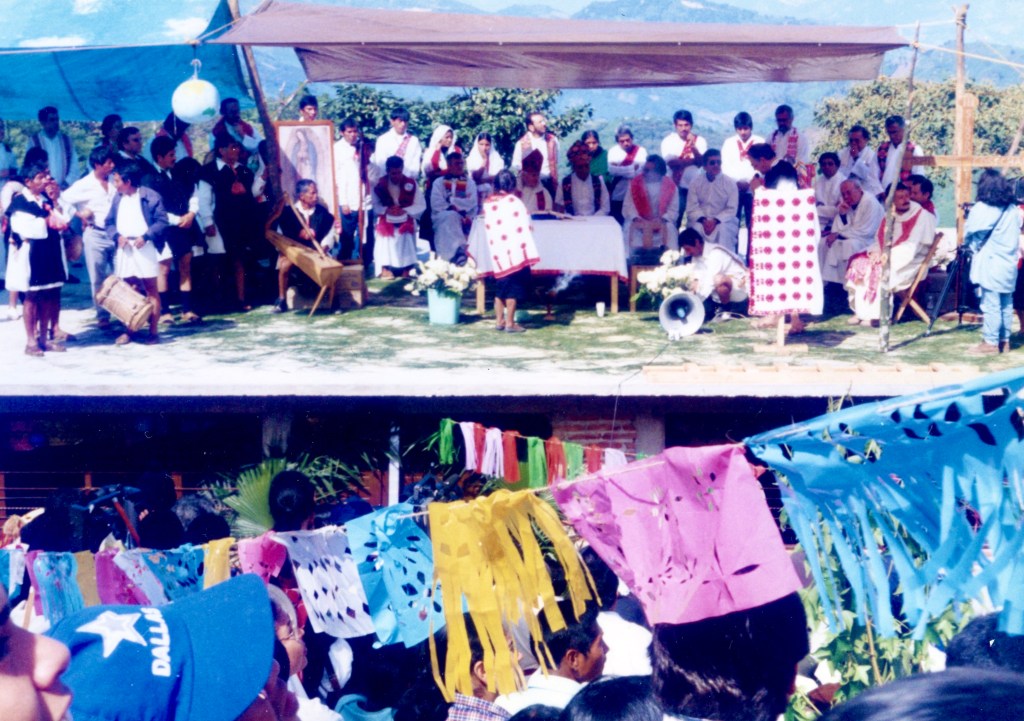
In December of 1998, I travelled with several friends to Acteal to join events marking the first anniversary of the massacre. The survivors (including the woman at centre who faces the bishops) and families of those who died wore white shawls embroidered with red flowers. Today, reports (like this piece by Luis Hernández Navarro) show that little has been resolved in the community, the surrounding municipality of Chenalhó (where paramilitaries retain control), or Chiapas state.

Desire for reconciliation marks first anniversary of Acteal massacre

Text of an article I wrote that was published in Catholic New Times, Jan. 31, 1999.

ACTEAL, Chiapas, Mexico – The people who came to Acteal Dec. 22 made a brightly-coloured crowd.

Huipiles – hand-woven, brightly-coloured blouses – were evidence of the diversity of the people of Chiapas, many of whom used mountain paths to avoid military patrols. Baseball caps and t-shirts marked both the similarity and diversity of the rest of us who came from other parts of Mexico and the world.

Many people, perhaps 1,000 of the 5,000 who were there, wore ski-masks or bandanas to cover their faces. They were supporters of the Zapatista Army for National Liberation (EZLN), the mostly-indigenous guerrilla movement which launched a rebellion five years ago this New Year’s Day.

In the year since 21 women, 15 children and nine men were murdered here, Acteal has changed dramatically. There are many more buildings now, including a community kitchen and a new chapel, and one of bricks and cement: the tomb of the victims.

In another respect, Acteal is exactly the same: it is a community of refugees from other hamlets, people forced to come here out of fear of paramilitary death squads who operate in the mountains of Chiapas. The diocese of San Cristóbal estimates that there are 10,000 displaced people in the municipality of Chenalhó, where Acteal is located.

We gathered on the hillside near the tiny chapel where members of the community group known as Las Abejas (the bees) were at prayer the morning that the paramilitaries arrived. Below us was the ravine where most of them died. The permanent tomb is there now. On its cement roof, a makeshift altar was built, and this was where the two bishops of San Cristóbal, Samuel Ruiz and his coadjutor, Raul Vera, led the celebration of a memorial mass.

‘Tatic’ Samuel Ruiz (left) served as bishop of San Cristóbal de Las Casas from 1959 until his retirement in 1999; he died in 2011. Raúl Vera was coadjutor bishop in San Cristobal from 1995 to 1999, and was widely expected to succeed Ruiz. He was abruptly transferred to Saltillo in northern Mexico, where he served until his retirement in 2020. Vera grew into a role as a staunch human rights defender, including the rights of LGBTIQ people. Photos: Jim Hodgson, February 1999, Mexico City.

Las Abejas, still faithful to their vision of a non-violent solution to the conflict in spite of the Chiapas violence to which they have been subjected, planned the event. They were assisted by Pablo and Salvador, two former paramilitaries who helped plan the massacre and who repented their crimes. They were accepted the community’s punishment and were pardoned by the survivors.

The survivors and families of those who died wore white shawls embroidered with red flowers and sat in the centre of the large crowd.

As the community choir – something else that is new in Acteal – sang the first hymn, an army helicopter circled slowly overhead, three times in all with a final pass by several minutes later.

For many, it exemplified the kind of harassment to which the people have been subjected by the army over the past five years in this area, where there is one soldier for every 12 inhabitants. This, say human rights workers, is one aspect of the application here of low intensity conflict, a war strategy developed by the U.S. military to destroy the spirit of popular support for social change movements. 

The first reading was the story of a catechist, Alonso Vázquez Gómez, who saw his wife and baby killed in the first volley of shots. He came close to her and said, “Woman, get up. Woman, get up.” Neither she nor the baby responded. Alonso stood and cried out, “Forgive them, Lord, for they don’t know what they are doing!” He was cut down then by two bullets which entered his head. The Gospel reading was Luke’s brief, spare account of the crucifixion of Jesus Christ, who spoke the same words as he died.

Bishop Vera spoke of “the scandalous forgiveness” by Jesus and Alonso of their killers and said we stood on holy ground. While about 100 people are in jail on charges related to the massacre, human rights workers say those responsible for its planning have not been arrested. Bishop Vera invited all to accept the “divine amnesty” offered by the victims, but warned that any “human amnesty cannot be impunity, much less amnesia.”

Bishop Ruiz said we were in the presence of martyrs and that Acteal was a unique moment in salvation history – one, however, that must never be repeated. “Acteal is the seed of a new Mexico, the peaceful, just and worthy Mexico of which we all dream,” he said, adding that it is a monument to peace and hope in the resurrection.

After a sign of peace and the communion shared amongst masked and unmasked, pacifists and guerrillas, Mexicans and foreigners, we left Acteal. We passed nervously through the same two military checkpoints which had inspected and recorded our identification and travel documents on the way in.

The next day, we heard of five foreigners whose documents were taken from them at the same checkpoints and who would have to appear later before immigration authorities to explain why they had attended a mass in the mountains on a sunny December day.

Something else that hasn’t changed: the unquenchable fear that the Mexican government bears towards Christians, Indians, intellectuals, artists, peasants and a few half-awake foreigners.

This potent combination knows that what Samuel Ruiz said is true: Acteal is the seed of the peaceful and just Mexico of which we all dream, and we will not rest until those words become reality.

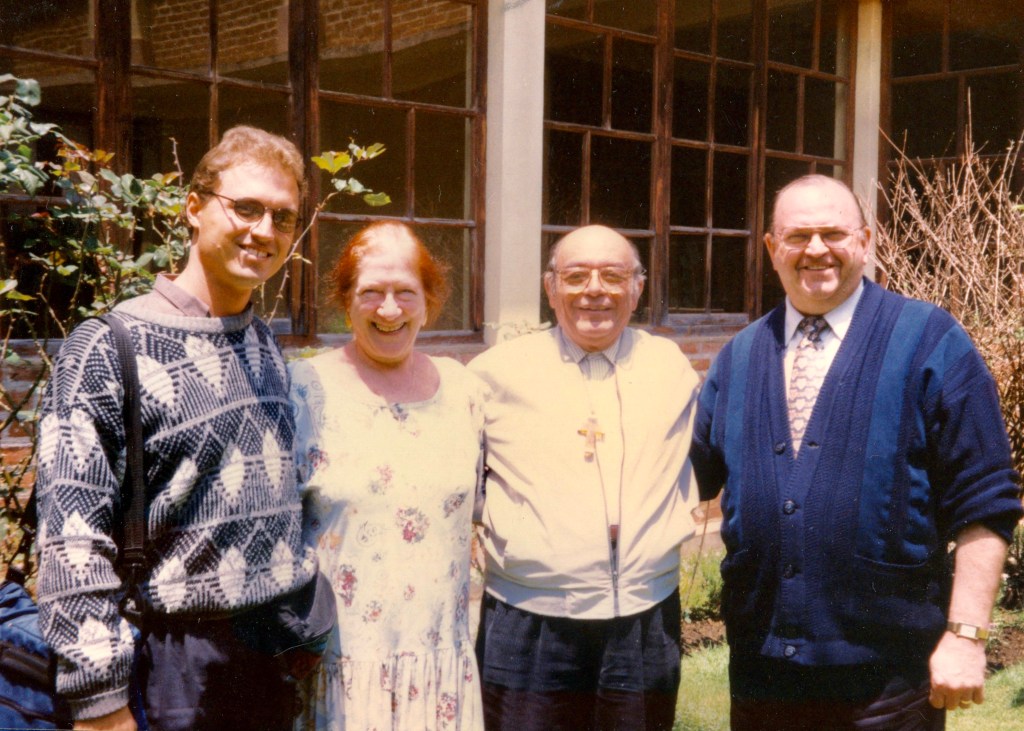
Solidarity: It was my privilege to accompany a Canadian Religious Conference visit to the diocese of San Cristóbal in March 1998. Here, Doryne Kirby, IBVM, and Jean-Claude Trottier, SM, stand beside Bishop Ruiz. Photo: Simon Appolloni, Development and Peace, Toronto.