I feel some relief this morning by two newsletters from U.S. activists that arrived in my email.
One is from “Stop The Coup 2025,” a campaign to fight Project 2025 (the Republicans’ plan for the next Trump administration). It has a toolkit for community organizers that includes a section, “Spotlight on Risk Preparedness/Criminalization/Underground Survival Tips.”It discusses the importance of organizations and individuals taking steps now to prepare and assess their vulnerability to Project 2025’s agenda and learning from LGBTQIA+ activists in other places who have been forced to live and organize under the radar due to state-sanctioned criminalization.
Here’s a bit more information about Project 2025:
Project 2025 has a radical anti-democracy, anti-diversity, anti-gender agenda to:
systematically dismantle the federal government – a soft coup
give the next Republican president new “supreme powers” – an autocracy
use Executive Orders to “legally” reverse many of our civil rights
use the military to help clamp down on domestic dissent
criminalize & erase gender & LGBTQIA+ identity from government protection
reverse racial equality, attack diversity, and reverse environmental gains
replace secular education with Christian theocracy and a pro-life agenda
recruit and train 20,000 conservatives for government jobs
Use “Schedule F” to remove 50,000 civil servants
Require government “Loyalty Pledges” to an extremist right-wing agenda
Reverse historic US defense policy of deterrence to offense
Require US foreign policy, USAID to align with pro-life agenda
LAUNCH THEIR 180-DAY ADMINISTRATION TAKEOVER ON January 20, 2025
The other newsletter that brought hope to my inbox today came from Codepink, the U.S. network of feminist peace activists. I’ve worked with them in the past to counter the harm caused by U.S. sanctions in Venezuela, Cuba and elsewhere, and some of my colleagues have worked with them for peace in the Korean peninsula and the Middle East. Part of the message today:
We don’t want to waste your time with platitudes about how everything will be okay or even talk about the breakdown of the election. We think it’s more useful to go off what we know for certain now: Donald Trump is going to be president in January.
But, a majority of Americans oppose U.S. support for Israel, and don’t want their tax dollars funding weapons that murder innocent people and destroy the earth. A greater majority of Americans oppose the U.S. starting new wars. It’s okay to feel deflated and discouraged, but don’t forget that the people are on our side – all we have to do is reach them.
We will continue to do what we have always done: educate by exposing horrific violence carried out by those in power, activate a movement for peace, and cultivate local communities that represent the world we want to live in. Solidarity is our best friend. Finding new and creative ways to scratch at power is our path forward.
Political signs of the times at a rest stop near Junction, Texas.
Last time, and this time: concern for rights of refugees
Back in 2016, I was in Antofagasta, Chile, when I learned that Donald Trump had defeated Hillary Clinton and won the U.S. election. The news was unexpected, just like now.
I was in Chile’s far north to meet and show solidarity with Chilean Methodists who were working with migrants who had come from Colombia and other parts of Latin America and the Caribbean, including Haiti.
Indeed, a great deal of my personal and professional life has been devoted to work with refugees and other people who are forced to flee their homelands because of various political, economic and environmental causes.
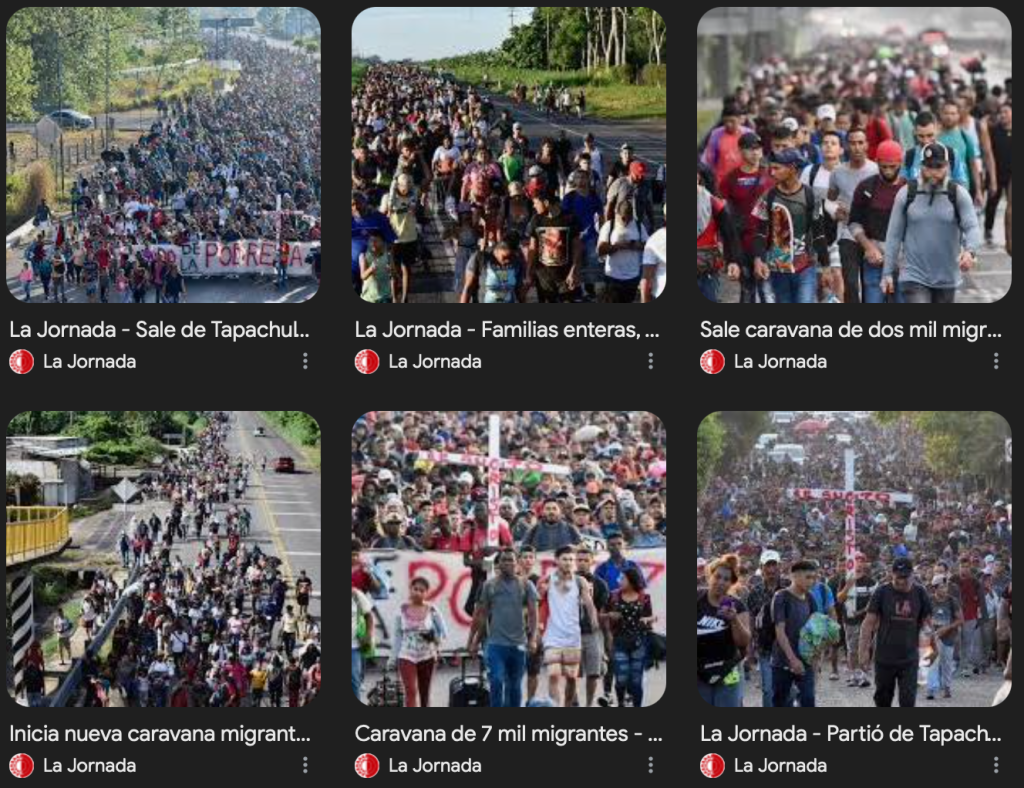
Caravans of migrants from many countries continue to cross Chiapas on their way north, holding out hope that they might score a formal U.S. refugee application before January 20 when Trump, who promises mass deportations, will take power. (Images: La Jornada, Mexico).
Now I am in north-western Chiapas, having crossed in recent weeks several of the “red states” where support for Trump is strong.
In the wake of the election, pundits point out that Trump weaponized ‘fake news.’ He played to machismo and racists and to people who haven’t a clue what being Trans even means. That he won over a smart, articulate, experienced woman of colour after being convicted of crimes and successfully sued for sexual assault is an indictment of U.S. democracy.
Some, including Sen. Bernie Sanders, point as well to the Democratic Party establishment which again defended the status quo. “It should come as no surprise that a Democratic Party which has abandoned working class people would find that the working class has abandoned them.”
As ever, don’t expect the Democratic Party to save us. Now is the time for grassroots action.
For Natasha Lennard, writing in The Intercept, the answer is radical action from the grassroots:
“Far-right policies and parties tend to win the day when so-called centrists take up conservative platforms to purportedly capture disaffected white voters and thus keep the far-right at bay; the upshot is treating conservative nationalism as the fulcrum of all politics. This is what the Harris campaign did, particularly when it came to immigration. At best, as with Britain’s currently ruling Labour Party, the Tories might have lost, but right-wing politics have been reconfigured as the normalized center.”
For years, I have gathered and often shared the stories of how people organize for a better future for their communities and the planet. A few days ago, I started gathering articles as they appeared about the ecological crisis.
And I am alarmed – though the rational part of my brain reminds me that I have long-known of the intersection of ecological disaster with civil conflict and war.
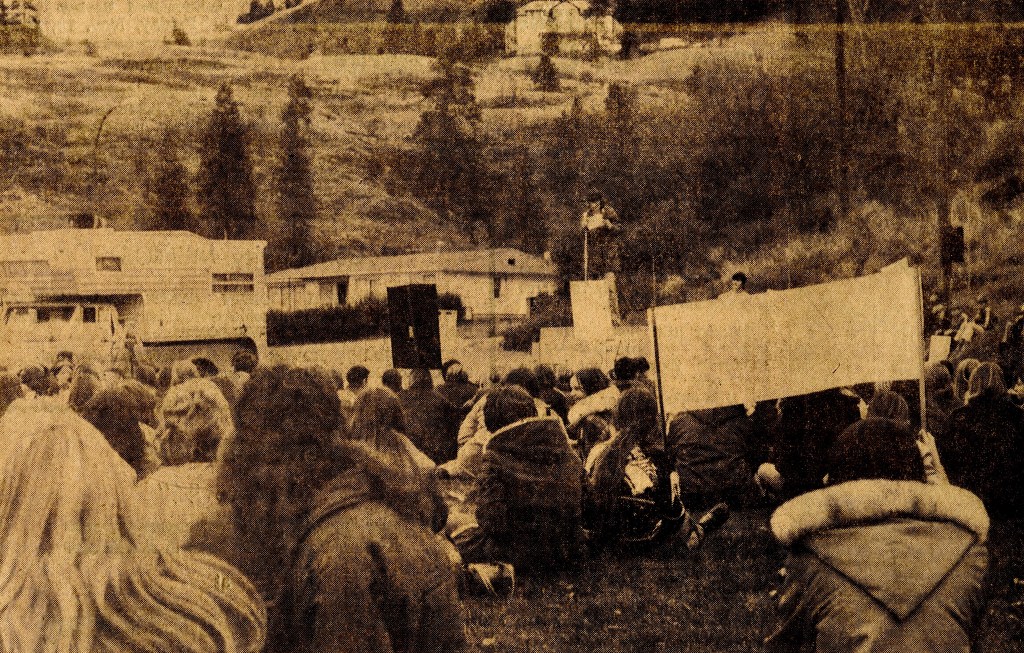
In 1971, I was 13 when I attended my first demonstration. It was about peace and the environment: opposing the third in a series of U.S. nuclear tests at Amchitka in the Aleutian Islands between Alaska and Siberia. Again today, war and ongoing failure to respect ecology bring us closer to collapse. A previous test in 1969 gave rise to the Don’t Make A Wave Committee in Vancouver. The group became the global movement Greenpeace. (Photo: an old clipping from the Summerland Review, November 1971).
Addressing the UN General Assembly a week ago, Secretary General António Guterres pointed to the two canals most vital to world trade and management of supply chains.
Trade via the Panama Canal is down 36 per cent in the past month because of low water levels – a consequence of the climate crisis.
Trade via the Suez Canal is down by 42 per cent, since the start of Houthi attacks on shipping in the Red Sea more than three months ago. Those attacks in turn are a foreseeable consequence of the excessive – many argue “genocidal” – Israeli response to the Hamas-led attack on Israeli civilians from the Gaza strip last Oct. 7.
The Pressenza news service reports this week that for the first time on record, the average global temperature exceeded 1.5 degree Celsius over a 12-month period, according to data from the Copernicus Climate Change Service (C3S). Last month was also the warmest January globally since C3S records began in 1950, with an average air surface temperature 0.7 degrees Celsius higher than the January average from 1991 to 2020.
Meanwhile, the Atlantic Ocean system of ocean currents may already be on course to collapse, according to a new report published Feb. 9 in the journal Science Advances. Such collapse could lead to further sea level rise and cause temperatures to plunge dramatically in Europe and rise in the southern hemisphere.
A new UN report shows that about 44 per cent of migratory species worldwide are declining in population. More than a fifth of the nearly 1,200 species monitored by the UN are threatened with extinction.
In Mexico, prolonged drought led to sharp drops in production of corn and avocados last year. Lack of rainfall has affected water reservoirs used for agriculture. Across the country, water storage is at 42.7 per cent of normal, and down 34.8 per cent from 2022. This is leading producers to plant less in the winter 2023-24 season. Images from La Jornada: (left) “corn production dropped 40 per cent because of the drought;” (centre) “Monarch butterflies occupy 59.3 per cent less surface area than the previous year because of climate impacts;” (right) “Industrial activity in Iztapalapa (the east side of Mexico City) could be paralyzed for lack of water.”
In January, Mexico’s national weather service reported that 2023 was the driest in 82 years, with just 21.1 per cent of normal rainfall. Last year also saw the largest amount of land afflicted by wildfires.
The Aqueduct Water Risk Atlas has published an interactive map where you look at drought risks in any part of the planet. Half of Mexico and large parts of the western United States are in red, along with most of northern Alberta.
Raúl Zibechi, the Uruguayan observer of social movements in Latin America, published a column recently that examined these and other risks.
“We continue to be stuck in the minuteness (‘chiquitismo’) of consumerist and narcissist daily life,” he wrote – “the latest telephone or clothing; the football game where we are merely spectators; the electoral campaign that only entertains, but does not resolve anything profound. This is the strategic triumph of capitalism: taking us headlong toward collapse while we look at the screen, ignoring the destruction and massacre of life.”
Views from Corpus Christi, Texas, June 2007. (Photos: Jim Hodgson)
In the speech by António Guterres that I noted above, he denounced the wars and ecological destruction, and offered some signs of ways forward. He spoke of A New Agenda for Peace.
“Peace is a rallying cry,” he said. “It is a call to action.” And he went on to describe the actions that must be taken: ceasefires, negotiations, addressing causes of migration, protection of species, debt and development finance, real action on climate, and reform of UN systems including the Security Council.
“We must also make peace with the planet. Humanity has waged a war we can only lose: our war with nature,” Guterres said. “For my part, I can guarantee that I will never give up pushing for peace.”
In recent weeks, my partner and I took a long drive from British Columbia through the western United States and then almost the length of Mexico to arrive in Chiapas.
While people who migrate northwards either for seasonal work or for more permanent refuge from poverty, violence and impacts of climate change were on our minds and in the news, at least some of the people we met alongside us in gas stations and cafés were seasonal workers heading home for the winter.
Migration, my friends, is normal. In southern Texas and northern Mexico, we encountered thousands of monarch butterflies as they headed for Michoacán. And here in Chiapas, the migratory birds are arriving daily.
At around the time of our trip, leaders of ten nations of Latin America and the Caribbean – frustrated by slow progress with the United States (and other northern countries) in advancing meaningful human development and managing the flow of people – gathered in the historic Maya city of Palenque, Chiapas, and proposed some ways forward.
Led by Mexico, the governments of Belize, Colombia, Costa Rica, Cuba, El Salvador, Haiti, Honduras, Panama and Venezuela signed the Palenque Declaration on Oct. 22 and called for solutions. (A representative of the newly-elected government in Guatemala also joined the talks.)
In the declaration, presented by the Mexican Foreign Minister, Alicia Bárcena, the leaders described several structural causes of migration: internally political, economic, social factors and the effects of climate change. But they also pointed to “external factors such as unilateral coercive measures of an indiscriminate nature – dictated from the United States – that negatively affect entire populations and, to a greater extent, the most vulnerable people and communities.”
They urged the United States to lift the sanctions imposed on Cuba and Venezuela that help drive the exodus. Such sanctions are against international law and, as the migration flow shows, they have impacts beyond the countries to which they are applied.
The document also proposed undertaking efforts to modify the financial architecture of debt; to close social gaps to as to reduce the impulse to migrate; push for measures aimed at increasing agricultural activity to promote food self-sufficiency in the region; and to promote intraregional trade and investment for socioeconomic development.
The signatory nations stressed that measures must be taken to confront transnational organized crime, human trafficking and corruption, as well as promote joint cooperation in security matters.
They called for destination countries to “adopt immigration policies and practices in line with the current reality of our region and abandon those that are inconsistent and selective, to avoid arbitrarily producing both ‘call effects’ and ‘deterrent effects’ – advantages given to certain countries for political reasons while nationals of other countries are blocked.
They encouraged destination countries to widen their regular migration pathways, with emphasis on labour mobility and promotion of re-integration and safe return of temporary workers to their homes.
The declaration makes special mention of Haiti, and called on nations to support efforts by the United Nations and others to re-establish conditions for human security so that the political, economic and social situation may be normalized, and to focus on sustainable development. (The presence of the Haitian president at the gathering angered some of the Haitian migrants camped out in the centre of Palenque, reported La Jornada.)
The declaration’s emphasis on economic drivers of migration did not satisfy everyone. Eunice Rendón of the Mexican advocacy group Agenda Migrante told Courthouse News Service that while insecurity was mentioned as a factor driving migration, “it’s not one of the causes, it’s the principal cause,” Rendón said.
“People go because the gang members threaten to kill them, because they try to forcibly recruit them,” she said. (Some might argue that the lack of education and employment opportunities are drivers as well in recruitment for organized crime.)
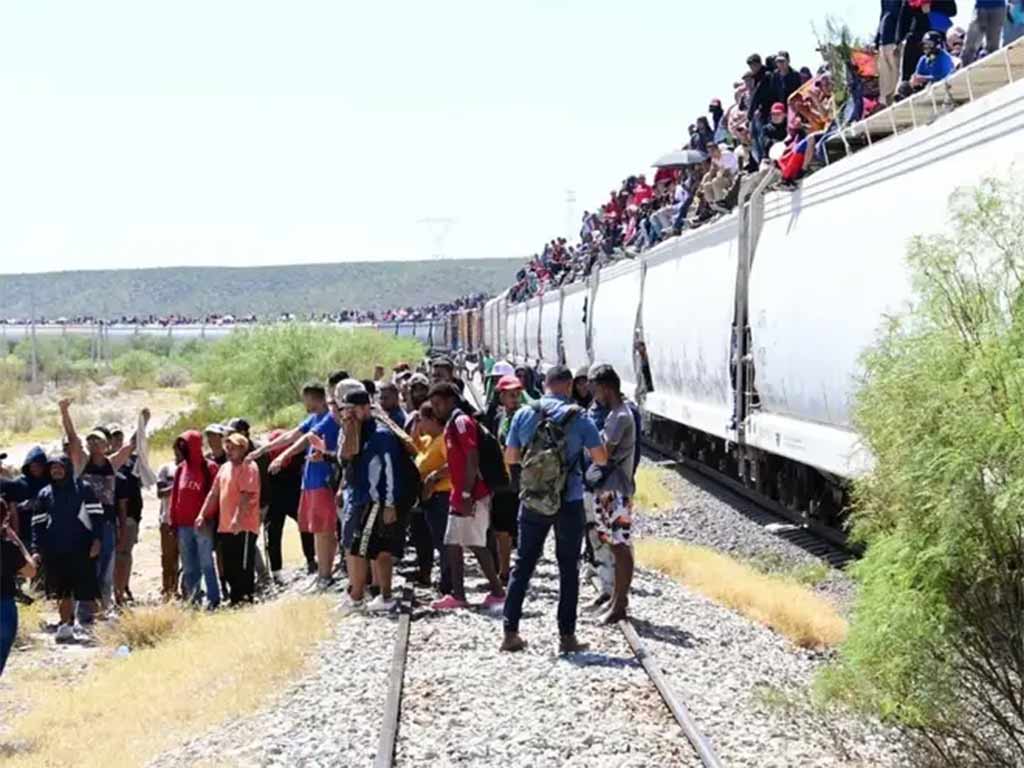
Meanwhile, migration dramas continue. On Nov. 9, authorities reported that they found found 123 Central and South American migrants trapped in a trailer in Matehuala, San Luís Potosí (less than a week after we passed through there). And than 400,000 migrants have crossed the Darien Gap from Colombia into Panama in 2023, according to the Panamanian government, up from 250,000 in 2022.





 Unwrapping Development