"Another World is Possible," World Social Forum, Porto Alegre, Brasil (2005)

The old order is dead. Let’s make a new, more just order.

by Jim Hodgson

It was too much to hope that the well-heeled audience at Davos would boo Donald Trump from the stage a day after they had offered Mark Carney a standing ovation. But by the end of Wednesday, it seemed that the wall of resistance to any U.S. take-over of Greenland was successful, and the president backed down. An important victory.
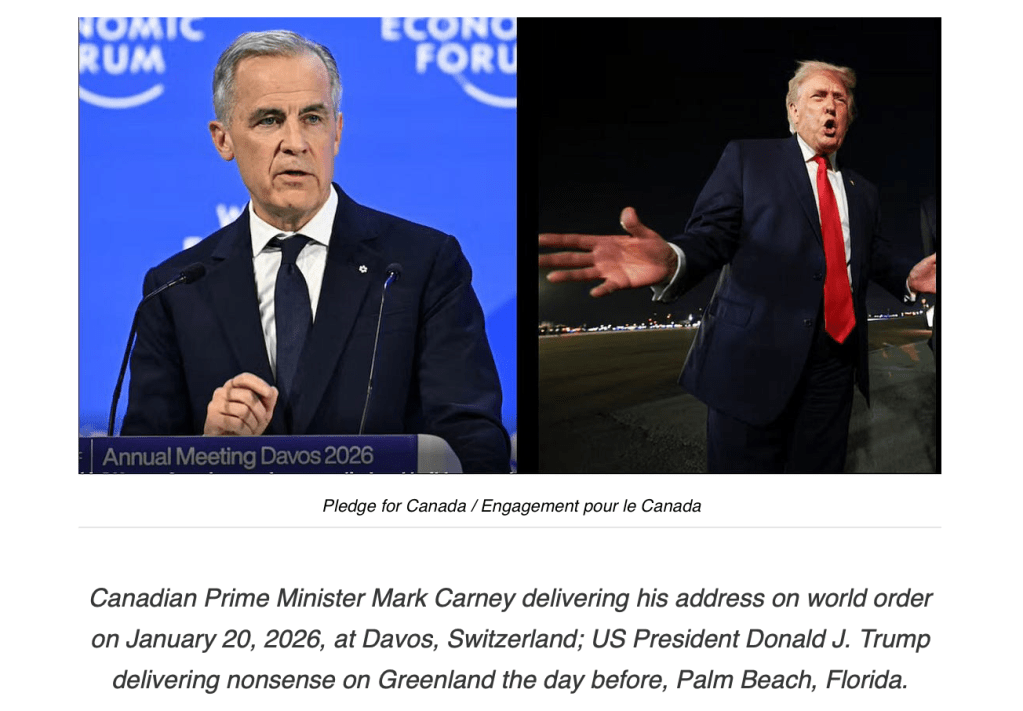

Still, “la rupture de l’ordre mondial” of which Carney spoke remains. And he’s right: we shouldn’t mourn it. The international financial institutions invented in 1944 at Bretton Woods, New Hampshire, gave overwhelming power to the rich countries of the Global North. 

And the United Nations system that followed, with a veto given to each of the five most powerful countries, has protected their interests – even in the face of overwhelming contrarian votes in the UN General Assembly. Think, for example, of the annual vote to end the cruel U.S. blockade of Cuba.

That order was designed by the nations that existed at the end of World War II, especially the colonial or neo-colonial states of Europe and the Americas. Most of the Caribbean, Africa and large parts of south Asia were still under colonial rule. That order imposed and perpetuated a Global North-based order on all the new nations that were born in the 25 years or so after the war: the majority of nations that exist today.

And that order, at least in the eyes of three of the five veto-holders, effectively imposed capitalism as a synonym for democracy. The United States and its allies were satisfied with a sort of formal democracy, a certain alternance between parties of the right and centre-right, and if that failed, then a military government was a useful interlude until the real order could be re-established and markets were safe. 

Canada would “go along to get along,” as Carney admitted. 

Just as it did less than three weeks ago when the United States bombed Venezuela and kidnapped its president. And just as it has for more than two years over Israel’s genocide in Gaza.

In his speech, Carney seemed to offer a vision of capitalism without the now-erratic United States. It’s still reliant on resource extraction, military spending, and massive capital investment.

But if we are all to grow and thrive, we must demand more. We require an end to practices that exploit social inequities and our shared ecology. 

Alternatives

Because of the paths on which my life has taken me, one that is especially close to my heart is the call from the Indigenous people of Zapatista communities in southern Mexico for “a world with room for all” – “un mundo donde quepan muchos mundos.” But other visions come from other places, including three decades of gatherings of the World Social Forum.
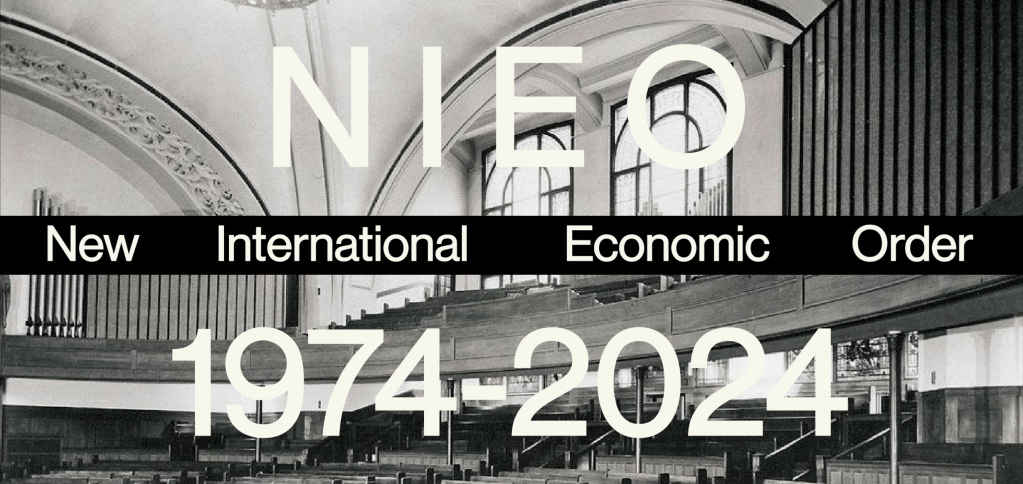
More than 50 years ago, the majority world united behind a vision of economic decolonization, sovereign development, and international cooperation across areas such as debt, trade, finance, and technology. That vision became known as the New International Economic Order (NIEO) and was adopted by the UN General Assembly. But, power relations being what they are, it was never implemented. (Progressive International put together a set of reflections that trace its history and update the proposals for the 21st century.)

In March last year, the World Council of Churches and several global communions of churches repeated their call for a New International Financial and Economic Architecture (NIFEA). “It is immoral that over a billion people – half of them children – subsist in poverty whilst billionaires increased their wealth by over 15% in 2024 to US$15 trillion. It is outrageous that the richest 10% of the global population receives more than half of global income, whereas the poorest half earns merely 8.5% of it,” they said in a statement.

They expressed deep concern about “a rapidly escalating climate and biodiversity emergency that jeopardises livelihoods and poses an existential threat to all life.” It notes that “several tipping points are close to being crossed or have already been crossed, leading us to recognise that we may be beyond a point of no return.”

The old order is dead. The time in which we are living demands we do better.
The “feminist foreign policy” is dead. What next?

by Jim Hodgson

A decade of promises and at least a measure of good will were flushed away with Prime Minister Mark Carney’s declaration that his government does not have a feminist foreign policy.

Speaking in Johannesburg at the end of the G20 summit, he said issues such as gender equality and reducing gender-based violence are an “aspect” of his government’s foreign policy. “But I wouldn’t describe our foreign policy as feminist foreign policy.”

Frankly, it was always hard to reconcile proclamations of feminist foreign policy (FFP, as it came to be known) by Prime Minister Justin Trudeau and his foreign ministers with Canada’s efforts to sell weapons abroadinaction in Gaza, and preference for threats and sanctions over dialogue in Venezuela. After all: wouldn’t a truly feminist foreign policy veto arms sales to Saudi Arabia because of its suppression of women’s rights? 

House of Commons finance committee chair Karina Gould, who served in several cabinet posts under Trudeau and ran against Carney for the Liberal leadership, told the Canadian Press that Carney’s words “certainly” mark a departure from the previous government. But she insisted the policy the prime minister described remains feminist.

“The ideals that he was talking about continue to be feminist, and I think that what it means is that as Canadians, we expect that we’re going to stand up for gender equality around the world and here in Canada,” she said.

“Prime Minister Carney is making it very clear he is no friend to women and he is no friend to gender equality in this country,” NDP MP Leah Gazan told reporters Nov. 24.

International Women’s Day march, Guatemala City, March 8, 2023 (Jim Hodgson photo)

Feminist aid policy

The Trudeau government did somewhat better with its Feminist International Assistance Policy (FIAP). Beyond policy documents, FIAP seemed to produce some results across the development cooperation sector with promotion of gender equity, empowerment of women and girls, and rights and inclusion for 2SLGBTQIA+ people. 

Even so, there were calls for more. Canada’s ecumenical justice coalition KAIROS said FIAP was “sound policy” but that its funding priorities needed “to align the advancement of human rights and women, peace and security with economic empowerment.”

After the Harper government in 2009 refused to support the KAIROS international assistance work, funding was restored by the Trudeau government to a revamped KAIROS Women, Peace and Security program. 

Now Trudeau is gone, his “sunny ways” undermined by the SNC Lavalin affair and his treatment of cabinet ministers who were women. And international development cooperation is being buried in favour of investment regimes, eternal debt and oceans that rise along with temperatures.

“Inside/outside strategies”

And so I find myself thinking in different ways. Sometimes I feel that I placed too much faith in the official spaces, even as I always identified most strongly with social movements. Sometimes we used “inside/outside” strategies: those who could talk to the politicians would do so; the rest of us would march in the street outside. I think of anti-free-trade demonstrations in Québec City in 2001 or the protests at the Toronto G7/G20 meeting in 2010.

Today in Mexico City’s La Jornada newspaper, Raúl Zibechi has a column in which he decries the “pyramids” of power we build within our progressive movements even as we denounce the pyramids of power in our capitalist “democracies.” He points to an event the Zapatistas will hold in San Cristóbal de Las Casas,  Chiapas, Dec. 26-30 this year. Zibechi and others will offer their “analyses on pyramids and on how histories are handled within the economic system, bad governments, laws and the judicial structure, resistance movements, the left and progressivism, human rights, the feminist struggle, and the arts.”

I can’t attend this year, but I will pay attention. As the new accord between Carney and the premier of Alberta showed this week, we can’t trust conventional power to make good choices on behalf of the people. We need to propose alternatives and press to make them reality.

“Security for whom?” asks KAIROS after Canada cuts foreign aid

by Jim Hodgson

Canada’s newest cuts to foreign aid spending follow cuts by other wealthy countries (most notably the elimination earlier this year of the U.S. Agency for International Development). Beyond immediate impacts, these cuts point to a reshaping of sixty years of international cooperation for development.

Over the next four years, Canada will chop $2.7 billion from its aid budget. At the same time, at the behest of the Trump regime next door, it will increase military spending with $81.8 billion over five years.

In June, Canada announced its commitment to increase military spending: CodePink, Development and Peace, and CBC headlines.

Few analysts bring together the issues of development assistance, militarism and climate justice the way that the ecumenical coalition KAIROS Canada has in its statement on the budget:

Canada needs to decide what role it wants to play in the world. These issues are inseparable: climate justice, Indigenous sovereignty, migrant justice, gender equality and peacebuilding rise or fall together — and Canada’s future depends on advancing them as one interconnected project of justice. 

KAIROS added that it is concerned by the prospect of a scaled-up military-industrial complex in Canada. “Even today, arms components made in Canada are used against civilians in Gaza and other conflict zones due to loopholes that allow them to flow indirectly through allies, helping to further entrench global insecurity.” (Canadian-built military surveillance and targeting equipment was used in at least two of the U.S. attacks on small ships in the Caribbean Sea, as reported recently by another Canadian ecumenical coalition, Project Ploughshares.)

KAIROS said the government “could have introduced a wealth tax to tackle the historic wealth gap and fund real climate action. It could have ended subsidies for fossil fuel corporations. Instead, it cut public services, forcing job losses that fall hardest on women, Indigenous Peoples and racialized communities,” as the Canadian Centre for Policy Alternatives warns.

While there are no actual projections yet of where the foreign aid cuts will hit, the budget statement cites Canada’s spending on global health programs as an example, saying this has “grown disproportionately” in comparison to other countries.

“Any reductions to Canada’s global health investments will have devastating consequences for women and children around the world, while threatening the health, security and prosperity of Canadians,” said Charmaine Crockett of the Canadian Partnership for Women and Children’s Health (CanWaCH) in a joint statement with Cooperation Canada. “Canada’s decades of leadership in global health have always been about investing in a safer, more equitable world, because we know that when we turn our back on the world’s most marginalized people, we all suffer.”

The cut to Canadian aid, elimination of USAID, and reduced spending announced by Britain, Germany, Netherlands and others means that in total, G7 countries are trimming their aid budgets by nearly one-third, the steepest reduction since 1960, according to the Globe and Mail

Several Canadian organizations (350.org Canada, World Beyond War, Migrant Rights Network, Council of Canadians, and the Canadian Association of Professional Employees) have come together in a letter-writing campaign to opposition leaders to encourage them to demand change before Parliament votes again on the budget.

Where to now with international development?

I want to share links to some articles that delve more deeply into the significance of what may become a shift away from a model in which rich countries of the Global North “donated” funds to impoverished countries of the Global South. The model has always been criticized as it promotes dependence and blocks systemic change. This is “big picture” stuff, very distant from issues of how to support refugees at border posts or funding for cooperative farming in Central America. (I am, as always, grateful to Brian Murphy for sharing these and other articles. You can follow him on Bluesky @murphyslog.bsky.social.)

First, “The end of the global aid industry,” by Zainab Usman. Usman proposes a focus on industrialization – what has worked for China and South Korea and is unfolding now in Vietnam and Thailand. Usman writes:

Part of the problem with the aid industry is that its benefits have been spread too thinly across a multitude of domains and not focused enough on productivity-enhancing sectors. To this end, advocates of global development should focus on enabling poorer countries to access cheap development financing for targeted investments in sectors that connect people, such as electricity, telecommunications, and mass transit. 

Second, “The geopolitics of international development (after foreign aid),” by Ken Opalo in An Africanist Perspective. Opalo examines a series of essays in Foreign Policy magazine’s Fall 2025 issue that all deal with development issues. Opalo sets his description of the decline of the foreign aid model in the context of a rising multipolarity that is matched by the “ongoing general decline of the authority and influence of Western states.”  

There’s no denying that the financial, intellectual, and institutional hegemony of Western countries significantly shaped development practice over the last 60 years. This era had both good and bad elements. The good elements included efforts to incentivize the modernization of economic management and policymaking in low-income countries (work that’s far from finished, and which has yielded some good results); while the bad elements included the fostering of aid dependence, cyclical faddism, reflexive policy extraversion, lack of elite ambition, and implicit support for a hierarchical world order that permanently placed low-income countries at the bottom of the global totem pole.

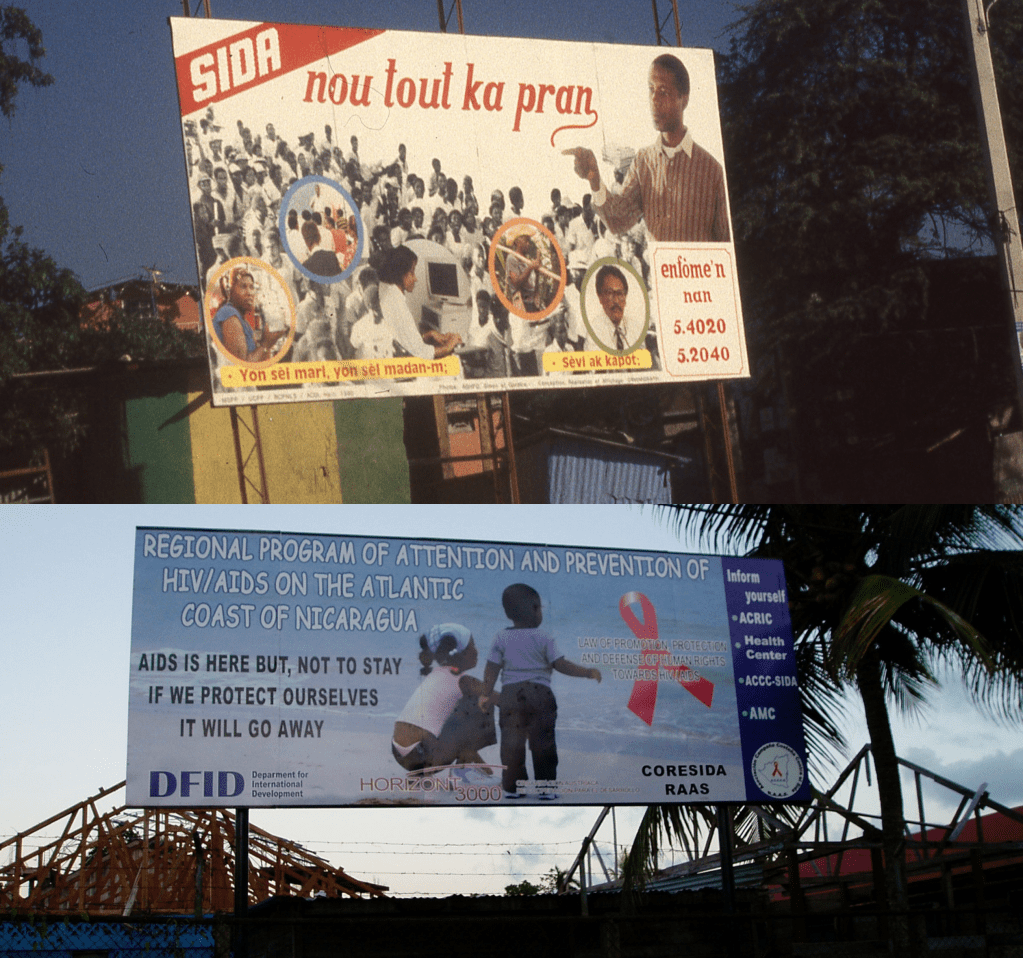
AIDS prevention education in decades past: Haiti in 1984 (top); Atlantic coast of Nicaragua in 2007 (below). Jim Hodgson photos.

Third, “Three ways to help the developing world survive the end of aid,” by Winnie Byanyima, Executive Director of UNAIDS, in The Guardian. Byanyima reminds us that developing countries are still drowning in debt and facing interest rates up to 12 times higher than wealthy countries. “Low- and middle-income countries now pay $4 to the richest in the global north for every $1 they receive in aid. Thirty-four of Africa’s 54 countries spend more on debt than on healthcare.” She adds:

  • Governments must relieve the “chokehold of sovereign debt.”
  • The richest need to pay their fair share: the wealth of billionaires soared by $2 trillion in 2024, but they paid an effective tax rate of just 0.3 per cent.
  • Governments need to treat lifesaving medicines not as commodities, but as global public goods. “This has been one of the great successes of the HIV response” (at least over the past 20 years, though not before—and threatened again with loss of U.S. funding this year).