“Security for whom?” asks KAIROS after Canada cuts foreign aid

by Jim Hodgson

Canada’s newest cuts to foreign aid spending follow cuts by other wealthy countries (most notably the elimination earlier this year of the U.S. Agency for International Development). Beyond immediate impacts, these cuts point to a reshaping of sixty years of international cooperation for development.

Over the next four years, Canada will chop $2.7 billion from its aid budget. At the same time, at the behest of the Trump regime next door, it will increase military spending with $81.8 billion over five years.

In June, Canada announced its commitment to increase military spending: CodePink, Development and Peace, and CBC headlines.

Few analysts bring together the issues of development assistance, militarism and climate justice the way that the ecumenical coalition KAIROS Canada has in its statement on the budget:

Canada needs to decide what role it wants to play in the world. These issues are inseparable: climate justice, Indigenous sovereignty, migrant justice, gender equality and peacebuilding rise or fall together — and Canada’s future depends on advancing them as one interconnected project of justice. 

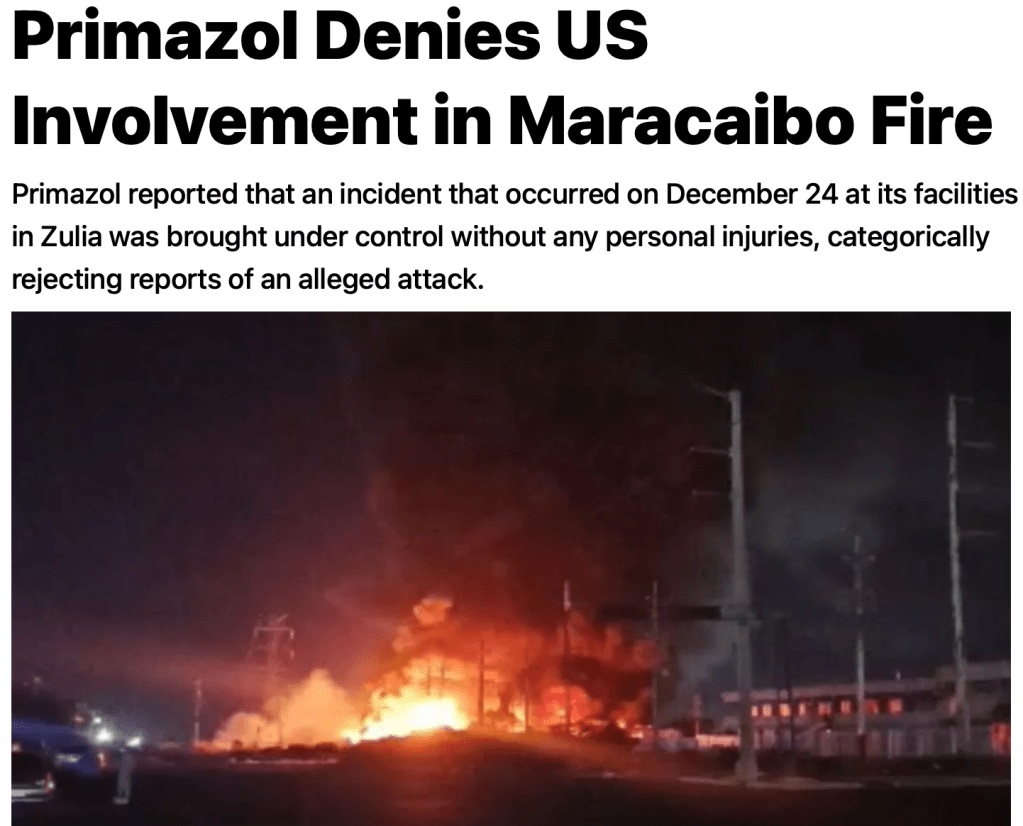
KAIROS added that it is concerned by the prospect of a scaled-up military-industrial complex in Canada. “Even today, arms components made in Canada are used against civilians in Gaza and other conflict zones due to loopholes that allow them to flow indirectly through allies, helping to further entrench global insecurity.” (Canadian-built military surveillance and targeting equipment was used in at least two of the U.S. attacks on small ships in the Caribbean Sea, as reported recently by another Canadian ecumenical coalition, Project Ploughshares.)

KAIROS said the government “could have introduced a wealth tax to tackle the historic wealth gap and fund real climate action. It could have ended subsidies for fossil fuel corporations. Instead, it cut public services, forcing job losses that fall hardest on women, Indigenous Peoples and racialized communities,” as the Canadian Centre for Policy Alternatives warns.

While there are no actual projections yet of where the foreign aid cuts will hit, the budget statement cites Canada’s spending on global health programs as an example, saying this has “grown disproportionately” in comparison to other countries.

“Any reductions to Canada’s global health investments will have devastating consequences for women and children around the world, while threatening the health, security and prosperity of Canadians,” said Charmaine Crockett of the Canadian Partnership for Women and Children’s Health (CanWaCH) in a joint statement with Cooperation Canada. “Canada’s decades of leadership in global health have always been about investing in a safer, more equitable world, because we know that when we turn our back on the world’s most marginalized people, we all suffer.”

The cut to Canadian aid, elimination of USAID, and reduced spending announced by Britain, Germany, Netherlands and others means that in total, G7 countries are trimming their aid budgets by nearly one-third, the steepest reduction since 1960, according to the Globe and Mail

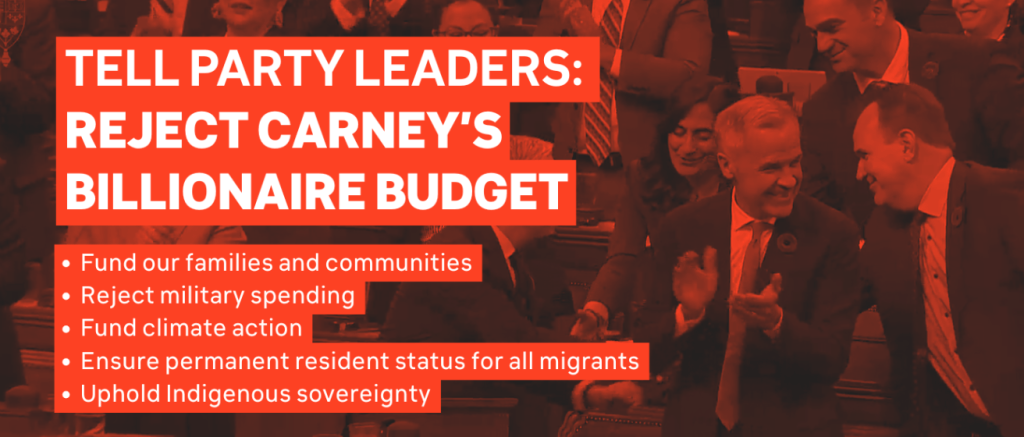
Several Canadian organizations (350.org Canada, World Beyond War, Migrant Rights Network, Council of Canadians, and the Canadian Association of Professional Employees) have come together in a letter-writing campaign to opposition leaders to encourage them to demand change before Parliament votes again on the budget.

Where to now with international development?

I want to share links to some articles that delve more deeply into the significance of what may become a shift away from a model in which rich countries of the Global North “donated” funds to impoverished countries of the Global South. The model has always been criticized as it promotes dependence and blocks systemic change. This is “big picture” stuff, very distant from issues of how to support refugees at border posts or funding for cooperative farming in Central America. (I am, as always, grateful to Brian Murphy for sharing these and other articles. You can follow him on Bluesky @murphyslog.bsky.social.)

First, “The end of the global aid industry,” by Zainab Usman. Usman proposes a focus on industrialization – what has worked for China and South Korea and is unfolding now in Vietnam and Thailand. Usman writes:

Part of the problem with the aid industry is that its benefits have been spread too thinly across a multitude of domains and not focused enough on productivity-enhancing sectors. To this end, advocates of global development should focus on enabling poorer countries to access cheap development financing for targeted investments in sectors that connect people, such as electricity, telecommunications, and mass transit. 

Second, “The geopolitics of international development (after foreign aid),” by Ken Opalo in An Africanist Perspective. Opalo examines a series of essays in Foreign Policy magazine’s Fall 2025 issue that all deal with development issues. Opalo sets his description of the decline of the foreign aid model in the context of a rising multipolarity that is matched by the “ongoing general decline of the authority and influence of Western states.”  

There’s no denying that the financial, intellectual, and institutional hegemony of Western countries significantly shaped development practice over the last 60 years. This era had both good and bad elements. The good elements included efforts to incentivize the modernization of economic management and policymaking in low-income countries (work that’s far from finished, and which has yielded some good results); while the bad elements included the fostering of aid dependence, cyclical faddism, reflexive policy extraversion, lack of elite ambition, and implicit support for a hierarchical world order that permanently placed low-income countries at the bottom of the global totem pole.

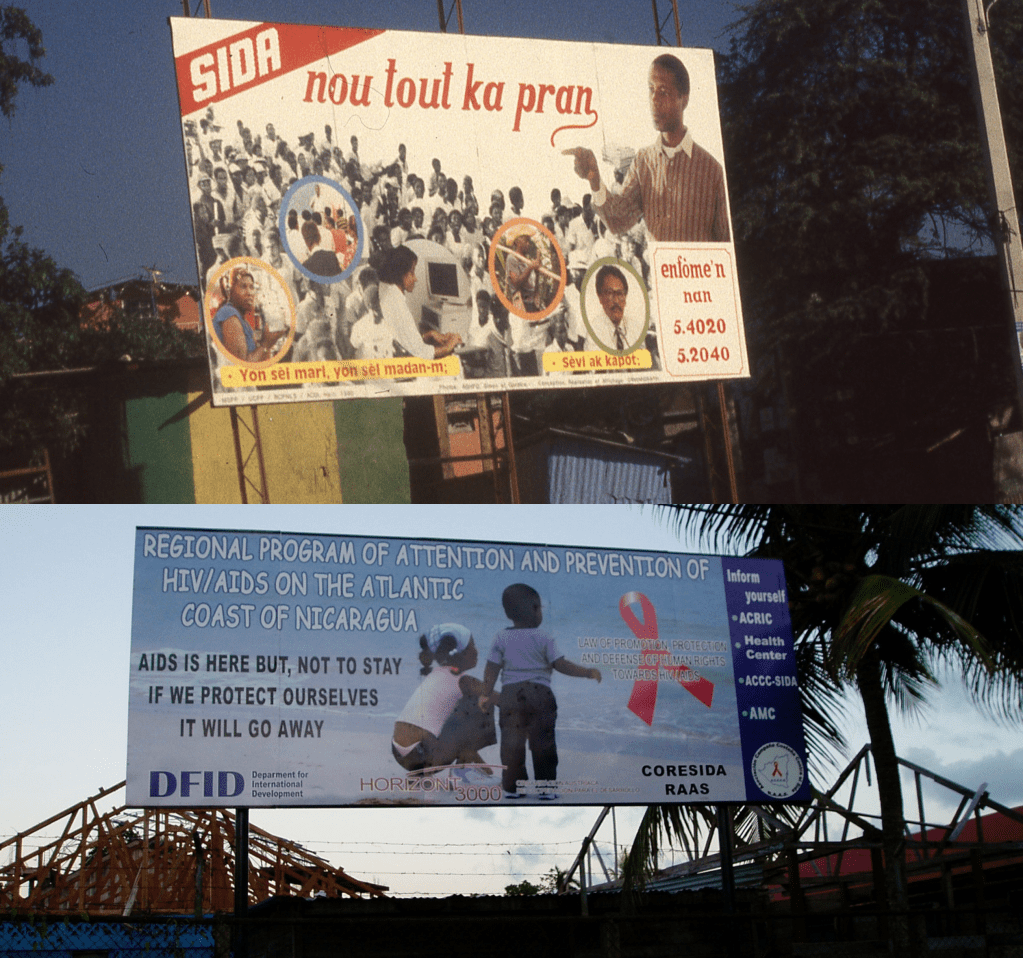
AIDS prevention education in decades past: Haiti in 1984 (top); Atlantic coast of Nicaragua in 2007 (below). Jim Hodgson photos.

Third, “Three ways to help the developing world survive the end of aid,” by Winnie Byanyima, Executive Director of UNAIDS, in The Guardian. Byanyima reminds us that developing countries are still drowning in debt and facing interest rates up to 12 times higher than wealthy countries. “Low- and middle-income countries now pay $4 to the richest in the global north for every $1 they receive in aid. Thirty-four of Africa’s 54 countries spend more on debt than on healthcare.” She adds:

  • Governments must relieve the “chokehold of sovereign debt.”
  • The richest need to pay their fair share: the wealth of billionaires soared by $2 trillion in 2024, but they paid an effective tax rate of just 0.3 per cent.
  • Governments need to treat lifesaving medicines not as commodities, but as global public goods. “This has been one of the great successes of the HIV response” (at least over the past 20 years, though not before—and threatened again with loss of U.S. funding this year).

One Nobel winner to another: Why did you ask U.S. to invade Venezuela?

by Jim Hodgson

Perhaps I should be grateful to the Norwegian Nobel Committee for again putting Venezuela into the headlines with its absurd award of the Nobel Peace Prize to María Corina Machado, a woman who has never rejected violence as she sought the overthrow of successive Venezuelan governments since 1998. 

The prize came as the United States stepped up its attacks on fishing boats it alleged (without evidence) were carrying drugs from the Venezuelan coast to the United States. It came as the Trump administration ended a “quiet diplomacy” effort with President Nicolás Maduro that was led by Richard Grenell – a victory for hard-liners like Secretary of State Marco Rubio. If the United States opts for war. In the words of James B. Greenberg: “it will not be because diplomacy failed. It will be because war itself is the preferred instrument.”

And today, the New York Times reports that Trump has authorized “covert CIA action” in Venezuela. U.S. officials “have been clear, privately, that the end goal is to drive Mr. Maduro from power.” (That, by the way, is not news: it’s been the goal all along.)

I was astonished by the award, but then also by the responses. 

Most “progressive” U.S. commentators, including historian Heather Cox Richardson, celebrated Machado simply because she was not Donald Trump. Likewise Occupy Democrats, The Other 98%, and U.S. Democratic Socialists: one of them (I forget which) erred in saying she was Colombian. 

Even World Council of Churches and Pax Christi congratulated her. Made me wonder who they talk with in Latin America, where the reaction is strongly against Machado. Then I welcomed the flow of criticism in the threads that followed the WCC and Pax Christi Facebook posts. During the weekend, the WCC amended its message, and Pax Christi shared a new message (above). 

In the United States, author Greg Grandin told Democracy Now that the Nobel prize was the “opposite of peace.” 

But still: how can the Nobel committee see her together with previous Latin American winners like Rigoberta Menchu and Adolfo Pérez Esquivel who allied themselves persistently with the social movements of the poor, the workers, the Indigenous people, women?

I met Pérez Esquivel at least twice: once in Toronto and again in Buenos Aires (above left) at an economic alternatives conference in 2003. Right: the open letter to Machado.

From one Nobel peace prize winner to another

Let’s hear from Adolfo Pérez Esquivel, Nobel peace prize winner in 1980 for his non-violent defense of democracy and human rights in the face of Latin America’s military dictatorships, especially the regime of Jorge Rafael Videla in Argentina. He published an open letter to Machado on Oct. 13 in the Buenos Aires daily, Página 12. The text is partly translated to English here, source of the following excerpts:

“In 1980, the Nobel Committee granted me the Nobel Peace Prize; 45 years have passed and we continue serving the poorest, alongside Latin American peoples. I accepted that high distinction in their name — not for the prize itself, but for the commitment to shared struggles and hopes to build a new dawn. Peace is built day by day, and we must be coherent between what we say and what we do,” he asserted.

“At 94, I am still a learner of life, and your social and political stance worries me. So I am sending you these reflections,” he emphasized.

In the letter, he argued that the Venezuelan government, led by President Nicolás Maduro, “is a democracy with lights and shadows,” and he underscored the role of former president Hugo Chávez, who, he said, set a path of freedom and sovereignty for the people and fought for continental unity.

“It was an awakening of the Patria Grande,“ he emphasized.

At the same time, he asserted that the United States has not only “attacked” Venezuela but also refuses to allow any country in the region to step outside its orbit and colonial dependence, treating Latin America as its “backyard.” He also highlighted the more than 60-year blockade against Cuba, which he called an attack on the freedom and rights of peoples.

In one of the letter’s toughest passages addressed to Machado, he rebuked her for clinging to Washington even as it confronts her country.

“I am surprised by how tightly you cling to the United States: you should know it has no allies and no friends — only interests. The dictatorships imposed in Latin America were instruments of its drive for domination, and they destroyed lives and the social, cultural and political organization of peoples who fight for freedom and self-determination. Our peoples resist and struggle for the right to be free and sovereign, not a colony of the United States,” he wrote.

On that point, he said the government of Nicolás Maduro «lives under threat» from Washington and from the “blockade,” with U.S. naval forces in the Caribbean and «the danger of an invasion of your country».

“You have not said a word, or you support the interference of the great power against Venezuela. The Venezuelan people are ready to confront the threat,” he warned.

He also criticized that, after receiving the prize, the far-right leader dedicated it to U.S. President Donald Trump. “Corina, I ask you: why did you call on the United States to invade Venezuela?”

“Upon the announcement that you were awarded the Nobel Peace Prize, you dedicated it to Trump — an aggressor against your country — who lies and accuses Venezuela of being a narco-state,” Pérez Esquivel said. He compared that accusation to George W. Bush’s false claims that Saddam Hussein had weapons of mass destruction, used as a pretext for an invasion that looted that nation and caused “thousands of victims.”

“It troubles me that you did not dedicate the Nobel to your people but to Venezuela’s aggressor. I believe, Corina, that you must analyze and understand where you stand,” the Argentine insisted, arguing that her posture makes her “another piece of U.S. colonialism.”

“You resort to the worst when you ask the United States to invade Venezuela,” he added.

Pérez Esquivel concluded: “Now you have the chance to work for your people and build peace — not provoke greater violence. One evil is not resolved with a greater evil; we would only have two evils and never a solution to the conflict. Open your mind and your heart to dialogue and to meeting your people; empty the jug of violence and build the peace and unity of your people so that the light of freedom and equality can enter.”

UN approves a ‘Gang Suppression Force’ for Haiti

By Jim Hodgson

The UN Security Council adopted a resolution last week that authorizes deployment of 5,500 troops to Haiti to replace the understaffed and underfunded Multinational Security Support Mission (referred to as MMAS in Haiti). The new Gang Suppression Force (FRG) has a mandate to “neutralize, isolate, and deter” gangs, secure infrastructure, and support institutional stability.

On Aug. 26, UN Secretary General António Guterres warned that humanitarian efforts in Haiti are “shamefully overlooked and woefully underfunded.” On Sept. 30, Volker Türk, the UN high commissioner for human rights, welcomed creation of the FRG and said: “Efforts to restore security must be anchored in respect for human rights and go hand in hand with the reconstruction of the rule of law.”

Politico called the vote to create the FRG a “win” for the Trump administration. That alone should raise concern among the rest of us.

The UNSC decision came days after a police-directed drone attack on an alleged gang leader’s birthday party, where he was handing out presents to local children. At least eight children were killed.

Since June 2024, Haiti has been governed by a transitional council (CPT). Leadership rotates among a wobbly coalition from different sectors of Haitian society. It includes the civil society-led  Montana Accord network (named for the hotel where their accord was signed). Earlier, the Montana group had offered a “passarelle” or series of steps for an interim government as a way to move to new elections. (The terms of all Haitian politicians expired in 2023.) The CPT might have been able to move forward on that process, but Haiti is afflicted by a rising tide of gang violence that some argue is at least partly driven by Haiti’s richest people

In August, leadership of the CPT passed to Laurent Saint-Cyr, a former head of the American Chamber of Commerce in Haiti. At the same time, the prime minister is his fellow businessman Alix Didier Fils-Aimé.

To my suspicious mind, this means Haiti has returned to the same power structure that prevailed after 2011 under presidents Michel Martelly and Jovenel Moïse, and then the unelected leadership of Prime Minister Ariel Henry through early 2024 – men all backed by the United States, Canada, France and a powerful local oligarchy that has blocked every effort to ease Haiti’s inequality and to advance social goals, including education, health care, housing and public infrastructure. 

(Bear with me, please: you can read more of my own analysis towards the end of this piece.)

First, the news

According to the UN, at least 1.3 million Haitians remain internally displaced due to violence, with 5.7 million facing food insecurity. About 3,100 people were killed in violent incidents between January and June this year, and at least 2,300 grave violations against children have been recorded.

The UNSC resolution to create the Gang Suppression Force (known as FRG in French: Force de Répression des Gangs) was proposed in August by Panama and the United States. The resolution passed Sept. 30 with 12 votes in favour and none against. Permanent Security Council members China and Russia, along with rotating member Pakistan, abstained from the vote.

It replaces the MMAS, created just two years ago by the UN to support Haitian police forces, but never adequately funded. The new force would raise the personnel ceiling from 2,500 in the current mission to 5,550 personnel will grow from 2,500 to 5,550 personnel, with a UN Support Office providing logistical support amidst Haiti’s intersecting security, humanitarian, and political crises. But it will not be answerable to any Haitian authority, not even the Haitian National Police. 

Currently, it appears the new FRG would include the United States, Bahamas, Canada, El Salvador, Guatemala, Jamaica, and Kenya—in effect a reboot of the MMAS.

Memories of a previous UN intervention: UN trucks parked near Cap-Haïtien in February 2005 (Jim Hodgson photo).

Responses

Approval of the FRG was welcomed by the Caribbean regional group CARICOM, and the Organization of American States – even though the new OAS secretary-general, Albert Ramdin, had in June advocated dialogue with the gangs. That idea was rejected by the CPT. 

The Canadian government had earlier announced contribute $60 million toward gang-suppression efforts in Haiti. Mark Richardson, a Global Affairs Canada director general for the Caribbean, recently told the House of Commons foreign affairs committee that it is “too early” to have conversations about whether Canadian troops would be part of the new UN mission.

After the UN vote, U.S. Ambassador Henry Wooster pressed the CPT to hold elections:

  • 🕊️ Context: follows the UN Security Council’s green light for the deployment of the Gang Repression Force (FRG).
  • 🇺🇸 U.S. position: call for a clear plan and timetable for free and credible elections in Haiti.
  • 🧭 Stated objective: to prevent the transition from dragging on and to encourage the restoration of democratic institutions.
  • ⚖️ Political challenge: Washington wants to link security stabilization to an inclusive and supervised electoral process.
  • 🕰️ Next steps: consultations between the Haitian government and international partners on implementation of the FRG and of an electoral timetable.

More critical views are offered by the Haïti Liberté newspaper. One article describes the rationale offered by China and Russia for not vetoing the resolution. It adds that Guyana, Algeria, Sierra Leone, and Somalia sought to insert language that called for “full respect for the sovereignty and political independence of Haiti,” but their proposal was rejected by the U.S. Denmark, Greece, South Korea, and Slovenia “advocated for strengthening the text with language on compliance with international law, including international human rights law,” but “the US apparently consistently supplemented these additions with the qualifier ‘as applicable’.”

The same article quotes Haïti Liberté director Berthony Dupont questioning proposed use of the UN regular budget for operational and logistical support of this force. 

“In the context of the [UN]’s financial crisis, caused largely by the irresponsible actions of its largest contributor [the U.S.], expecting significant funding to support a new initiative that exists only on paper, and which lacks a sustainable foundation and clear prospects, is naive, to say the least. Let us put it straight: if that contributor failed to provide the funds it promised for the MMAS, what guarantee do we have that anything will be different this time?”

In Port-au-Prince, the human rights group Collectif Défenseurs Plus told Alterpresse that it recognizes that “international assistance has become inevitable” in the face of an overwhelmed HNP and unprecedented violence. But it demands guarantees: accessible accountability mechanisms, zero tolerance for any human rights violations, and uncompromising support for Haitian institutions.

“The Haitian crisis is above all political,” the collective insists, warning that the FRG must not become a crutch for a power lacking legitimacy, but rather create a space for an inclusive transition and transparent elections.

Between hopes for restored security and fears of another international failure, the success of the FRG will depend as much on its ability to break the criminal grip as on the will of Haitian actors to rebuild a credible state. As the Defenders Plus Collective emphasizes, “security is a right, and so is sovereignty.”

How might Haiti be better served?

“While it is important to address the consequences of gang violence, influential foreign actors in Haiti should do more to address its root causes,” writes Roromme Chantal, a political science professor at l’Université de Moncton. 

“To this end, research demonstrates that conflict resolution such as the one in Haiti should be approached in a manner that allows for the participation of local groups (official authorities, civil society representatives, grassroots organizations), providing them, if necessary, with the funding, logistical means, and technical capacity to implement carefully targeted programs.”

My thoughts

I find myself thinking again of anthropologist Michel-Rolph Trouillot. He wrote a book called State Against Nationin the years following the end of the Duvalier dictatorship. He argued that the Haitian state is relatively autonomous from the nation: all problems are turned into political problems, but the state – much less the political class – is not the same as the society. If we listen, we may find that the Haitian people have a project that is different from that imagined in the proposed solutions that focus too narrowly on the state. In another book, Silencing the Past, he argued that historical narratives are often silenced: even the truth about Haiti’s revolution, history’s most successful slave rebellion that made Haiti the “first nation to embrace an equity and human rights approach by permanently banning the slave trade from the first day of its existence.

If anyone were listening, they might find that Haitians are more interested in communal solutions and local democracy. This would be something more akin to the “mandar obedeciendo” (to rule by obeying the bases, the grassroots) advocated by the Zapatistas in southern Mexico than whatever Haitian elites and their neoliberal allies abroad are proposing, which seems a lot like “duvalierisme sans Duvalier” – reproduction of a totalitarian state, a predator state: one that is safe only for the rich.