Cuba VI – James Baldwin, racism, imperialism and ourselves

In the 2010 interview when Fidel Castro apologized to gay Cubans for his government’s treatment of them in the 1960s, he asked, “Why hate the United States, if it is only a product of history?”

At the same time, we need to name what is going on. For the sake of describing the intersections of racism, sexism, homophobia and transphobia, and also economic, political and military power exercised in the world today, sometimes we talk about “Empire.” But there are moments, such as in discussions of Cuba (or in the wake of 20 years of war in Afghanistan), when we need to be more direct, and talk about imperialism: coercion and force used by stronger states against less advantaged peoples.

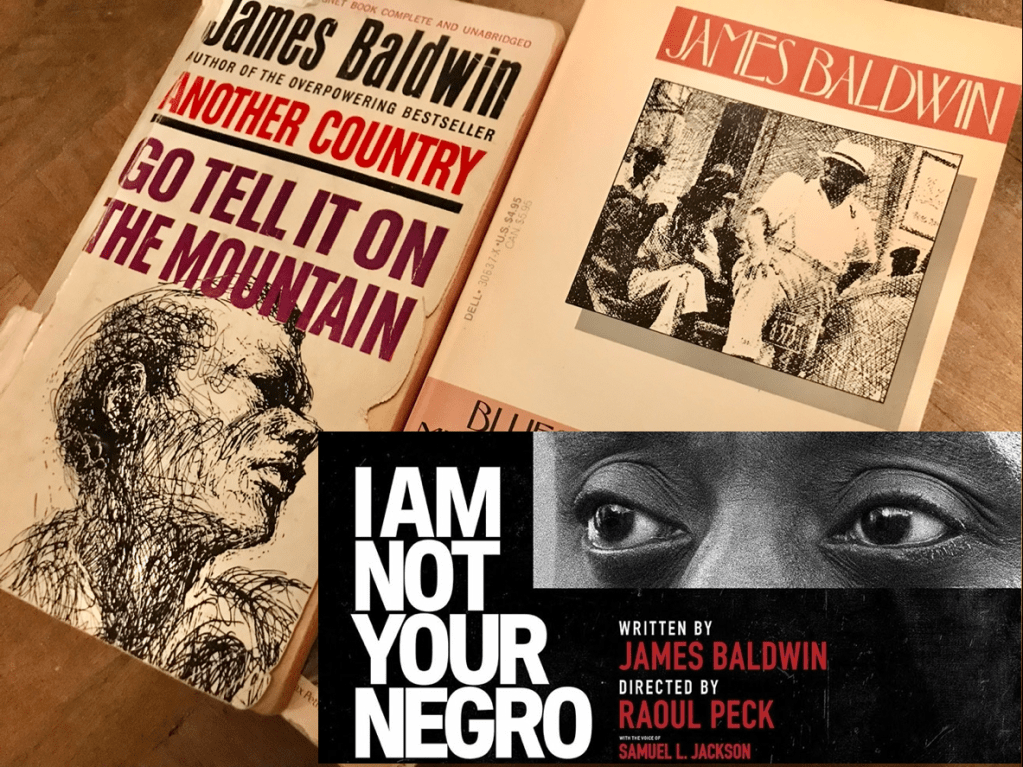
James Baldwin: “I attest to this: The world is not white; it never was white, cannot be white. White is a metaphor for power, and that is simply a way of describing Chase Manhattan Bank.”

For the gay African-American writer James Baldwin (1924-87), the way that the United States behaved abroad was tied to racism and homophobia at home. In an essay on Baldwin, the Indian writer and academic Prakash Kona wrote

“In sustaining the hegemony of powerful global elites who serve as engine for corporate capitalism America is guilty of keeping alive the notion of a civilization obsessed with its own sense of racial, moral and political superiority.”

To make his argument, Kona drew on Baldwin’s reflections on “American innocence” — “an innocence trapped in an unwillingness to take responsibility for one’s actions” that for Kona is most “clearly revealed than in their foreign policy in the third world.” That particular quality of “American innocence” is demonstrated perfectly by Dick Cavett in a question to Baldwin that opens Raoul Peck’s brilliant film, I am not your Negro (2016, currently streaming here). 

Peck again took up Baldwin’s themes in an essay in The Atlantic in 2000, saying that the people of the United States need to heed Baldwin’s words:

Why can’t we understand, as Baldwin did and demonstrated throughout his life, that racism is not a sickness, nor a virus, but rather the ugly child of an economic system that produces inequalities and injustice? The history of racism is parallel to the history of capitalism. The law of the market, the battle for profit, the imbalance of power between those who have all and those who have nothing are part of the foundation of this macabre play. He spoke about this not-so-hidden infrastructure again and again:

“What one does realize is that when you try to stand up and look the world in the face like you had a right to be here, you have attacked the entire power structure of the Western world.” And more pointedly: “I attest to this: The world is not white; it never was white, cannot be white. White is a metaphor for power, and that is simply a way of describing Chase Manhattan Bank.”

Cuba holds firm

While many other attempts to break free of U.S. hegemony over the Americas have been suppressed (Dominican Republic in 1963 and 1965; Chile in 1973; Honduras in 2009—to mention only a few examples) and others are under siege (Venezuela today), Cuba holds firm.

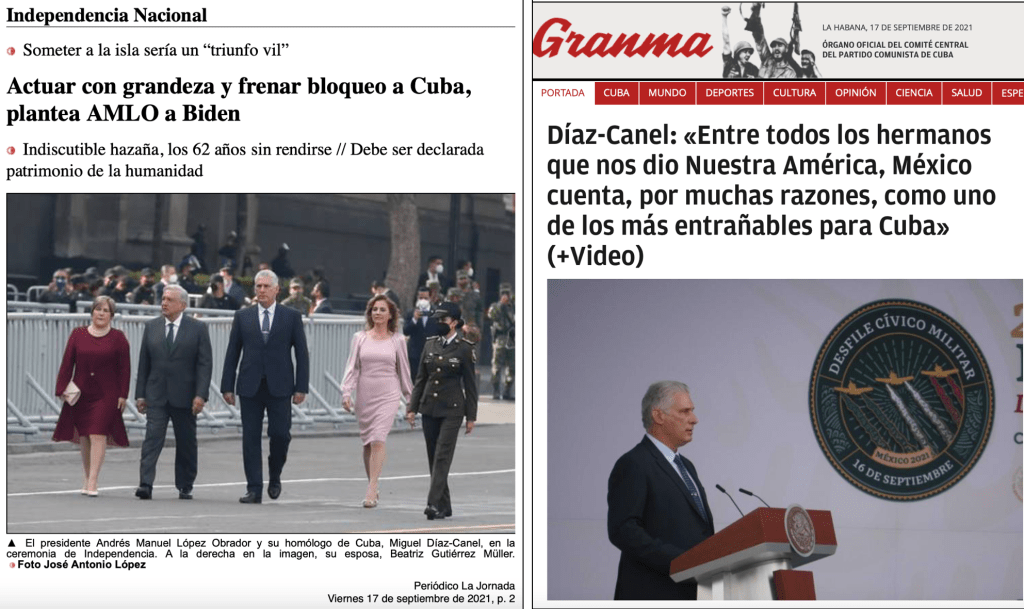
Yesterday (Sept. 16), Mexican President Andrés Manuel López Obrador welcomed his Cuban counterpart, President Miguel Díaz-Canel, to events marking the 211th anniversary of the beginning of Mexico’s fight for independence.
“I have said and I repeat: we can be in agreement or not with the Cuban Revolution and with its government, but to have resisted for 62 years without submission is an indisputable historical feat.”  Texts of their speeches (in Spanish).

Many of us from the global North get involved in the global South out of a partly-formed sense of solidarity or misguided charity. We only start to think about imperialism when we see that our goals of social justice or an end to poverty are blocked outright by U.S. imperialism (the history of invasions and coups) or by systemic oppression and exploitation (debt, banking and trade rules, etc.). Social movements find that their way towards liberation is blocked by systems imposed from the richer, Northern countries.

Their starting point in Latin America was usually the problem Gustavo Gutiérrez described: poverty—and then what to do about it. My starting point has been among various expressions of liberation theology, social gospel or the preferential option for the poor, and aligning myself with similarly-inspired actions. Hence my support for political options like those taken in Cuba, Venezuela, Bolivia and most recently (and still tentatively) Peru, and movements like the MST (landless people) in Brazil and the Zapatistas in Mexico. Those movements may not set out to be anti-imperialist, but to the extent that they are opposed by capitalism and its proponents, they must become anti-imperialist.

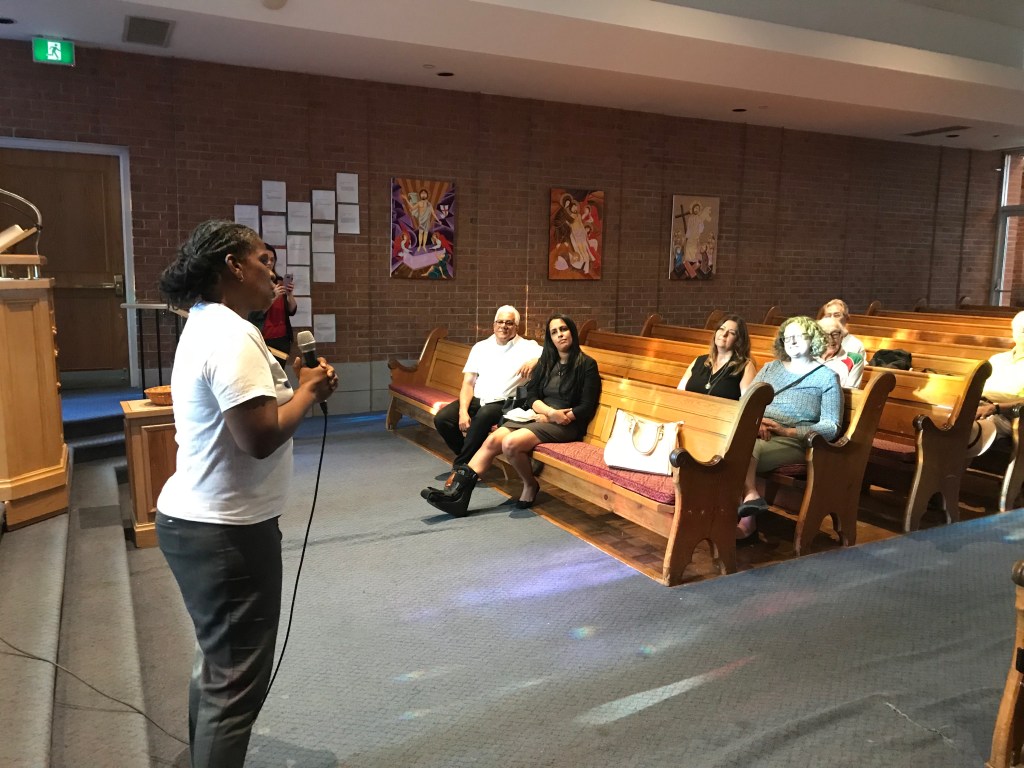
Gail Walker (left) of Pastors for Peace speaks to a gathering at College Street United Church in Toronto in July 2018.

By way of conclusion, some ways to connect with others who work in solidarity with people in Cuba.

Pastors for Peace and the larger coalition of which it is part, the Intereligious Foundation for Community Organization (IFCO), are based in New York City and led mostly by African-American and Latinx people. P4P has done a superb job of undercutting the US blockade of Cuba by simply breaking it: people go to Cuba in caravans, provide aid, and support US students to study medicine in Cuba. You can join their mailing list here for updates on Cuba.

In Canada, there are a variety of solidarity networks, including the Canadian Network on Cuba and the Canadian-Cuban Solidarity Association (CCFA) that promote friendship and share information. CUBAbility, a Toronto-based group, sends musical instruments and other aid. Some churches (notably The United Church of Canada) and trade unions work with partners in Cuba.

In Afghanistan, Colombia and everywhere, we must all become artisans of peace

A banner at the June 2010 protests against the fenced-off meetings of the G8/G20 in downtown Toronto. Photo: Jim Hodgson

While I was working to improve my French in Ottawa decades ago, I occasionally attended Mass in francophone parishes. One Sunday, this line got my attention: « Heureux les artisans de la paix… » (Mt 5:9, Jérusalem). Instead of “blessed are the peace-makers,” the text said “artisans of peace.” I love that. It implies arduous, loving work that will produce something both beautiful and useful.

As Taliban fighters move on to Kabul, and the rights of women and girls are again threatened, I feel anguish for all who have died, those who will die, and for all the lives ruined in this ill-conceived war. 

And I have to say: the aftermath of the 9-11 terrorist attacks should and could have been managed differently.

In 2001, Sept. 11 was a Tuesday. On Friday that week, I had lunch in a Toronto restaurant with Central American friends who had worked their whole lives for justice and peace and lost family members in the struggle. TV screens were showing the interfaith service underway at U.S. National Cathedral in Washington.

Led by President George W. Bush and evangelist Billy Graham, the service left me scandalized—discourse about enemies, not a word about love or peace—and feeling helpless and hopeless in the face of the war that everyone knew would follow. U.S. Navy Chanters at beginning and end. The closing hymn was The Battle Hymn of the Republic—“Glory, glory, hallelujah… His truth is marching on… terrible swift sword”—giving Christian blessing to the war. Then a benediction, that we might bear the days to come with strength. The recessional included the tolling of a bell and the colours of the various military services being removed. The political and military establishment returned to work, to duty. 

And so began the War on Terror, what Bush kept calling a Crusade.

A week later, the Canadian Council of Churches (CCC) sent letters to Canadian Prime Minister Jean Chrétien and to members of churches in Canada proposing a different approach.

The dogs of war were howling loudly, so the letters were scarcely noticed at the time. But today, as Taliban troops move closer to Kabul, they are prophetic voices crying in the wilderness (John 1:23). Their relevance today is in their warning against imperialist adventures and articulation of alternative approaches. These are lessons the world still needs to learn.

First, the letters insisted that perpetrators of terrorist crimes must be brought to justice, and that due legal processes must be followed. To the Prime Minister, the CCC said: “We acknowledge that in international relations due process is not always clear, but we remind you that the United Nations and its Security Council are the essential custodians of international due process.” 

The letters acknowledged global interdependence. The letter to church members said: “Whatever action is taken must fully acknowledge that we live in an interdependent world. It is no longer possible to believe that we can live in an island of fortified safety in an otherwise unsafe world.” It added:

“Co-operative international efforts to prevent terrorism must be supplemented by co- operation in developing a broad range of agreements that provide for the security of all. International agreements such as the Kyoto Protocol, the International Criminal Court, the Anti-Ballistic Missile Treaty, legal limits on small arms possession and transfers, and other international mechanisms are vital building blocks for a world community that cares for the security and safety of all of its citizens.”

The letters deplored the targeting of people of other faiths. “We therefore encourage Christians throughout Canada to join together with people of other faiths to offer solidarity and courage. Above all let us find a common voice in calling for security and safety for all the world’s people.”

The letters encouraged attention to root causes and a “justice and peace” perspective in the face of terrorist actions:

“It is not morally or spiritually acceptable to speak lightly of war. A campaign against terrorism is necessary, but only in the context of a broader commitment to justice. In the past, a single-minded campaign against communism in Afghanistan helped create conditions of terror in Afghanistan, including support to the now accused Osama bin Laden; it spawned the Taliban; and it contributed to enormous instability in Pakistan. So also an unthinking military campaign against terrorism could have immense unforeseen consequences if not guided by due processes of law, appropriate limits to force, and pursuit of justice for all.”

The letter to the Prime Minister was signed by: Janet Somerville, the CCC general secretary (and one of my former editors at Catholic New Times); Ernie Regher, the director of Project Ploughshares; David Pfrimmer, chair of the CCC’s justice and peace commission; and Bishop André Vallée, CCC president.

Instead of complex, long-term strategies of peace-making, a war strategy was followed: defeat the Taliban and the al-Qaeda network militarily and rebuild core institutions of the Afghan state. But the United States and its NATO allies failed to destroy either group, or to secure and stabilize Afghanistan. 

In April 2002, President Bush announced a version of the post-World-War-II “Marshall Plan” for Afghanistan, promising substantial financial aid. But development efforts were under-funded and U.S. attention shifted to that other perceived enemy: Iraq. 

What was needed in Afghanistan was not war, but a long, slow process of engagement, dialogue, community development, facilitation of victim-offender reconciliation: solidarity instead of imperial interference. You don’t have to like the Taliban to begin a conversation—but that might not have been the starting point anyway. It’s pretty clear that people in Saudi Arabia—a key U.S. ally and supplier of oil—bankroll the Taliban, al-Quaida and factions in Pakistan, promoting a fundamentalist version of Islam that is not shared by the vast majority of Muslims. 

Inter-religious dialogue has a role here too. The Kingdom of Saudi Arabia supports the G20 Interfaith Forum, an event usually held just ahead of G20 meetings to look at issues of religion and sustainable development. It may be uncomfortable for their representatives to listen to people like me talking about LGBTI rights in a conversation about religious freedom, but from such encounters over time, change happens. And the United States needs to develop more honest relationships with its “allies” like Saudi Arabia and Pakistan, engaging them on human rights, knowing that change won’t happen immediately but over time. Looking the other way doesn’t help Afghans or anyone else.

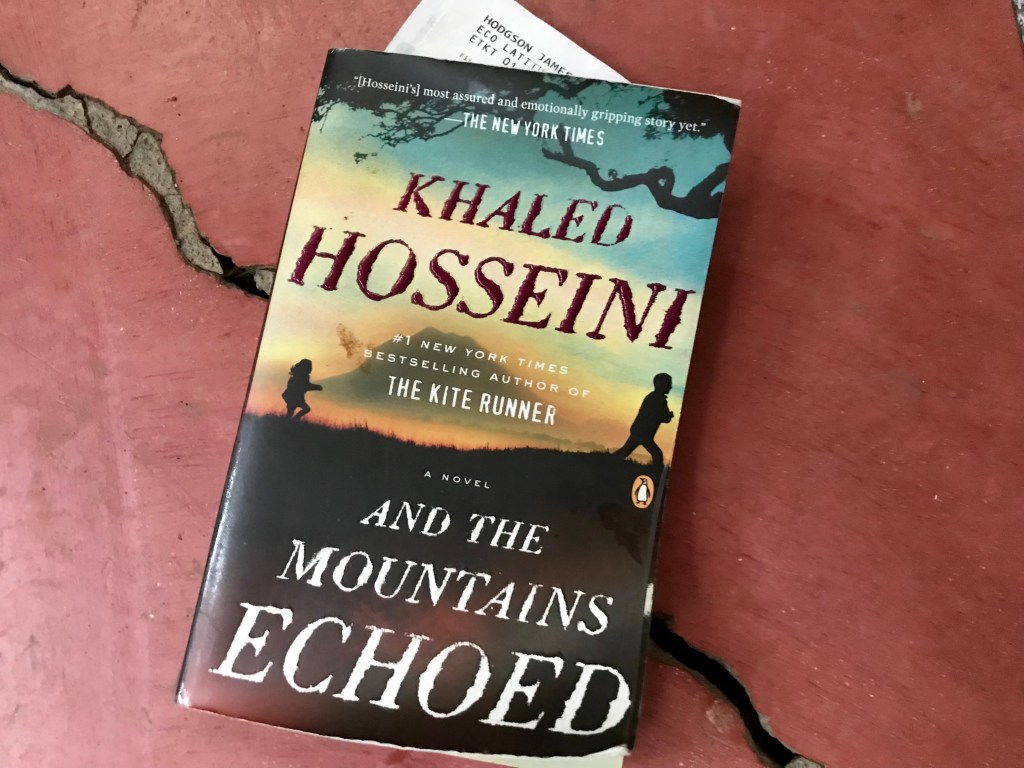
This week, I have been reading Khaled Hosseini’s novel, And the Mountains Echoed. Like his earlier novel, The Kite Runner, he sweeps across Afghan history and geography. On page 127, he writes of war, wars, “many wars, both big and small, just and unjust, wars with shifting casts of supposed heroes and villains, each new hero making one increasingly nostalgic for the old villain.”

We must all become artisans of peace.