Talking about peace when there is no peace*

Jim Hodgson, May 23, 2023

Peace is a pre-condition for any possibility of transforming the global economy for the sake of humanity and the Earth – or, more modestly, achieving those elusive Sustainable Development Goals by 2030.

In the weeks after Russia’s invasion of Ukraine, I added my voice to those of others who pleaded for peace talks. In recent weeks, new efforts from church leaders and global South political leaders are underway to bring the sides together. But peace initiatives are either ignored or disdained by most media and “Western” leaders.

Headlines and images from Mexico’s La Jornada and Argentina’s Página 12 newspapers. On the left, Lula asks that a new Cold War between China and the United States be avoided and defends the use for currencies other than the U.S. dollar for international trade. On the right, from top: Zelensky asks for support from G7 powers; G7 leaders create new sanctions against Russia and debated in Hiroshima the nuclear arsenals of other countries; The Vatican makes its peace effort official so as to end the war in Ukraine.

Case in point: the participation at the recent G7 meeting in Hiroshima of Brazilian President Luiz Inácio “Lula” da Silva and Indian Prime Minister Narendra ModiFinancial Times dismissed Lula and Modi as Russian President Vladimir “Putin’s apologists.” Their participation was eclipsed by that of Ukrainian President Volodymyr Zelensky, who did meet with Modi, but blamed scheduling conflicts for not meeting Lula – and then joked with reporters that Lula was more disappointed than he was. 

Well, yes. Lula’s interest in peace has everything to do with funds diverted to war and away from efforts for authentic development that could help alleviate the other crises of climate change and migration. (Lula also said that Zelensky did not show up for a meeting they had scheduled.)

In Hiroshima,  Lula criticized the division (or re-division) of countries into two antagonistic blocs and abandonment of a multipolar world that seemed to be emerging in the wake of the pre-1991 Cold War.

Meanwhile, South African President Cyril Ramaphosa was not even invited. But he and other African leaders are involved in a peace initiative to end the war in Ukraine. In a news conference May 17, he said he had had “separate telephone calls” with Putin and Zelensky over the weekend, where he presented an initiative drawn up by Zambia, Senegal, the Republic of Congo, Uganda, Egypt and South Africa. Leaders of the six countries say they plan to travel to Russia and Ukraine “as soon as is possible.”

In his weekly newsletter on May 15, Ramaphosa said South Africa would not be drawn “into a contest between global powers” despite having faced “extraordinary pressure” to do so.

“We do not accept that our non-aligned position favours Russia above other countries. Nor do we accept that it should imperil our relations with other countries,” Ramaphosa said.

During the same week, Chinese envoy Li Hui visited Moscow, his first stop in a European tour that would also take him to Kyiv, to develop a 12-point plan proposed by Beijing on the first anniversary of the Russian invasion. 

Last September, Mexican President Andrés Manuel López Obrador called for establishment of a Commission for Dialogue and Peace that would facilitate the search for a solution through negotiations. 

Nobody has a “magical formula to achieve peace,” writes Juan Pablo DuchLa Jornada’s Moscow correspondent. “But [proponents of peace] hope that Russia and Ukraine would establish a ceasefire and sit down to negotiate their conditions with the objective of putting an end to the bloodshed and devastation. All that is lacking is that Moscow and Kiev by open to making concessions – the first not wanting to cede Ukrainians regions already annexed and the latter refusing to lose territory – but without concessions, it does not seem possible to open a path toward peace in a war that, say what you will, only brings calamities.”

WCC delegation with Ukrainian church leaders in Kyiv on May 11 (WCC photo); Patriarch Kirill with WCC general secretary in Moscow on May 17 (ROC photo).

Meanwhile, the World Council of Church and Pope Francis have both renewed their efforts for peace. 

In mid-May, a delegation led by WCC general secretary Jerry Pillay visited church and government leaders in Kyiv and Moscow. In Kyiv, the WCC delegation met with senior leaders of both the Ukrainian Orthodox Church and the Orthodox Church of Ukraine, two churches whose dispute has intensified since the Russian invasion. In Moscow, they met with Patriarch Kirill, head of the Russian Orthodox Church and widely viewed as a supporter of President Putin.

For his part, Pope Francis has given Italian Cardinal Matteo Zuppi the task of leading a mission in hopes it can “ease tensions” in the Ukraine war and lead to a path of peace. The pope has said has said he would go to Kyiv if such a journey would help bring peace, but said that could happen only if he could also visit Moscow.

* The phrase “peace, peace, when there is no peace” is found in Jeremiah 6:14 and later at 8:11. It is also found in Ezekiel 13:10 and 16. The direct criticism is of those who build flimsy walls and smear them with whitewash: a makeshift solution to a problem. The metaphor then and now is points to poor leadership. In our time, we can think of leaders who promise that war will lead to peace. “They have treated the wounds of my people carelessly,” writes the prophet Jeremiah, “saying ‘peace, peace,’ when there is no peace.”

War Never Again – Westerplatte, Gdansk, Poland (site of the first battle of World War II in 1939).

Haiti: another military intervention looms large

by Jim Hodgson

Haitians (whose own proposals for building a better country are persistently ignored) once again face an illegitimate government, one that has proposed a foreign intervention force to quell gang violence and to keep itself in power. 

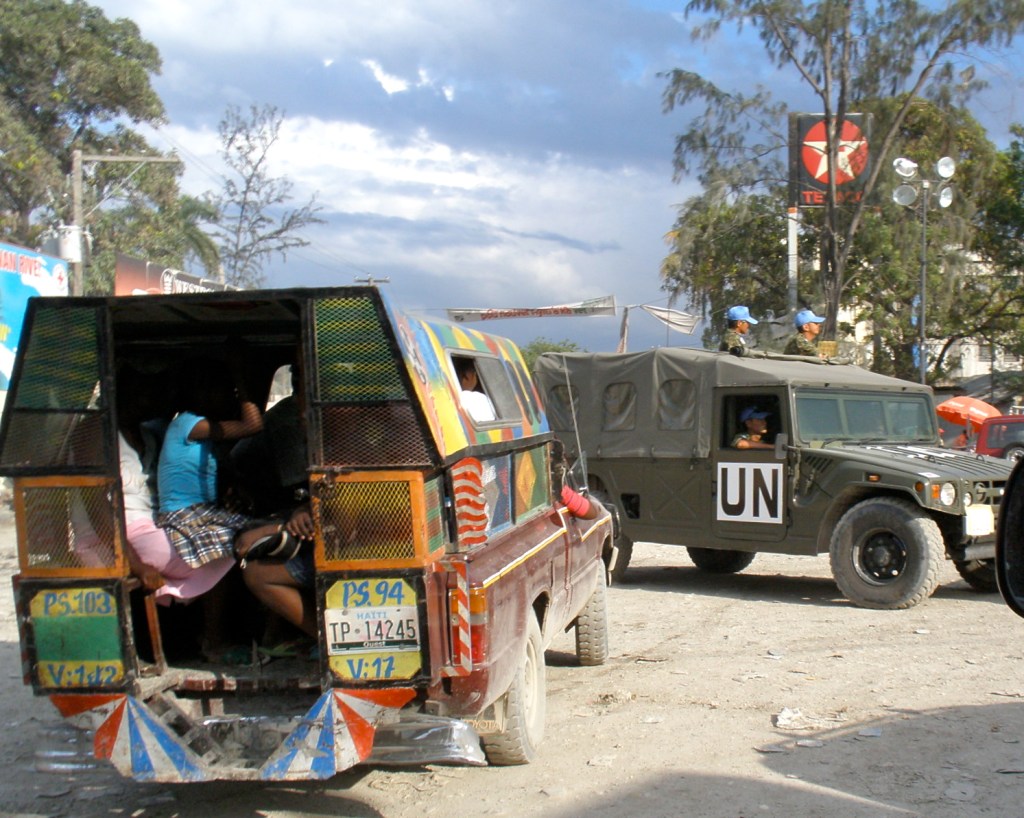
Haiti and the UN: another crossroads. Photo: Jim Hodgson, April 14, 2010, Port-au-Prince.

In reporting by many journalists from the global north, popular protest against the government, increased fuel prices, corruption and intervention is blended with reports of actions by the street gangs.

On Friday, Oct. 21, the UN Security Council approved its resolution authorizing a foreign military intervention and imposing sanctions on only one of Haiti’s gang leaders. (One might ask: when do gang leaders travel? Where do they go? Which banks do they use? Who sells them their weapons?)

The new intervention propositions emerged from the UN general secretary and Haiti’s “interim” prime minister: as if such interventions had worked in 1915, 1994, or 2004 to resolve the problems of people impoverished by the same imperial powers who are now invited to return.

Those powers misunderstand the present crisis. They can’t tell the difference between protest against the unelected government of Prime Minister Ariel Henry and the criminal activity of gangs. On Oct. 15, the United States and Canada delivered armoured vehicles for use by Haitian police.

Worse, the great powers continue to ignore the specific civil society proposals for a way forward that are contained in the “Montana Accord”  (named for the hotel where the group met). The group told a visiting U.S. delegation that it opposes foreign military intervention.

Cholera – never really eliminated after being brought to Haiti by support staff to soldiers in a previous UN force – is back. There are proposals to bring vaccines, but Haiti was able to deliver COVID vaccines to just a few more than three per cent of the population. Only 41 per cent of Haitian children are vaccinated against measles and 51 per cent are fully vaccinated against polio. Effective management of the cholera outbreak would require some sort of humanitarian truce, and that would require negotiations with the gang leaders – pretty much anathema to the imperial powers who seem more inclined to use force.

The current debates over the legitimacy of the government, possibilities for new elections, getting back on track with humanitarian aid and a reasonable development agenda are addressed in a new letter to U.S. President Joe Biden by four U.S. senators and nine members of the House of Representatives.

Recalling “decades of US meddling in Haiti’s internal affairs,” the group lauded the Montana Accord, which proposes a transition period that will ultimately result in elections, adding:

“None of these weighty issues can be addressed effectively in isolation. Neither free and fair elections, nor effective delivery of humanitarian assistance, are possible until the violence is quelled. Yet the Haitian police conspire with the gangs, and past U.S. efforts to build a professional, accountable police force have failed. The violence can only be quelled by Haitian authorities acting consistently with the rule of law through impartial judicial processes.”

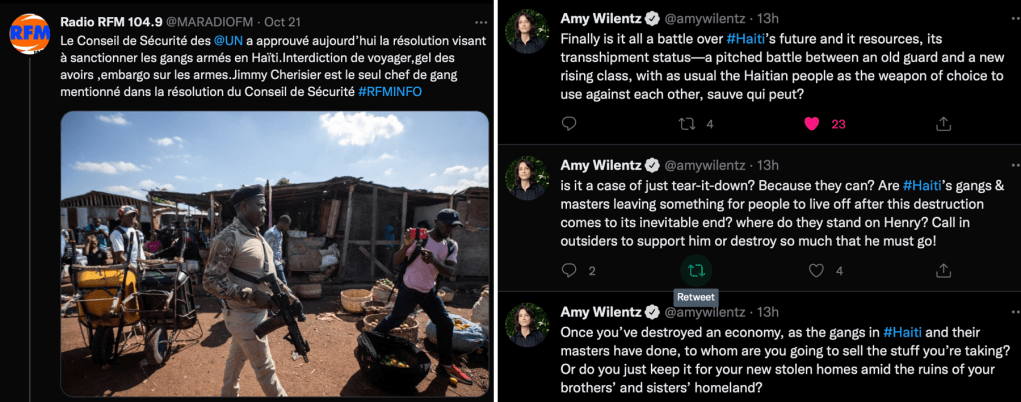
News of the UN Security Council resolution (left); earlier, Amy Wilentz, a noted U.S. writer on Haitian events, expressed her doubts about intervention proposals.

I’ll share a short reading list with you:

Edwidge Danticat (my favourite Haitian writer) in The New Yorker: “The Fight for Haiti’s Future.” The United States and its allies should withdraw their support support for Henry and the Parti Haïtien Tèt Kale (P.H.T.K.), the Haitian Bald-Head Party. “During the Party’s decade in power, Haitians have consistently taken to the streets to protest against P.H.T.K. leaders’ ineffectiveness and corruption, and to demand accountability for the funds misused, misappropriated, and pilfered through Venezuela’s oil-purchasing program, Petrocaribe. Accountability never came.”

If you read French and would welcome regular updates on what is going on in Haiti, I would encourage you to sign up for Info-Haïti. This is the monthly bulletin of Concertation pour Haïti, a Montreal-based coalition of civil society organizations. Write to: communications@aqoci.qc.ca or follow the Concertation on Twitter at: @haiti_pour. 

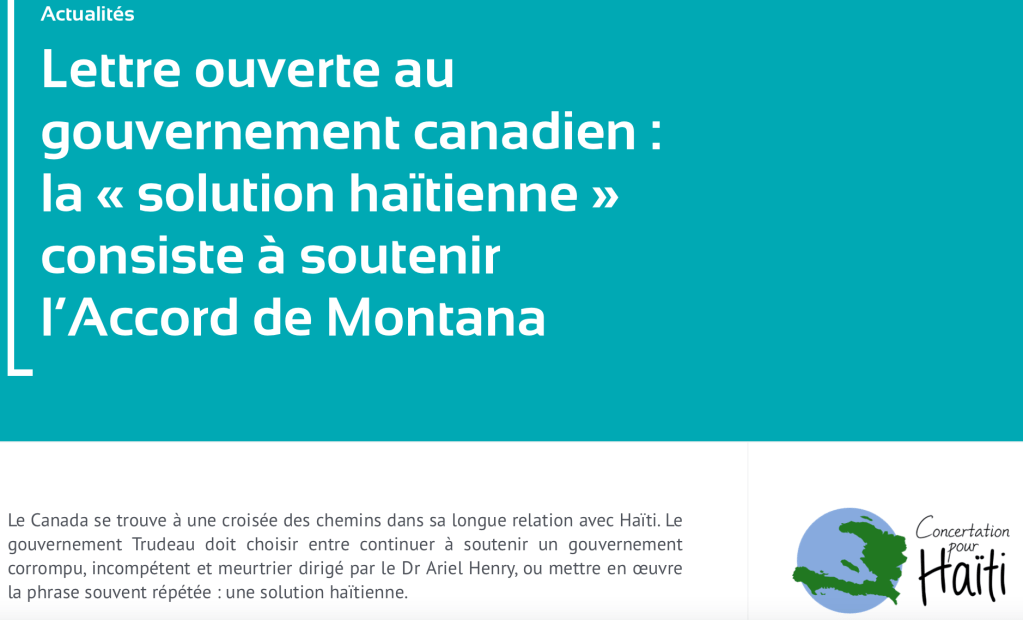
On Oct. 20, members of the Concertation produced their own letter to the government of Canada with recommendations for a way forward. “Canada must now stop supporting the government of Ariel Henry and put its full weight behind this coalition, which offers the only viable proposal for a transition that would allow Haitians to organize free and fair elections. To continue to support the current Prime Minister is to condemn the country to corruption, impunity, the continued domination of gangs, and ever-worsening food insecurity.”

A former U.S. ambassador to Haiti, Dan Foote, has warned that if the U.S. moves forward with the UN plan to send armed forces into Haiti, the result will be a predictable catastrophe.

And The New York Times has managed to produce pretty useful lesson plans for teachers about Haitian history and culture.

World Council of Churches: for peace, against sanctions, and sexuality talks continue

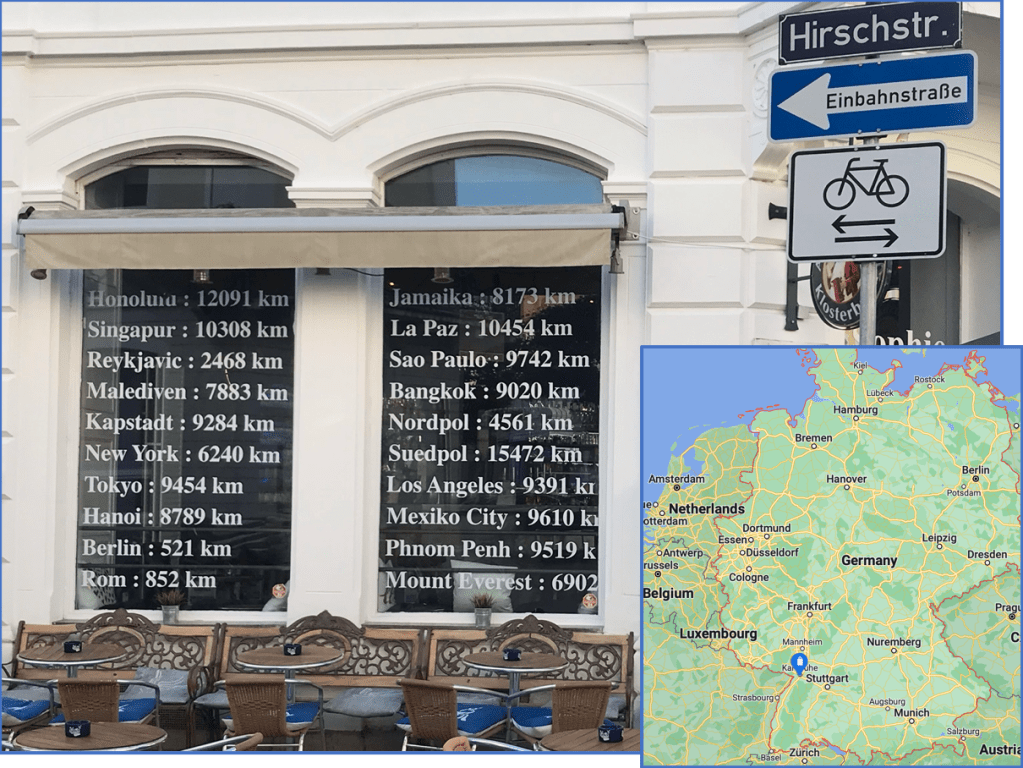
From this small city in southwest Germany, impacts of the WCC Assembly may be felt from Cape Town (9,284 km) to to Phnom Penh (9,519 km).

KARLSRUHE – As sometimes happens in large gatherings, I found myself on a single track in this Assembly of the World Council of Churches. For several years, I have participated in Rainbow Pilgrims of Faith, a global coalition that has accompanied the WCC work on sexuality (specifically) and gender justice (generally). 

Here in Karlsruhe, I led the group’s media work: blog posts, news releases and a few interviews. My colleagues managed more direct forms of engagement with delegates and other participants through an information booth and in various panels and workshops. 

At the same time, 660 delegates and more than 2,000 other participants from all parts of the world worked to shape ecumenical priorities for the next eight years or so.

Signs are positive that WCC will continue work on sexuality (sexual orientation, gender identity and expression), but that was just one thread in a tapestry of concerns addressed here.

There are many documents and scores of news releases to pour over, but two stand out for me. 

One, the more theological or spiritual of the two, is A Call to Act Together. For inspiration, it drew from the last book of the Bible, Revelation, and its themes of human suffering at work in the world: war, death, disease, and famine. “We were conscious of their manifestations in the world today. In their wake come injustice and discrimination, where those who have power often use it to oppress others rather than to build inclusion, justice, and peace.”

The message continues: “As the climate emergency accelerates, so does the suffering experienced by impoverished and marginalized people.”*

A sign of peace in Toronto’s distillery district.

The second document, The Things That Make For Peace, is also worthy of attention. It is longer and more focused on policy options.

“We understand that making peace involves addressing racism, xenophobia, antisemitism, hate speech and other forms of hatred of the other (all of which have increased and intensified during these years, in large part encouraged by populist nationalist movements); crisis and competition for essential resources for life; economic injustice and inequality in the marketplace; interstate conflicts and re-emergence of war; and the raising of the spectre of nuclear war.”

It is specific about Russia’s invasion of Ukraine and other armed conflicts – from Colombia to Eritrea and Ethiopia – calling for a global ceasefire “as an urgent moral imperative.”

Particularly close to my heart are sections that call for “support for the churches and peoples of Syria, Cuba, Venezuela and Zimbabwe in the midst of oppression due to international sanctions that affect these populations’ human rights and dignity.” 

Syria is an important case in point, the document says. “International and unilateral sanctions are contributing to worsening the humanitarian situation, harming a civilian population already made vulnerable by war. Moreover, sanctions are damaging the historical multicultural and multi-religious fabric of the Syrian society, forcing Christians and other indigenous groups to flee the country.”

The document calls for the removal of Cuba from the U.S. list of countries that sponsor terrorism and to “accompany the churches as prophetic voices of peace, hope, cooperation and mutual respect.”

* There is a third, equally-impressive document that I found later: The Living Planet: Seeking a Just and Sustainable Global Community. The document calls governments to “practical actions… to meet the pressing need to avert ecological disaster.”