“Security for whom?” asks KAIROS after Canada cuts foreign aid

by Jim Hodgson

Canada’s newest cuts to foreign aid spending follow cuts by other wealthy countries (most notably the elimination earlier this year of the U.S. Agency for International Development). Beyond immediate impacts, these cuts point to a reshaping of sixty years of international cooperation for development.

Over the next four years, Canada will chop $2.7 billion from its aid budget. At the same time, at the behest of the Trump regime next door, it will increase military spending with $81.8 billion over five years.

In June, Canada announced its commitment to increase military spending: CodePink, Development and Peace, and CBC headlines.

Few analysts bring together the issues of development assistance, militarism and climate justice the way that the ecumenical coalition KAIROS Canada has in its statement on the budget:

Canada needs to decide what role it wants to play in the world. These issues are inseparable: climate justice, Indigenous sovereignty, migrant justice, gender equality and peacebuilding rise or fall together — and Canada’s future depends on advancing them as one interconnected project of justice. 

KAIROS added that it is concerned by the prospect of a scaled-up military-industrial complex in Canada. “Even today, arms components made in Canada are used against civilians in Gaza and other conflict zones due to loopholes that allow them to flow indirectly through allies, helping to further entrench global insecurity.” (Canadian-built military surveillance and targeting equipment was used in at least two of the U.S. attacks on small ships in the Caribbean Sea, as reported recently by another Canadian ecumenical coalition, Project Ploughshares.)

KAIROS said the government “could have introduced a wealth tax to tackle the historic wealth gap and fund real climate action. It could have ended subsidies for fossil fuel corporations. Instead, it cut public services, forcing job losses that fall hardest on women, Indigenous Peoples and racialized communities,” as the Canadian Centre for Policy Alternatives warns.

While there are no actual projections yet of where the foreign aid cuts will hit, the budget statement cites Canada’s spending on global health programs as an example, saying this has “grown disproportionately” in comparison to other countries.

“Any reductions to Canada’s global health investments will have devastating consequences for women and children around the world, while threatening the health, security and prosperity of Canadians,” said Charmaine Crockett of the Canadian Partnership for Women and Children’s Health (CanWaCH) in a joint statement with Cooperation Canada. “Canada’s decades of leadership in global health have always been about investing in a safer, more equitable world, because we know that when we turn our back on the world’s most marginalized people, we all suffer.”

The cut to Canadian aid, elimination of USAID, and reduced spending announced by Britain, Germany, Netherlands and others means that in total, G7 countries are trimming their aid budgets by nearly one-third, the steepest reduction since 1960, according to the Globe and Mail

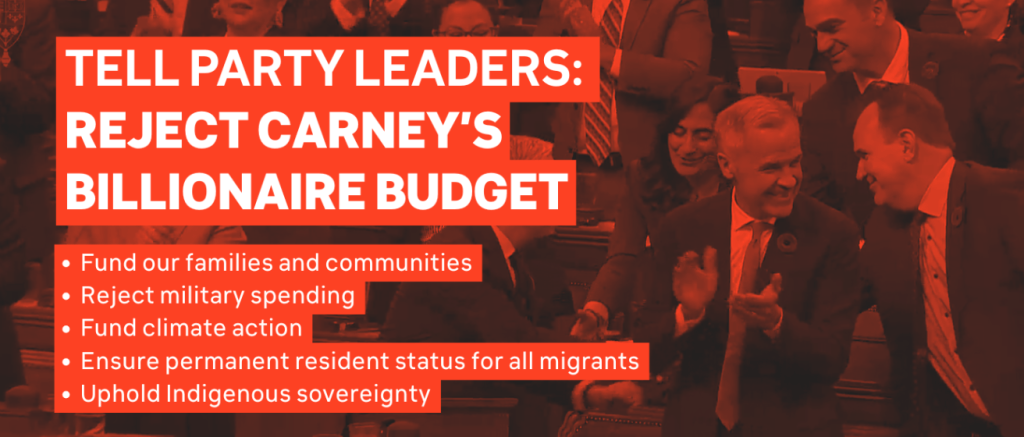
Several Canadian organizations (350.org Canada, World Beyond War, Migrant Rights Network, Council of Canadians, and the Canadian Association of Professional Employees) have come together in a letter-writing campaign to opposition leaders to encourage them to demand change before Parliament votes again on the budget.

Where to now with international development?

I want to share links to some articles that delve more deeply into the significance of what may become a shift away from a model in which rich countries of the Global North “donated” funds to impoverished countries of the Global South. The model has always been criticized as it promotes dependence and blocks systemic change. This is “big picture” stuff, very distant from issues of how to support refugees at border posts or funding for cooperative farming in Central America. (I am, as always, grateful to Brian Murphy for sharing these and other articles. You can follow him on Bluesky @murphyslog.bsky.social.)

First, “The end of the global aid industry,” by Zainab Usman. Usman proposes a focus on industrialization – what has worked for China and South Korea and is unfolding now in Vietnam and Thailand. Usman writes:

Part of the problem with the aid industry is that its benefits have been spread too thinly across a multitude of domains and not focused enough on productivity-enhancing sectors. To this end, advocates of global development should focus on enabling poorer countries to access cheap development financing for targeted investments in sectors that connect people, such as electricity, telecommunications, and mass transit. 

Second, “The geopolitics of international development (after foreign aid),” by Ken Opalo in An Africanist Perspective. Opalo examines a series of essays in Foreign Policy magazine’s Fall 2025 issue that all deal with development issues. Opalo sets his description of the decline of the foreign aid model in the context of a rising multipolarity that is matched by the “ongoing general decline of the authority and influence of Western states.”  

There’s no denying that the financial, intellectual, and institutional hegemony of Western countries significantly shaped development practice over the last 60 years. This era had both good and bad elements. The good elements included efforts to incentivize the modernization of economic management and policymaking in low-income countries (work that’s far from finished, and which has yielded some good results); while the bad elements included the fostering of aid dependence, cyclical faddism, reflexive policy extraversion, lack of elite ambition, and implicit support for a hierarchical world order that permanently placed low-income countries at the bottom of the global totem pole.

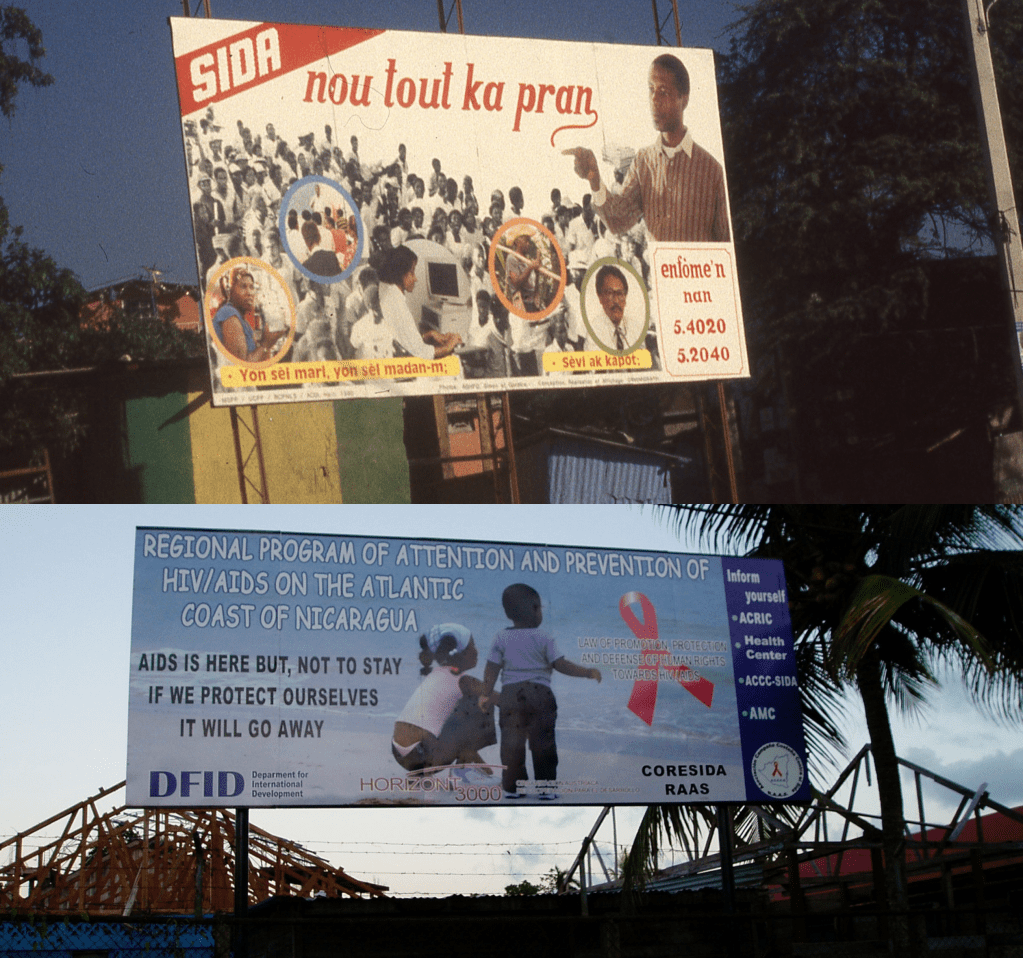
AIDS prevention education in decades past: Haiti in 1984 (top); Atlantic coast of Nicaragua in 2007 (below). Jim Hodgson photos.

Third, “Three ways to help the developing world survive the end of aid,” by Winnie Byanyima, Executive Director of UNAIDS, in The Guardian. Byanyima reminds us that developing countries are still drowning in debt and facing interest rates up to 12 times higher than wealthy countries. “Low- and middle-income countries now pay $4 to the richest in the global north for every $1 they receive in aid. Thirty-four of Africa’s 54 countries spend more on debt than on healthcare.” She adds:

  • Governments must relieve the “chokehold of sovereign debt.”
  • The richest need to pay their fair share: the wealth of billionaires soared by $2 trillion in 2024, but they paid an effective tax rate of just 0.3 per cent.
  • Governments need to treat lifesaving medicines not as commodities, but as global public goods. “This has been one of the great successes of the HIV response” (at least over the past 20 years, though not before—and threatened again with loss of U.S. funding this year).

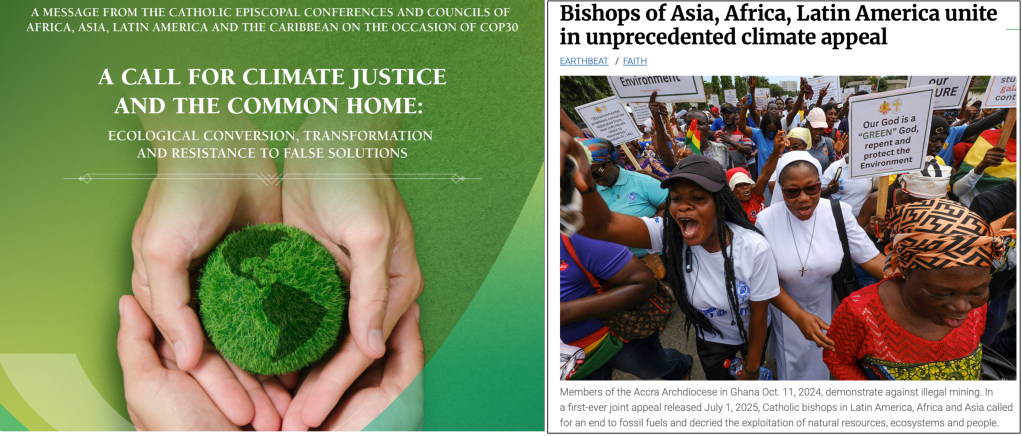
Catholic bishops from Latin America, Africa and Asia demand climate justice

by Jim Hodgson

In a new document, Catholic church leaders from across the Global South blasted the “openly denialist and apathetic stance” of “so-called elites of power” in the industrialized world who pressure their governments to back away from much-needed mitigation and adaptation measures.

Preparing for the next United Nations climate change gathering, COP30, which will take place in November in Brazil, conferences of bishops from Asia, Africa and Latin America (FADM, SECAM and CELAM respectively) published a joint document entitled A call for climate justice and the common home: ecological conversion, transformation and resistance to false solutions. (You can download the document here.)

It’s the first time the three regional bodies have created a joint statement. The document offers an expansive vision for the U.N. climate conference. “At COP30, we demand that States take transformative action based on human dignity, the common good, solidarity and social justice, prioritising the most vulnerable, including our sister Mother Earth,” the bishops said.

They described the U.N. climate gathering as a moment for the church “to reaffirm its prophetic stance.”

Part of the 32-page document states:

Our demand

The climate crisis is an urgent reality, with global warming reaching 1.55°C in 2024. It is not just a technical problem: it is an existential issue of justice, dignity and care for our common home.

The science is clear: we must limit global warming to 1.5°C to avoid catastrophic effects. We must never abandon this goal. It is the Global South and future generations who are already suffering the consequences.

We reject false solutions such as ‘green’ capitalism, technocracy, the commodification of nature, and extractivism, which perpetuate exploitation and injustice.

Instead, we demand:

Equity: Rich nations must pay their ecological debt with fair climate finance without further indebting the Global South, to recover losses and damages in Africa, Asia, Latin America and the Caribbean, and Oceania.

Justice: Promote economic degrowth and phase out fossil fuels, ending all new infrastructure and properly taxing those who have profited from them, ushering in a new era of governance that includes and prioritises the communities most affected by the climate and nature crises.

“I am raising a voice that is not mine alone, but that of the Amazonian peoples, of the martyrs of the land—we could say of the climate—and of the riverside, Indigenous, Afro-descendant, peasant and urban communities,” said Cardinal Jaime Spengler, archbishop of Porto Alegre in southern Brazil and president of CELAM. He was speaking at a news conference July 1 at the Vatican.

Vatican News reported that Canadian Cardinal Michael Czerny, prefect of the Vatican’s human development office, spoke spontaneously in the news conference to point to the document’s connection to the legacy of Pope Francis. “Ten years ago, I wonder if there is anyone who could have imagined this press conference as a fulfilment and implementation of Laudato si’. This is an extraordinary expression of what Pope Francis has called for and what Pope Leo is continuing to underline and call. I am grateful,” he said.

WCC begins Ecumenical Decade of Climate Justice Action

In Johannesburg ten days earlier, the World Council of Churches launched its Ecumenical Decade of Climate Justice Action.

During a plenary session June 21 of the WCC central committee, church leaders from six continents shared reflections and urged action for climate justice.

The plenary emphasized the biblical concept of jubilee as a framework for systemic transformation—a key foundation of the Ecumenical Decade. Speakers called for churches to move beyond charitable responses toward addressing root causes of climate injustice, particularly the disproportionate impact on vulnerable communities.

“Our lifestyle consumes 1.8 times what Earth can renew. Economic transformation must begin in the heart; theology must shape discipleship and discipleship must shape the world,” said Rev. Dr. Charissa Suli, president of the Uniting Church in Australia, during a theological reflection on “Jubilee for People and Earth.”

[When I shared Dr. Suli’s comment on Facebook several days ago, my colleague and friend Mark Hathaway pointed out: “In the Global North, it is more like 4.5 times what the Earth can renew—and even higher in the U.S. and Canada (I think about 6 times). The richest 10-20 per cent of humanity is responsible for most consumption and most GHGs [greenhouse gases] and a mere 100 large corporations are responsible for 70 per cent of GHGs.”

WCC has held previous ecumenical decades in the past, including The Ecumenical Decade of the Churches in Solidarity with Women (1988-1998) and The Ecumenical Decade to Overcome Violence (2001-2010).

Vatican’s Jubilee commission urges systemic change as it launches new debt relief report

A Vatican-backed report authored by more than 30 prominent economists calls for urgent action and systemic reforms to address the global debt and development crises of our times.

The group, convened by the late Pope Francis for this Jubilee year, provides recommendations on debt relief and economic policy.

What follows is (mostly) from a news releases today by Jubilee USA and the Initiative for Policy Dialogue at Columbia University:
“This report is a blueprint to solve the current global debt crisis, prevent future economic crises and create an economy that radically reduces poverty,” said Eric LeCompte, executive director of the Jubilee USA Network and a Vatican advisor who is at the Pontifical Academy of Social Sciences (PASS) for the report launch. 

“While debt relief and a just economy are at the center of Catholic teaching, this is the first report convened by a Pope that focuses on technical recommendations to achieve an economy that serves everyone,” he added.
Nobel Prize-winning economist Joseph Stiglitz and former Argentine Minister of the Economy, Martín Guzmán, led the work of the expert group.

The report “seeks to contribute to a comprehensive rethinking of the global rules governing finance, taxation, trade, and the sharing of knowledge,” said PASS. “At its heart lies a clear and urgent goal: to help build a global economy that serves people, especially the most vulnerable, and truly leaves no one behind.”
Pope Francis reiterated the interfaith calls of Pope Benedict and Pope John Paul II on debt relief and economics, making these issues the focus of the Christian holy year of Jubilee 2025. Pope Leo XIV continues the efforts of his predecessors. 

Twenty-five years ago in Jubilee 2000, over $100 billion in international debt was cancelled, but a lack of structural reform, combined with recent world events, resulted in systemic vulnerabilities that are now undermining hard-won gains. 

The time for new Jubilee action is now.

Recommendations include:

  • Improve debt restructuring: Change multilateral institution policies and legislation in key jurisdictions so that creditors and debtor governments are newly incentivized to agree to more timely and sustainable debt restructurings.
  • End bailouts to private creditors: Multilateral institutions including the International Monetary Fund should change their policies and practices to support sustainable recoveries, not de facto bailouts of private creditors or crippling austerity.
  • Strengthen domestic policies: Developing countries should more extensively use capital account regulations to discourage destabilizing flows and create a more stable environment for long-term investments and should invest in structural transformation.
  • Enhance transparency: All should support financial policies that are transparent and have broad societal support.
  • Reimagine global finance: All should support a comprehensive change in global financing models to drive financing for sustainable development, including lending that supports long-term growth.

The report’s findings will be discussed at the 4th International Conference on Financing for Development in Seville, Spain, June 30-July 3 and other global gatherings where the global debt and development crises will be high on the agenda.
“Developing countries spent a record $1.4 trillion paying debt in 2023 and too many countries spend more on paying debt than they do on the urgent needs of their people,” said LeCompte who also serves on United Nations debt expert groups. “In African and low-income countries, debt payments are two-thirds higher than their combined spending on health, education and social services.”
According to the World Bank, more than 800 million people live in extreme poverty, over 100 million more than previously believed. The report calls for a range of reforms as a debt and poverty crisis that has been growing in the face of the pandemic, wars, cost-of-living and interest rate hikes rose to prominence in the agenda of global leaders in multiple forums. Proposals include greater transparency, reforms to the International Monetary Fund, changes to laws in New York and the United Kingdom which govern private sector debt, improving debt contracts and an international bankruptcy system akin to the national bankruptcy courts that exist in most countries.
“This report can move the G7, G20, IMF and United Nations to make short-term decisions to address the current crisis and lay a foundation to prevent future crises,” stated LeCompte.
“The experts who wrote this report are a critical part of the global Jubilee movement, which includes advocates in pews, development groups, conservatives, liberals and people of every faith,” shared LeCompte. 

Read or download the report here or here.

Read Pope Francis’ Jubilee 2025 debt focus speech here.