“From collapsing ecosystems to collapsing economies, our communities have been battered by a storm of climate chaos, debt distress, deepening inequality, and systemic exploitation. These crises are the direct result of a global economic system built to extract from our lands, our people, our futures—so the rich and powerful can thrive off our suffering.”
That was the message May 29 of the Asian Peoples’ Movement on Debt and Development (APMDD), a Manila-based network that calls for change in debt, climate, economic and development systems.
In June 2024, Pope Francis and other church leaders around the world launched a new Jubilee campaign for debt cancellation. In Canada, the call is taken up by KAIROS, the Canadian Council of Churches and by Development and Peace (D&P) — among others. KAIROS launched a “Turn Debt into Hope” Jubilee 2025 petition that by June 13 had been signed by more than 36,400 Canadians.
Promoters of the campaign gathered for a People’s Forum in Calgary this past weekend ahead of the G7 summit and joined Sunday’s protests in the heart of the city. The Catholic Register reported on the event:
Salome Owuonda, executive director at the Africa Centre for Sustainable and Inclusive Development (Africa CSID), spoke about the consequences of crushing debt in Kenya…. She told participants that in her East African country “50 per cent of revenue generated is directed toward paying debt” and that puts health care, education, climate action and food security at risk. “And things are not getting better,” said Owuonda. “The government is calling for more taxes as they have to try and pay the debt.”
Dean Dettloff, a research and advocacy officer at D&P, shared that over “3.3. billion people in the world live in countries that spend more paying the interest of their debt than health care and education.” He added that many nation states also direct more funds to these expenditures than safeguarding the environment.
Tarek Al-Zoughbi, a Palestinian Christian who serves as the project and youth coordinator at Wi’am: The Palestinian Conflict Transformation Centre in the West Bank, spoke about the suffering in Gaza and many countries around the world.
Al-Zoughbi said that during this Jubilee year, we “must begin to recognize this image of God that is in each of us and that is in the spirit of creation.” He called for an end to environmentally exploitative practices that contribute to ecological debt.
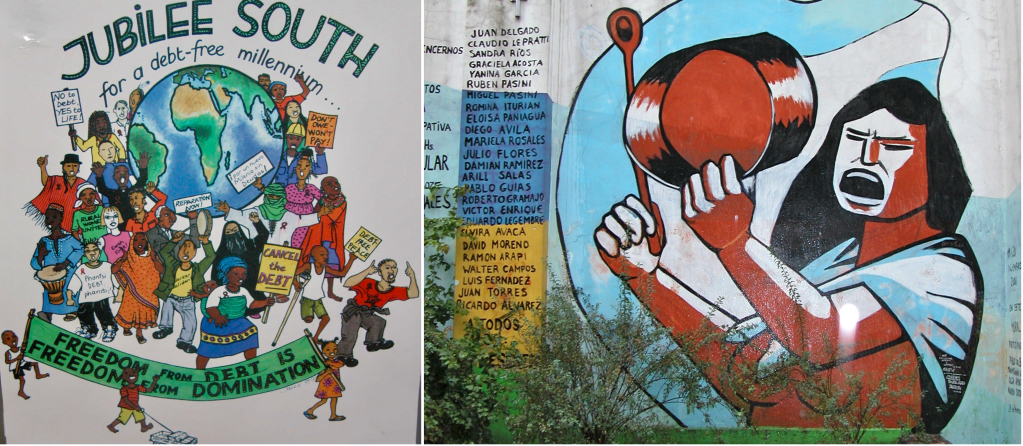
Some readers will recall the the Millennium Jubilee of 2000, which mobilized millions globally to demand debt cancellation for nations in the Global South. KAIROS reminds us:
In Canada, this movement took shape as The Canadian Ecumenical Jubilee Initiative, the country’s most successful faith-based advocacy campaign. This powerful campaign, led by church-based justice organizations, KAIROS’ predecessor coalitions, and the Canadian Council of Churches, played a crucial role in achieving over $100 billion in global debt relief.
Yet, 25 years later, a worsening global debt crisis continues to affect vulnerable populations, exacerbated by rising interest rates, climate change, and economic inequality. An unacknowledged “ecological debt” owed by the North to the South and Indigenous Peoples further exacerbates the crisis.
Global “Financing for Development” system is part of the problem
When Pope Francis launched the new Jubilee debt campaign a year ago, he called for a “new international financial architecture” that breaks the financial-debt cycle that has contributed to a current global debt now estimated at $313 trillion.
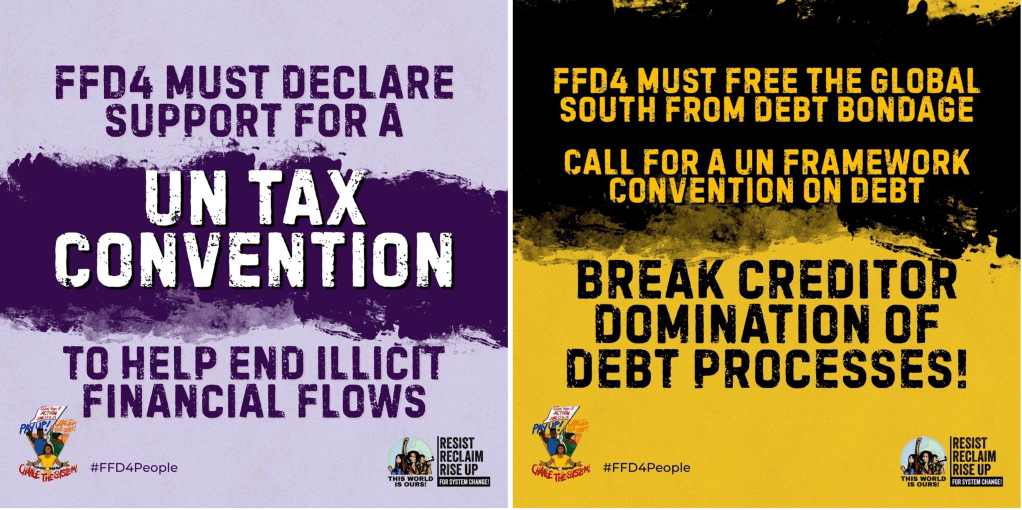
That APMDD statement that I referred to above presses hard on that global financial architecture, describing a “rigged system” that favours creditors. It criticizes the Financing for Development (FfD) process, which was created to ensure fair and just financing for development and climate action—especially for the Global South. “Instead, it has become another space for the Global North to rewrite the rules to protect their power, shirk their responsibilities, and advance false solutions. Their hypocrisy is most glaring when it comes to climate finance.”
At the end of June, world leaders will gather in Seville, Spain, for the fourth international conference on financing for development, dubbed FfD4. (I attended an ecumenical pre-event at the first FfD conference in Monterrey, Mexico, in 2002 and wrote about it here.) In recent months, negotiations on the outcome document have sparked intense civil society campaigning.
The Global Policy Forum said June 17 that the final draft retains an intergovernmental process for managing debt, but weakened its mandate to making “recommendations”. Critics argue that this could kill whatever hope remains for achieving Sustainable Development Goals (SDG) as “debt crises strangle fiscal space and derail the implementation of the Agenda 2030 for Sustainable Development.” Global Policy Forum describes some of what is gone from the outcome document (referred to now as the “Compromiso de Sevilla”):
The paragraph on phasing out fossil fuel subsidies (27i) has been deleted entirely, as well as the specification of asset types to be covered by national and global asset registries (28g). The language around the UN Framework Convention on International Tax Convention was also softened just two months before the first round of negotiations starts: “We support” was downgraded to “we encourage support” (28b). A similar change occurred in the paragraph on investor-state dispute settlement, where the “we undertake reform” was replaced by “we support efforts to reform” (43l).
Meanwhile, the rich countries led by the United States are cutting international aid and increasing their military spending.
The G7 meeting near Calgary issued a series of statements (CBC, left) but one searches in vain for anything about debt cancellation or development assistance. The statement on “migrant smuggling” fails to address the question of why people leave their homes or how development aid and peace-making strategies can ease the problem.
The APMDD statement concludes:
“We are here to expose the Global North—not just for failing to deliver climate finance, but for actively sabotaging it in bad faith. This is no accident. It is a calculated strategy to protect their profits and deny justice to those they have exploited for centuries…. We see through every lie. We reject every excuse.”
Back in the late 1990s, I travelled frequently by bus over the mountains between my home in Cuernavaca and my job in Mexico City. Even when the traffic was bad, the trip usually took less than two hours. The bus company almost always showed a film.
When not working or looking at the views, including the Popocatepetl volcano, I watched the movies. I can’t guess how many movies I saw without ever seeing how they ended. My friends and I joked about organizing a Pullman de Morelos film festival, renting or borrowing some of the movies, and just watching the last half hour of all of them to see how they ended.
Among those movies was a favourite of mine, Smilla’s Sense of Snow (Bille August, 1997). The shocking death of a small boy in Copenhagen opened a tale of conflict between corporate greed and the Inuit people of Greenland. But I never saw how it ended.
Years went by and then, in a used bookstore in Strathroy, Ontario, I found the novel by Peter Høeg on which the film was based. It’s an excellent book with a satisfying ending.
Among parts that have stayed with me was this:
“…[W]e read Karl Marx’s Das Kapital. It was a book I grew quite fond of. For its trembling, feminine empathy and its potent indignation. I know of no other book with such a strong belief in how much you can accomplish if you simply have the will to change.” *
Hmm. Empathy as a feminine virtue? Let’s see. Google offers this definition: “the ability to understand and share the feelings of another.”
To me, it’s a basic element of human decency. A measure of empathy is vital in action to transform the plight of those made miserable by any who abuse their power. To empathize doesn’t mean you have to agree with someone: just recognise their different circumstances. Maybe some of us would rather say solidarity.
“In a time when empathy is increasingly treated as a vice, we must not turn our backs on the world’s most impoverished,” wrote Andy Harrington after a recent visit to South Sudan. Harrington is the executive director of the Canadian Foodgrains Bank (CFGB), a Winnipeg-based NGO that enables food aid to reach people in need and communities to move toward food sovereignty. He said people are already dying because of Trump’s cuts to USAID, adding that Canadian support is more essential than ever. (Eight people in South Sudan, including five children, died as they tried to walk for three hours to seek treatment for cholera after U.S. cuts forced local health services to close, Save the Children said April 9.)
Elon Musk said recently that empathy is killing Western civilization. But it seems the far-right has been attacking empathy for a long time now. And it does so with some masculine archetypes.
“MAGA influencers have begun to talk ofthe tariffs as a way to make the United States ‘manly’ again, by bringing old-time manufacturing and mining back,” asserts historian Heather Cox Richardson in her Substack post on April 8. In these first three months of the disastrous Trump regime in the United States, she has found her way into my daily reading as she sets current events in historical context. She adds:
In a larger sense, Trump’s undermining of the global economy reflects forty years of Republican emphasis on the myth that a true American man is an individual who operates outside the community, needs nothing from the government, and asserts his will by dominating others.
Associated with the American cowboy, that myth became central to the culture of Reagan’s America as a way for Republican politicians to convince voters to support the destruction of federal government programs that benefited them. Over time, those embracing that individualist vision came to dismiss all government policies that promoted social cooperation, whether at home or abroad, replacing that cooperation with the idea that strong men should dominate society, ordering it as they thought best.
The Trump administration has taken that idea to an extreme, gutting the U.S. government and centering power in the president, while also pulling the U.S. out of the web of international organizations that have stabilized the globe since World War II. …
Now Trump is demonstrating his power over the global economy, rejecting the conviction of past American leaders that true power and prosperity rest in cooperation.
In less than 100 days, the Trump regime has dismantled that “liberal consensus” that at least regulated corporate excess, provided very basic social welfare, and promoted infrastructure. (This is not to ignore some of the United States’ greatest failures. Among them: slavery and Indigenous genocide, of course. But also not providing universal health care and maintaining racial segregated schools by underfunding the public education systems.)
* Peter Høeg, Smilla’s Sense of Snow, Toronto: McClelland-Bantam, 1997, pp.144-45.
For years, I have gathered and often shared the stories of how people organize for a better future for their communities and the planet. A few days ago, I started gathering articles as they appeared about the ecological crisis.
And I am alarmed – though the rational part of my brain reminds me that I have long-known of the intersection of ecological disaster with civil conflict and war.
In 1971, I was 13 when I attended my first demonstration. It was about peace and the environment: opposing the third in a series of U.S. nuclear tests at Amchitka in the Aleutian Islands between Alaska and Siberia. Again today, war and ongoing failure to respect ecology bring us closer to collapse. A previous test in 1969 gave rise to the Don’t Make A Wave Committee in Vancouver. The group became the global movement Greenpeace. (Photo: an old clipping from the Summerland Review, November 1971).
Addressing the UN General Assembly a week ago, Secretary General António Guterres pointed to the two canals most vital to world trade and management of supply chains.
Trade via the Panama Canal is down 36 per cent in the past month because of low water levels – a consequence of the climate crisis.
Trade via the Suez Canal is down by 42 per cent, since the start of Houthi attacks on shipping in the Red Sea more than three months ago. Those attacks in turn are a foreseeable consequence of the excessive – many argue “genocidal” – Israeli response to the Hamas-led attack on Israeli civilians from the Gaza strip last Oct. 7.
The Pressenza news service reports this week that for the first time on record, the average global temperature exceeded 1.5 degree Celsius over a 12-month period, according to data from the Copernicus Climate Change Service (C3S). Last month was also the warmest January globally since C3S records began in 1950, with an average air surface temperature 0.7 degrees Celsius higher than the January average from 1991 to 2020.
Meanwhile, the Atlantic Ocean system of ocean currents may already be on course to collapse, according to a new report published Feb. 9 in the journal Science Advances. Such collapse could lead to further sea level rise and cause temperatures to plunge dramatically in Europe and rise in the southern hemisphere.
A new UN report shows that about 44 per cent of migratory species worldwide are declining in population. More than a fifth of the nearly 1,200 species monitored by the UN are threatened with extinction.
In Mexico, prolonged drought led to sharp drops in production of corn and avocados last year. Lack of rainfall has affected water reservoirs used for agriculture. Across the country, water storage is at 42.7 per cent of normal, and down 34.8 per cent from 2022. This is leading producers to plant less in the winter 2023-24 season. Images from La Jornada: (left) “corn production dropped 40 per cent because of the drought;” (centre) “Monarch butterflies occupy 59.3 per cent less surface area than the previous year because of climate impacts;” (right) “Industrial activity in Iztapalapa (the east side of Mexico City) could be paralyzed for lack of water.”
In January, Mexico’s national weather service reported that 2023 was the driest in 82 years, with just 21.1 per cent of normal rainfall. Last year also saw the largest amount of land afflicted by wildfires.
The Aqueduct Water Risk Atlas has published an interactive map where you look at drought risks in any part of the planet. Half of Mexico and large parts of the western United States are in red, along with most of northern Alberta.
Raúl Zibechi, the Uruguayan observer of social movements in Latin America, published a column recently that examined these and other risks.
“We continue to be stuck in the minuteness (‘chiquitismo’) of consumerist and narcissist daily life,” he wrote – “the latest telephone or clothing; the football game where we are merely spectators; the electoral campaign that only entertains, but does not resolve anything profound. This is the strategic triumph of capitalism: taking us headlong toward collapse while we look at the screen, ignoring the destruction and massacre of life.”
Views from Corpus Christi, Texas, June 2007. (Photos: Jim Hodgson)
In the speech by António Guterres that I noted above, he denounced the wars and ecological destruction, and offered some signs of ways forward. He spoke of A New Agenda for Peace.
“Peace is a rallying cry,” he said. “It is a call to action.” And he went on to describe the actions that must be taken: ceasefires, negotiations, addressing causes of migration, protection of species, debt and development finance, real action on climate, and reform of UN systems including the Security Council.
“We must also make peace with the planet. Humanity has waged a war we can only lose: our war with nature,” Guterres said. “For my part, I can guarantee that I will never give up pushing for peace.”