In El Salvador, the struggle continues as AG appeals not-guilty verdict in case of Santa Marta 5

The office of El Salvador’s Attorney General has decided to appeal the acquittal Oct. 18 of five community leaders, a move quickly rejected by their community and by Salvadoran and global organizations that have worked in solidarity for more than two decades to reject a proposed gold mine that threatened water resources.

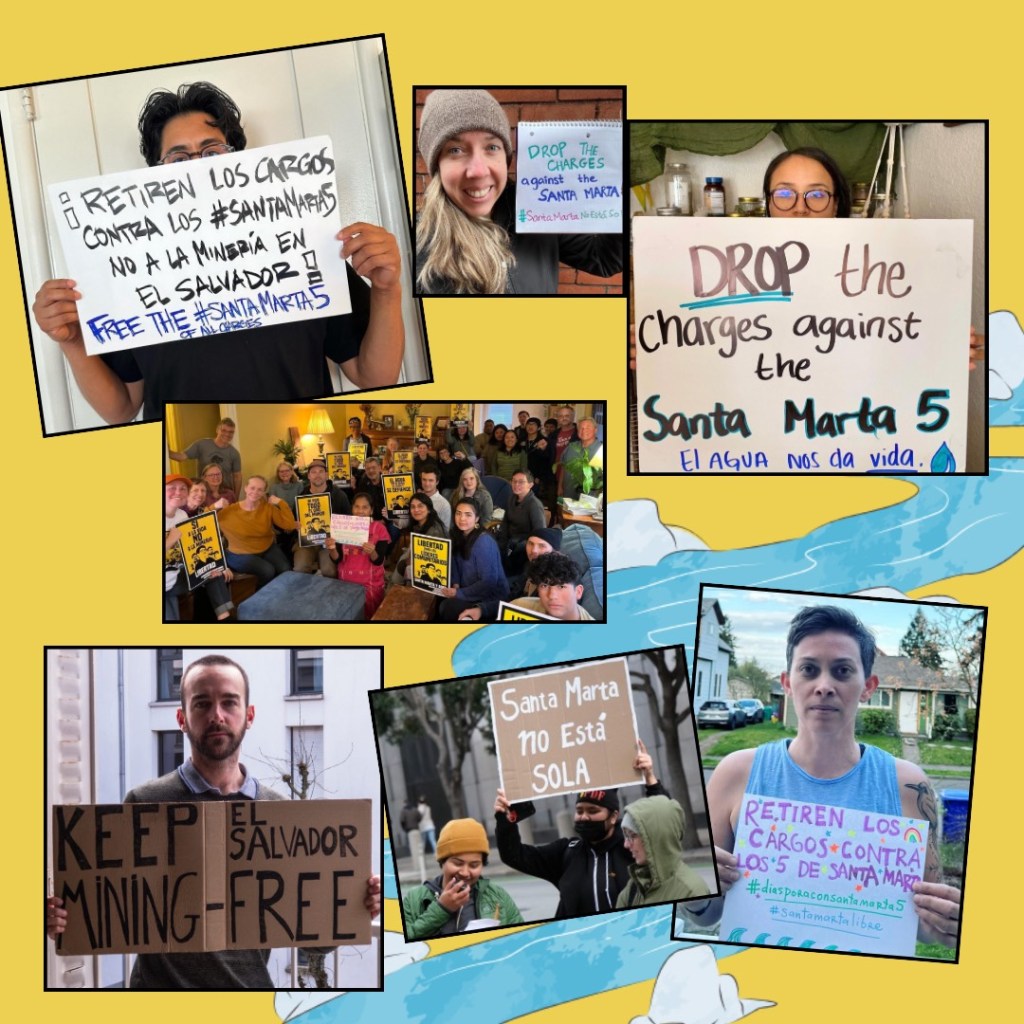
Images: ACAFREMIN (the Central American Alliance Against Mining) and CISPES (Committee in Solidarity with the People of El Salvador)

The office of El Salvador’s Attorney General has decided to appeal the acquittal Oct. 18 of five community leaders, a move quickly rejected by their community and by Salvadoran and global organizations that have worked in solidarity for more than two decades to reject a proposed gold mine that threatened water resources.

Leonel Herrera, a journalist covering the case for Diario Co Latinocalls the decision to appeal “reprehensible.” Authorities should use their time and resources “to investigate true war crimes, beginning with the massacres committed against Santa Marta which took the lives of hundreds of civilians—mostly women, the elderly and children.” 

This was never a true criminal case, Herrera added, but rather “a spurious accusation invented to persecute a group of former guerrilla fighters not for war crimes, but rather for what they do now: care for the water, protect the ecosystem and attain the continuity of lives gravely threatened by the possible re-activation of mining projects.”

Santa Marta Rejects Appeal of Acquittal of Water Defenders

Translation by CISPES (Spanish original is  here)

We reject the appeal of the Attorney General’s Office and demand that the acquittal of our environmental leaders be upheld

The Attorney General’s Office (FGR) remains determined to prevent legality and justice from prevailing for the community leaders of Santa Marta and ADES, who were definitively acquitted last October 18 by the Sentencing Court of Sensuntepeque, Cabañas. For this reason, an appeal has been filed before the Criminal Chamber of Cojutepeque.
Despite multiple calls to respect the acquittal of the environmental activists of Cabañas, the Prosecutor’s Office seeks to reverse Sentencing Court’s ruling, which is in accordance with the law and congruent with the principles of due process. The appeal is characterized by a lack of valid legal argumentation and by the disrespectful way in which the representatives of the Prosecutor’s Office refer to the honorable sentencing judges.
In this sense, we ask the magistrates of the Criminal Chamber of Cojutepeque not to admit the appeal and to ratify the decision of the Sentencing Court of Sensuntepeque, which has acted independently, in accordance with the law and without being pressured by extrajudicial factors that conspire to condemn the defenders of water, the environment and life threatened by the possible reactivation of mining.
In this regard, it is worth remembering that the ruling of the Sensuntepeque Sentencing Court responds to the mandate of the Cojutepeque Criminal Chamber, which on two occasions transferred the decision of whether or not the alleged acts constituted crimes against humanity or war crimes to the Sensuntepeque Sentencing Court.
In accordance with this mandate, the sentencing judges analyzed the case and unanimously determined that the alleged crimes presented by the prosecution did not meet the definition of a crime against humanity or a war crime, as established in the Rome Statute and the Geneva Conventions, respectively. Therefore, they ruled that the criminal action was inadmissible due to the statute of limitations of the alleged crimes and decreed a definitive dismissal for the defendants.
We alert the country and the world of this attempt by the Salvadoran Attorney General’s Office to continue using the judicial system to persecute environmental activism and manipulate restorative and transitional justice to criminalize environmental defenders who warn about the serious dangers of mining extractivism.

Definitive freedom for the community leaders of Santa Marta and ADES!
Yes to Life, No to Mining!

Cabañas, El Salvador, October 30, 2024

Political trial of El Salvador’s water defenders continues

by Jim Hodgson

Sadly, it’s not unusual for peace activists and the defenders of ecology or Indigenous rights to find themselves facing trumped-up criminal charges. It’s a bit weird when it happens to members of a modest community development organization in rural El Salvador.

But that’s what has happened to five people whose organization, the Santa Marta Association for Economic and Social Development (ADES). They’re people that I have know for more than 20 years.

This past week, five ADES members have been on trial, accused of a murder that supposedly occurred long ago during El Salvador’s civil war. No one, except zealous defenders of the government of Nayib Bukele, believes they are guilty of that crime. Rather: they built an alliance that reached around the globe, preventing a gold mine from operating in their Cabañas department and eventually winning a ban on metals mining in the whole country. While it is true that the five defendants were FMLN combatants during the 1980-1992 civil war, they are protected by the internationally-recognized Peace Agreement and the National Reconciliation Law, both signed in 1992.

Defence lawyers will present final arguments on Monday (Oct. 14) and a verdict could be issued as soon as Tuesday (Oct. 15). The next few days are a CRITICAL time to raise the visibility as much as we can to try to avoid a grave injustice. 

Here below you will find a statement from observers of the trial and some suggestions about how you can show your solidarity.

Statement of the international observer delegation on the ongoing trail of the Santa Marta and ADES water defenders  

October 11, 2024

Following three days of observing the trial of the five Santa Marta and ADES environmentalists, the international delegation convened by International Allies Against Mining in El Salvador releases the following statement:

San Salvador, we are international observers from King’s College Western University in Canada, Dartmouth College and UCLA Law School in the United States, and the Autonomous University of Mexico City in Mexico. At the conclusion of the third day of the trial, we offer the following observations:

  1. We witnessed a trial that, formally, appears to have followed most international standards of due process, however, the proceedings transgressed those standards on numerous occasions. We agree with the defense that sufficient proof was not presented to convict the five defendants. Based on what was presented in the courtroom, we believe that the only just resolution is the acquittal of all five defendants. Failure to acquit signals the lack of presumption of innocence and, therefore, the lack of an independent judiciary in El Salvador. 
  2. For example, the Attorney General´s communications team violated the gag order imposed by the judges, exposing the identities of witnesses and observers, as well as depicting the defendants in ways that assumed their guilt across social media. We fear that this violation of the gag order without a court reprimand represents a lack of procedural impartiality. Additionally, while journalists were allowed to access court grounds on the final day of the trial, we believe this was a last minute measure to rectify the earlier breach of the gag order by the Attorney General. We lament that the measure was not announced widely to members of the wider press who were respecting the gag order. Throughout the proceedings, the independent press was not allowed to take photos or videos inside the courtroom.
  3. Additionally, we observed an overly aggressive strategy by the lawyers representing the Attorney General that included berating and a using of their bodies to put pressure on witnesses. For this behavior, they were repeatedly cautioned and corrected by the tribunal. Despite warnings and requests by the judges, the Attorney General´s lawyers ignored directions, interrupted procedures, and failed to respect courtroom decorum. 
  4. At least one defendant was mistreated by the police who deprived him of sleep and food. Rather than transferring him directly to his residence following the day’s proceedings, he was held at a police substation and verbally abused, only to arrive home hours later underfed and exhausted. The following morning, police arrived at his home unexpectedly early and denied him a proper breakfast. We witnessed the visible fatigue and inability to focus on the proceedings from all of the accused. Mistreatment remains a concern as the defendants are of advanced age with a variety of preexisting conditions such as diabetes and hypertension. The well-being of the accused must be prioritized to ensure a fair trial. 

Outside of the courtroom, we witnessed overwhelming support for the defendants from international human rights organizations, the Santa Marta community, Salvadoran civil society, and social movement organizations. Many have concluded that the case is an attempt by the Salvadoran government to intimidate the environmental movement that resulted in the landmark national ban on metallic mining in 2017. For us, the incessant pursuit of a conviction by the Attorney General’s lawyers despite a lack of evidence, cannot be unlinked from these broader politics and concerns against communities resisting the encroachment of extractive projects.

While we await the closing arguments and the tribunal’s decision, and based on our observations, we maintain that justice can only be served by a ruling that affirms the innocence of the accused. The community of Santa Marta too, aggrieved and impacted by this lengthy ordeal, must be presented with restitution and steps must be taken to ensure lasting transitional justice.

Given the mistreatment described against one of the defendants above, we recommend that the rest of the proceedings, particularly the logistics of transportation, are monitored by the Office of the Ombudsperson for the Defense of Human Rights in El Salvador (PDDH) to ensure their personal and physical integrity.

  • Aideé Tassinari, Universidad Autónoma de la Ciudad de México
  • Yvette Borja, Faculty of Law, University of California Los Angeles
  • Jorge Cuéllar, Dartmouth College
  • Bernie Hammond, King’s College, University of Western Ontario

What you can do: 

Check out these suggestions from the Committee in Solidarity with the People of El Salvador (CISPES): 

Social media solidarity posts: Make the case visible on social media & make sure the community knows we have their back! As the trial approaches, one of the most important things we can do is show the Salvadoran government that all eyes are on them. You can show your solidarity with the Santa Marta 5 by participating in the international social media campaign!

Write a brief statement of solidarity like:

  • Drop the charges against the Santa Marta 5!
  • ¡Retiren los cargos contra los Santa Marta 5!
  • International solidarity is with the Santa Marta 5!
  • The diaspora is watching! Free the #SantaMarta5 of all charges!
  • Keep El Salvador metallic mining-free!

Take a picture OR make a short video with your sign

Post on social media with the following hashtags: #SantaMartaNoEstaSola  #ComunidadSantaMarta #ADESNoEstáSola

Tag the following orgs on Twitter: @stopesmining @acafremin @CSantaMarta1987 @ades_sm@no_mineria_sv @cispes_solidarity 
(On Facebook: @ComunidadSanta Marta, @Mesa Nacional frente a la Minería Metálica en El Salvador, @International Allies Against Mining, @acafremin, @ADES Santa Marta)

Check out these examples for inspiration from CISPES on X and Instagram

For more information, check out some of these resources:

El Salvador faces scrutiny for ‘political’ trial of five environmental activistsThe Guardian, Oct. 9

La Justicia de Bukele vs los Defensores del Agua, Manuel Pérez Rocha, La Jornada, Oct.7

Solidarity with El Salvador’s Santa Marta 5 Grows Across Borders | NACLA
Minera Titán, la empresa que acecha para llevarse el oro de El Salvador – Voz Pública
Threat of Metal Mining Returns to El Salvador, Organizations Warn | CISPES
State of Deception: Fact Finding Report

Almost a decade later, truth still elusive in case of the 43 students in Guerrero, Mexico 

They’ve been gone for almost 10 years now, those 43 education students who were taken one night in Iguala, Guerrero. Hypotheses abound but despite promises and investigations, the crime is not solved. 

But there are new revelations about the cover-up orchestrated at the highest levels of the Mexican state in weeks after the disappearance (see below).

President Andrés Manuel López Obrador (known popularly as AMLO) has done many good things as he nears completion of his six-year term. But his failure to press finally for the full truth of the Mexican army’s involvement in the disappearance of the students who attended the Ayotzinapa teachers training school stains his record. 

“A decade of failure,” says a headline in the Mexico City daily newspaper, La Jornada. Students, teachers and family members say their struggle will continue.

During a march in Mexico City on Monday, Aug. 27, Luz María Telumbre, mother of one of the disappeared students, told a reporter that she would be among the parents who would meet the president again the following day. This time, she said, it will be to say: “’thanks for nothing’ because we’re still walking, shouting in the streets for justice and truth.”

Another mother, Joaquína García, said “it isn’t fair that we should be in the streets for 10 years seeking justice and we still don’t know anything about the boys.” She added that she wants to tell the next president, Claudia Sheinbaum, “that we will not stop struggling until we find them and that as a woman and mother, we hope she will understand us.”

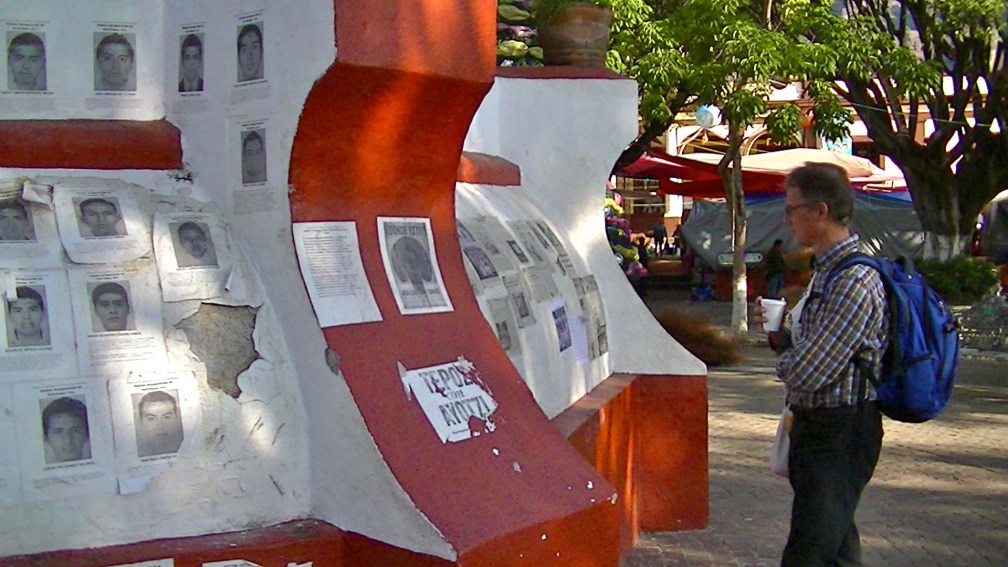
On the night of Sept. 26, 2014, students from the Ayotzinapa Normal School were attacked in Iguala, Guerrero, after they had commandeered buses to travel onward to Mexico City for a protest over the Oct. 2, 1968, massacre of student protesters at Tlatelolco plaza in Mexico City.

In Iguala, six people—including three students—were killed in the assault, 25 were injured and 43 students were abducted and presumably murdered later. Leading suspects are members of the Mexican army who worked alongside municipal officials and drug-traffickers who were trying to move opium gum (semi-processed heroin) on one of the buses that was taken.

What happened before?

One afternoon in the late 1990s, I accompanied a group of students from Canada and the United States to a meeting with rural teachers in the mountains near Tlapa in northeast Guerrero.

These teachers spoke for communities afflicted by poverty, military incursions and the drug war. They taught their students in Spanish as well as in Nahuatl or one of the other Indigenous languages spoken in the area. They dedicated their lives to strengthening rural communities through the education of children. They were convinced that people needed to be able to organize themselves and demand that their rights be respected so that things would begin to change.

“The rural teachers colleges are among the only means of social mobility within the reach of young people from campesino communities,” wrote Luis Hernández Navarro, opinion editor at La Jornada, back in 2011. “Through them, they have access to education, housing, food and later, with luck, a job they are qualified to do.” 

The first time I that I can recall hearing of the Ayotzinapa school was in January 2008, when Blanche Petrich, another La Jornada journalist, came to Toronto to support work by Canadian churches in defense of refugees from Mexico. She told us:

“To describe the panorama of repression in Guerrero, it’s enough to follow the route of the popular movement. ‘Wherever there is organization, protest, defense of human rights, mobilization of roadblocks, there is repression, irregular apprehensions and arrest warrants,’ we’re told by the [Tlachinollan] human rights organization in the La Montaña area, led by Abel Barrera. That is, the campesinos who oppose the taking of their lands for a dam in La Perota, close to Acapulco, the ecologists who resist cutting of trees in the Petatlán sierra, the laid-off workers of a government office in the state capital of Chipalcingo, the community leaders of Xochistlaguaca, the students at the normal school in Ayotzinapa: they all suffer persecution.”

And what’s new?

Through an access to information request, journalists obtained new information about the cover-up that was orchestrated after the abductions by high ranking authorities in the government during meetings presided over by then-President Enrique Peña Nieto and attended by then-Attorney General Jesús Murillo Karam and other officials. Their “historic truth” version—since proven false—contended that local police turned the students over to a drug gang which murdered them, burned the bodies at a garbage dump, and put the remains into a river.

AP photo and story (left) about revelations by a former senior official; a tweet by the Fábrica de Periodismo about the cover-up led by high officials of the previous Mexican government.

Tomás Zerón, former head of investigations for Mexico’s Attorney General’s Office, is now a fugitive hiding in Israel, beyond the reach of the Mexican justice system. But in 2022, he answered questions posed in writing by Alejandro Encinas, then Mexico’s Interior Undersecretary for Human Rights.

Appointed by AMLO’s government, Encinas chaired the Commission for Truth and Access to Justice in the Ayotzinapa Case (COVAJ). The commission included family members and their advisors. Their report, published in August 2022, said federal, state and municipal politicians, along with the armed forces and local police, knew what had happened. 

But that report and a subsequent one in September 2023 have been undermined by the refusal of President López Obrador to accept its conclusions and his accusations against the human rights groups that accompany the families, including Tlachinollan and the Jesuit-backed Miguel Augustín Pro Human Rights Centre.

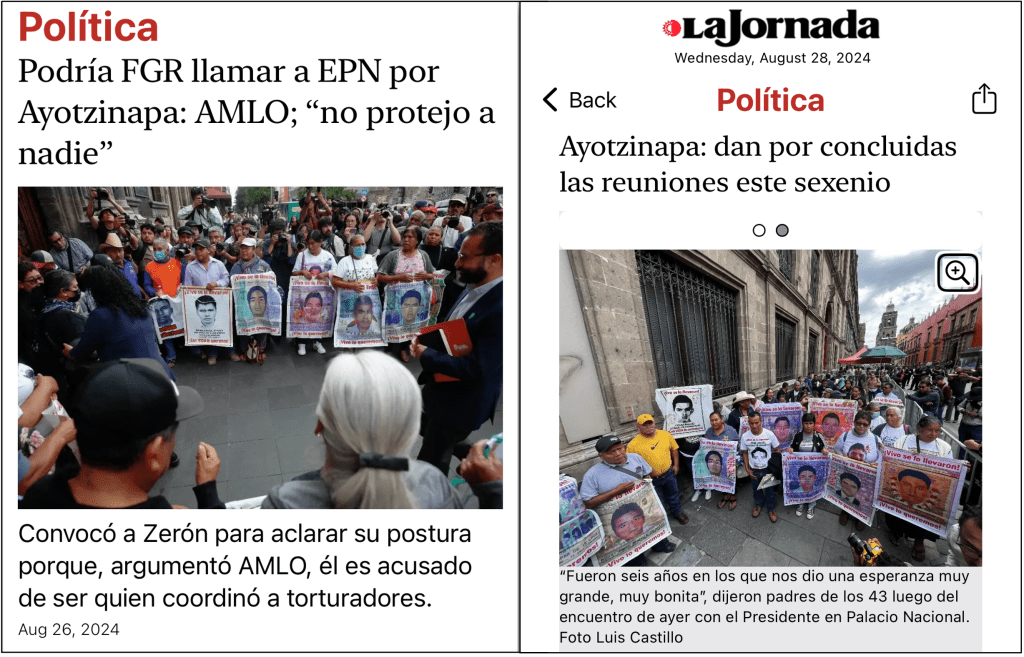
Left: La Jornada story Tuesday with headlines (adding my own details): federal prosecutors may call former president Ernesto Peña Nieto to testify about Ayotzinapa; AMLO: “I don’t protect anybody.” Below the photo, the text says that AMLO has also called on Zerón “to clarify his position because he is accused of coordinating the torturers.” Right: story today about the last of the parents’ meetings with AMLO.

After a meeting Tuesday (Aug. 27) with the president, the parents said it was the last one they would hold with him before he leaves office Oct. 1. 

“We ended badly,” said their lawyer, Vidulfo Rosales of Tlachinollan. He added that while in the first three years of this government, they saw clear good will to get to the truth, in 2022, the situation changed. “This is when we touched the sensitive fibres of the Mexican Army; we could advance no further. There was a break, a crisis, including in the relationship, the dialogue.”

“This government, unfortunately, could not give us truth and justice,” he added.