Of elections and other fables: Guatemala today

by Jim Hodgson

My recent sojourn in Guatemala coincided with the formal launch of Guatemala’s 2023 election campaigns in March. But not everyone who wants to run will be allowed on ballots.

Voters will head to the polls on June 25 to elect a new president, vice-president, 160 congress members, 20 seats in the Central American Parliament, and mayors and counsellors in 340 municipalities. 

Leading the list of those banned from running is Thelma Cabrera, a 52-year-old Indigenous farm-worker who was to be the candidate of the Movement for the Liberation of the Peoples (MLP). 

She is blocked because her running mate, Jordán Rodas, could not present a letter stating there are no corruption cases open against him—even though other politicians with pending cases were allowed to register. From 2017 until last year, Rodas served as a human rights prosecutor, but he was forced to leave Guatemala because he had allied himself with anti-corruption efforts. Several times this year, the UN High Commissioner for Human Rights, Volker Türk, has warned that new prosecutors are using the judicial system to harass and prosecute justice officials who previously investigated crimes of corruption.

The MLP emerged before the last election four years ago as the “political arm of a social movement”—the Comité de Desarrollo Campesino (CODECA, the Farmworkers Development Committee). 

“We are seeking to transform the country, after all the injustices we have suffered,” Cabrera told Associated Press recently. The MLP’s main objectives are the nationalization of basic services; promotion of a Popular and Plurinational Constituent Assembly to build a plurinational state from the Indigenous’ autonomies and territories; and recovery of land and water for cultivation and consumption.

But you know who IS allowed to run? Zury Ríos, the daughter of the former military dictator, José Efraín Ríos Montt, who led the 1982 coup and who was found guilty in 2013 of genocide. The constitution bans close family members of coup organizers from running for office, but in the case of Ríos, the law is simply overlooked.
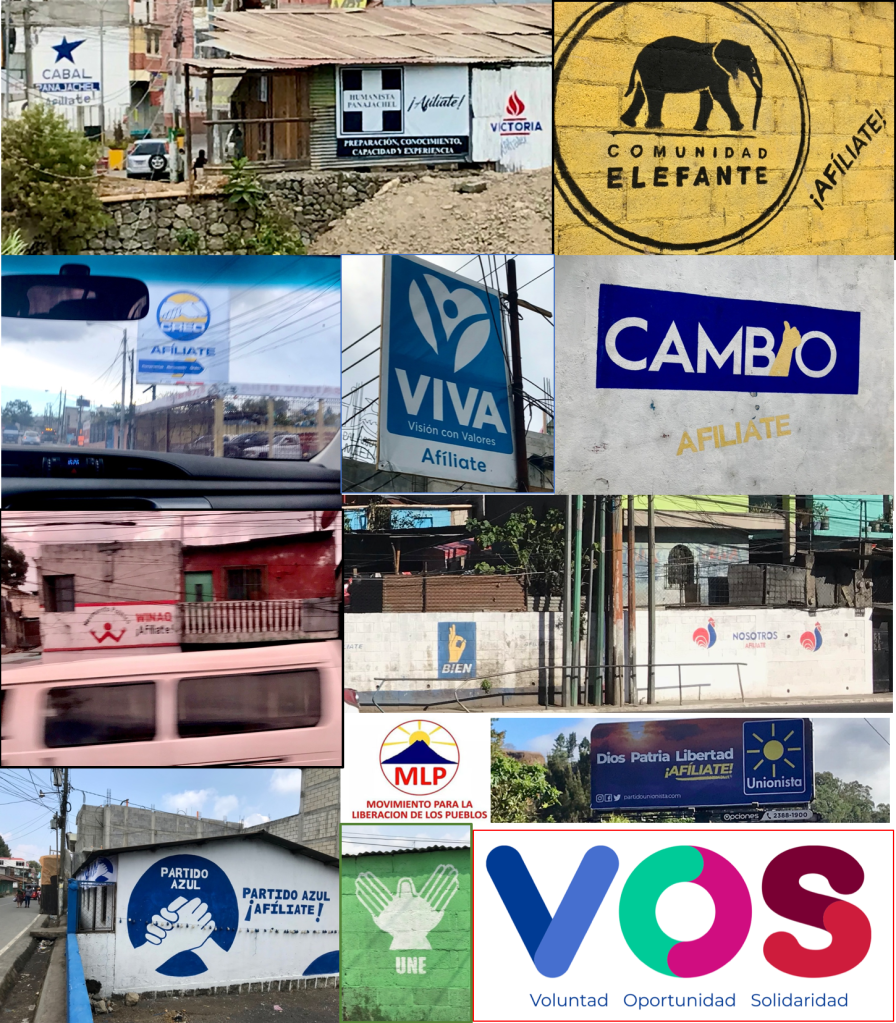
Campaign posters abound, mounted by a vast array of political parties. 
For about 20 days in March, I was in Guatemala in the company of people from the Maritimes-Guatemala Breaking The Silence Network (BTS) and the Comité Campesino del Altiplano (CCDA, Highlands Committee of Small Farmers). You can read about our specific activities with regard to Indigenous land rights and fair-trade coffee on the BTS site.

As I set out to write about these elections, I struggled with how we think about corruption, democracy and, yet again, notions of development. I mean, why should I pick on Guatemala for its apparent failures? Scores of countries seem unable or unwilling to quash corruption or expand democratic participation, much less advance policies to promote the common good (“vivir bien”) or to “rule by obeying” the people (“mandar obedeciendo,” as the Zapatistas in Chiapas have been doing in their communities for almost 30 years now). 

In writing in these blogposts about development, I have tried to emphasize the importance of good political choices in shaping development priorities. This is true whether protecting the greenbelt around Toronto from urban sprawl or creating conditions in Guatemala that might allow people to remain in their homes instead of migrating northward. 

A lot of what gets talked about in Guatemala is corruption–sometimes defined as use of public office for private gain and sometimes as a problem of opacity: “how much do things really cost?” And it’s real: judges, prosecutors, police; government officials (congress members, civil servants). 

But I am uncomfortable using the term without broader context. Sometimes, discourse about corruption is linked to the problem of under-development in ways that make the rich northern countries seem innocent. But please think of debates in the United States, for example, over campaign financing and gerrymandering of voter districts, or in Canada of the coziness of real estate developers with the government of Ontario or of mining companies with their reluctant regulators

Discourse about corruption in Guatemala and elsewhere needs to be examined for bias. I can’t do a complete lit review in this blog space, but here’s an essay (2001) that deconstructs the way the World Bank has used the term. Another researcher (2006) looks at ways “the anti-corruption consensus” leads to omissions that then fail to engage the “core problems of politics and ethics.” People in wealthier countries should examine their own polities—take the log out of their own eyes before remarking on the specks in the eyes of others (Matthew 7:3-5).

Discourse about democracy can also be problematic. Countries of the global North seem content that others observe formal democracy: fairly regular elections, multiple parties, etc.—but put up obstacles when governments in the global South try to change their essential, existential problem: poverty. 

In the face of that overwhelming reality, talk of formal democracy remains unconvincing. People no longer expect “Liberté, Égalité et Fraternité” or “Life, Liberty and the Pursuit of Happiness” or even “Peace, Order and Good Government” to trickle down from the Western democracies. Indeed, liberal democracies these days are leaving doors wide open to fascism because liberals are more interested in unrestrained capitalism and in protecting private property than in easing the problems of poverty and growing inequality faced by the wretched of the earth (Frantz Fanon) or even taking on the more focused challenge of addressing root causes of migration while more than 100 million people are on the move.
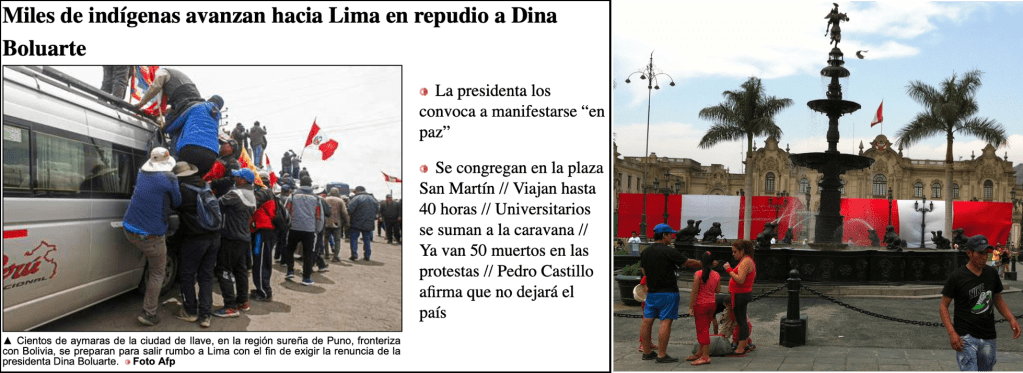
In Peru, the “battle between rich and poor” continues in wake of parliamentary coup

Indigenous people from Puno region head for the capital city, Lima (La Jornada, Jan. 18); the Government Palace on a quieter day in 2015.

For many years, Peruvians have endured political crises repeatedly. Few presidents have been able to serve full terms and even if they do, they may end up in jail for corruption – the fate of six of the last 10 presidents. 

In the 20th century, elected presidents faced military coups. Today, those have given way to parliamentary coups: impeachment and removal from office. What might be a normal state of tension between executive and legislative branches in Peru today is toxic. There was a week in November 2020 when Peru had three presidents. The last of these presided through the electoral period that saw Pedro Castillo, a teacher from rural Peru, triumph narrowly over Keiko Fujimori, daughter of a former dictator, on June 6, 2020.

More than 40 days after Castillo’s arrest and replacement by his vice-president, Dina Boluarte, about 50 people have been killed in protests and more than 600 injured, including 30 injured just yesterday (Thursday, Jan. 19). 

The protesters demand (with some variations): that Boluarte resign; that new congressional elections be held; that a constituent assembly be chosen to draft a new constitution; new presidential elections before the end of this year; and release of Castillo from prison.

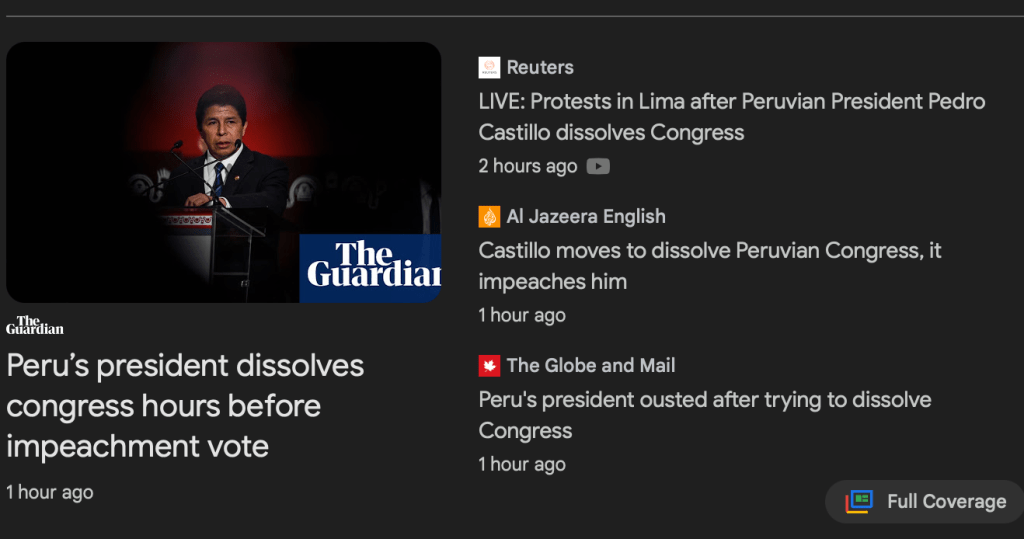
Headlines from Peru on Dec. 7

The fury right now is that Castillo was elected by the rural poor – farmers, workers, Indigenous peoples – and in this latest conflict, they feel their vote is not respected by racist, urban elites. It may be that Castillo erred in trying to suspend congress on Dec. 7, but its summary impeachment (no trial) was at least as illegal. In his defence, Castillo’s move came after 18 months of confrontation: he was never allowed to lead. It’s the system that’s broken.

The outcome is consistent with 520 years of colonialism and keeping those of Indigenous ancestry out of the halls of power. During the election campaign, Castillo had said it was “a battle between the rich and the poor, the struggle between master and slave.” That is what is playing out on the streets and at the roadblocks today.

A fact-finding mission by the Inter-American Commission of Human Rights (IACHR) visited Peru in mid-January. Right: in Canada, Amnesty International launched an urgent action campaign to send letters to Peruvian and Canadian authorities.

The Latin American ecumenical news agency ALC Noticias spoke with several Peruvian church leaders.

We have arrived at social collapse, said Rev. Rafael Goto, a Methodist minister in Lima long active in human rights causes. “The crisis in which Peru is living shows us again the discrimination and contempt faced by those who are most impoverished. Once again, it seems that two different ways of looking at society are at play. On one side, that of political power, the historic colonial and oppressive mentalities are revived. On the other side, the excluded population continues to resist so as to break the chain of marginalisation, invisibility, and contempt.”

Rev. Luzmila Quezada, a Wesleyan minister, teacher and leader in the women’s movement, warned that Peru is reaching a point where “dehumanization” is apparent. “This crisis challenges us to connect with the suffering of our brothers and sisters in the Andean South who have suffered for centuries from the exclusion and social stigmatization of a racist and fascist elite that only cares about material goods and forgets the maximum and urgent value of human life: who is our neighbour in this country?”

Meanwhile, a Catholic priest who worked for 26 years in the Puno diocese in southeast Peru (where some of the most extreme repression occurred), has returned to his native Argentina after his bishop ordered him to resign as parish priest in the city of Juliaca. In response to violence in Juliaca on Jan. 9, Fr. Luis Humberto Béjar had demanded Boluarte’s resignation. 

Later, he told reporters that he made the call because he believes that peace can only be achieved with her resignation. “I do not regret saying what I said, and I would say it 50 times more. In three hours, if I am not wrong, they killed 17 people, and one more died of wounds later.” A policeman was also killed in Juliaca that day.

A Quechua Indigenous woman whom I know in the Andean highlands sent a note to say that she and others are doing what they can to support the protests, but that it is difficult knowing that most of the victims of the violence are Quechua. 

“Our leaders are threatened,” she wrote. “There are no lawyers who will defend them. Everyone is afraid because the army and police are acting on behalf of the congress and Dina [Boluarte]. We have returned to the time of [Alberto] Fujimori [dictator in the 90s].”

Fake criminal charges, mining justice and solidarity in El Salvador

My friend Antonio Pacheco, renowned leader of a community development group in northern El Salvador, was arrested with five other men on Jan. 11 and charged in connection with a war-time death that happened more than 30 years ago. They are also charged with “illicit association,” the accusation that has led to detention of more than 60,000 alleged gang members by the government of President Nayib Bukele. 

The charges, say friends and allies, have nothing to do with achieving justice for any of the 75,000 people who died during the civil war, and everything to do with the government’s drive to re-open metals mining in El Salvador in the wake of its Bitcoin cryptocurrency failure.

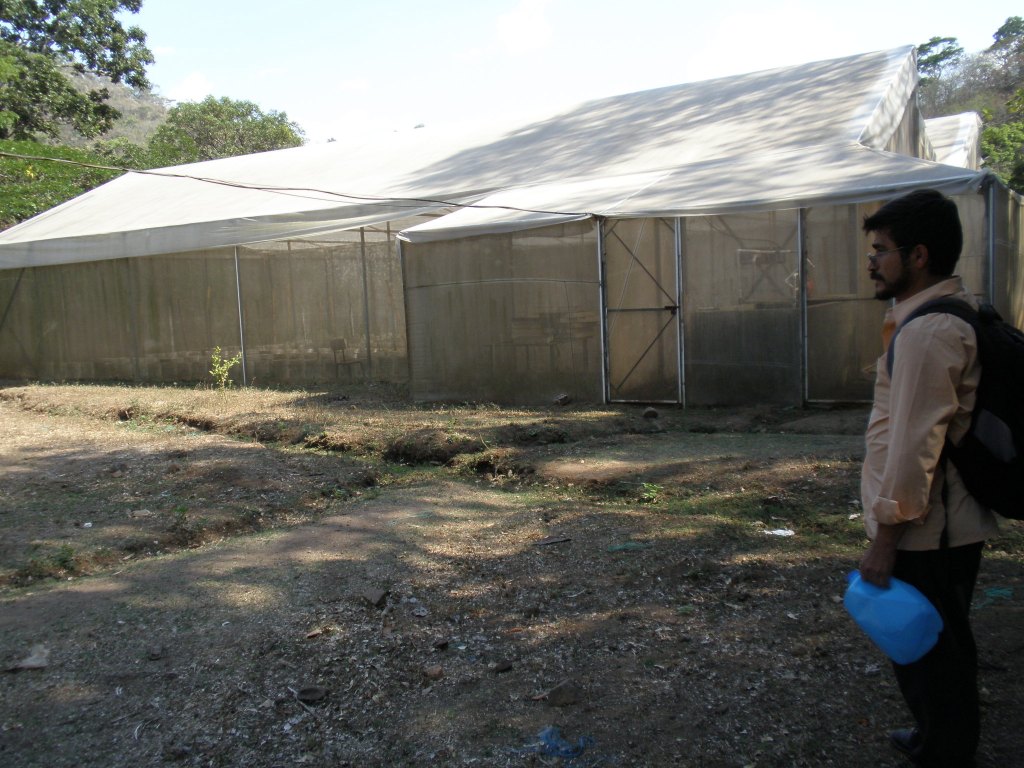
Antonio Pacheco observes an ADES greenhouse in Santa Marta in 2009. Photo: Jim Hodgson

Pacheco and members of the Santa Marta Development Association of El Salvador (ADES) were leaders in the successful effort to stop a gold mining project in Cabañas department, and part of El Salvador’s National Roundtable on Metals Mining that achieved a ban on metals mining in 2017. 

During the civil war in the 1980s, Santa Marta was targeted by the Salvadoran military and most residents fled to Honduras. Successive Salvadoran governments have not investigated the dozens of cases of human rights violations documented by the people of Santa Marta against the armed forces (including the Lempa River massacre in 1980, where 30 people were murdered and 189 others disappeared). 

The arrests last week drew global attention, including articles in The Guardian, the German news service DW and TeleSUR, and solidarity statements from the U.S. Institute for Policy Studies, the Honduran group COPINH, the U.S. Sister Cities network, and others. “Antonio Pacheco has struggled almost his entire life to build a country that seeks social, economic and cultural well-being and who is a friend to the causes of the Honduran people,” said COPIHN (the organization led by Bertha Cáceres until her murder in 2016).

I came to know Antonio, ADES and many other people the rural communities of northern Cabañas during the 20 years of my work with The United Church of Canada. I wrote about him several times, including a profile published in the United Church’s Mandate magazine in February 2011:

“A Life-Long Passion” (excerpt)

A child grows up in El Salvador in the 1960s. He asks: “Mamá, why are there poor people?”

Decades later, the question still animates Antonio Pacheco, executive director of ADES….

“I hardly ever talk about this,” Antonio said, smiling over his coffee in the food court below the United Church general council office in Toronto. “I had this intense curiosity. I asked lots of questions. I read, and read some more. I read the Bible, or tried to.”

In the sixties and seventies, Christians in Latin America began creating “base communities” to provide space for questions like those of Antonio and to share the Word of God among neighbours.

“One word caught my attention: solidarity. I began to understand why Jesus was taken to the cross,” Antonio said. 

“By the time I was 11, I understood that I wanted to work for the people. I wanted to be a doctor so that I could help.”

But as Antonio entered high school in the mid-seventies, El Salvador was in political upheaval. The base communities and church leaders became targets of repression. Antonio emerged as a leader of the student movement in his high school in San Salvador, and joined the revolutionary movement in 1977. Political and education work took him to Santa Marta for the first time in 1979, and by 1982 as the civil war raged, Antonio worked with the community directly in its education efforts. But aerial bombing grew so intense that the entire community fled into exile in Honduras in the mid-1980s.

It was after the return to Santa Marta in October 1987 that Antonio’s community development work really began to bear fruit. Even though a final peace accord was not achieved until 1992, the people of Santa Marta sought and found international help to rebuild. The United Church of Canada and the Anglican Primate’s World Relief and Development Fund were among the first partners. In 1993, ADES was born to secure and manage development funds. Antonio has served as executive director since 1998.

Today, formal education is one of Santa Marta’s great successes…. ADES continues to lead in agricultural development and training in northern Cabañas, but a number of programs have spun off in varying degrees of autonomy: a micro-credit program for market workers, a community radio station in nearby La Victoria, and an AIDS education program for rural youth that works on both sides of the border.

Now in the 2020s, ADES is working with support from the United Church and the Manitoba Council for International Co-operation to expand ecological agricultural practices in Cabañas.

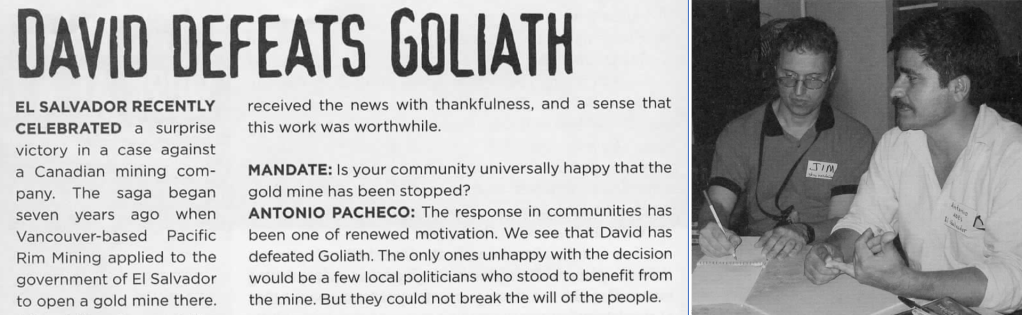
“David defeats Goliath”

With the mining victories in 2016 and 2017, Mandate published a short interview that I did with Antonio. At the end, I asked what he would say to Canadians about their responsibility to regulate their mining companies

“The Canadian people should be aware that Canadian companies operating outside the country have practices that fail to respect the human rights of the people in communities, and that they fail to repair damage to the environment. For those reasons, it is necessary and urgent that their actions abroad be regulated in Canada.”

Left: Mandate, February 2017. Right: Jim Hodgson with Antonio Pacheco, August 2006. Photo: Presbyterian World Service & Development.