What’s love got to do with it? The life and work of Joseph Ratzinger/Pope Benedict XVI

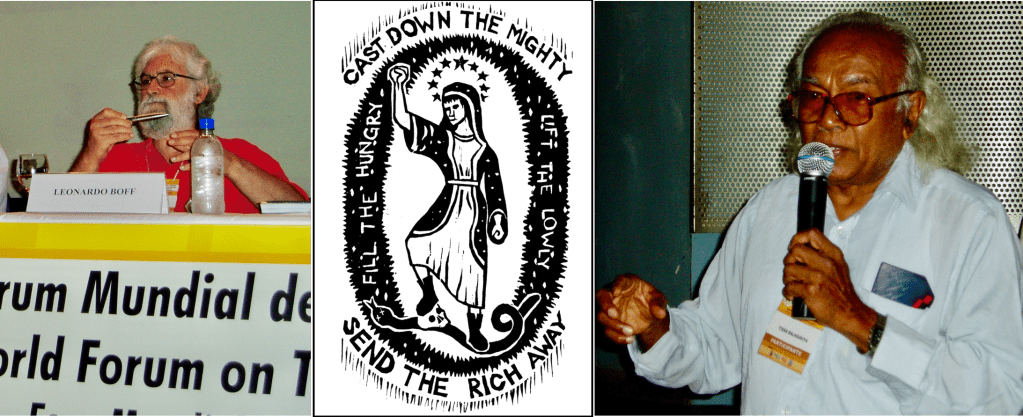
Centre: Ben Wildflower‘s image of Mary and her words in the Magnificat (Luke 46-55). Among speakers at the 2005 World Forum on Theology and Liberation in Porto Alegre, Brazil, were Brazilian theologian Leonardo Boff (left) and Sri Lankan theologian Tissa Balasuriya (right), both reprimanded by the Vatican in previous decades.

Jim Hodgson

Why write about the death of a former pope and cardinal in a blog about development? Because his condemnation of several liberation theologians in the 1980s and later were attacks on the most vigorous and coherent critique of contemporary development practice – or the ways inequality and exploitation are either maintained or overcome – to emerge from Christians in the late 20th century. And whatever good he may have done will always be overshadowed by the harsh treatment of some of our era’s finest theologians by Ratzinger during his leadership of the Vatican’s Congregation for the Doctrine of the Faith (CDF). 

When I came to Toronto in early 1984 to work with Catholic New Times, one of my “beats” was to cover the ways the Vatican was contending with liberation theology and its advocates. Over time, such scrutiny was imposed on feminists, defenders of LGBTI people, and advocates of respect for religious pluralism – and continued into Benedict’s pontificate. (Other writers elsewhere are recalling too his role in covering up clerical sexual abuse.)

Over the years, I have had the privilege of meeting many of those who were reprimanded by Ratzinger and his CDF successors. Some found solidarity in the global ecumenical movement and join events like the World Forum on Theology and Liberation, an event held every couple of years since 2003 alongside the World Social Forum.

The central tenet of liberation theology – the preferential option for the poor – is now enshrined in Catholic social teaching. Debates continue, of course, about what we mean by “the poor” as new (and not-so-new) theological “subjects” emerge among those who are marginalized from patriarchal power in churches and beyond, and by political and economic structures that persist. And it’s important to remember that not all of those censured by the CDF had come under scrutiny because of their option for the poor, but also because of their analysis of power in the church (Leonardo Boff), relationships with other religions (Tissa Balasuriya, Roger Haight), rights of women (Ivone Gebara), ecology (Matthew Fox), or defence of sexual and gender minorities (Raymond Hunthausen, Jeannine Gramick, Robert Nugent), among others.

My single encounter with Cardinal Ratzinger came on April 23, 1986 when he spoke to a crowd of about 6,000 people at the old Varsity Arena at the University of Toronto. Outside, members of the Canadian Catholics for the Ordination of Women protested. The event was sponsored by Frank Stronach’s multinational auto parts company, Magna International. The crowd, made up mostly of conservative Catholics, welcomed his criticism of “theologians who abuse their authority as teachers.”

I saw Ratzinger as an obstacle, a foe, and was disheartened when he was chosen to be pope in 2005. 

Pope Benedict: Christian witness to love opens new paths for justice

On a Saturday morning in November 2007, I slipped in to a pew in Havana’s Santísima Trinidad Anglican Cathedral to reflect on the social teaching of Pope Benedict XVI. 

The ecumenical lay education centre known as ISEBIT had welcomed Archbishop Luigi Bonazzi, the Apostolic Nuncio in Cuba to speak to students. (Bonazzi would later serve as nuncio in Canada and is now the nuncio in Albania.) 

In the context of a class on International Development Cooperation, in which students had been debating issues of humanitarian aid, Don Luigi began his reflection based on Benedict’s first encyclical, Deus Caritas Est (God is Love).

With Don Luigi’s guidance, I found myself surprised and then intrigued by the pontiff’s approach. “Being Christian,” Benedict wrote in the opening to his encyclical, “is not the result of an ethical choice or a lofty idea, but the encounter with an event, a person, which gives life a new horizon and a decisive direction.”

For Benedict, the heart of Christian faith is in the simple statement, “God is love.” There are many implications: from the nature of God (“God is love” / “Love alone is” / “love makes being” / “love remains”) to “ways to address needs that require love” and “the need of humans for the witness of Christian love that is inspired by faith” and “the charitable action of the church.” 

There is a complex challenge here to those of us who react to what we perceive to be simplistic acts of charity by proclaiming the need for justice. Justice, for Benedict (and Don Luigi), cannot be “over” love: but Christian witness to love opens new paths for justice

At this point, various aspects of Catholic social teaching find their place: 

  • each person is understood within a community of people, overcoming the idea of enemy;
  • affirmation of the human person as subject, not object, not instrument; 
  • encouragement of people to participate passionately for the common good; 
  • the church does not seek power over the state, but to avoid that politics in the “polis” (city) becomes about power, not service; all of our ideas are needed so that the “polis” can function;
  • the church participates “partially” in political life for the sake of a just society.

A student asked about social justice. Don Luigi responded: “Given these commitments, the church participates truly in the building of a just society. It participates and cannot not participate.” 

When we truly love, we cannot help but get involved. 

Later, Pope Benedict would write Caritas in Veritate (“Charity in Truth”), a 144-page encyclical that is mostly about our collective economic life (with digressions). Its essence is the “principle of gratuitousness” – that being itself is a divine gift, including economic life. “The market is the economic institution that permits encounter between persons” as “economic subjects” who choose to trade goods and services of equivalent value. That, he says, involves trust and fraternity. The market used justly is an application of charity, which is the virtue Benedict believed to be at the core of all things, not “an added extra” tagged on with other activities.

This and other teachings prompted Cardinal Michael Czerny, the Canadian who is prefect of the Vatican Dicastery for Promoting Integral Human Development, to praise Benedict’s embrace of “integral human development,” a phrase used decades earlier by Pope Paul VI. “To develop truly, authentically, people need to treat each other as the siblings we really are, freely and generously and openly,” he told the Globe and Mail after Benedict’s death Dec. 31.

But the debates won’t stop. Ratzinger’s leadership in the CDF failed to model ways of loving or of constructive theological dialogue. By the time of Benedict’s resignation in 2013, the Catholic Church had endured more than 35 years of top-heavy efforts to close the windows that had been opened by the Second Vatican Council (1962-65). That Pope Francis has allowed some breezes to blow in dusty corridors is a sign of hope for those of us who still insist that God’s love is for ALL, that the powerful must be brought down from their thrones, and the poor lifted up (Luke 1:46-55).


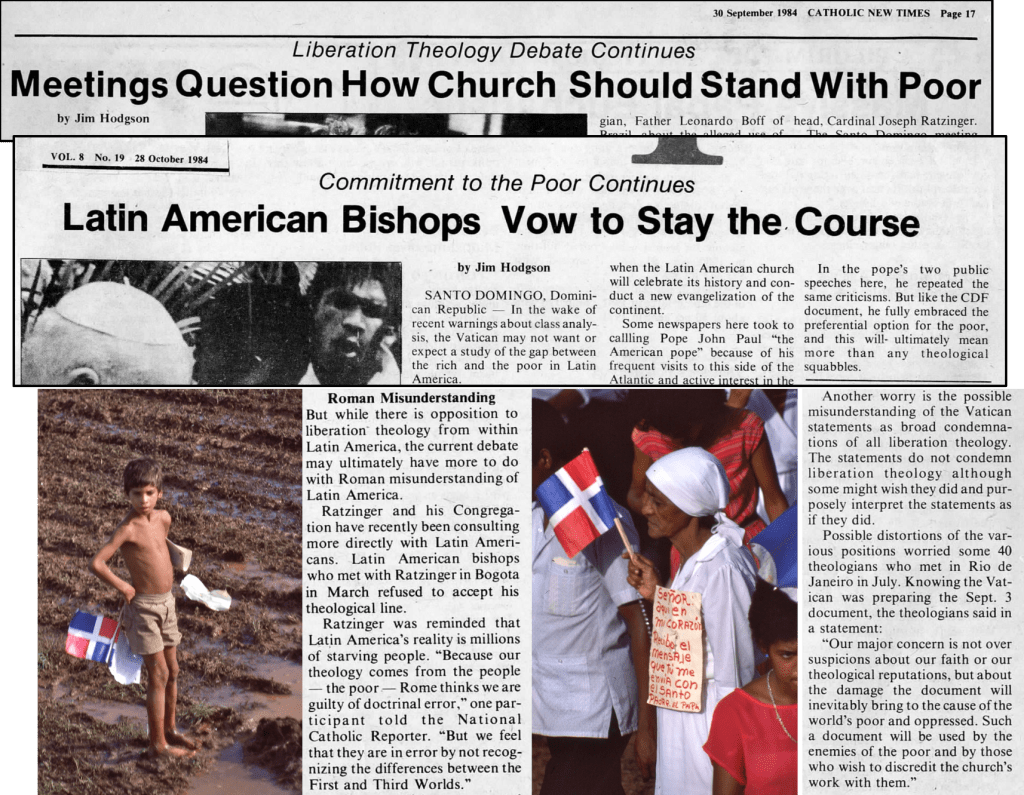
Some of my 1984 articles focused on the gaps between Roman understanding of authority and Latin Americans’ perceptions of their own reality. Theological reflection followed action by people to transform their reality, and gave rise to questions of how churches should accompany the poor (and other marginalised groups) in their struggles for justice. (I have added the colour photos I took of people attending a mass celebrated in October 1984 by Pope John Paul II at a racetrack near Santo Domingo, Dominican Republic.)

Haiti: another military intervention looms large

by Jim Hodgson

Haitians (whose own proposals for building a better country are persistently ignored) once again face an illegitimate government, one that has proposed a foreign intervention force to quell gang violence and to keep itself in power. 

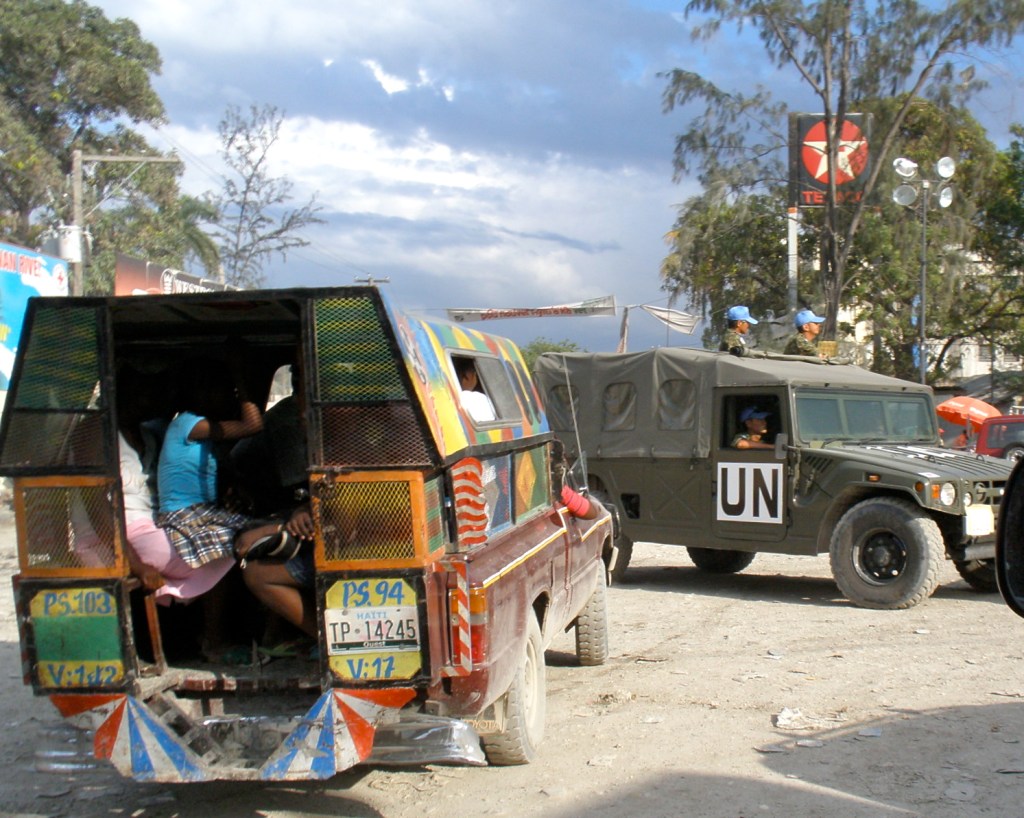
Haiti and the UN: another crossroads. Photo: Jim Hodgson, April 14, 2010, Port-au-Prince.

In reporting by many journalists from the global north, popular protest against the government, increased fuel prices, corruption and intervention is blended with reports of actions by the street gangs.

On Friday, Oct. 21, the UN Security Council approved its resolution authorizing a foreign military intervention and imposing sanctions on only one of Haiti’s gang leaders. (One might ask: when do gang leaders travel? Where do they go? Which banks do they use? Who sells them their weapons?)

The new intervention propositions emerged from the UN general secretary and Haiti’s “interim” prime minister: as if such interventions had worked in 1915, 1994, or 2004 to resolve the problems of people impoverished by the same imperial powers who are now invited to return.

Those powers misunderstand the present crisis. They can’t tell the difference between protest against the unelected government of Prime Minister Ariel Henry and the criminal activity of gangs. On Oct. 15, the United States and Canada delivered armoured vehicles for use by Haitian police.

Worse, the great powers continue to ignore the specific civil society proposals for a way forward that are contained in the “Montana Accord”  (named for the hotel where the group met). The group told a visiting U.S. delegation that it opposes foreign military intervention.

Cholera – never really eliminated after being brought to Haiti by support staff to soldiers in a previous UN force – is back. There are proposals to bring vaccines, but Haiti was able to deliver COVID vaccines to just a few more than three per cent of the population. Only 41 per cent of Haitian children are vaccinated against measles and 51 per cent are fully vaccinated against polio. Effective management of the cholera outbreak would require some sort of humanitarian truce, and that would require negotiations with the gang leaders – pretty much anathema to the imperial powers who seem more inclined to use force.

The current debates over the legitimacy of the government, possibilities for new elections, getting back on track with humanitarian aid and a reasonable development agenda are addressed in a new letter to U.S. President Joe Biden by four U.S. senators and nine members of the House of Representatives.

Recalling “decades of US meddling in Haiti’s internal affairs,” the group lauded the Montana Accord, which proposes a transition period that will ultimately result in elections, adding:

“None of these weighty issues can be addressed effectively in isolation. Neither free and fair elections, nor effective delivery of humanitarian assistance, are possible until the violence is quelled. Yet the Haitian police conspire with the gangs, and past U.S. efforts to build a professional, accountable police force have failed. The violence can only be quelled by Haitian authorities acting consistently with the rule of law through impartial judicial processes.”

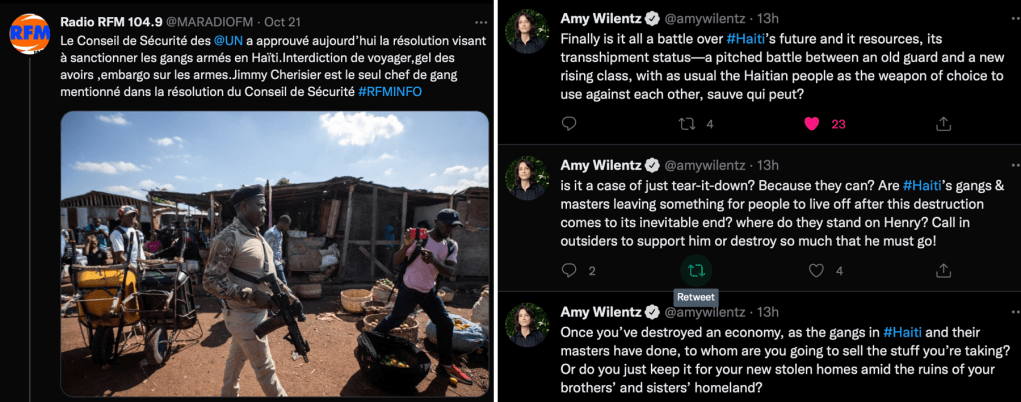
News of the UN Security Council resolution (left); earlier, Amy Wilentz, a noted U.S. writer on Haitian events, expressed her doubts about intervention proposals.

I’ll share a short reading list with you:

Edwidge Danticat (my favourite Haitian writer) in The New Yorker: “The Fight for Haiti’s Future.” The United States and its allies should withdraw their support support for Henry and the Parti Haïtien Tèt Kale (P.H.T.K.), the Haitian Bald-Head Party. “During the Party’s decade in power, Haitians have consistently taken to the streets to protest against P.H.T.K. leaders’ ineffectiveness and corruption, and to demand accountability for the funds misused, misappropriated, and pilfered through Venezuela’s oil-purchasing program, Petrocaribe. Accountability never came.”

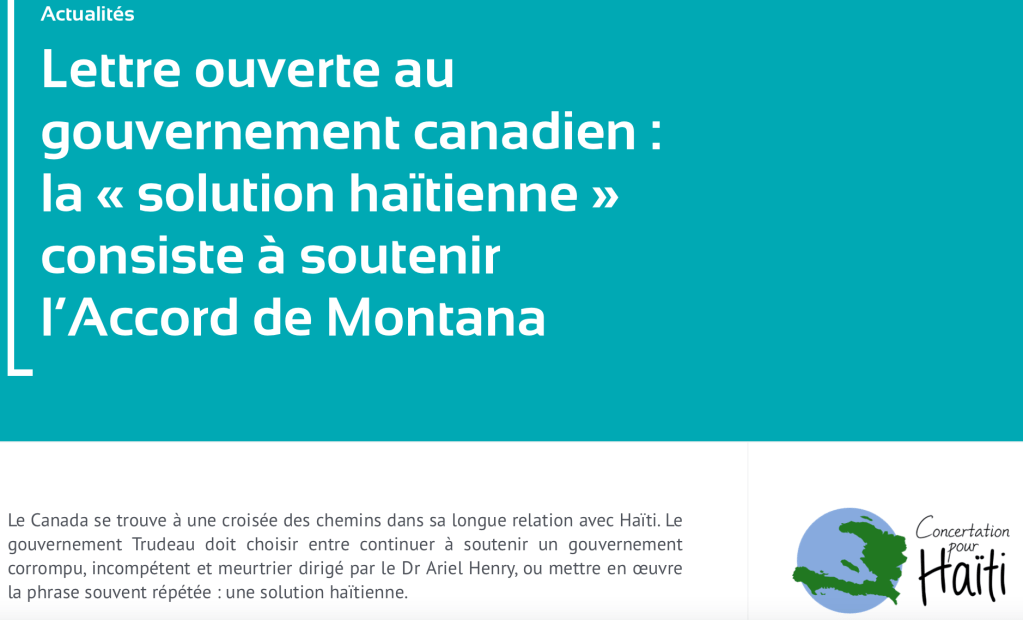
If you read French and would welcome regular updates on what is going on in Haiti, I would encourage you to sign up for Info-Haïti. This is the monthly bulletin of Concertation pour Haïti, a Montreal-based coalition of civil society organizations. Write to: communications@aqoci.qc.ca or follow the Concertation on Twitter at: @haiti_pour. 

On Oct. 20, members of the Concertation produced their own letter to the government of Canada with recommendations for a way forward. “Canada must now stop supporting the government of Ariel Henry and put its full weight behind this coalition, which offers the only viable proposal for a transition that would allow Haitians to organize free and fair elections. To continue to support the current Prime Minister is to condemn the country to corruption, impunity, the continued domination of gangs, and ever-worsening food insecurity.”

A former U.S. ambassador to Haiti, Dan Foote, has warned that if the U.S. moves forward with the UN plan to send armed forces into Haiti, the result will be a predictable catastrophe.

And The New York Times has managed to produce pretty useful lesson plans for teachers about Haitian history and culture.

In Mexico, 43 students missing for eight years: not forgotten and still making headlines

By now, you might not remember the murders and forced disappearances of the “normalistas” – education  students who were training to be rural teachers in the state of Guerrero in southern Mexico. 

On the night of Sept. 26, 2014, students from the Ayotzinapa Normal School were attacked in Iguala, Guerrero, after they had commandeered buses to travel to Mexico City for a protest over the Oct. 2, 1968, massacre of student protesters at Tlatelolco plaza in Mexico City.

In Iguala, six people – including three students – were killed in the assault, 25 were injured and 43 students were abducted and presumably murdered later. Leading suspects are members of the Mexican army who worked alongside municipal officials and drug-traffickers who were trying to move opium gum (or semi-processed heroin) on one of the buses that was taken.

As the eighth anniversary approaches, a series of events reveals more about what happened as well as efforts by people tied to the former government of Enrique Peña Nieto to maintain the cover-up. 

Left: La Jornada front page today: protests over judicial decisions, military cover-up. Right: remembering the 43 students in Tepoztlán, Morelos, December 2014.

First the news:

  • On Aug. 18, the report of the Commission for Truth and Access to Justice (appointed by the current government of President Andrés Manuel López Obrador) published its report, stating that the students’ disappearance was a “state-sponsored crime.” The report accuses Col. José Rodríguez Pérez, commander of the 27th infantry battalion located in Iguala, of giving the order to murder the missing students. He was arrested on Sept. 15.
  • By pointing to army collusion, the new report denounced the version offered by 2015 by the Peña Nieto administration that the students were killed by a local drug gang after being abducted by municipal cops acting on the orders of Iguala’s corrupt mayor, and that their bodies were incinerated at a dump in the nearby town of Cocula – which is not to say that those officials do not share part of the responsibility for the crimes. Following the report, Peña Nieto’s  attorney-general, Jesús Murillo Karam, was arrested for obstruction in administration of justice in the case. Another official whose arrest has been sought, Tomás Zerón de Lucio,head of Peña Nieto’s Criminal Investigation Agency, left Mexico and is hiding in Israel
  • Among the many stories that emerged from the report is that of one of the students, Julio César López Patolzin, a former soldier now revealed to have been an army spy infiltrated into the school. Even though he was in touch with his supervisors up to the night of the disappearances, the army made no effort to extricate him from among the other students, making him a victim along with the others. 
  • Despite the truth commission report, a judge assigned to the case by the former government has ordered the release of at least 121 police officers and government officials previously charged, including some of the municipal officials and accused drug-traffickers. The district court judge, Samuel Ventura Ramos, is located in Matamoros, Tamaulipas (in northeastern Mexico, close to the U.S. border).
  • Federal prosecutors are now bringing charges against the judge, and President López Obrador demanded Friday (Sept. 23) to know why the cases are not taken up again. “What has that to do with justice? Who chose that judge? And why is the Ayotzinapa case, which has to do with Guerrero, attended to by a judge in Tamaulipas?”

What does all this mean?

When looking at the news these days, it’s important to keep in mind that part of the game plan of globalized capitalism is to show the state as ineffective, whether against the COVID pandemic, inflation, or protecting human rights and public security.

In Mexico, where the present government is attempting to transform the system into one more amenable to the impoverished majority, economic power and some instruments of political and judicial power are still held by old elites. 

Moreover, the system as implemented over the past 30 years has made the students and their cultures redundant, wrote Alejandro Nadal of the Centre for Economic Studies at El Colegio de Mexico. Industrialized agriculture is privileged over traditional small-holder farms. “That is to say, there is no place for campesinofarmers who aspire to a dignified life in freedom. The youth of Ayotzinapa rebelled and the established powers responded,” Nadal wrote in La Jornada.

And, who are those powers? Again we see, as we have repeatedly over the past two decades of a stepped-up “war on drugs,” we see the collusion of a drug cartel (this one is called Guerreros Unidos, or United Warriors) with politicians and other state actors.

“The war on drugs has never controlled drug trafficking and has always been about social control,” wrote Laura Carlsen, director of the director of the Americas Program of the Center for International Policy. “Now it’s Mexico’s youth that are paying the price of that duplicity.”

I lived and worked in Mexico from 1994 to 2000. I was based in the city of Cuernavaca, about 90 km south of Mexico City in the state of Morelos and about 50 km north of the border with Guerrero. We frequently visited a Nahua Indigenous community near Taxco, Guerrero. If you take the libre (the two-lane, non-toll highway) towards Acapulco, you pass through Iguala.

During those years, I made several visits to the city of Tlapa in the eastern part of the state. I came to know the Tlachinollan human rights centre and once spent an afternoon near Olinalá talking with a group of rural teachers. Their option for the poor was absolute and inspiring.

The students reflected the context from which they emerged and to which they would have returned as teachers: impoverished and exploited rural Mexico. Their work was heroic.

The latter paragraphs of this text are adapted from a piece I wrote in a previous Unwrapping Development blog format in October 2014, days after the disappearances.