Drone attacks in the Caribbean have Canadian connections

By Jim Hodgson

Separate incidents of use of explosive drones by the U.S. military to attack alleged Venezuelan drug-traffickers and by Haitian police to attack local gang leaders may have Canadian connections.

The Canadian ecumenical coalition Project Ploughshares reported Monday (Oct. 6) that a Canadian-made high-tech camera system was used to attack two boats that the United States said were carrying drugs. CBC News analysed the Ploughshares report, compared it to product manuals and previously released videos and spoke with former military and defence industry experts, concluding that it is highly likely Canadian tech was involved in surveillance during the operations.

Project Ploughshares and CBC reports on the U.S. attacks and their Canadian connection. The full Ploughshares report is here.

“There has to be more human rights oversight,” said Kelsey Gallagher, a senior researcher with Project Ploughshares. “We are seeing Canadian weapons being misused.” Founded in 1976, Project Ploughshares is the peace research institute of the Canadian Council of Churches

Global Affairs Canada told CBC that it is “aware of the U.S. operation and is monitoring the situation.”

The United States has said it used drones three times to attack boats it alleges were carrying drugs, but provided no evidence of drug-trafficking. The Ploughshares report shows that the U.S. military used a Canadian-made L3Harris WESCAM MX-Series sensor system for tracking and surveillance of boats that were struck as they sailed from Venezuela in the first two of three strikes reported last month.

Drone attack in Haiti’s capital kills 8 children

Meanwhile, a police-directed drone strike on a birthday party in Port-au-Prince that killed at least nine people (most of them children) and wounded 17 others has drawn attention to drones provided to Haiti by Canada. 

The explosions happened Sept. 20 in Cité Soleil, a large, impoverished neighbourhood controlled by Viv Ansanm, a powerful coalition of criminal gangs that the U.S. has designated as a foreign terrorist organization.

Al Jazeera news service said the drones used in the operation were supplied by Canadian police. Successive Canadian governments have long maintained programs of assistance and training to Haitian police. 

Months earlier, Global Affairs Canada told CBC that it was “concerned” about reports of extrajudicial executions, a violation of international human rights law. GAC did not clarify if Ottawa knew of cases in which Canadian-provided drones had been used for lethal purposes in Haiti. It said Haiti had agreed that the equipment provided would not be used “to commit or facilitate any violation of international humanitarian law or international human rights law.”

On Oct. 2, UN Human Rights Commissioner Volker Türk said Haiti’s use of lethal force against gangs was disproportionate and likely unlawful.
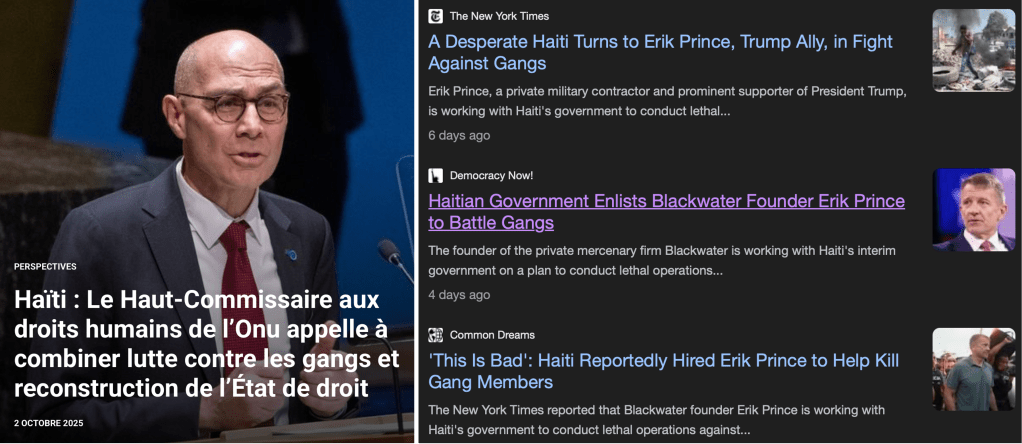
Volker Türk (left); Google News headlines in June regarding Erik Prince and his new role in fighting the gangs of Haiti.

Speaking in Geneva to the UN Human Rights Council, Türk said police units had summarily executed 174 people for alleged gang affiliation this year while government drone strikes against alleged gang members in Port-au-Prince had killed at least 559 people to date, including 11 children.

“Most of these drone strikes are likely unlawful under international human rights law,” Türk added.

Canada is legally bound to ensure that its export of military goods does not contribute to violations of international law. Compared to ongoing controversy over Canada’s arms exports to Israel – often shipped via the United States – Canada’s indirect involvement in these drone incidents in the Caribbean may be relatively limited, but seem to reveal a pattern of disregard for human rights consequences of commercial deals in our neoliberal world.

In March this year, the Haitian government hired Vectus Global, a company run by Blackwater founder Erik Prince, to operate drones.

Two days after the drone strike on the birthday party, the UN Security Council approved a new Gang Suppression Force for Haiti. I’ll share more about that (and Canada’s contribution) in days ahead.
Trump revives “big stick” approach to Latin America

by Jim Hodgson

With all of my passion for justice and in the face of so many gross injustices, I can get paralyzed. And with Trump in power next door, there is always something new to distract us from what went before or from demanding freedom for captives or the release of the #EpsteinFiles.

Just today, he threatened Canada again. #ElbowsUp, still.

Yesterday, it was a plan to end Israel’s war in Gaza that even the New York Times admits “checks every box on Israel’s wish list.” It does nothing to strengthen Palestine or assist recovery after the genocide, and will impose a new, colonial-style authority on the people. 

Let’s step back for a moment.

Last week, I was going to write about Trump’s efforts to rescue his far-right cronies in Argentina and Brazil. Here’s a short version.

Argentina’s president, Javier Milei, faces a collapsing peso and political setbacks. Milei’s chainsaw approach to slashing government was a model for Trump and Elon Musk. U.S. Treasury Secretary Scott Bessent said Sept. 22 that Washington is ready to do “whatever is necessary” – from central bank swaps to direct peso purchases or buying Argentine debt through the Treasury’s Stabilization Fund. The moves are intended to ease political opposition to Milei that has grown as the economy collapses. Milei – already dependent on a $20 billion IMF package – sought U.S. support ahead of congressional elections in October. Investors have been pulling money out from Argentina since Milei’s party lost an election in Buenos Aires province on Sept. 7, provoking worry that he will soon lack legislative support to advance his agenda. 

Front-page of a Buenos Aires newspaper shows Trump managing the rescue plan for Argentina’s Milei. Right: response from Occupy Democrats.

Earlier, Trump imposed a 50% tariff on goods from Brazil, claiming that Brazil engages in unfair trade practices and that the government is engaged in a “witch hunt” against Trump’s ally, former president Jair BolsonaroBolsonaro was convicted earlier this month of attempting a coup after voters dumped him from office. He was sentenced to more than 27 years in prison, sparking Trump’s ire. The present Brazilian government called the U.S. move “a new attempt of undue interference in Brazilian internal affairs.”

When he spoke of the U.S. rescue of Argentina’s Milei, Bessent told reporters that the Trump administration hoped to solidify what it sees as a rightward shift in Latin American countries, including potentially Colombia. (Colombia is now government by a left-centre coalition led by President Gustavo Petro, who cannot succeed himself. His party is currently selecting a new candidate.) 

New and old threats

Bessent’s move came hours before Trump took centre stage at the United Nations General Assembly to press his MAGA-style policies on the rest of the world. 

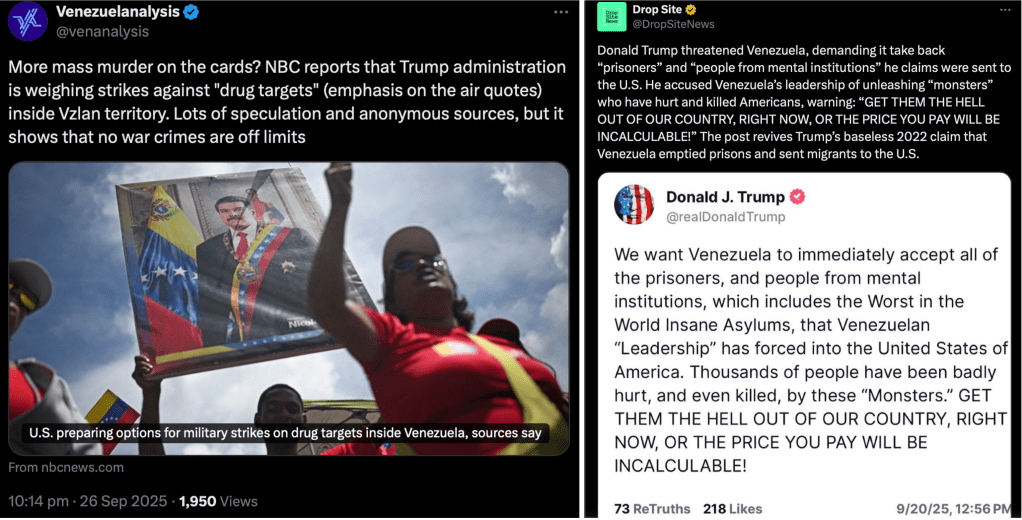
In the speech, Trump threatened to “blow out of existence” Venezuela’s president, Nicolás Maduro. Maduro responded with a plan to declare a state of external unrest to enable rapid mobilization in defence of Venezuela. He had earlier sent a letter to Trump, proposing direct talks. When asked about the letter, White House press secretary Karoline Leavitt, said it was “full of lies” and said the administration still views Maduro as an “illegitimate leader.”

Trump’s threat came after he moved warships into the south Caribbean and after recent attacks on Venezuelan fishing boats (alleged without evidence to be carrying drugs). Trump and his minions seem determined to revive the worst applications of U.S. foreign policy in Latin America, from the 19th-century Monroe Doctrine to Teddy Roosevelt’s “big-stick” diplomacy in the early 20th century.

A recent US government document revealed the Trump administration plans to redirect $1.8 billion in foreign aid toward a new “America First” strategy, Reuters news agency reported Sept. 24. It would give priority to neutralizing “Marxist, anti-American regimes” in Latin America. The report said $400 million would support activities to end illegal immigration to the US, counter China, and “confront the Marxist, anti-American regimes of Venezuela, Cuba and Nicaragua.” The document, known as a Congressional Notification, follows news that the upcoming National Defense Strategy will also pivot the U.S. away from a focus on adversaries like China and Russia to instead prioritize efforts in the Americas.

But not everyone serving Trump is onside with these approaches. On Sept. 29, the Washington Post reported that eight current and former officials have said there is a deep rift between the political appointees at the Pentagon and the military leaders there. Reflecting on the Post report, historian Heather Cox Richardson said that War Secretary Pete Hegseth “is withdrawing forces from Europe, reducing the concentration of power and consolidating commands abroad while focusing on using the military in the U.S. and neighboring countries.

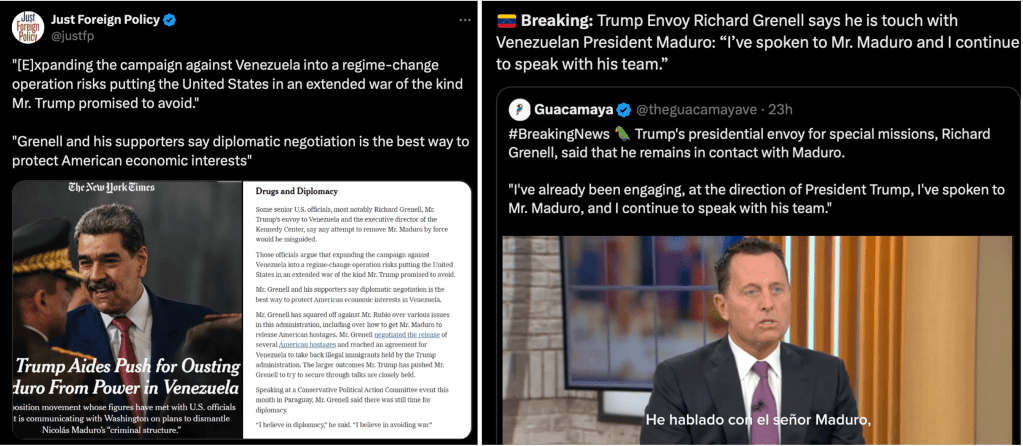
Among Trump administration opponents to use of force to provoke regime change in Venezuela is Richard Grenell, Trump’s special envoy to the country, said Drop Site News on Sept. 29. Grenell has successfully re-opened channels for export of Venezuelan oil to the United States. Grenell and his supporters say diplomatic negotiation is the best way to protect U.S. economic interests. Among those who oppose Grenell is U.S. Secretary of State Marco Rubio. 

Gunboats follow sanctions in U.S. strategy for regime change in Venezuela

by Jim Hodgson

U.S. claims to have bombed a supposed “drug vessel” in the southern Caribbean were met with considerable scepticism and calls for action to stop an invasion.

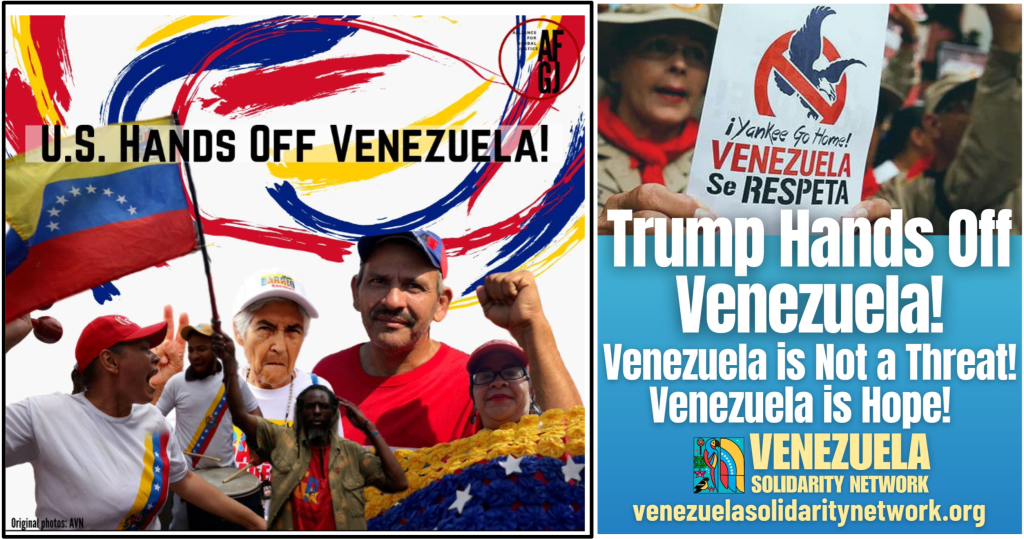
Action suggestion from the Alliance for Global Justice (AFGJ): Please send an email to UN Secretary General António Guterres asking him to intervene to stop a possible U.S. invasion of Venezuela.

“Earlier this morning [Tuesday], on my Orders, U.S. Military Forces conducted a kinetic strike against positively identified Tren de Aragua Narcoterrorists in the SOUTHCOM area of responsibility,” President Donald Trump said in a Truth Social post. “The strike occurred while the terrorists were at sea in International waters transporting illegal narcotics, heading to the United States. The strike resulted in 11 terrorists killed in action.”

He added that TdA is a “foreign terrorist organization” that operates under the control of Nicolás Maduro, Venezuela’s president.

Mexico’s La Jornada shared Images of the U.S. boat attack

Neither Trump nor the video showed any proof that the boat was carrying drugs, nor that it came from Venezuela, nor that it had anything to do with TdA, much less that its destination was the United States. There is no indication of who the crew was. Why would 11 people be on a small boat that is supposedly carrying a large amount of drugs? Could they have been migrants? Human traffickers? It’s more common that such craft are stopped and searched. If anything is found, arrests follow. Not summary executions.

On social media, Venezuelan news outlet Venezuelanalysis speculated on how U.S. SOUTHCOM knew the small boat was carrying drugs without carrying out an inspection. On Monday, President Maduro said his country was at “maximum preparedness” and denounced the expanded U.S. military presence in the Caribbean as, “an extravagant, unjustifiable, immoral and absolutely criminal and bloody threat.”

In Colombia, President Gustavo Petro said he doubted the veracity of the U.S. claim. “We have spent decades capturing civilians who transport drugs without killing them.”

In Mexico, where Trump’s secretary of state Marco Rubio arrived Monday night, news of the attack was felt to be a warning to President Claudia Sheinbaum about methods the United States might use in its effort to dismantle Mexican cartels.

In previous weeks, the United States had deployed as many as eight warships, a nuclear-powered submarine and 4,500 troops as part of Trump’s anti-drug cartel operation, projecting military force into the Caribbean Sea. Among useful news analyses: The Cradle (left, a publication usually focused on events in West Asia). Newsweek (right), unusual among mainstream U.S. media is sharing multiple articles about a new “Trump Doctrine.” It’s similar in effect to the Monroe Doctrine, ostensibly about curbing European influence in the Americas, but used to justify U.S. interference in Latin America and the Caribbean since 1823.

In March, Trump used the Tren de Aragua myth as a justification to justify the extraordinary rendition of young Venezuelan men to El Salvador. A New York Times article in April showed that Tren de Aragua is not invading the United States. Nor is it a “terrorist organization,” and to call such “criminal groups terrorist is always a stretch since they usually do not aim at changing government policy.” The article goes on to show that Tren de Aragua is not centrally organized, much less that it colludes with the Maduro government. 

Maduro said in March that TdA “no longer exists; we defeated it.” The Venezuelans held in El Salvador were finally returned home in July.

Left: Chevron is once again moving Venezuelan oil to the United States. Right: President Nicolás Maduro speaks with foreign reporters.

This new chapter in Venezuela’s drama plays out in the context of historic U.S. refusal to accept the development in this hemisphere of a political and economic model other than the capitalist one. Since 1998, Venezuela has embarked upon a “Bolivarian Revolution” (named for Simon Bolivar, the hero of the 19thcentury independence struggle) and intended to break capitalist hegemony over every aspect of the lives of the people.

Since 2005, U.S. administrations have made the annual determination that Venezuela has “failed demonstrably to adhere to its obligations under international narcotics agreements.” A year later, the United States began applying sanctions (“unilateral coercive measures,” the UN calls them). These and other measures have been strengthened since 2015, eventually driving a severe economic crisis and exodus of millions of people who sought better opportunities elsewhere.

In this second Trump administration, some see incoherence. On the one hand, ongoing verbal threats and this military build-up. On the other, easing of sanctions to allow Chevron to import Venezuelan oil to the United States. Conjecture persists about the relative influence of corporations like Chevron that want back in, the south Florida Venezuelans and Cubans who are Rubio’s constituency, and the isolationist sector of the Trump-MAGA base that wants out of all foreign wars.