Let’s be clear. The U.S. kidnapping of President Nicolás Maduro and his wife Celia Flores today has nothing to do with debates over the quality of Venezuelan democracy or about drug-trafficking. Like Iraq more than 20 years ago, this intervention has everything to do with oil.
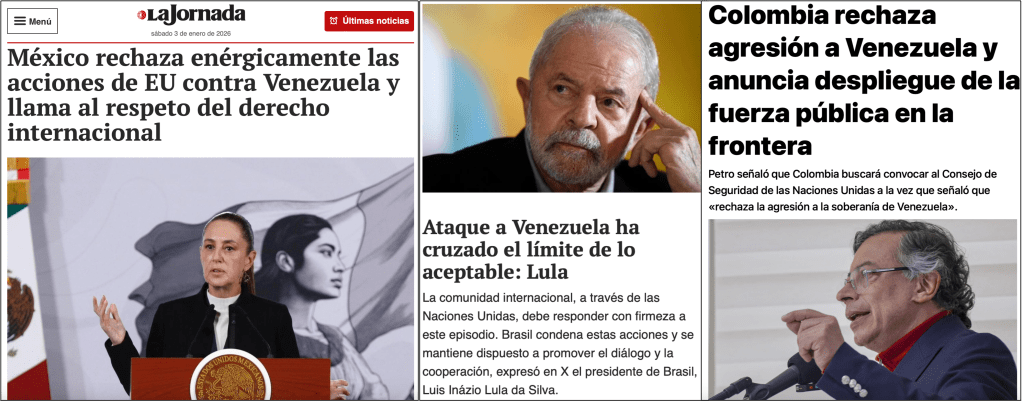
Left: Claudia Sheinbaum, “Mexico energetically rejects the U.S. actions against Venezuela and calls for respect for international law.” Centre: Luis Inácio da Silva, Brazil, “Attack on Venezuela has crossed the limit of what is acceptable.” Lula added that he remains willing to promote dialogue and co-operation. Right: Gustavo Petro, “Colombia rejects aggression against Venezuela and deploys public force on the border.” Petro added he would try to convene the UN Security Council.
As responsible Latin American leaders are pointing out today, the U.S. assault on Venezuela is illegal. Mexican President Claudia Sheinbaum pointed to Article 2(4) of the United Nations Charter: “Members must refrain from threatening or using force against another state’s territory or independence.”
But the rules-based international order has been under attack for years, even by those who purport to uphold it. U.K. journalist Owen Jones writes today that the invasion of Iraq in 2003 helped normalize aggression, including Putin’s invasion of Ukraine and the on-going Israeli occupation of Palestine and genocide in Gaza. U.S. journalist Chris Hedges writes that the kidnapping of President Maduro shows “America is a gangster state.”
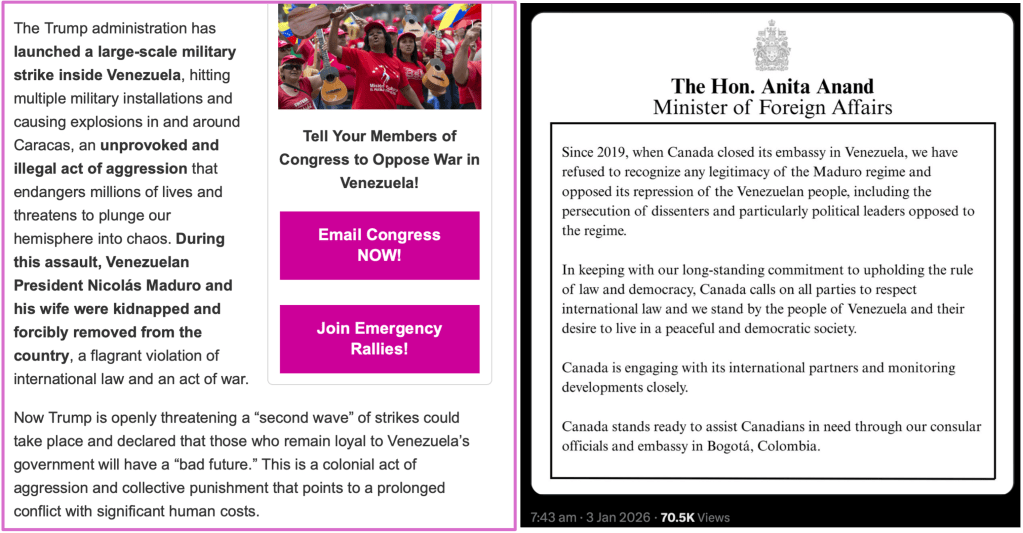
The contrast between a statement by the U.S. women’s peace network CodePink and one by Canada’s foreign minister Anita Anand on X cannot be more stark. CodePink launches a campaign for letters to members of congress; Anand declines to condemn the U.S. intervention.
Chilean President Gabriel Boric expressed concern and condemnation calls for respect for international law, non-intervention and respect for territorial integrity.
In his news conference today, Trump said, “We will run the country,” and: “We will stay until such time as a proper transition can take place.” Venezuelans may have other plans.
Perhaps you are following these events in mainstream media. You might also look at Latin America-based alternatives that have English-language sites. Among them:
Orinoco Tribune is an independent media outlet that provides news and analysis on Venezuela, Latin America and the Global South. It was founded in 2018 and is known for its progressive perspective and critical coverage of US foreign policy and imperialism.
The claim by U.S. President Donald Trump that his forces attacked “a big facility” in Venezuela left me wondering if he was (again) flat-out lying, having another cognition meltdown, or maybe speaking some sort of truth.
In a radio interview Dec. 26, Trump said: “We just knocked out – I don’t know if you read or you saw – they have a big plant or big facility where they send the, you know, where the ships come from. Two nights ago, we knocked that out. So we hit them very hard.”
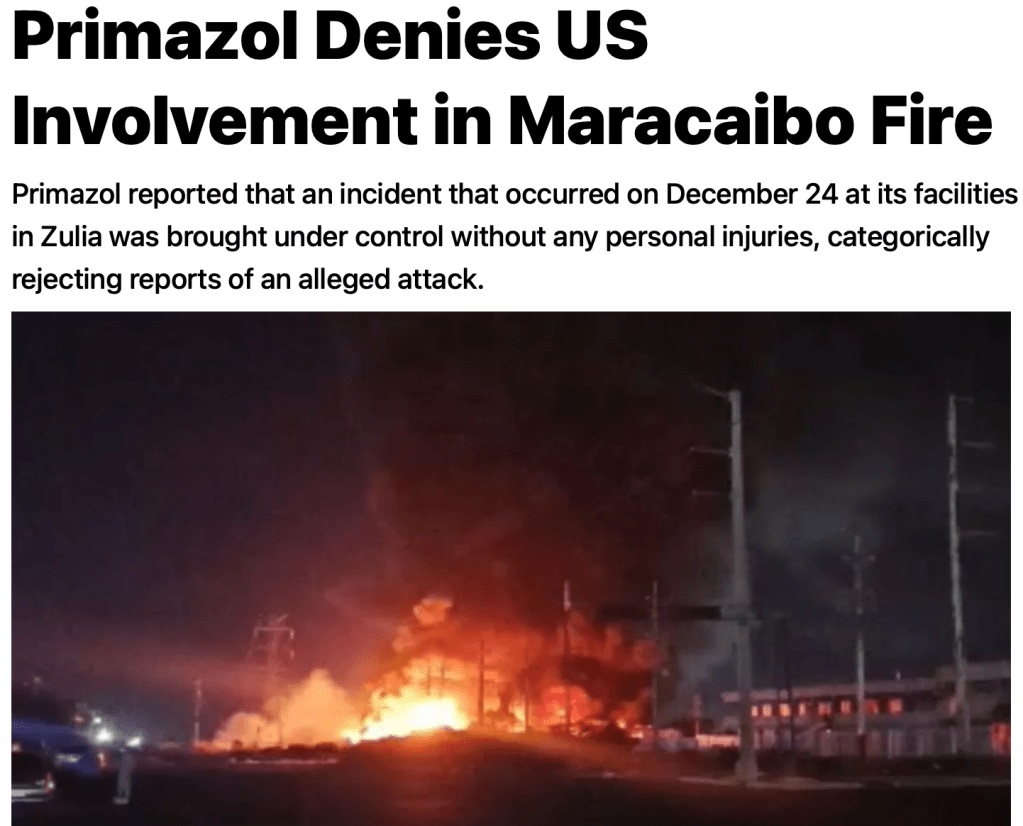
In Venezuela, officials reacted hesitantly. It turns out there was a fire earlier that day at a chemical warehouse run by a company called Primazol in Maracaibo, a major hub for the export of petroleum. But in Venezuela, the fire was treated as a minor event, and the company issued a statement rejecting “the versions circulating on social media,” stating that they “have no relation to the incident and it does not correspond to official or verified information.”
The Primazol plant is located five km from the sea, making it doubtful that there was any facility there from which boats carrying drugs could depart, much less a “dock,” as Trump claimed in a second set of comments at Mar-a-Lago Dec. 29. (“There was a major explosion in the dock area where they load the boats up with drugs.”)
Today’s New York Times morning newsletter quotes U.S. officials who may be trying to provide cover for their boss or offering a semi-truthful account:
A port strike
The C.I.A. [Central Intelligence Agency] conducted a drone strike on a port facility in Venezuela last week, people briefed on the operation said. The strike was on a dock where U.S. officials believe a Venezuelan gang was storing narcotics, and it did not kill anyone, they said. The strike is the first known American operation inside Venezuela.
This Times story offers new details on the strike, which President Trump has already discussed openly, despite the secrecy that typically surrounds C.I.A. operations.
The Trump administration has focused on three goals — to limit Nicolás Maduro’s power, to use military force against drug cartels and to secure access to Venezuela’s vast oil reserves for U.S. companies.
“We’ve had 27 weeks of imperial madness”
Venezuelan Interior Minister Diosdado Cabello denounced the silence of the international community, particularly the United Nations (UN) and other multilateral organizations, regarding the months-long offensive waged against his country by the United States government.
“We’ve had 27 weeks of imperial madness… harassment, threats, attacks, persecution, theft, piracy, murder, and the world – I mean the world, that UN and its cronies – is silent; nobody says a word,” he stated during the activation of a new security program in Aragua state.
He added that “imperialism, those who think they own the world,” not only intend to steal Venezuela’s natural resources, but “want to go further” and subjugate the Venezuelan people because “they don’t like dignified peoples who demand respect and respect themselves.”
Cabello, who highlighted the character of the Venezuelan people in the face of years of attacks of various kinds, offered assurance: “They are not going to ruin our Christmas or New Year, they cannot because of how many things we have endured, how many things they have tried against this people.”
On Monday afternoon, the U.S. Southern Command announced that it had struck another small boat in the eastern Pacific, killing two more men. The new strike means that the U.S. military has killed more than 100 individuals in an operation widely condemned as illegal.
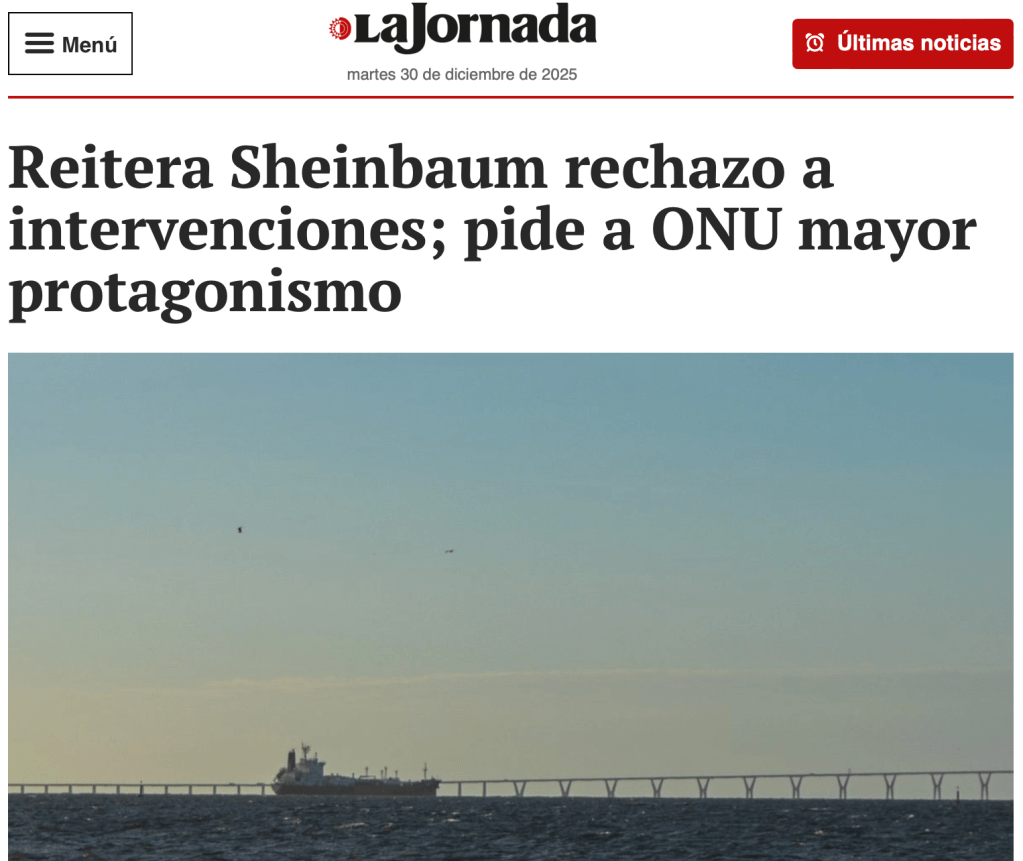
Mexico’s president rejects interventions, call for greater UN leadership
Speaking at a news conference early on Dec. 30, President Claudia Sheinbaum said that the UN should play a more prominent role in these cases.
“What we have to say is that we do not agree with interventions, especially military ones. That is enshrined in our country’s constitution, and that is what we will continue to defend,” she said in response to a question about the case.
When asked if there should be a call in the region to support Venezuela, she replied, “Yes, and as we have said, the United Nations must take a more prominent role in these cases.”
Diverse parts of the UN Office of the High Commissioner for Human Rights (OHCHR) are responding to the situations facing Venezuela in different ways.
On Dec. 24, several UN experts (“special rapporteurs”) denounced the partial maritime blockade imposed by the United States on Venezuela as violating fundamental rules of international law. The same day, Venezuelan Foreign Minister Yván Gil welcomed the statement: “The truth about Venezuela is breaking through around the world.”
Meanwhile, the OHCHR has announced a new “fact-finding” mission to Venezuela that will include Alex Neve, former secretary general of Amnesty International Canada.
And Canada?
Silence from Ottawa regarding U.S. aggression towards Venezuela has been resounding – even in the face of reports that Canada helps the United States in those boat attacks. It’s clear that the government of Prime Minister Mark Carney is choosing its words carefully in the face of U.S. threats to Canada’s sovereignty.
But Canada should at least uphold the 2014 declaration by Latin America and Caribbean countries that their region is a “zone of peace,” support calls for UN leadership in peace-making, and reject the new U.S. National Security Strategy.
Beyond the constant babbling of That Man Next Door is a real plan for U.S. domination of the Americas.
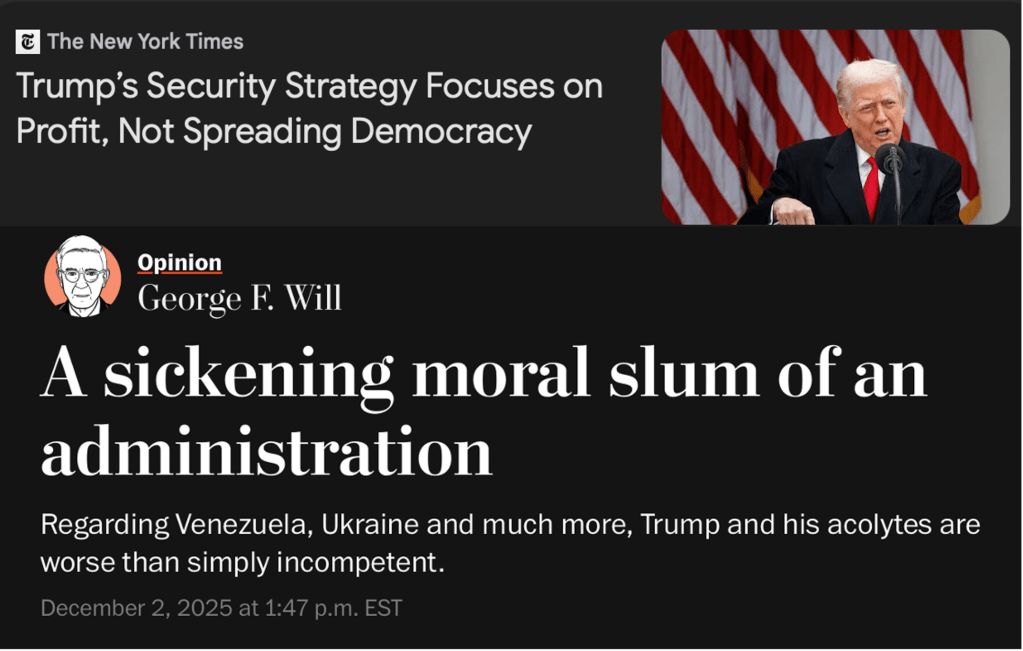
The Trump administration’s 2025 National Security Strategy (NSS) says it will discourage Latin America and Caribbean nations from working with each other and with countries from outside the hemisphere. Overtly racist and nationalist, it also presses European countries to take “primary responsibility” for their own defence.
New York Times headlines in recent days.
The document was released Thursday night (Dec. 4) and neatly summarized Friday night (Dec. 5) by U.S. historian Heather Cox Richardson:
In place of the post–World War II rules-based international order, the Trump administration’s NSS commits the U.S. to a world divided into spheres of interest by dominant countries. It calls for the U.S. to dominate the Western Hemisphere through what it calls “commercial diplomacy,” using “tariffs and reciprocal trade agreements as powerful tools” and discouraging Latin American nations from working with other nations.
“The United States must be preeminent in the Western Hemisphere as a condition of our security and prosperity,” it says, “a condition that allows us to assert ourselves confidently where and when we need to in the region.” …
It went on to make clear that this policy is a plan to help U.S. businesses take over Latin America and, perhaps, Canada. “The U.S. Government will identify strategic acquisition and investment opportunities for American companies in the region and present these opportunities for assessment by every U.S. Government financing program,” it said, “including but not limited to those within the Departments of State, War, and Energy; the Small Business Administration; the International Development Finance Corporation; the Export-Import Bank; and the Millennium Challenge Corporation.”
Should countries oppose such U.S. initiatives, it said, “[t]he United States must also resist and reverse measures such as targeted taxation, unfair regulation, and expropriation that disadvantage U.S. businesses.”
Think of it. The tariff fights with Canada, Mexico and Brazil. The stepped-up sanctions against Venezuela,Cuba and Nicaragua. The mass murders of alleged “drug-traffickers” by exploding their boats in the open sea. Overt threats of “land strikes” in Mexico, Colombia and Venezuela. Trump’s interventions in national elections in Argentina and, most recently, Honduras. These are all part of the same strategy for renewed U.S. dominance.
Resistance grows and is not futile.
I take my title today from the headline over La Jornada’s lead editorial Sunday, Dec. 7: Monroe nunca se fue. Trump’s policy (“Donroe”) rejects the polite notion of a “good neighbour policy” towards Latin America and the Caribbean promoted after 1933 by Franklin D. Roosevelt and others. But that approach was betrayed repeatedly by presidents from both parties who involved themselves in coups in Guatemala, Brazil, Chile, Honduras and elsewhere, along with invasions of the Dominican Republic, Haiti, Grenada and Panama – and the wars in Central America in the 1980s and U.S. support for paramilitary death squads in Colombia.
The people of Honduras went to the polls Sunday, Nov. 30. Before the vote, Trump did two things: he pardoned former President Juan Orlando Hernández, convicted last year in the United States for trafficking cocaine; and he endorsed the candidate of Hernández’s National Party, Nasry Asfura (known as “Tito” or “Papi”). A week after the vote, Asfura is in what election officials called a “technical tie” with a slightly more centrist candidate, Salvador Nasralla of the Liberal Party. Those two parties represent different factions of Honduran family oligarchs.
Whichever of them is ultimately declared the victor (a process that could take until Dec. 30), the ruling Libre party has been pushed aside. President Xiomara Castro had led the country for the past four years; her party’s candidate, Rixi Moncada, has only about 20 per cent of the official count – although many aspects of the election remain in dispute – including U.S. interference.
Key here is the coup On June 28, 2009, that ousted the elected government of Mel Zelaya, not quite a half-year into the administration of Barack Obama and his secretary of state Hillary Clinton. Their machinations brought about more than 12 years of rule that facilitated drug-traffickers, mining, corrupt land sales and human rights abuse – only partly subdued after the election of Castro four years ago.
“The abuse of force,” concludes La Jornada’s editorial, “is not, as [Trump] pretends, a sign of strength, but the recourse of one who cannot attract his neighbours with technological innovation, productive investment, exemplary institutions or a viable model of civilization.”




 Unwrapping Development