
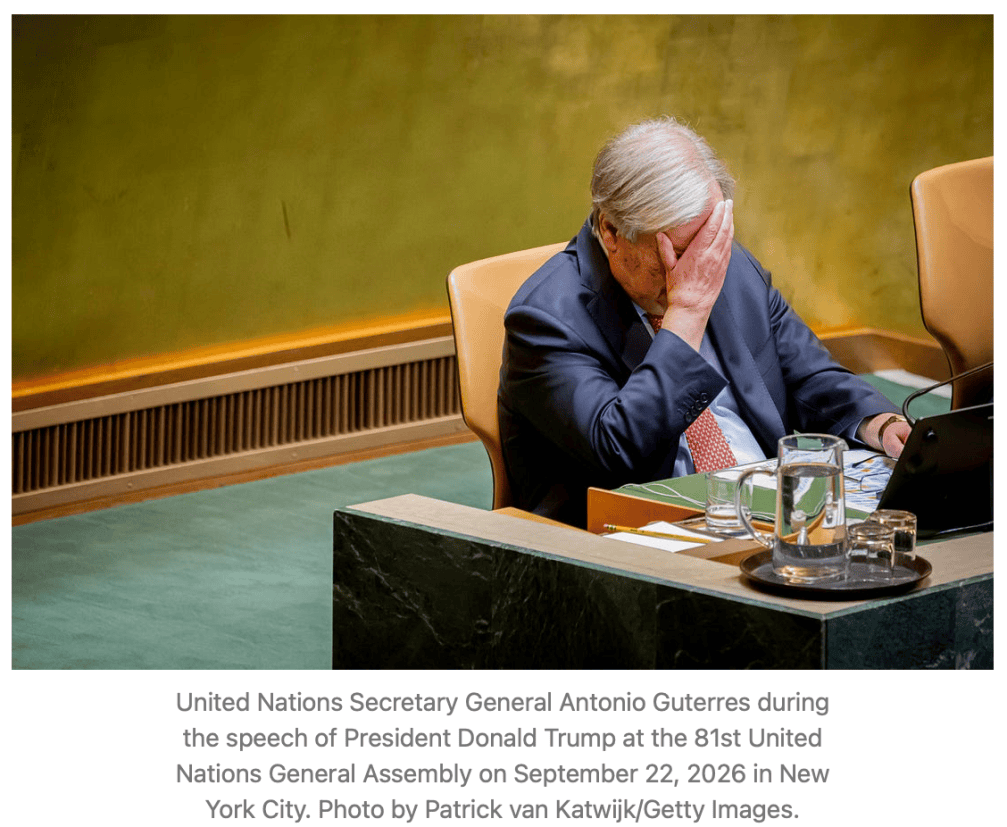
by Jim Hodgson
The first hours of the annual parade of world leaders at the UN General Assembly Sept. 22 showed again the sharp disagreement between the leader of the United States and many other leaders over multilateral cooperation and unilateral abuse of power.
In his speech, Donald Trump threatened to “annihilate” Iran, proclaimed his nation’s supremacy, and declared that “to the victor go the spoils.” He also called Cuba “a failed state,” though any “failure” is due to his country’s decades of interference, embargo and sanctions.
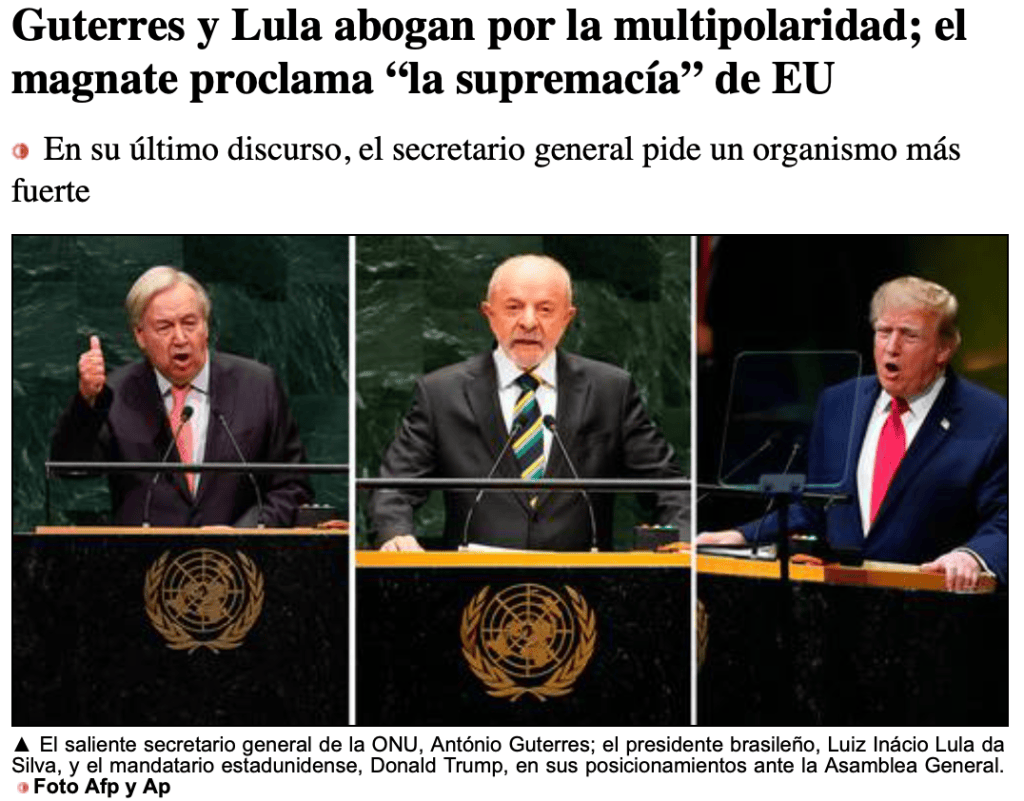
“In the face of a global catastrophe more than 80 years ago,” Guterres said, “the United Nations was created as an act of defiance. The defiance of people who refuse to surrender the future to fear. The defiance against the self-defeating notion that might makes right. The defiance of countries that know our futures are bound together. The defiance of hope.”
Lula, who seeks re-election in October, warned that countries should not interfere in the internal affairs of other nations. In the current campaign, Trump has openly backed Flávio Bolsonaro, son of a disgraced former president. Trump previously interfered in elections in Honduras, Argentina and Colombia.
Lula urged world leaders to take stronger action in response to intensifying global conflicts and called on the UN to recover its capacity for dialogue and mediation. He added that it is time to choose between multilateralism or global fragmentation.
“Concessions to the law of the stronger have surpassed all limits. This is not idealism, but pure realism,” he said. “War is not the continuation of politics by other means; it’s the complete breakdown of politics.”
In his speech, Trump said Mexico was the “epicentre” of drug-trafficking in Latin America and that it had ceded some of its territory to the cartels.
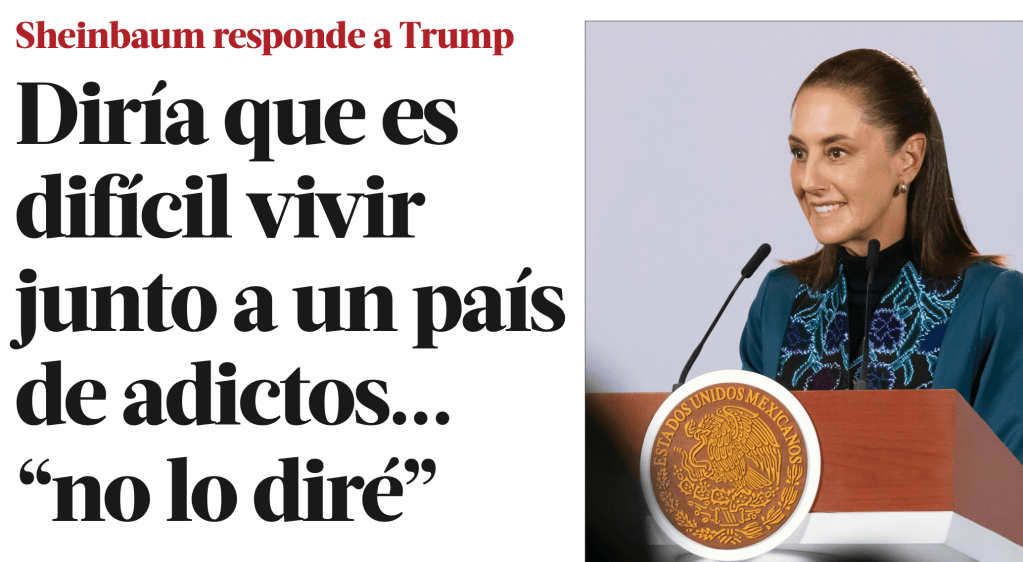
A day later, President Claudia Sheinbaum responded with irony:
“I could say that it is very difficult to live next to a country with such a high level of consumption of illegal drugs. Or I could say that it is very difficult to live next to a country that produces so many weapons. But I won’t say that because we have a good relationship.”
(Sheinbaum did not attend the General Assembly; Mexico’s remarks were delivered Friday by Foreign Minister Roberto Velasco, who emphasized collaboration with other countries and reform of UN structures.)
Trump gathers his “Shield of the Americas”
Since Trump returned to the White House in January 2025, the United States has tried to dominate its neighbours in the Western Hemisphere. The early 19th-century Monroe Doctrine (now dubbed “Donroe”) is revived to limit perceived threats in the region.
Over the past 13 months, the U.S. military has killed at least 230 people in about 70 air strikes on boats in the Caribbean and Eastern Pacific Ocean. In January, U.S. forces kidnapped Venezuelan President Nicolás Maduro and his spouse Cilia Flores, and now holds them in a prison in Brooklyn across the East River from the United Nations building.
In April, U.S. and Ecuadoran soldiers launched an effort to dismantle a drug-trafficking group. On Sept. 24, U.S. troops and the U.S. Drug Enforcement Administration assisted Ecuadoran authorities in arresting more than 30 people with alleged ties to Mexico’s Jalisco New Generation Cartel.
During the high-level General Assembly session, Trump gathered leaders of the 14 countries allied with him in his so-called “Shield of the Americas.”
They pledged coordinated action against 24 organizations designated as “narco-terrorist.” The declaration calls for sanctions, intelligence sharing, security cooperation and a commitment to invoke the Inter-American Treaty of Reciprocal Assistance, or Rio Treaty, to consider collective military action against the groups.
New Canadian aid to Palestine and Haiti (but not Cuba)
Canada’s foreign minister, Anita Anand, also emphasized multilateral collaboration in her speech. Canada’s foreign policy, she said, is guided by establishing autonomy in strategic fields to limit superpower coercion, along with aspirations to lead middle powers.
“Great powers are walking away from global economic co-operation, dismantling economic integration,” Anand said. State sovereignty “has been treated with disdain.”
“We are facing serious challenges in the global order,” Anand said.
“We will lead other middle powers to act collectively and decisively, because middle powers are playing a key role in building the framework for the new international order — which is being established as we speak.”
Earlier in the week, Prime Minister Mark Carney pledged $100 million in aid for Palestine in an effort to preserve “the possibility of a two-state solution.”
The funding includes $80 million in humanitarian aid, while the rest is development funding for security initiatives, including top-up funds for a multi-year project to train police in the West Bank.
Anand announced $25.4 million in new Canadian funding for Haiti to support security, governance and community resilience in Haiti. But there have been no new funding announcements for Cuba since commitments earlier this year of $13.5 million to the Pan-American Health Organization, the World Food Program and UNICEF for programs in Cuba.
(Images: http://www.lajornada.com.mx)

