
by Jim Hodgson
“The U.S. government is going crazy with its shameful war on Cuba,” writes Medea Benjamin of CodePink. “Every week, there’s a new sanction, a new restriction, a new way to punish the Cuban people.” She goes on to describe measures directed against U.S. travellers and solidarity groups.
Here, I want to focus on the measures that are forcing foreign investors to abandon holdings in hotels, mines and other joint ventures – and forcing cancellations by still more airlines and abandonment of Cuba by the credit card duopoly of Visa and Mastercard. All of these actions hurt the Cuban people, directly or indirectly.
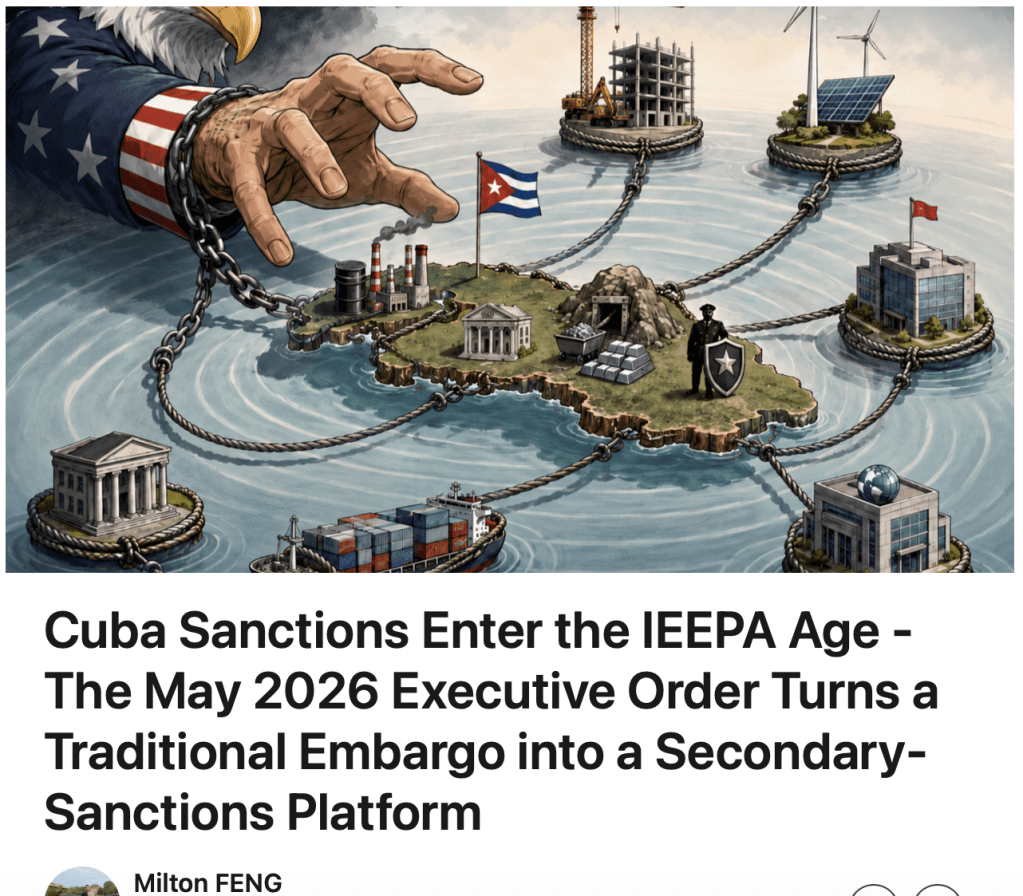
On May 1, U.S. President Donald Trump signed an executive order, effective June 5, that freezes U.S. assets of foreign companies and people that conduct business with the Cuban government.
A week later, U.S. Secretary of State Marco Rubio announced more details: the U.S. would impose additional sanctions on Cuban state-owned businesses that manage joint operations with foreign companies across tourism, retail, mining and distribution. The move had an immediate impact on Canadian investment in Cuba, notably nickel-miner Sherritt’s surrender to Gillon Capital LLC, the family office linked to Ray Washburne, a former adviser and appointee of Trump himself.
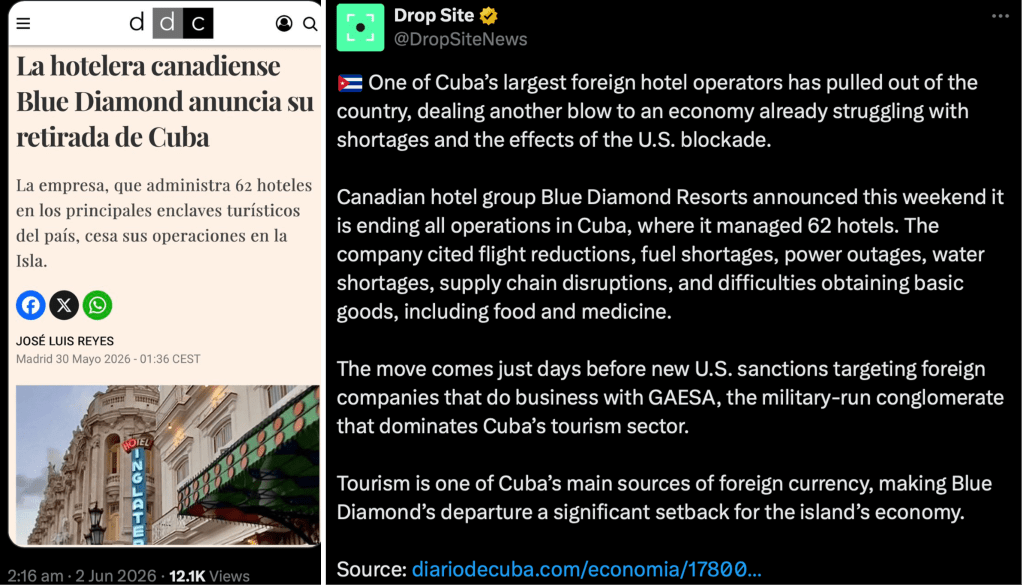
Many of the U.S. measures were aimed at partnerships with GAESA, a company linked to Cuba’s military. On June 2, the Cuban government defended GAESA, saying its joint ventures had funded housing, schools, clinics, and infrastructure.
The Spanish foreign minister said the moves against the hotel companies would aggravate the “humanitarian hardship” faced by the Cuban people in the wake of other U.S. sanctions and the fuel blockade underway since early this year. Church leaders from Canada and other parts of the world saw first-hand the impact of the U.S. blockade on ordinary people when they visited earlier this year.
But Canada has said nothing.
Like the European Union, Canada has law to protect its companies from the kind of extraterritorial reach demonstrated by Trump’s executive order. Amendments in the 1990s to its Foreign Extraterritorial Measures Act (FEMA) explicitly prohibit Canadian corporations from complying with US extraterritorial measures that affect trade and commerce with Cuba.
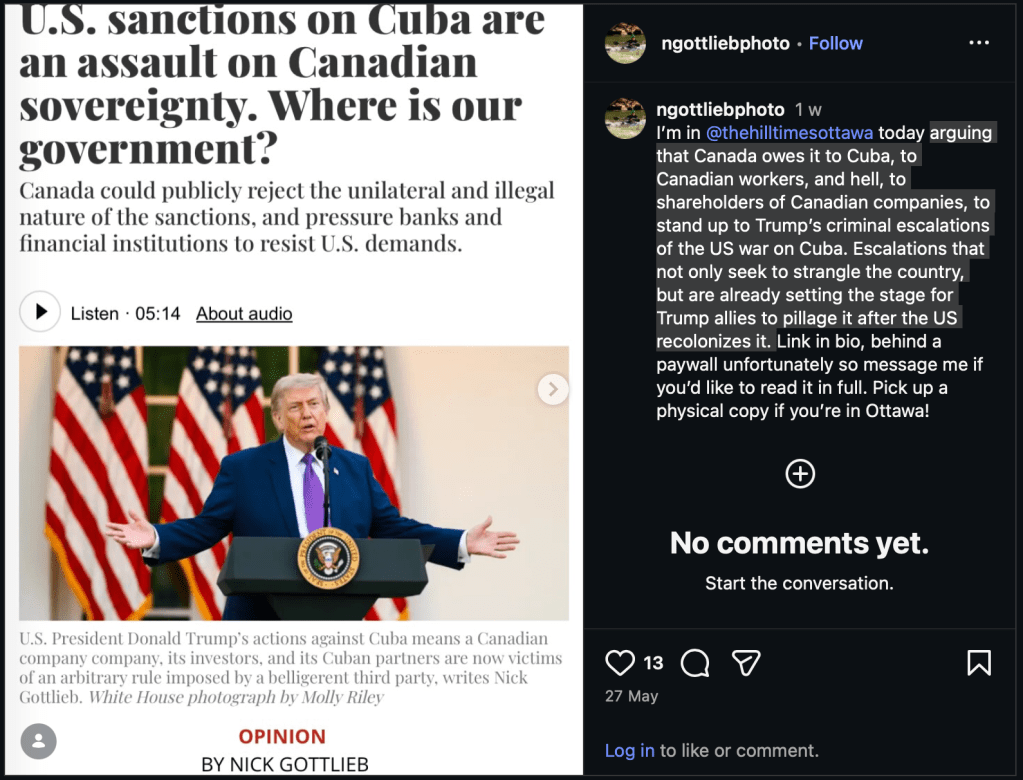
“If the Canadian government refuses to invoke FEMA at the precise moment it was designed for, then the legislation becomes little more than symbolic theatre,” wrote Dalhousie University’s Isaac Sainey in a Facebook post May 20. “Worse still, Canada effectively concedes that Washington possesses the right to determine Canadian economic policy and punish Canadian firms at will. This is not sovereignty. It is subordination.”
But CUSMA. Under Mark Carney’s leadership (not that he has said so yet), it seems Canada will not support Cuba as long as its free trade relationship with the United States is facing re-negotiation. In 2019, when Justin Trudeau was prime minister and Chrystia Freeland his foreign minister, Canada strongly defended the interests of Canadians doing business in Cuba.
When Trump threatened Canada last year, most of us joined with Carney in saying “#ElbowsUp.” That defiance needs to extend in solidarity with people in Cuba and in other parts of this hemisphere threatened by resurgent U.S. imperialism.
Please write (again) to the prime minister and to your member of parliament. If you are in a country other than Canada, please write to or call your representatives to ask for their solidarity with the people of Cuba.


2 thoughts on “Hey Canada! Just say NO to U.S. threats against Cuba”