
by Jim Hodgson
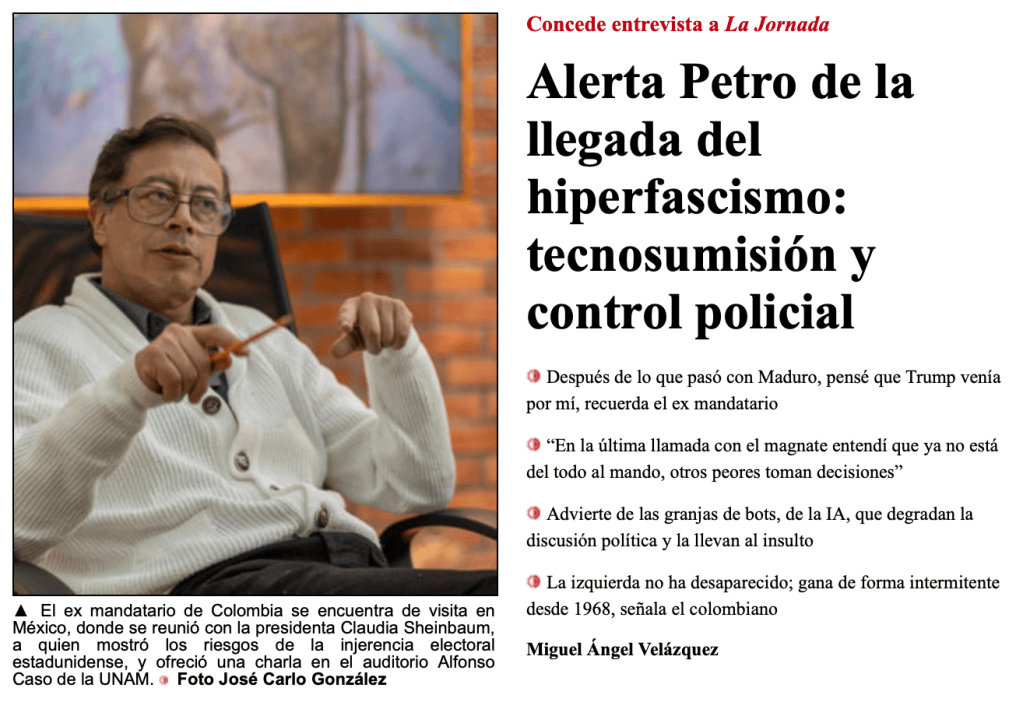
During a visit last week to Mexico City, Colombia’s former president Gustavo Petro declared he would work with others to prevent “hyper-fascism” and “techno-fascism” from taking control of all Latin America.

He met with President Claudia Sheinbaum in the National Palace (above); spoke with students at Mexico’s National Autonomous University on economic policy in the climate crisis; met with Colombians living in Mexico; and sat down for an interview with Miguel Ángel Velázquez of La Jornada daily newspaper.
In that interview, Petro spoke of his complicated relationship with the administration of Donald Trump. The two have differed sharply over Israel’s treatment of Palestine, climate justice, relations with Venezuela and Cuba, and the U.S. “war” on drugs.
Petro’s four-year presidential term ended on Aug. 7 when his hard-right successor, Abelardo de la Espriella was sworn in. Petro had been Colombia’s first president from a party of the left. He had tried (unsuccessfully) to bring about “total peace” in a country torn for decades by civil war and violence tied to drug-trafficking. It was Jan. 3, when the United States kidnapped Petro’s Venezuelan counterpart, Nicolás Maduro, that fear set in.
“After the crucial day, when they bombed Caracas, Trump said: ‘Watch your back, because now I’m coming for Petro.’ That day I thought: ‘A missile is coming for me.’”
After talks among diplomats and with Republicans in the U.S. congress, Petro and Trump met in the White House on Feb. 3. Trump called the conversation “terrific.” Petro said it was “constructive.” (In the La Jornada interview, Petro added that others behind Trump “worse than him” are driving the key decisions.)
Their rapprochement did not last. In Colombia’s presidential election, Trump and his officials backed de la Espriella, calling the other candidate, human rights defender Iván Cepeda, a “radical left Marxist.” This was one more instance of U.S. interference in Latin American elections (after a presidential vote in Honduras and mid-term contests in Argentina).
Now, countries from Argentina and Chile to El Salvador and Trinidad and Tobago have governments of the hard-right that are solidly attached to Trump’s agenda. The next election to watch is in Brazil next month, where progressive President Luiz Inácio (Lula) da Silva faces Flávio Bolsonaro, son of disgraced former president Jair Bolsonaro.
Across the region, right-wing parties are backed by a large-scale disinformation network, La Derecha Diario (“The Right Wing Daily”). A failed murder-for-hire plot in Bolivia has drawn wider attention to the network’s activities.
In his interview with La Jornada, Petro spoke of his vision of the political moment:
“We live in a planetary shell; it’s the matrix of lies. We act like in The Matrix, like in the movie. Suddenly you find a bot farm. It’s not made up of human beings, but rather profiles that automatically react to any Latin American leader because they want to degrade political discourse and reduce it to insults. That’s why I call it the matrix of lies. In this shell of falsehood, some parts escape because they are strong, like states, but the intention of this matrix is to enslave human beings, and it’s not just a physical chain, but a mental one, to enslave human beings to allow the exploitation of non-renewable natural resources, for example.”
Petro explained the counterattack: “Mathematics is required, because it’s a mathematical, algorithmic attack, both in the bots used to manipulate human beings and in the elections themselves and their final results.”
In a subsequent editorial, La Jornada wrote:
“Petro’s contribution to the political debate serves as a wake-up call to increase vigilance regarding foreign agents who exploit communication tools such as social media to promote neo-fascist rhetoric, spread misinformation, incite hatred, and manipulate electorates to benefit their external and internal sponsors – namely, the White House and a sector of big business resistant to democracy.
“Alongside the bleak picture he paints, there is a message of hope. In his country in 2022, the people elected the first progressive government in history, and this experience cannot be seen as a failure. Societies are not defenseless against technofascism, he says, because they can protect themselves with strong minds and with the same resources used by oppressors: mathematics. Education is fundamental to the resistance that he joins and invites others to join.”
Yes. And, to me, hope is in revival of the networks of social movements that gave rise to the “pink wave” of progressive governments a quarter-century ago.
A postscript: In a Labour Day essay, Canadian politician and activist Charlie Angus offered a similarly sharp warning about the power of the big-tech corporations in the Trump White House. He recalled that in his farewell address, Joe Biden warned that the Silicon Valley elite were capable of destroying democracy and damaging the future.


Democracy requires a citizen base that is not so much highly educated but willing to read critically and use their lived experience to understand what is really happening in their community.
Top of the list is to not be drawn into a politics of fear. Fear is the greatest negative motivator for being drawn into a political movement and ideology that makes promises but will not make life better for those who want to live simply so that others can simply live.
LikeLiked by 1 person
Jim: Thanks for taking the time to bring to our attention some of the important considerations that Petro is raising about the increase
LikeLiked by 1 person
Thanks for being the first I know of, Jaime, to mention the antics of ultra right-wing latinos (i.e., Fernando Cerimedo) using US financed and encouraged farm bots to move governments and citizens to the right in recent electoral contests! One coould have guessed these knaves were meeting in Miami with Rubio’s pals and gusanos of all varieties. And now Cerimedo is jailed for hiring sicarios to assassinate his (pregnant) former wife! Bizarre beyond words – and SO dangerous!
LikeLiked by 1 person
Thanks Joe. More information here:
How to Steal a Hemisphere: Fernando Cerimedo and the Heist of Latin American Democracy
https://reactionary.international/investigations/how-to-steal-a-hemisphere/en/
LikeLike