Karl Marx in the Rose Garden

By Jim Hodgson

I take my title today from a subhead in a column by Enrique Galvan Ochoa in the Mexico City daily La Jornada. I’ll translate and summarise from his text here:

Not even Karl Marx would dare to imagine such a spectacular coup against neoliberalism and globalization as that carried out by President Donald Trump with his explosion of tariffs to the whole world on April 2 in the Rose Garden of the White House. The cathedrals of capitalism tumbled, from Wall Street to all the other global stock markets. In just a week, investors fled in search of refuge for their money: in gold, government bonds—swallows in search of a nest. The blow from that unpredictable businessman installed in Washington will have lasting effects. And it will hit the poor as well as the rich.

With respect, I am not so sure that it was a blow against neoliberalism so much as its logical next step: away from unrestricted movement of capital and toward concentration of wealth in ever-fewer hands. 

But that’s my point: I’m not sure. Daily—this has been going on since Trump began his run for political office a decade ago—new opinion pieces land in my inbox, many of them making strong historical analogies. Is he trying to restore a golden age/Belle Époque—think of the 1870s through to the start of the First World War and the beginning of income tax—for oligarchic billionaires and their closest allies, the mere millionaires? 
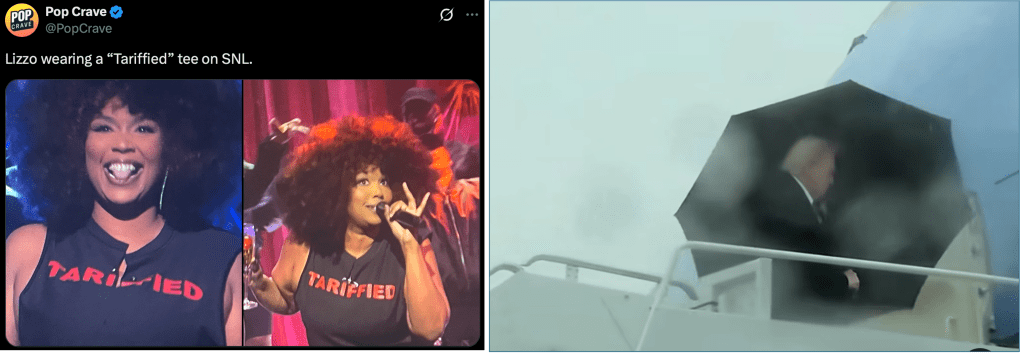
I loved seeing the rapper Lizzo on Saturday Night Live this past weekend wearing a cropped t-shirt emblazoned TARIFFIED. On the right: Trump in a storm.

What to make of these tariff wars and consequent stock market losses? I find myself pushed to go deeper.

You don’t have to be a Marxist—I think here of sociologist Max Weber and Canadian social democrat Tommy Douglas—to see how societies (including the liberal ones) are divided between the dominant structures defended by the elites and the counter movements supported by those with fewer privileges. 

And you don’t have to be a Marxist to appreciate his writing. A passage in The Communist Manifesto describes how love and poetry, religion and community, are “drowned in the icy waters of selfish calculation.”  All of these are drowned so that personal worth becomes exchange value—you sell your labour—and numberless freedoms are abolished in favour of “that single, unconscionable freedom—Free Trade.” * 

We might be forgiven if we thought free trade was invented at the time of the great debates ahead of the North American Free Trade Agreement (NAFTA) in 1994, or the Canada-U.S. agreement in 1989, or the advent of the common market in Europe in the 1960s. Some might know that elections in Canada were fought and lost at the end of the 19th and early 20th centuries over various proposals for free trade with the United States: “No truck or trade with the Yankees!” cried the Conservatives in 1911, defeating the Liberals of Sir Wilfred Laurier. 

Just before Marx and his co-author Friedrich Engels published their Manifesto in 1848, debate raged in Britain over the “Corn Laws.” These were tariffs and other trade restrictions on imported food enforced between 1815 and 1846. Large land-owners wanted the tariffs kept high to keep out competition. Industrialists wanted them lowered because cheaper food meant they could pay workers less. (The industrialists won.) In a speech in Brussels in January 1848, Marx said protectionism was conservative and free trade was destructive. But he also saw that free trade in that context “hastens the social revolution” and thus merited his support. 

I like to say that I have been fighting free trade since 1848. But truth is the first time I wrote about the free trade debate was in 1986 (above).

My issue wasn’t so much having about rules for international trade—and we always press for protection for labour, the environment and human rights—as it was the protections that were built into the trade agreements for corporations (always referred to as “investors”). Under those waves of free trade deals, governments were blocked from protecting public health or the environment. Corporations would bring their complaints to an “investor-state” dispute resolution tribunal. Most times, the tribunals would rule in favour of the corporation and the state would be on the hook for the corporation’s imagined future earnings. Or they would succumb to the threat of the suit, as Panama is doing now in the face of a $20-billion suit.

Now that Trump has thrown away the rule book, it may seem that people like me are suddenly defending free trade. I think we’re defending the idea of at least having rules. Even as we fight specific battles (I think of the lawsuit brought by Canadian mining companies against El Salvador), we learned to live with economic integration: even after the havoc caused in Canada to industrial jobs and farmers after the 1989 FTA with the United States; even after U.S. abandonment of its industrial workers; and even after two million Mexican farmers were forced from their land and into the cities and across the border after NAFTA in 1994. 

But let’s not lose sight of longer-term objectives. In the face of this crisis in capitalism, what are the opportunities? The “social revolution” envisioned by Marx may be distant, but in these last 40 years, social movements have never ceased to uphold human rights broadly understood: economic, social, cultural and environmental. 

Manuel Pérez Rocha works now with the Institute for Policy Studies and writes an occasional column for La Jornada. (In the late 90s, we both worked with the Mexican Action Network on Free Trade, RMALC). Recently, he pointed to a long list of actions taken together by Mexican, Canadian and U.S. organizations. He continued: 

“Under Trump, we suffer from a savage neoliberalism that evades treaties, written rules, and multilateral organizations. He sees no friends and only enemies. The only laws are those of the strongest and ‘I’m in charge.’ Mexico must respond by demanding a thorough review of the USMCA [called CUSMA in Canada and T-MEC in Mexico], chapter by chapter, since its purpose and content are largely the same as those of NAFTA: to make Mexico an export platform to take advantage of cheap labour. Together with Canada, we must promote this review by generating spaces and resources for democratic participation, not only for business leaders but also for grassroots organizations in all three countries.”

Meanwhile, Charlie Angus continues his resistance campaign. (In the current federal election, he is not running again.) On April 14, he reminded his Substack readers of Rules for Radicals by Saul Alinsky.

Angus points to what Alinsky would say about our collective sense of loss over what is happening in the world today:

“Do one of three things. One, go and find a wailing wall and feel sorry for yourselves. Two, go psycho and start bombing – but this will only swing people to the right. Three, learn a lesson. Go home, organize, build power.”

* Karl Marx and Friedrich Engels (1848), The Communist Manifesto in Essential Works of Marxism (18th ed., 1979), New York: Bantam, p.15.

Right to Truth Day sparks reflection on human rights in Argentina, El Salvador and the United States

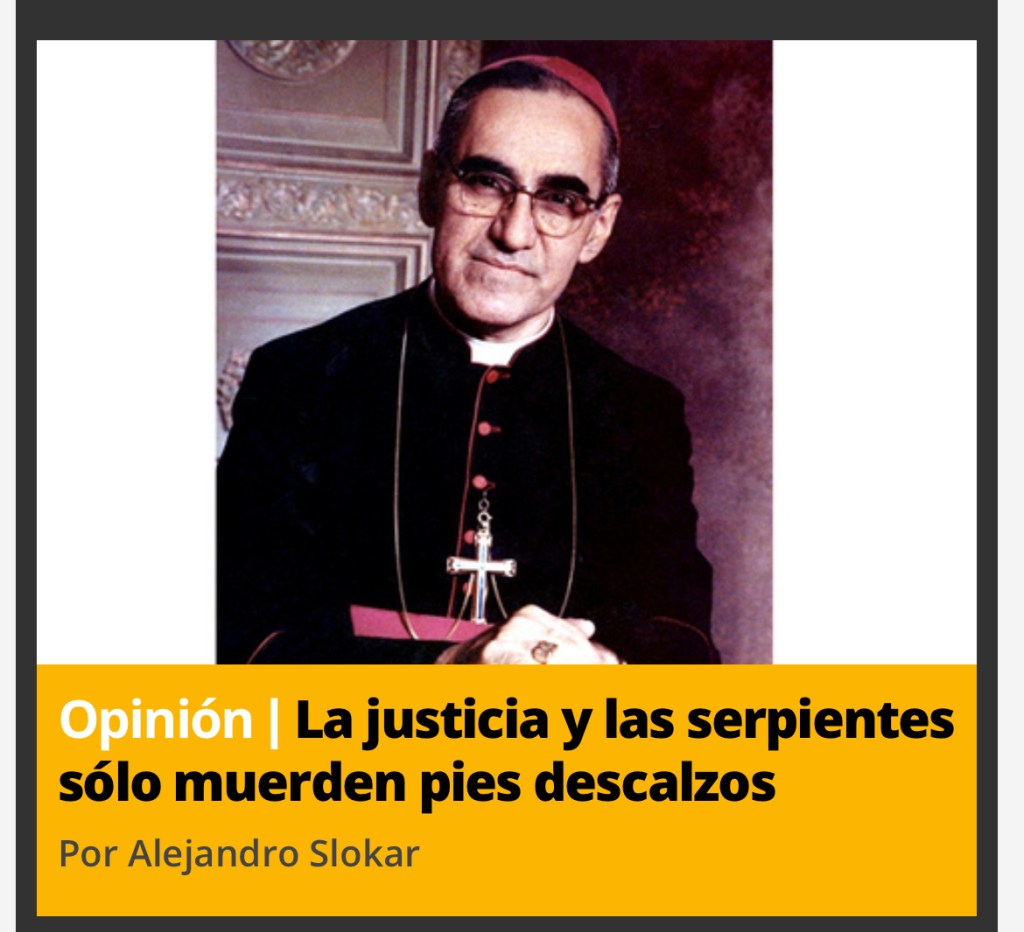
A headline and a photo in the Buenos Aires newspaper Página 12 caught my eye today. Together with a photo of Saint Óscar Romero was this phrase: “Justice and snakes only bite bare feet.” *

The writer, Alejandro Slokar, is a judge in Argentina’s federal court for appeals of criminal cases (Cámara Federal de Casación Penal). Here, he is writing about the International Day for the Right to the Truth Concerning Gross Human Rights Violations and the Dignity of Victims—or more simply, the Right to Truth Day, marked now every March 24.

March 24 is not only the date when we recall the martyrdom of San Salvador’s archbishop, the human rights defender Óscar Romero in 1980. It’s also when Argentineans recall the 1976 military coup that ushered in a “dirty war” against the popular movements of the impoverished—those with bare feet—along with trade unionists, journalists, writers, artists and human rights defenders. As many as 30,000 people were killed or disappeared over the next five years.

In El Salvador, about 80,000 people were killed or disappeared between 1979 and the end of the civil war in 1992.  In both countries, as elsewhere across Latin America, movements to find the “historical truth.” 

In recent weeks, families of people who disappeared during Mexico’s long “war on drugs” have drawn attention to a half-hectare farm in Teuchitlán, about 60 km west of Guadalajara in the state of Jalisco. The farm had been used to recruit new traffickers, but also to execute those who refused the cartel’s orders. State and federal authorities had known about the site since last September but did nothing to secure it or to identify human remains and other items found on the land. Predictably, state and federal authorities point fingers of blame at each other.

About 120,000 people have gone missing in Mexico since 2006 when then-President Felipe Calderón launched a military-led offensive against the drug cartels in an attempt to curb their violent turf wars. Instead, the violence became worse. And Calderón’s security chief, Genaro García Luna, was convicted in October in a U.S. court for his deep ties to the Sinaloa cartel. 

Among the disappeared (still) are 43 students from a training school for rural teachers in Ayotzinapa, Guerrero state, taken in 2014.

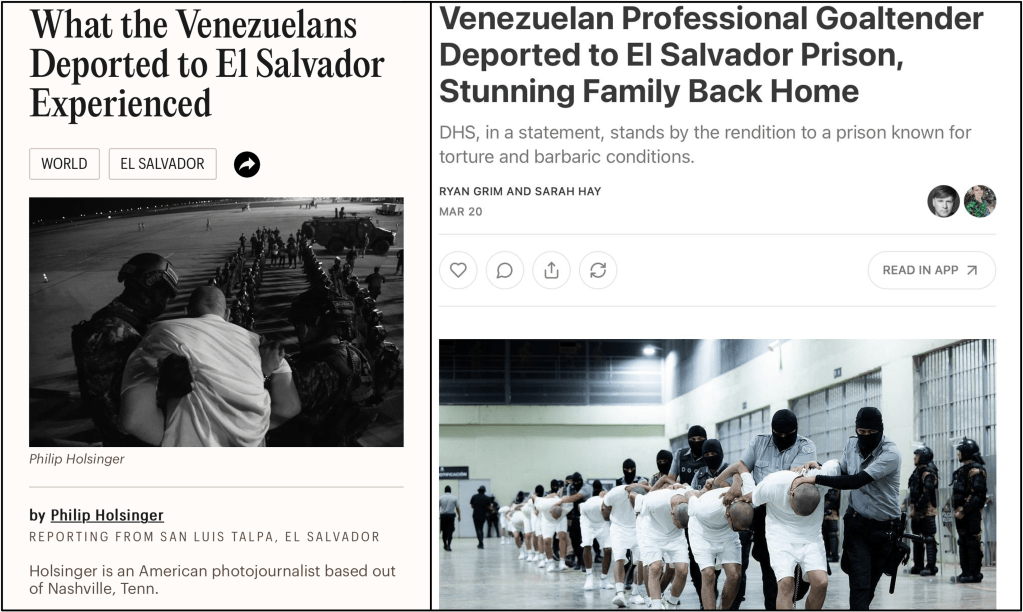
The “right to truth” cannot only be about historical cases. It must be the demand now in the case of the young men taken by the Trump regime and dumped into El Salvador’s infamous Terrorism Confinement Centre (CECOT). Certainly, some of the 238 Venezuelans may be criminals who were members of the “Tren de Aragua” gang but, as stories leak out, it’s clear that some of those deported were never accused, much less tried or convicted, of any crime. 

TIME magazine published a stunning photo essay about the deportations. The photojournalist, Philip Holsinger, included this description of one of his encounters: “One young man sobbed when a guard pushed him to the floor. He said, ‘I’m not a gang member. I’m gay. I’m a barber.’ I believed him. But maybe it’s only because he didn’t look like what I had expected—he wasn’t a tattooed monster.”

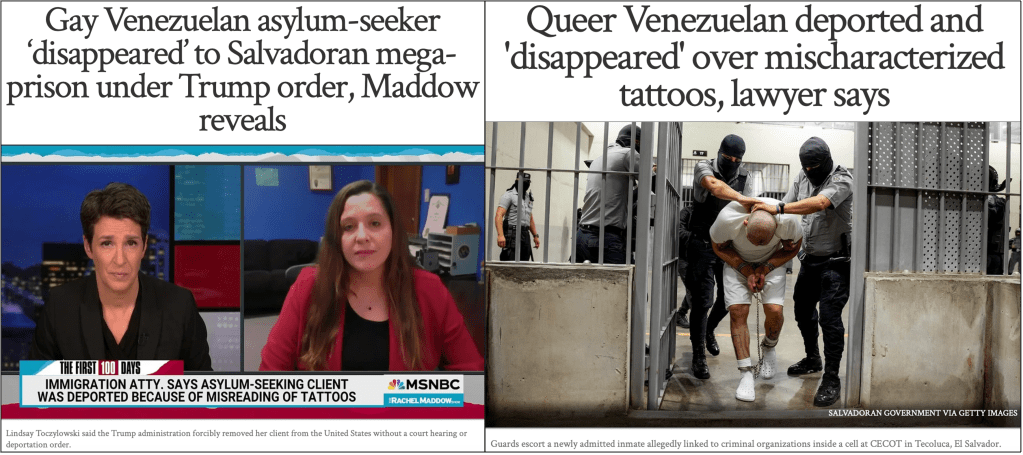
Drop Site News reported that another deportee was a Venezuelan professional soccer player and youth soccer coach with no criminal record. “The family only discovered that their loved one, Jerce Reyes Barrios, had been sent to El Salvador when they saw him in viral videos posted by the Trump administration, in which it celebrated what it said was the mass deportation of violent members of the Venezuelan gang Tren de Aragua.”

The LGBTQIA+ Advocate magazine shared reporting on PBS by Rachel Maddow about a gay makeup artist who was among the deported prisoners—forcibly removed from the United States without a court hearing or deportation order.

Those stories, combined with reports of detentions of visa holders and other visitors, and harassment of legal residents and citizens, suggest that what happened in Argentina and El Salvador has begun in the United States. Can paramilitary death squads be far behind?

Writing of historical events and of the present-day right-wing populist regimes of Nayib Bukele in El Salvador and Javier Milei in Argentina, Slokar’s article argued that such abuses derive from the “neocolonial models”—European feudalism—applied in throughout the Americas. “While those responsible die in their beds without sanction, the consequences are almost infinite, farce and tragedy at the same time, and expressed in the inhumane neoliberal experiment that laughs at the Constitution, bitcoin, extractivism and punitive demagoguery that converge in the present.”

* The quote is variously attributed to both Óscar Romero and to the Uruguayan journalist Eduardo Galeano. It may be that Galeano was quoting Romero, but I cannot find the original source: just partial citations.

Take action in solidarity with Cuba

In the face of the flood of orders spewing from the White House since January 20, I feel compelled to attack all of them, everywhere, and all at once.

Today I am taking a deep breath to encourage you to take action in solidarity with Cuba. The item below focuses on what Canadians can do, but if you are in another country, please write to your government to encourage them to increase humanitarian aid to Cuba and not to be cowed by U.S. pressure.

A day before the new U.S. administration took power, I spoke about Cuba with my friends Dean Detloff and Matt Bernico for their Magnificast podcast. I feel now I was too optimistic, but have a listen. The image shows a bus given for use by churches and civil society organizations by Pastors for Peace.

Take Action for Cuba

You are invited to join other Canadians and Canadian international cooperation, trade, faith and civil society organizations to join forces in taking action in response to the economic hardships being faced by Cubans.

1.     Sign and share this new Take Action live at https://petition.web.net/CanadaActNowOnCuba.

In the midst of the difficult political situation in the U.S. and the leadership transition in Canada, advocacy is still necessary.

Cuban partner organizations and recent visitors say conditions in Cuba today are much more difficult than in the early 1990s when the implosion of the Soviet Union led to a sharp deterioration in living standards. The pandemic shuttered the tourism industry, a main source of revenue used to acquire food, medicines and fuel from abroad. Cuba has also suffered a series of hurricanes, droughts and floods, leading to lost crops and food shortages. Energy shortages limit public transit and even the collection of garbage.  

The Canadian government has responded to calls from civil society to increase humanitarian assistance but more is needed.

In 2024, Canada contributed $1.7 million in humanitarian assistance in response to several emergencies including Hurricanes Oscar and Rafael. Funds were shared via multilateral agencies including the World Food Program and UNICEF, along with NGOs including CARE Canada, the Canadian Red Cross and Humanity and Inclusion.  

In his first days in office, the new US president has revoked revoked Biden’s measures to remove Cuba from the U.S. list of sponsors of terrorism.  The difficulties of sending money and engaging in trade will continue.

Sign now!

2.      Use the information provided in the Take Action and its demands to engage candidates in your riding.  While the election period has not started yet, we know it’s coming. 

3.     Many Canadians are part of efforts to fill a container, carry a suitcase of medical supplies, are organizing a people-to-people delegations, or making a donation through a church, union, or humanitarian agency.  Please tell your MP and other politician to raise the profile of the economic crisis in Cuba.  Send them pictures, and post them on social media. 

Thank you!

PS: Over the past two years, I have worked with my former colleagues at The United Church of Canada, other churches, several trade unions and international development organizations to draw attention to the impact of U.S. sanctions (“the blockade”) on the Cuban people. We hoped for more positive change from the Biden administration and of course feel disappointment that the new U.S. government has reverted to harsh measures. In these times, Canada must maintain its independent foreign policy and not cave to U.S. pressure.]