
The White House has a new document on Cuba. To those of us who have been watching for a while, it seems more acute: it tightens the screws on a people already suffering severe effects—shortages of power, food, and medicine—provoked by the U.S. blockade.
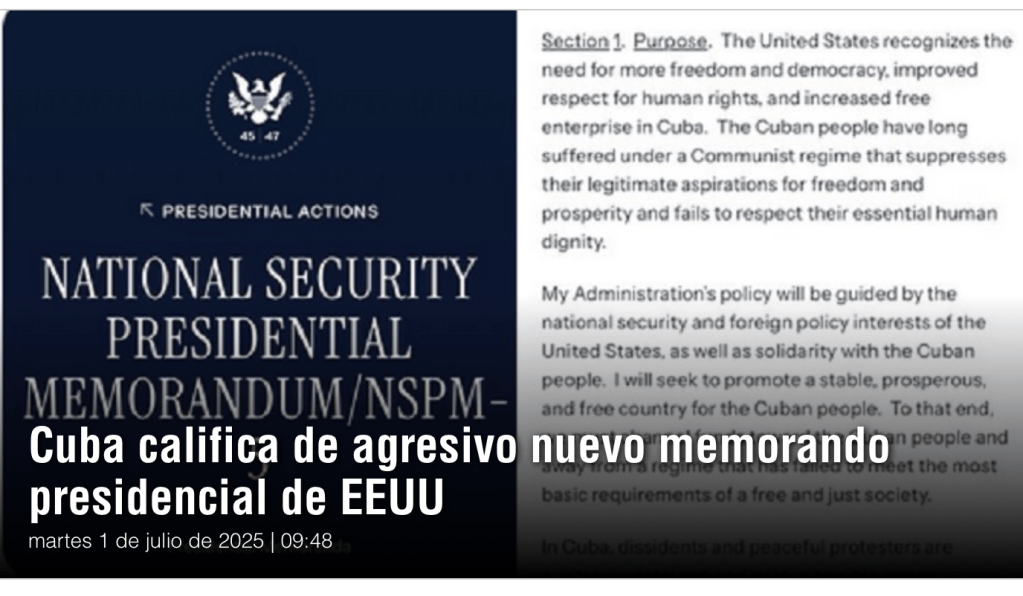
Esteban Lazo, president of Cuba’s National People’s Power Assembly, called the statement aggressive and unjust.
The statement talks about freedom for the people, democracy, respect for human rights and human dignity, and protection for dissidents and “peaceful demonstrators.” But it also tightens restrictions on U.S. citizens who travel to Cuba. Academic travellers must “engage in a full-time program of activities that enhance contact with the Cuban people, improve civil society, and promote the independence of the people from the authorities.”
It limits how Cubans might seek asylum in the United States and how family members send money back home. It gives U.S. Secretary of State Marco Rubio (a second-generation Cuban-American) the power to identify any entity under the control of, or acting for or on behalf of Cuban companies, as well as to regulate their financial transactions.
It also specifies that that the Trump administration will oppose petitions before the United Nations and other international forums that demand the lifting of the embargo.
There’s a new list of “prohibited officials,” including ministers, deputy minister, members or employees of Cuba’s Parliament and Supreme Court and even the editors of Cuban state media organizations.
“Who are they trying to deceive?” ask the editors of Granma, the newspaper of the Communist Party of Cuba, in a front-page article today. “All this has been suffered by the Cuban people for more than 60 years.”
In social media posts June 30, President Miguel Díaz-Canel said that the new U.S. policy statement “responds to narrow interests that are not representative of the majority in that country, and further reinforces the economic blockade.” The goal, he added, is to cause the greatest harm and suffering to the Cuban people. “The impact will be felt, but we will not be defeated.”

Two weeks earlier, Cuba’s Catholic bishops recognized the critical situation faced by the Cuban people. In a Message for the Jubilee Year, they described: “the avid search for essential goods, the prolonged lack of electricity, the growing emigration, the disillusion, the apathy due to the repetition of promises that never come to fruition… the sadness.” Among the victims of the crisis are: “the elderly, who are alone and abandoned… those who feel they can’t freely express their convictions,” as well as those who are living on the streets, eating from the garbage bins, suffering from addictions. “They’re resentful or broken, and becoming ever more violent… lacking love, and empty of hope.” They comprise an “uncertain future,” and not only in Cuba, but also for the world.
The bishops called on “everyone, but primarily those who hold higher responsibilities” to “create a climate without pressures nor internal or external restrictions” for the “changes that Cuba needs.” The use of “external” refers to the blockade and other measures of the U.S. government; the “internal” to the political actions of the Cuban government.
Trump and Rubio use sanctions and other measures to try to force regime change. They pay no heed to the needs of the Cuban people, but churches, unions and non-governmental organizations around the world continue to press for an end to the blockade and for increased humanitarian aid.
 Unwrapping Development
Thanks for this Jim. We have friends with family connections to Cuba. These cruel injustices will likely affect them directly. So much meanness. Breathtaking. Ken
LikeLiked by 1 person