
By Jim Hodgson
Separate incidents of use of explosive drones by the U.S. military to attack alleged Venezuelan drug-traffickers and by Haitian police to attack local gang leaders may have Canadian connections.
The Canadian ecumenical coalition Project Ploughshares reported Monday (Oct. 6) that a Canadian-made high-tech camera system was used to attack two boats that the United States said were carrying drugs. CBC News analysed the Ploughshares report, compared it to product manuals and previously released videos and spoke with former military and defence industry experts, concluding that it is highly likely Canadian tech was involved in surveillance during the operations.

“There has to be more human rights oversight,” said Kelsey Gallagher, a senior researcher with Project Ploughshares. “We are seeing Canadian weapons being misused.” Founded in 1976, Project Ploughshares is the peace research institute of the Canadian Council of Churches.
Global Affairs Canada told CBC that it is “aware of the U.S. operation and is monitoring the situation.”
The United States has said it used drones three times to attack boats it alleges were carrying drugs, but provided no evidence of drug-trafficking. The Ploughshares report shows that the U.S. military used a Canadian-made L3Harris WESCAM MX-Series sensor system for tracking and surveillance of boats that were struck as they sailed from Venezuela in the first two of three strikes reported last month.
Drone attack in Haiti’s capital kills 8 children
Meanwhile, a police-directed drone strike on a birthday party in Port-au-Prince that killed at least nine people (most of them children) and wounded 17 others has drawn attention to drones provided to Haiti by Canada.
The explosions happened Sept. 20 in Cité Soleil, a large, impoverished neighbourhood controlled by Viv Ansanm, a powerful coalition of criminal gangs that the U.S. has designated as a foreign terrorist organization.
Al Jazeera news service said the drones used in the operation were supplied by Canadian police. Successive Canadian governments have long maintained programs of assistance and training to Haitian police.
Months earlier, Global Affairs Canada told CBC that it was “concerned” about reports of extrajudicial executions, a violation of international human rights law. GAC did not clarify if Ottawa knew of cases in which Canadian-provided drones had been used for lethal purposes in Haiti. It said Haiti had agreed that the equipment provided would not be used “to commit or facilitate any violation of international humanitarian law or international human rights law.”
On Oct. 2, UN Human Rights Commissioner Volker Türk said Haiti’s use of lethal force against gangs was disproportionate and likely unlawful.
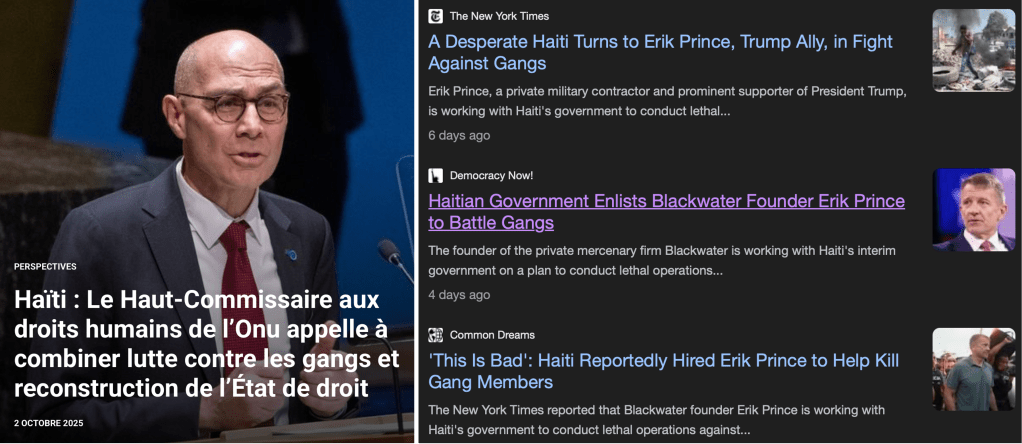
Speaking in Geneva to the UN Human Rights Council, Türk said police units had summarily executed 174 people for alleged gang affiliation this year while government drone strikes against alleged gang members in Port-au-Prince had killed at least 559 people to date, including 11 children.
“Most of these drone strikes are likely unlawful under international human rights law,” Türk added.
Canada is legally bound to ensure that its export of military goods does not contribute to violations of international law. Compared to ongoing controversy over Canada’s arms exports to Israel – often shipped via the United States – Canada’s indirect involvement in these drone incidents in the Caribbean may be relatively limited, but seem to reveal a pattern of disregard for human rights consequences of commercial deals in our neoliberal world.
In March this year, the Haitian government hired Vectus Global, a company run by Blackwater founder Erik Prince, to operate drones.
Two days after the drone strike on the birthday party, the UN Security Council approved a new Gang Suppression Force for Haiti. I’ll share more about that (and Canada’s contribution) in days ahead.
 Unwrapping Development
Jim: Unwrapping Development is a great initiative, congrats.
As you may or may not know, I was born in Venezuela and lived there till I was a teenager. My family used to go to a fishing village down from Maracay for the end of year holidays. Back in the late ‘50s the fishers could not go that far off shore to bring in a catch…and it took most of a day to do so. In 2006 when I returned to the same village I was surprised to see that the small fishing boats were now powered by 100+ outboard engines. They explained to me that it was thanks to the Chavez government….and now they could go as far out as to international waters to bring in a larger catch and be home by noon. After that in the afternoon they could take tourists along the coastline to visit other villages and beaches (and make extra income).
The Trump administration now blows up such Venezuelan fishing boats with no attempt to establish whether they are couriering drugs or actually going about their regular business of fishing. I can’t imagine how worried fishers along the Venezuelan coastline must be and the impact this is having on their livelihoods. Fishers from Trinidad are now having to fish on the other side of Trinidad to avoid being blown up, but the Venezuelan fishers don’t have that option.
What ever happened to ‘stop and search’ to ascertain what these small ‘open air’ boats might have in their holds. Blowing up small fishing boats off the coast of Venezuelan goes against all maritime laws that I am aware of. No Trump, Latin America will never become the U.S.’s backyard (again) and a time of reckoning will surely be coming down the line.
LikeLike