
by Jim Hodgson
Leaders of a dozen Latin American and Caribbean nations spent a few hours last week with President Donald Trump at one of his golf courses near Miami. This was the launch of the “Shield of the Americas,” a bloc of right-wing governments that have pledged to join Trump’s war against so-called “narco-terrorism.”
The spectacle recalled for me a 1992 film, El Viaje (The Journey), by Argentinian director Fernando “Pino” Solanas. It won prizes at film festivals in Cannes and Havana, and I saw it in Toronto.
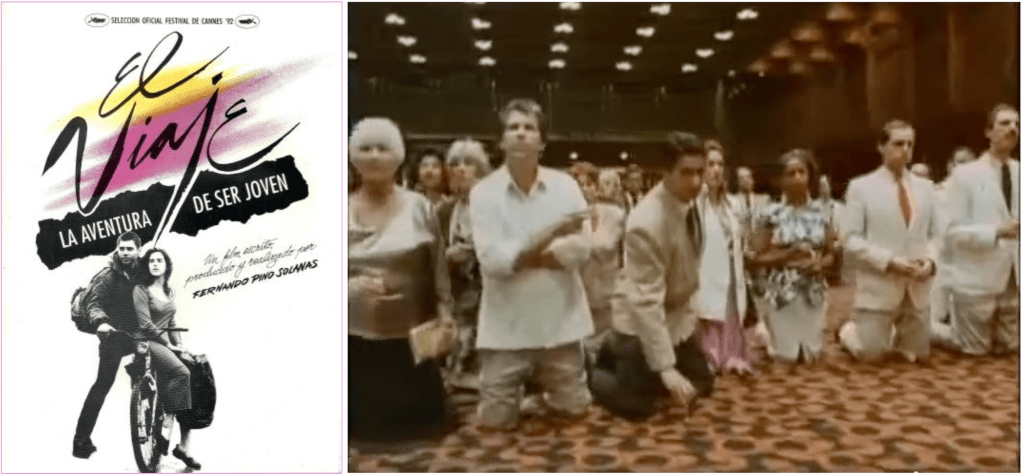
In Miami, the leaders plainly knew that their face time with Trump was squeezed out from his preoccupation with his ill-conceived and unpopular war on Iran. They even applauded his insults: “I’m not learning your damn language,” said Trump. “I don’t have time.”
Beyond the farce, however, there is harsh reality to be faced.
Trump called for an “anti-cartel coalition” that would use military might to “eradicate” drug cartels. A day earlier, his “war secretary,” Pete Hegseth, warned representatives from 16 countries in the region that if they didn’t adopt more aggressive strategies against drug cartels, the Trump regime would do it for them. Hegseth urged the countries to remain “Christian nations, under God, proud of our shared heritage with strong borders,” and not to be led astray by “radical narco-communism, anarcho-tyranny… and uncontrolled mass migration.”
Since his return to power 14 months ago:
- Trump has threatened to seize his northern neighbours, Canada and Greenland, and vowed to “take back” the Panama canal.
- He then launched airstrikes on alleged drug boats in the Caribbean and eastern Pacific, meddled in electoral processes in Argentina, Brazil and Honduras, and kidnapped the president of Venezuela and his spouse.
- At the end of January, Trump tightened the six-decade-long U.S. embargo of Cuba by threatening new tariffs against countries that exported fuel to Cuba, risking a humanitarian crisis. [**A reminder: tell your politicians to increase aid to Cuba and to oppose the fuel blockade.**]
- After months of threatening land attacks against drug-traffickers in Mexico and elsewhere, U.S. intelligence forces collaborated with Mexico last month to help kill a drug boss, El Mencho.
- On March 3 in Ecuador, U.S. military forces joined attacks by Ecuadoran forces on “designated terrorist organizations” – the “Lobos” and “Choneros” organizations so designated by U.S. Secretary of State Marco Rubio during a visit last September.
Trump’s threat at the summit to “take care of” Cuba drew an immediate response from Havana. President Miguel Díaz-Canel wrote on X:
“The little reactionary and neocolonial summit in Florida, convened by the United States and attended by right-wing governments from the region, commit themselves to accept lethal use of U.S. military force to resolve internal problems of order and tranquility in their countries.”
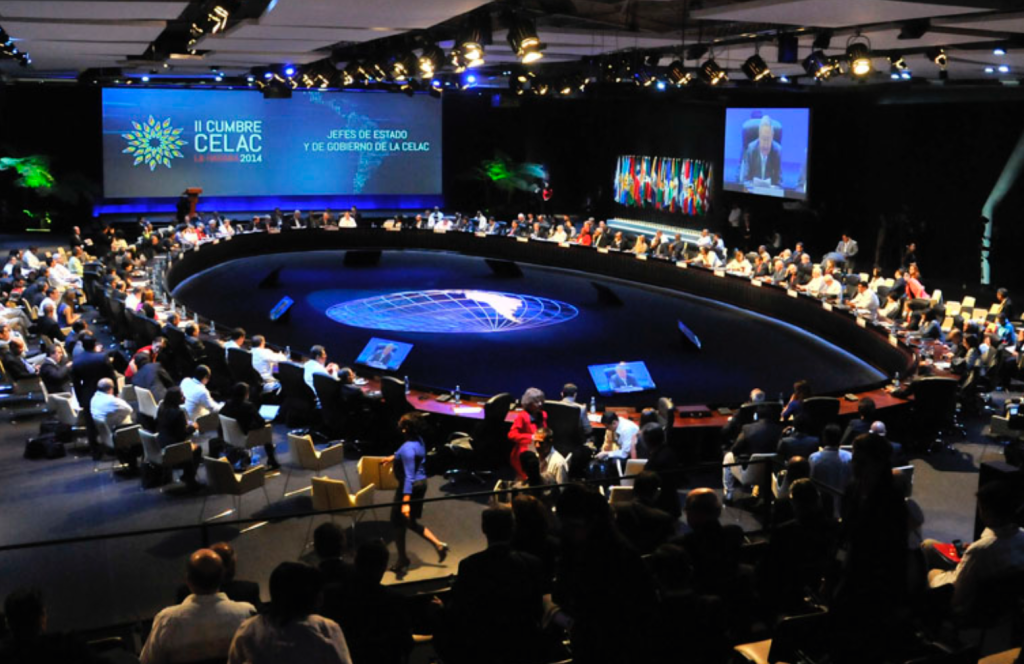
Cuba’s foreign minister, Bruno Rodríguez, said the Miami summit was “a clear and dangerous setback in the long and difficult process of independence for the peoples of Latin America and the Caribbean.”
In his speech, Trump said that Mexico was the “epicentre” of drug-trafficking. The cartels, he said, “are getting worse and taking over the country. The cartels are running Mexico. We can’t have that. Too close to us, too close to you.”
Hours later, President Claudia Sheinbaum, pleaded for “cabeza fría” (cool heads) as Mexico determines its next moves – all (like Canada) under the pressure of new free trade talks with the United States.
A few days before the summit, Costa Rica’s president-elect, Laura Fernández, called Mexico “a reference point for where we do not want to go” regarding violence, organized crime and drug-trafficking. She was the minister of national planning and economic policy under the out-going president, Rodrigo Chaves. Chaves attended the Sheild summit, not Fernández, but her comment got attention in Mexico.
In an editorial, the daily newspaper La Jornada said that if Fernández wants to avoid the suffering experienced in Mexico over the past two decades, she should bear in mind that the crisis of insecurity was launched by a politician of the same ultra-right current that she represents. After his election in 2006, President Felipe Calderón began Mexico’s war on drugs by:
“opening the country to U.S. spy agencies, subordinating national interests to those of Washington, ignoring the social and economic roots of the crime phenomenon, and declaring a war against his own citizens. The violence of the state became a criterion for measuring success. The lessons of the Calderón years are important to for the other governments (and the governed) that still see or pretend to see the White House ‘war on drugs’ as an offensive against criminal structures and not the mechanism of imperial domination that it is.”
 Unwrapping Development