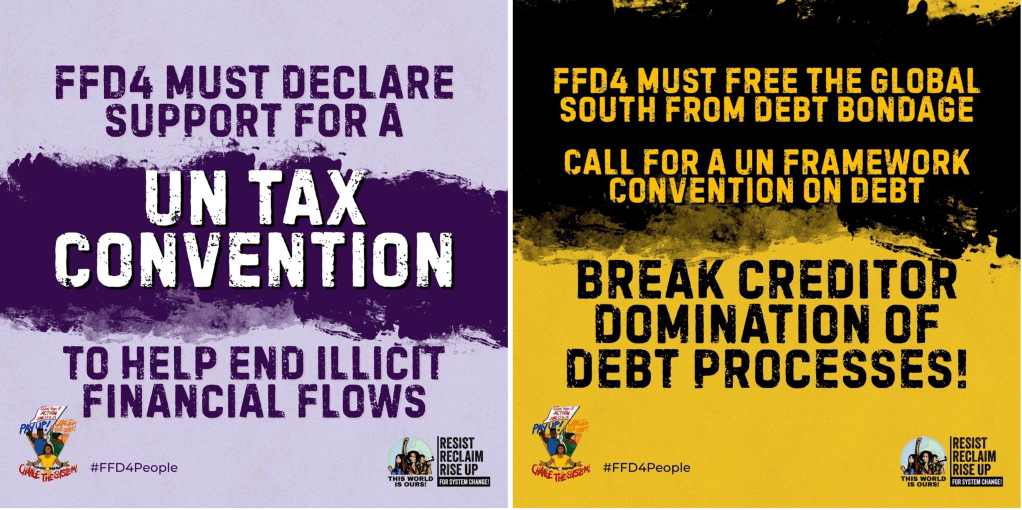
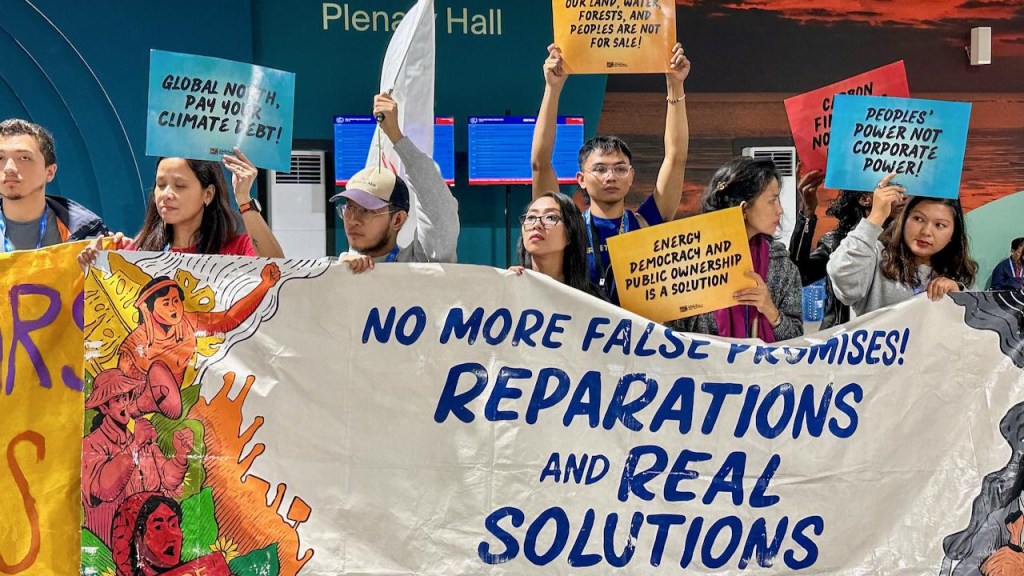
“From collapsing ecosystems to collapsing economies, our communities have been battered by a storm of climate chaos, debt distress, deepening inequality, and systemic exploitation. These crises are the direct result of a global economic system built to extract from our lands, our people, our futures—so the rich and powerful can thrive off our suffering.”
That was the message May 29 of the Asian Peoples’ Movement on Debt and Development (APMDD), a Manila-based network that calls for change in debt, climate, economic and development systems.
In June 2024, Pope Francis and other church leaders around the world launched a new Jubilee campaign for debt cancellation. In Canada, the call is taken up by KAIROS, the Canadian Council of Churches and by Development and Peace (D&P) — among others. KAIROS launched a “Turn Debt into Hope” Jubilee 2025 petition that by June 13 had been signed by more than 36,400 Canadians.
Promoters of the campaign gathered for a People’s Forum in Calgary this past weekend ahead of the G7 summit and joined Sunday’s protests in the heart of the city. The Catholic Register reported on the event:
Salome Owuonda, executive director at the Africa Centre for Sustainable and Inclusive Development (Africa CSID), spoke about the consequences of crushing debt in Kenya…. She told participants that in her East African country “50 per cent of revenue generated is directed toward paying debt” and that puts health care, education, climate action and food security at risk. “And things are not getting better,” said Owuonda. “The government is calling for more taxes as they have to try and pay the debt.”
Dean Dettloff, a research and advocacy officer at D&P, shared that over “3.3. billion people in the world live in countries that spend more paying the interest of their debt than health care and education.” He added that many nation states also direct more funds to these expenditures than safeguarding the environment.
Tarek Al-Zoughbi, a Palestinian Christian who serves as the project and youth coordinator at Wi’am: The Palestinian Conflict Transformation Centre in the West Bank, spoke about the suffering in Gaza and many countries around the world.
Al-Zoughbi said that during this Jubilee year, we “must begin to recognize this image of God that is in each of us and that is in the spirit of creation.” He called for an end to environmentally exploitative practices that contribute to ecological debt.
Some readers will recall the the Millennium Jubilee of 2000, which mobilized millions globally to demand debt cancellation for nations in the Global South. KAIROS reminds us:
In Canada, this movement took shape as The Canadian Ecumenical Jubilee Initiative, the country’s most successful faith-based advocacy campaign. This powerful campaign, led by church-based justice organizations, KAIROS’ predecessor coalitions, and the Canadian Council of Churches, played a crucial role in achieving over $100 billion in global debt relief.
Yet, 25 years later, a worsening global debt crisis continues to affect vulnerable populations, exacerbated by rising interest rates, climate change, and economic inequality. An unacknowledged “ecological debt” owed by the North to the South and Indigenous Peoples further exacerbates the crisis.
Global “Financing for Development” system is part of the problem
When Pope Francis launched the new Jubilee debt campaign a year ago, he called for a “new international financial architecture” that breaks the financial-debt cycle that has contributed to a current global debt now estimated at $313 trillion.
That APMDD statement that I referred to above presses hard on that global financial architecture, describing a “rigged system” that favours creditors. It criticizes the Financing for Development (FfD) process, which was created to ensure fair and just financing for development and climate action—especially for the Global South. “Instead, it has become another space for the Global North to rewrite the rules to protect their power, shirk their responsibilities, and advance false solutions. Their hypocrisy is most glaring when it comes to climate finance.”
At the end of June, world leaders will gather in Seville, Spain, for the fourth international conference on financing for development, dubbed FfD4. (I attended an ecumenical pre-event at the first FfD conference in Monterrey, Mexico, in 2002 and wrote about it here.) In recent months, negotiations on the outcome document have sparked intense civil society campaigning.
The Global Policy Forum said June 17 that the final draft retains an intergovernmental process for managing debt, but weakened its mandate to making “recommendations”. Critics argue that this could kill whatever hope remains for achieving Sustainable Development Goals (SDG) as “debt crises strangle fiscal space and derail the implementation of the Agenda 2030 for Sustainable Development.” Global Policy Forum describes some of what is gone from the outcome document (referred to now as the “Compromiso de Sevilla”):
The paragraph on phasing out fossil fuel subsidies (27i) has been deleted entirely, as well as the specification of asset types to be covered by national and global asset registries (28g). The language around the UN Framework Convention on International Tax Convention was also softened just two months before the first round of negotiations starts: “We support” was downgraded to “we encourage support” (28b). A similar change occurred in the paragraph on investor-state dispute settlement, where the “we undertake reform” was replaced by “we support efforts to reform” (43l).
Meanwhile, the rich countries led by the United States are cutting international aid and increasing their military spending.
The G7 meeting near Calgary issued a series of statements (CBC, left) but one searches in vain for anything about debt cancellation or development assistance. The statement on “migrant smuggling” fails to address the question of why people leave their homes or how development aid and peace-making strategies can ease the problem.
The APMDD statement concludes:
“We are here to expose the Global North—not just for failing to deliver climate finance, but for actively sabotaging it in bad faith. This is no accident. It is a calculated strategy to protect their profits and deny justice to those they have exploited for centuries…. We see through every lie. We reject every excuse.”
On this Earth Day, I want to share with you a reflection by Bishop Francisco Duque of the Anglican Church in Colombia. I worked with him in a larger team in one period (already a dozen years or more ago) of ecumenical efforts for peace with justice in Colombia.
Indeed, it was during that work that I stood with friends in a coffee shop in Bogotá and watched news of the election of the archbishop of Buenos Aires, Jorge Mario Bergoglio, as pope on March 13, 2013. I did not rejoice. All that I knew of Bergoglio was that he had opposed several of the initiatives of the governments of Néstor Kirchner and Cristina Fernández as it expanded sex education in public schools and legalized same-sex marriage in 2010.
Images of St. Francis. Left: preaching to the birds. Right: “Make me an instrument of your peace / Bless your people, Lord” is one I saw in Real de Catorce, San Luis de Potosí, in October 2024.
But Pope Francis surprised me: first by choosing to be known by the name Francis, signalling he would follow St. Francis of Assisi, long admired for his inspiration to contemporary ecological commitment and for initiating dialogue with Muslim leaders during Christian Europe’s “crusades” in the Middle East. And then he surprised me again with steps that showed respect for LGBTQIA+ people: first, “Who am I to judge?”, and later with his openness to diverse voices heard through synods, his advocacy for peace, the rights of migrants and debt forgiveness. I can only wish he had done more with regard to the rights of women and pray that his successor can go further.
In Canada, Pope Francis will undoubtedly be remembered most for his “penitential pilgrimage” and encounters with Indigenous peoples in 2022. Despite resistance from most of Canada’s Catholic bishops, he came, offered a (not fully accepted) apology, and gave truth and reconciliation efforts a dramatic push forward in public awareness.
But I think his lasting global legacy will be his way of holding faithful action for social justice and action for ecological justice together coherently. Here’s what Bishop Duque had to say.
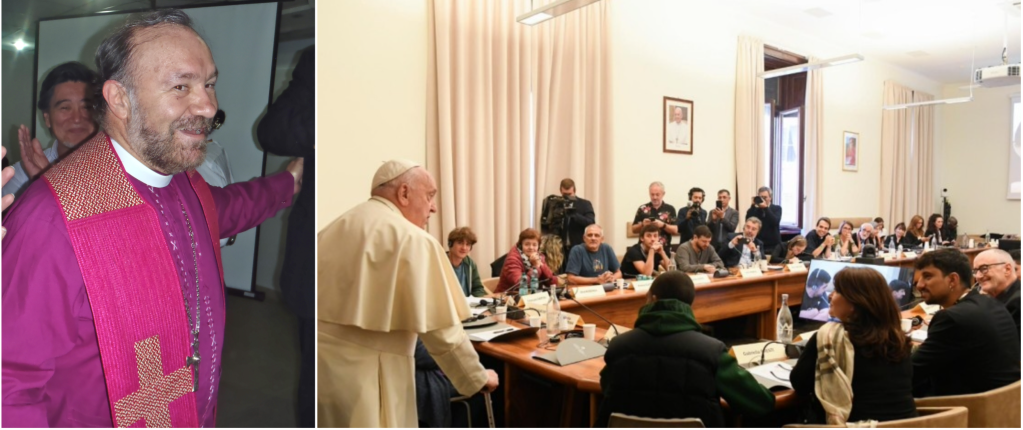
Left: Bishop Duque at a Methodist assembly in Medellín in 2012. Right: Pope Francis meets representatives of social movements in 2024.
Francis, pope of Amazonia and our common home
Francisco Duque
The world mourns the loss of a spiritual leader who transcended borders, creeds and generations. Pope Francis not only was the first Latin American pontiff. He was, above all, the pope of the Amazon and caretaker of our Common Home. His legacy, immense and profoundly humanist, will remain inscribed in the planet’s memory as a prophetic voice that urges us to hear the clamour of the earth and the cry of the poor as a single call.
From the time of the publication of his encyclical Laudato Si’ in 2015, Pope Francis illuminated the ways of global ecological awareness. With valiant and committed language, he denounced the structural causes of environmental collapse, unlimited resource extraction, climate injustice and indifference toward the suffering of communities that are most vulnerable, especially those who live in the lungs of the world: tropical forests, the Amazon in particular.
His spiritual leadership was also political and ethical. He convened scientists, Indigenous leaders, activists and religious authorities from around the world to make a new pact between humanity and nature. He promoted an integral ecology that did not separate the environment from the social. He recognized in Indigenous peoples that they are millennial guardians of wisdom. His encouragement of the Synod of the Amazon in 2019 marked a before and after: Amazonia was heard in the heart of the Vatican, not as a forgotten periphery but as a vital centre for the future of the planet.
From the Inter-Religious Initiative for the Tropical Forests (IRI-Colombia), we hold up a prayer of gratitude and hope. Gratitude for his strong words, for his planetary vision, for having returned to the faith its active dimension of protection of creation. Hope because the fertile seeds he planted will continue to bear fruit in the struggles of those who do not resign ourselves to ecocide or silence in the face of injustice.
Pope Francis leaves us a road map for humanity. There will not be peace without environmental justice. There will be no future without forests. There will be no reconciliation without a deep ecological conversion. His legacy challenges governments, businesses, religions and people. His voice remains alive, inspiring a global inter-religious movement that is committed to life. In these days of farewell, we echo his own question, charged with urgency and tenderness:
“What kind of world do we want to leave to those who come after us, to children who are now growing up?” (LS 160).?”
Thank you, Pope Francis, for reminding us that care for Amazonia is an act of faith, love and justice.
“I am infuriated to come home to the aftermath of six typhoons that have struck the Philippines in the space of just four weeks with basically zero gains from COP29,” said Patricia Mungcal, a young climate advocate who serves as humanitarian manager with the National Council of Churches in the Philippines.
“I will be telling thousands of Filipino families who were devastated by these strong typhoons that world leaders have left us to suffer the heaviest impacts of the climate crisis and disregarded our demands for finance and reparations. This failure to address loss and damage is a grave disregard of our human dignity and rights. We charge this failure of COP29 to the moral bankruptcy of the rich, polluting nations.”
News from Philippines and (right) Patricia Mungcal (screenshot from WCC video)
At the recent climate conference in Baku, Azerbaijan, world leaders failed miserably in their response to the climate crisis and its consequences. Of the $1.3 trillion of climate finance that independent experts estimate will be required annually by 2030, the UN climate conference agreed to provide just $300bn every year – by 2035 (Progressive International newsletter, Dec. 3).
Meanwhile, governments around the globe (including Canada) are still ploughing billions of dollars into fossil fuel subsidies to shelter citizens from higher energy costs, but that comes with a fiscal burden and impedes the goal of reducing overall use.
And Philippines had six typhoons. In the Canadian Rockies, Jasper townsite burned—just days after I had written about climate disasters in British Columbia.
What is to be done?
More often now, we are seeing the connection between the climate crisis and the growing indebtedness of the so-called “highly indebted poor countries” (HIPC). And proposals for a new international financial architecture are once again getting attention.
In June, Pope Francis pressed leading economists and world finance ministers to support new mechanisms to ease foreign debt, lamenting that “poorly managed globalization” has deprived millions of people of a “dignified future.”
“Ecological debt and foreign debt are two sides of the same coin that mortgages the future,” the pope said. “For this reason, dear friends, the Holy Year of 2025, to which we are heading, calls us to open our minds and hearts to be able to untie the knots of the ties that strangle the present, without forgetting that we are only custodians and stewards, not masters.”
The focus of this Jubilee Year is gaining ecumenical and inter-faith support. In Canada, KAIROS will lead a Canadian Ecumenical Jubilee campaign, in step with global debt relief efforts. “These are inspired by the Jubilee tradition from the Book of Leviticus. Rooted in faith, Jubilee calls for the release of debts, liberation from servitude, and the return of seized lands—principles that resonate deeply in today’s world,” says KAIROS. This campaign aims to:
Cancel unjust debts.
Establish a UN-led mechanism for debt resolution.
Prevent future cycles of crippling debt.
The 2025 meeting of G7 (leaders of the richest countries) will be held June 15-17 in Kananaskis, Alberta (southwest of Calgary).
The global Progressive International network, meanwhile, is presenting a Program of Action on the Construction of a New International Economic Order. It speaks of a “polycrisis”—the combination of the “old crises of debt, dependency and under-development” combined now with “an accelerating crisis of climate to threaten not only the developmental prospects of the South—but also, in the case of many small island states, their very existence.”
The Program of Action offers nearly three dozen measures across five broad sections: to leverage the South’s natural wealth, labor power, and collective voice in order to extract concessions from Northern partners; to bolster the sovereign development agenda by building Southern alternatives to Northern institutions; and to pool Southern knowledge, resources, and ingenuity in service of a whole that is greater than the sum of its parts.
Keep an eye on KAIROS, of course, and on Development and Peace-Caritas Canada for ways to get involved in the new Jubilee campaigns.
I also want to share with you some suggestions from Katharine Hayhoe, a Canadian atmospheric scientist whose research focuses on understanding the impacts of climate change on people and the planet.
“For climate action to happen at scale, conversations have to move beyond international summits to what’s happening in our communities, our workplaces, and our organizations. And there, change isn’t something we wait for. It’s something we catalyze,” she wrote after COP29.
She suggests starting conversations “about climate solutions where you work or study. Ask what your organization is already doing, and what more it could do—and share that with people around you, particularly those who can make decisions.”
That will be especially important as Canadians vote in a federal election in 2025, and as one party opts for simplistic slogans over serious conversations about climate policy.