I feel some relief this morning by two newsletters from U.S. activists that arrived in my email.
One is from “Stop The Coup 2025,” a campaign to fight Project 2025 (the Republicans’ plan for the next Trump administration). It has a toolkit for community organizers that includes a section, “Spotlight on Risk Preparedness/Criminalization/Underground Survival Tips.”It discusses the importance of organizations and individuals taking steps now to prepare and assess their vulnerability to Project 2025’s agenda and learning from LGBTQIA+ activists in other places who have been forced to live and organize under the radar due to state-sanctioned criminalization.
Here’s a bit more information about Project 2025:
Project 2025 has a radical anti-democracy, anti-diversity, anti-gender agenda to:
systematically dismantle the federal government – a soft coup
give the next Republican president new “supreme powers” – an autocracy
use Executive Orders to “legally” reverse many of our civil rights
use the military to help clamp down on domestic dissent
criminalize & erase gender & LGBTQIA+ identity from government protection
reverse racial equality, attack diversity, and reverse environmental gains
replace secular education with Christian theocracy and a pro-life agenda
recruit and train 20,000 conservatives for government jobs
Use “Schedule F” to remove 50,000 civil servants
Require government “Loyalty Pledges” to an extremist right-wing agenda
Reverse historic US defense policy of deterrence to offense
Require US foreign policy, USAID to align with pro-life agenda
LAUNCH THEIR 180-DAY ADMINISTRATION TAKEOVER ON January 20, 2025
The other newsletter that brought hope to my inbox today came from Codepink, the U.S. network of feminist peace activists. I’ve worked with them in the past to counter the harm caused by U.S. sanctions in Venezuela, Cuba and elsewhere, and some of my colleagues have worked with them for peace in the Korean peninsula and the Middle East. Part of the message today:
We don’t want to waste your time with platitudes about how everything will be okay or even talk about the breakdown of the election. We think it’s more useful to go off what we know for certain now: Donald Trump is going to be president in January.
But, a majority of Americans oppose U.S. support for Israel, and don’t want their tax dollars funding weapons that murder innocent people and destroy the earth. A greater majority of Americans oppose the U.S. starting new wars. It’s okay to feel deflated and discouraged, but don’t forget that the people are on our side – all we have to do is reach them.
We will continue to do what we have always done: educate by exposing horrific violence carried out by those in power, activate a movement for peace, and cultivate local communities that represent the world we want to live in. Solidarity is our best friend. Finding new and creative ways to scratch at power is our path forward.
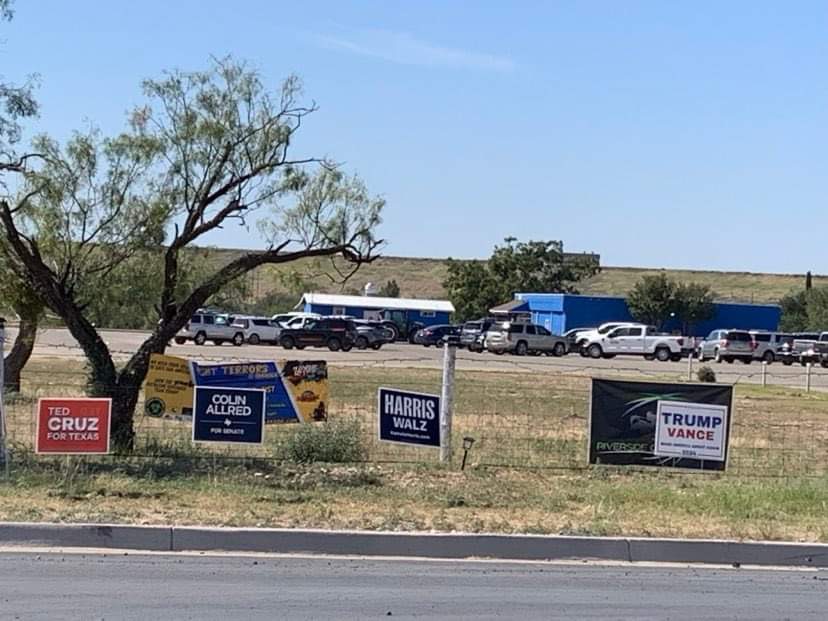
Political signs of the times at a rest stop near Junction, Texas.
Last time, and this time: concern for rights of refugees
Back in 2016, I was in Antofagasta, Chile, when I learned that Donald Trump had defeated Hillary Clinton and won the U.S. election. The news was unexpected, just like now.
I was in Chile’s far north to meet and show solidarity with Chilean Methodists who were working with migrants who had come from Colombia and other parts of Latin America and the Caribbean, including Haiti.
Indeed, a great deal of my personal and professional life has been devoted to work with refugees and other people who are forced to flee their homelands because of various political, economic and environmental causes.
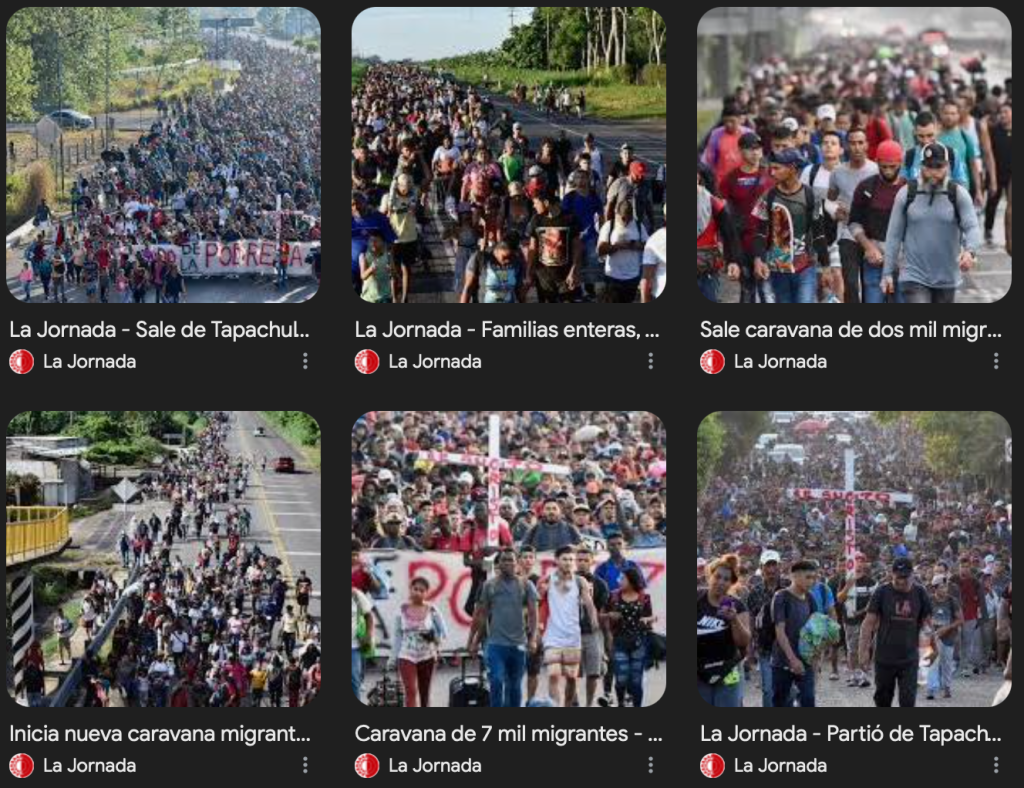
Caravans of migrants from many countries continue to cross Chiapas on their way north, holding out hope that they might score a formal U.S. refugee application before January 20 when Trump, who promises mass deportations, will take power. (Images: La Jornada, Mexico).
Now I am in north-western Chiapas, having crossed in recent weeks several of the “red states” where support for Trump is strong.
In the wake of the election, pundits point out that Trump weaponized ‘fake news.’ He played to machismo and racists and to people who haven’t a clue what being Trans even means. That he won over a smart, articulate, experienced woman of colour after being convicted of crimes and successfully sued for sexual assault is an indictment of U.S. democracy.
Some, including Sen. Bernie Sanders, point as well to the Democratic Party establishment which again defended the status quo. “It should come as no surprise that a Democratic Party which has abandoned working class people would find that the working class has abandoned them.”
As ever, don’t expect the Democratic Party to save us. Now is the time for grassroots action.
For Natasha Lennard, writing in The Intercept, the answer is radical action from the grassroots:
“Far-right policies and parties tend to win the day when so-called centrists take up conservative platforms to purportedly capture disaffected white voters and thus keep the far-right at bay; the upshot is treating conservative nationalism as the fulcrum of all politics. This is what the Harris campaign did, particularly when it came to immigration. At best, as with Britain’s currently ruling Labour Party, the Tories might have lost, but right-wing politics have been reconfigured as the normalized center.”
Contrasts: trees near Osprey Lake between Summerland and Princeton, and trees east of Spences Bridge, July 15, 2024.
by Jim Hodgson
David, Kamill and I headed out by car last Monday for a quick visit to a small patch of territory northwest of our Okanagan home where a forest fire and an extreme flood wrought havoc just months apart in 2021.
We drove west from Summerland on a beautiful mountain route that follows an ancient Indigenous trail—later part of the Kettle Valley Railroad and now a bike path—to just north of Princeton. Then we turned north to Merritt. From there, we followed the Nicola River northwest on Highway 8.
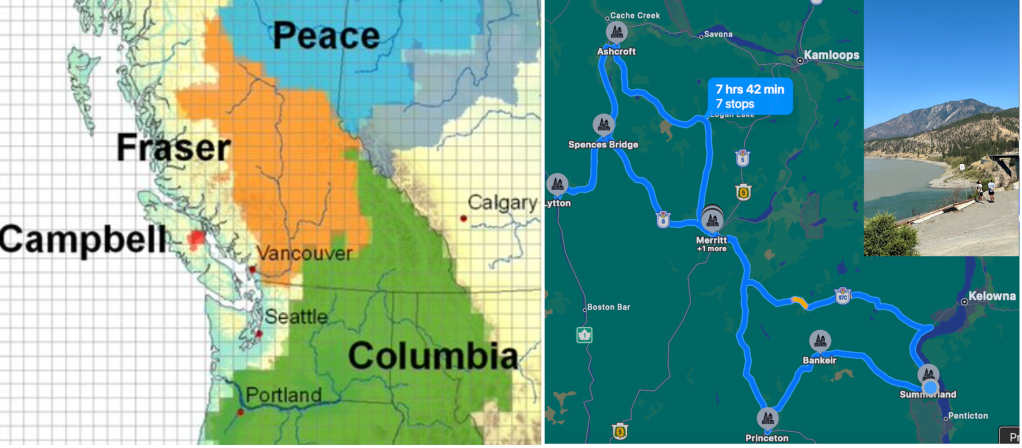
Left: Southern British Columbia watersheds: the Okanagan valley is in the Columbia watershed; the Nicola and Thompson rivers are in the Fraser watershed. Centre: our route (the inset shows where the Thompson enters the Fraser at Lytton).
On Nov. 14 and 15, 2021, an atmospheric river brought an unprecedented amount of rain to southern British Columbia. All highways leading east from Vancouver and into the province’s Interior were blocked by floods or landslides. Princeton and Merritt were among many communities flooded.
The Nicola valley was particularly hard hit. It’s a narrow valley, and areas along both sides of the river were farmland. It’s home to the Nooaitch, Shackan and Cook’s Ferry First Nation communities and to their settler neighbours. The flood destroyed homes, farms, the old rail bed and parts of the highway.You can see the devastation of the Nicola valley in a Globe and Mail photo essay or in a B.C. highways department video. In November 2022 after a year of work, the highway re-opened with partial repairs.
As we drove towards Spences Bridge, we also passed through an area severely damaged in a forest fire some years ago. At the same time, we could see a new fire spreading on a mountainside ahead of us above the Thompson River—likely what came to be called the Shetland Creek fire.
We had lunch in a nice little restaurant called The Packing House in Spences Bridge—just next to the Baits Motel. We drove south on Highway 1 (the Trans-Canada) along the Thompson River to its confluence with the Fraser River.
And here we came to Lytton, the town of 3,000 people that was destroyed by a wildfire on June 30, 2021. Back in the late 90s, David and I began stopping here occasionally on trips to or from Vancouver. (We like to vary our routes.) It was a lovely town. It had a museum about the history of Chinese migration to the area—and its creator hopes to rebuild. Elsewhere in town, there is more construction: signs that the community will recover.
As we observed how the blue Thompson flows into the muddy Fraser, we could see a helicopter collecting water to drop on another fire burning in the mountains across the river.
We drove home via Ashcroft, whose residents are now on evacuation alert because of the Shetland Creek fire. After passing the massive tailings pond of the Highland Valley Copper Mine—a disaster of a different sort—we returned to Merritt and took the Okanagan connector highway to Peachland, and then turned south on Highway 97 back to Summerland. We drove about 600 km that day.
Of flood and fire
On Tuesday, Toronto had another “once-in-a-century” rainstorm after previous ones in 2005, 2013 and 2018. That day, we were back on Highway 97 as we drove Kamill to the airport in Kelowna for the trip home to Ottawa.
On Wednesday, a wildfire south of Peachland closed Highway 97 for most of the day. Traffic was later restricted to “single-lane alternating” (a phrase I am getting used to) and fully re-opened Friday afternoon.
As the week progressed (and U.S. climate-change deniers held their party’s convention in Milwaukee), I gathered some stories of effects of the climate catastrophe elsewhere in the world. (I did this in post back in January as well.)
These AP stories were published June 20, the summer solstice. Eight days later, Hurricane Beryl formed in the Atlantic Ocean just east of the Caribbean’s Windward Islands. In just 10 hours, it jumped to Hurricane 4 level before striking Grenada, St. Vincent and the Grenadines, and other islands before easing as it moved west across the Caribbean, the Yucatan peninsula and south Texas.
Back in April, U.N. secretary general Antonio Guterres warned that “we cannot replace one dirty, exploitative, extractive industry with another” as we reshape how we power our societies and economies. Some developing countries have large reserves of “critical minerals” such as copper, lithium, nickel and cobalt. But they “cannot be shackled to the bottom of the clean energy value chain. The race to net zero cannot trample over the poor.”
In May, Raúl Zibechi, longtime observer of the role of social movements in processes of political change in Latin America, warned that the climate crisis cannot be stopped. Politicians won’t act for profound change; those who prefer wars over struggles for peace won’t change. His suggestion is that impoverished or otherwise marginalized peoples (“los de abajo”) build collective “arks.” The rich and powerful (“los de arriba”) already have theirs. The example he points toward is that of the Zapatista movement in Mexico’s southern Chiapas state, where for 30 years Indigenous communities have been living in a mostly self-sufficient and self-governing way.
Summers were always hot in the Fraser Canyon and up along the Thompson River towards Kamloops, just as they are where I live in the Okanagan valley. But it feels different now. There were always forest fires, but I don’t remember living in dread of them or having to put up with the long smoky days we have now. In the winter, there were cold spells, but I don’t remember the peach and grape crops being wiped out as has happened this year.
We are putting our emergency kit together (as we did last year) and placing all the important documents in one metal box. North American-style, I suppose: it’s an individualist sort of “ark.” We’re okay with having to take these steps. But we’re also talking about the election in B.C. later this year and a likely national one next year. How do we recover momentum for the dramatic changes necessary to carve a new way forward?
For the first time, Mexicans have chosen a woman to be their president. She is Claudia Sheinbaum, 61, a climate scientist who previously served as mayor of Mexico City.
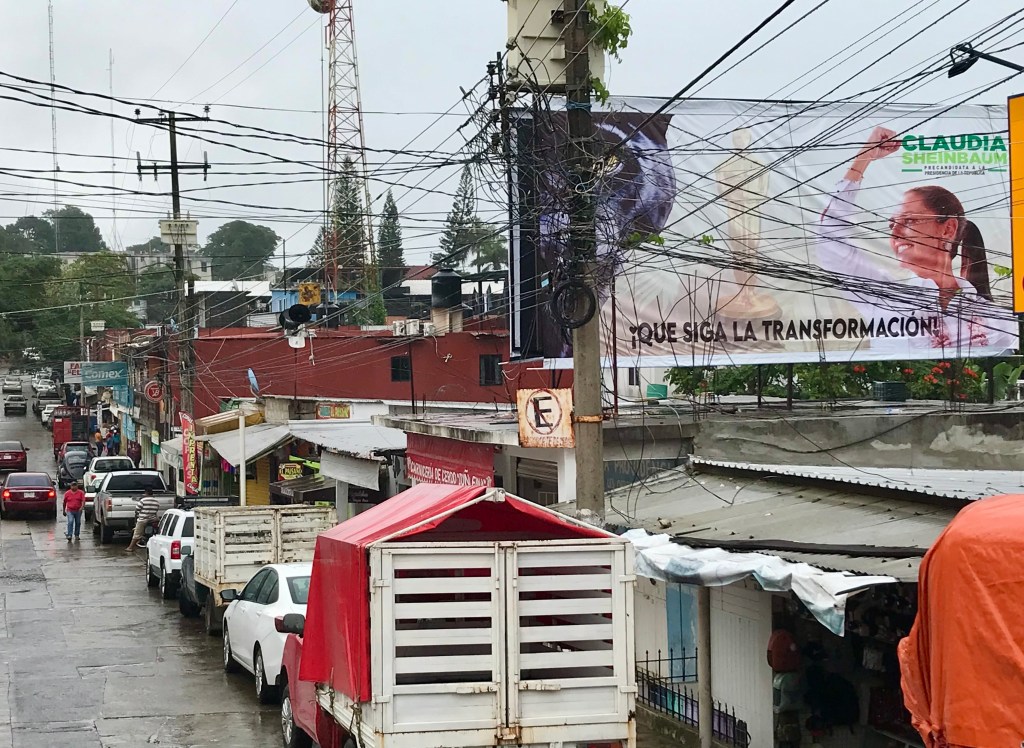
“The transformation continues!” A campaign billboard promotes the campaign of Claudia Sheinbaum in the southern state of Chiapas. The slogan refers to the ‘Fourth Transformation‘ of Mexican political institutions and the economy begun by her predecessor, Andrés Manuel López Obrador.
That a woman is president is no minor detail. It was only in the middle of the last century that women in Mexico won the rights to vote and to run for public office. Even now, only 14 of 193 nations have women in power as presidents or prime ministers.
Sheinbaum can be expected to continue the generally progressive approaches taken by her predecessor, Andrés Manuel López Obrador (known as AMLO). Her leading opponent was businesswoman and former senator Xóchitl Gálvez, candidate of a centre-right coalition.
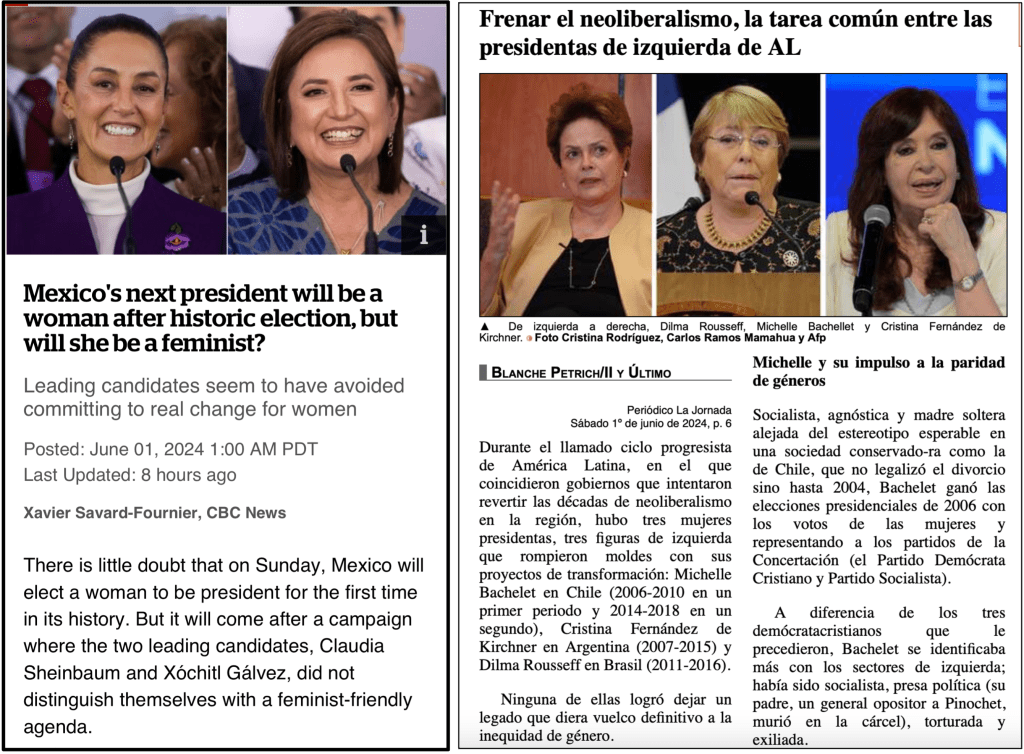
A CBC News report days earlier said that neither Sheinbaum nor Gálvez actually committed themselves to “real change for women” on issues such as pay equity, reproductive rights, or violence against women.
One of Mexico’s leading journalists, Blanche Petrich, wrote that three women (Michelle Bachelet in Chile, Cristina Fernández in Argentina, and Dilma Rousseff in Brazil) who were representative of the progressive “pink wave” governments in Latin America did not “leave a legacy that would definitively reverse gender inequality.”
A CBC News report on the quality of feminism represented by Mexico’s two leading candidates, and Blanche Petrich’s review in La Jornada of past experiences of women as presidents in Latin America.
Bachelet, notes Petrich, once said:
“What does it mean to be a woman in public office? Is it to be the same as a man, but with a skirt? No. When a woman arrives alone in politics, the woman changes. When many women arrive in politics, politics change. And clearly, one of the challenges and needs of our democracy is to improve the quality of politics.”
In the Mexican election, Sheinbaum and Gálvez tended to address issues of concern to women within a range of economic, social and criminal justice proposals. Framed this way, there were sharp differences between the two.
Sheinbaum will continue to give priority to social programs, pensions and scholarships that benefit the least advantaged, as well as concentrating on investment in infrastructure to support industries that create jobs. The approach by Gálvez was that of conservatives everywhere: keep taxes—and wages—low and let the market take care of the rest (though she did promise to maintain AMLO’s social programs).
At her victory celebration late Sunday night, Sheinbaum affirmed her movement’s commitment to democracy. “By conviction, we will never make an authoritarian or repressive government. We will also respect political, social, cultural and religious freedoms, and gender and sexual diversity.”
Regarding criminal justice issues (which media tend to subsume under the heading “security”), Mexico obviously has serious problems. At least 34 candidates were killed during the election period that included national as well as some state and municipal elections.
There are still about 30,000 homicides per year, though the government says the number has been dropping by about five per cent per year.
AMLO tried to turn back the violence unleashed by one of his predecessors. In 2006, then-President Felipe Calderón, with backing from the United States, launched a military-led offensive against the drug cartels to curb their violent turf wars. Instead, the violence became much worse.
AMLO promoted an approach he called “abrazos no balazos”–hugs not bullets. It meant addressing the social roots of violence by giving people the education and other resources they need to avoid being drawn into the drug-trafficking cartels and their systems of power. Over the long term, the approach should lead to reduced levels of violence.
But it has been controversial and is subject to manipulation, even in mainstream media like The New York Times, and has led to threats of military intervention from various U.S. politicians, including the presumptive Republican nominee, Donald Trump.
Even within the AMLO-Sheinbaum coalition, there is agitation. When Eduardo Ramírez–a former AMLO opponent who, like too many others, opportunistically shifted loyalties–celebrated his victory as governor of Chiapas Sunday night, he said: “There will be hugs, but no impunity.”