Transformation in Mexico: a work in progress

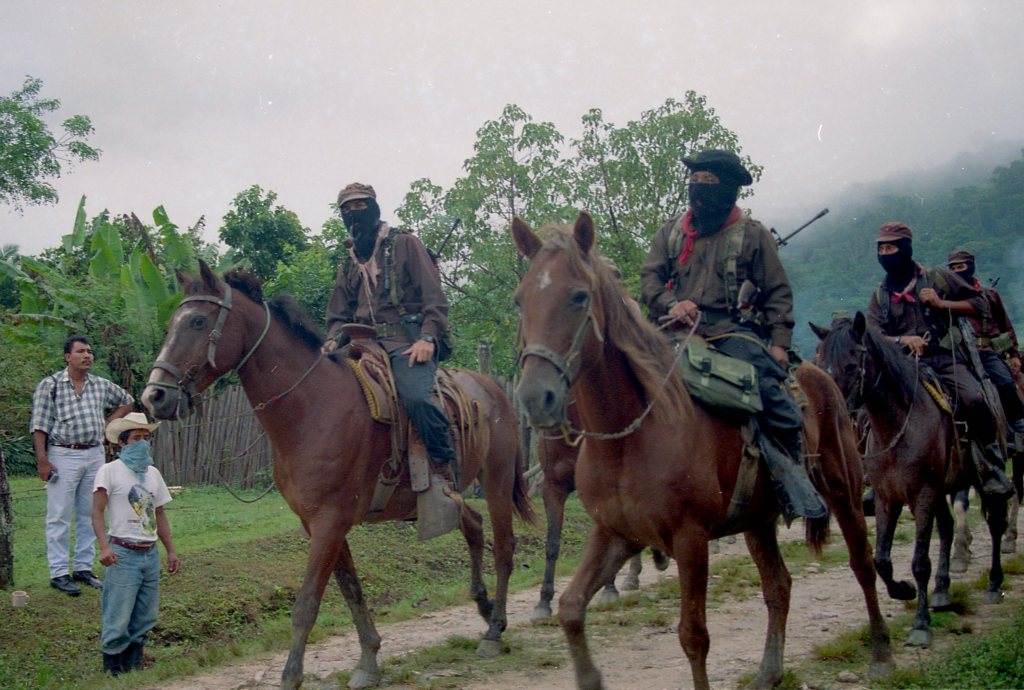
Zapatista leaders: Marcos and Moises in La Realidad, Chiapas, November 1996. Photo: Jim Hodgson

by Jim Hodgson

On Jan. 1, 1994, the same day that the North American Free Trade Agreement (NAFTA) came into effect, the Zapatista Army of National Liberation (EZLN) seized control of several cities in the highlands of Chiapas, Mexico’s southern-most state.

Within a few days, it was clear that the group was Indigenous-led and that it had a charismatic spokesperson in Subcomandante Marcos. The movement also had expectations of social transformation that extended beyond the immediate goal of improving the lot of the Maya people of the Chiapas highlands.

From mountains of southeast Mexico, the Zapatistas put forward a vision of a world where there is respect for diverse ways of being human and of organizing political life, where there might be diverse expressions of truth in the face of supposedly universal truths like the one offered by business elites about the all-powerful “invisible hand” of the free market. They invited us to imagine a world with room for all – “un mundo donde quepan muchos mundos.”

Headlines on Jan. 1, 1994: “Uprising in Chiapas,” “EZLN takes 4 cities in Chiapas”

The Zapatistas pressed for new ways of thinking about power – that leaders should obey their communities – and rejected the hegemony of political parties. The vision had a big impact on those who created the World Social Forum series of encounters that in turn have helped to transform politics in Latin America over the past quarter-century.

Zapatista communities established autonomy from other levels of government, and set about ruling themselves. In the words of a chronicler of social movements in Latin America, Raúl Zibechi, these processes “modify” how people relate to each other as they manage health, education, production, justice, celebrations, sports and art: more mutual, less expert-client, relationships.

Competing posters: Bishop Samuel Ruiz was a man “wanted” for “treason;” EZLN says, “The world that we want is one with room for many worlds.”

“Disorganized crime” and “remilitarization”

Thirty years on, the communities say they have to re-organize themselves in the face of violence between rival drug cartels – “disorganized crime,” the EZLN called them in a recent statement – that now afflicts Indigenous territories near the border with Guatemala and indeed across most of Chiapas. 

Forced displacement, said the Fray Bartolomé de Las Casas Human Rights Centre (known as Frayba), is among the most serious human rights violations in Chiapas today. In a new report launched in July, the San Cristóbal-based group said 16,755 people had been forced from their homes between 2010 and 2022. Frayba attributed the violence to actions by paramilitary groups that have afflicted the state for decades and to the newer criminal gangs, adding that the violence affects the Zapatista communities. At the same time, Frayba describes a “remilitarization” –more soldiers, more bases – in the area. 

Mexico’s Fourth Transformation

In 2018, Mexicans chose their new president, Andrés Manuel López Obrador (AMLO) on the same day as the people of Chiapas elected their new governor, Rutilio Escandón. Their party, the National Regeneration Movement (Morena), promotes a program of change they call the “Fourth Transformation” (4T), the previous three being the war of independence, the mid-19th-century liberal reforms of Benito Juárez, and the Mexican Revolution (1910 to 1917 – or through 1940, if you include the massive land reform led by Lázaro Cárdenas in the mid and late 1930s).  The 4T includes a security component: “abrazos, no balazos” (hugs, not shootings), the idea being to ensure that people have viable economic possibilities so that they do not turn to lives of crime.

More than five years into their respective administrations (and six months before the next elections), reviews are mixed. The old conservative parties loathe AMLO – “socialist!” “Chavista!” A more responsible critique comes from Indigenous people and sectors of the left that reject “neo-developmentalist” approaches that emphasize resource extraction and mega-projects for the sake of job creation – but again mostly benefit the traditional elites. Those criticisms were also levelled at all of the so-called “pink tide” governments that produced some changes over the past 25 years, but did not transform the systems of dependence on the export of natural resources. (This problem afflicts Canada too and in the face of climate change, requires urgent action.)

Despite promises, Mexico’s 4T government has not tried to implement the San Andrés Sakamch’en Agreement that was achieved in negotiations among Indigenous peoples and the government in 1996. Those talks, sparked by the EZLN-led rebellion and moderated by Bishop Samuel Ruiz, marked the first (and only) time that the government has negotiated face-to-face with Indigenous peoples. It was not a comprehensive peace deal, but rather the first step in a planned process to address Indigenous rights in Chiapas and beyond.

On June 2, 2024, voters will elect a new president and a new governor for Chiapas. These will be the sixth since the EZLN uprising. Over the years, the Zapatistas have used a variety of strategies to have an impact on Mexico’s political culture. They won’t be silent in the coming months.

Debt crisis again provokes “deprivation and misery” in Global South

Asia Debt Monitor, April 2023 

by Jim Hodgson

Forty years ago, I spent five weeks of July and August in the Dominican Republic, learning from families, churches and unions about the ways people confronted their impoverishment. The people that I met taught me about long-haul, multi-generational struggle and solidarity.

Soon after that visit, protests in the D.R., Egypt and Peru erupted against conditions imposed by the International Monetary Fund (IMF) and foreign banks. The issue then – and again now – was how to cope with national debt, budget deficits, and rising interest rates.

The 1984 debt crisis: “Dominicans pay in blood”

You are plunging Global South countries into a greater debt debacle that will cause more deprivation and misery,” wrote the Asian Peoples’ Movement on Debt and Development (APMDD) to leaders of the G7 rich countries on the eve of their mid-May summit in Hiroshima, Japan. Countries as diverse as Argentina, Pakistan, Sri Lanka and Zambia have confronted large debt and harsh repayment conditions in recent months. (Zambia has reached an agreement with lenders to restructure $6.3 billion of debt.)

This month, new reports from two United Nations agencies provide warnings and suggest some solutions to the weight imposed by banks and Global North governments on the people of the Global South.

The UN Development Program (UNDP) said 165 million people were forced into poverty between 2020 to 2023 as debt servicing pushed aside expenditures for  social protection, health and education. All of these additionally impoverished people poor live in low- and lower-middle-income economies, with the most-impoverished 20 per cent in low-income countries suffering the most with incomes in 2023 still below the pre-pandemic levels. Their governments cannot do more to assist because of conditions attached to debt repayment plans.

The UN Conference on Trade and Development (UNCTAD) said that public debt has increased faster in developing countries compared to developed countries over the past decade. “When developing countries borrow money, they have to pay much higher interest rates compared to developed countries, even without considering the costs of exchange rate fluctuations. Countries in Africa borrow on average at rates that are four times higher than those of the United States and even eight times higher than those of Germany.”

UNCTAD reports that 3.3 billion people live in countries were interest payments on debts are greater than spending for education and health care. An editorial in Mexico City’s La Jornada daily newspaper recalled thatUN Secretary General Antonio Guterres has denounced this injustice as “systemic failure.”

In a second editorial a day later, La Jornada noted the impact of Global South debt on efforts to confront the climate emergency. “In 2015, the 10 per cent of the world’s wealthiest people were responsible for half of the greenhouse gas emissions, and only one per cent were responsible for 15 per cent of those emissions. The most impoverished half of the people of the Earth generated only seven per cent of the emissions, but it is they who are most affected by climate change, higher food prices and even the destruction of their homes in severe weather events. The countries whose transnational corporations devastate the environment of the Global South with their unceasing extraction of natural resources close their doors to migrants and condemn them to remain in regions that have become uninhabitable because of the actions of those corporations.”

Historically, the ways that the IMF, banks and Global North governments have contended with debt crises have been to use them as opportunities to push neoliberal development models: free trade, extractivism, privatisation of state-owned companies and services, low-wage factory jobs and export-focused agriculture. And they avoid conversations about debt cancellation and reparations for colonialism and slavery.

APMDD and other Global South movements propose different approaches. In the letter cited above, APMDD urged G7 governments to: 

  1. Cancel the debt for countries in need, including public debts of a questionable and fraudulent nature that violated human rights and contributed to exacerbating the climate crisis.
  2. Support the elimination of IMF surcharges, which penalizes the most debt-distressed countries and further erodes the capacity of developing countries to respond to urgent social needs. 
  3. Enact/strengthen national legislation to require the participation of private creditors in debt relief, which is a key element in any serious wide scale debt reduction or restructuring effort. 
  4. Immediately deliver new, additional and non-debt creating climate finance for adaptation, mitigation and loss and damage, much more than the unfulfilled $100 billion/year pledge, to adequately meet the needs of the Global South. 

Once in a while, cracks appear in the wall of Global North indifference. In June, French President Emmanuel Macron convened a summit to reach a new “global pact” to finance the fight against poverty and human-induced climate change. I’ll share some outcomes in coming days.

Womin is a network of women’s organisations across Africa that proposes cancellation of African debt and ecofeminist alternatives to extractives models of development.

Talking about peace when there is no peace*

Jim Hodgson, May 23, 2023

Peace is a pre-condition for any possibility of transforming the global economy for the sake of humanity and the Earth – or, more modestly, achieving those elusive Sustainable Development Goals by 2030.

In the weeks after Russia’s invasion of Ukraine, I added my voice to those of others who pleaded for peace talks. In recent weeks, new efforts from church leaders and global South political leaders are underway to bring the sides together. But peace initiatives are either ignored or disdained by most media and “Western” leaders.

Headlines and images from Mexico’s La Jornada and Argentina’s Página 12 newspapers. On the left, Lula asks that a new Cold War between China and the United States be avoided and defends the use for currencies other than the U.S. dollar for international trade. On the right, from top: Zelensky asks for support from G7 powers; G7 leaders create new sanctions against Russia and debated in Hiroshima the nuclear arsenals of other countries; The Vatican makes its peace effort official so as to end the war in Ukraine.

Case in point: the participation at the recent G7 meeting in Hiroshima of Brazilian President Luiz Inácio “Lula” da Silva and Indian Prime Minister Narendra ModiFinancial Times dismissed Lula and Modi as Russian President Vladimir “Putin’s apologists.” Their participation was eclipsed by that of Ukrainian President Volodymyr Zelensky, who did meet with Modi, but blamed scheduling conflicts for not meeting Lula – and then joked with reporters that Lula was more disappointed than he was. 

Well, yes. Lula’s interest in peace has everything to do with funds diverted to war and away from efforts for authentic development that could help alleviate the other crises of climate change and migration. (Lula also said that Zelensky did not show up for a meeting they had scheduled.)

In Hiroshima,  Lula criticized the division (or re-division) of countries into two antagonistic blocs and abandonment of a multipolar world that seemed to be emerging in the wake of the pre-1991 Cold War.

Meanwhile, South African President Cyril Ramaphosa was not even invited. But he and other African leaders are involved in a peace initiative to end the war in Ukraine. In a news conference May 17, he said he had had “separate telephone calls” with Putin and Zelensky over the weekend, where he presented an initiative drawn up by Zambia, Senegal, the Republic of Congo, Uganda, Egypt and South Africa. Leaders of the six countries say they plan to travel to Russia and Ukraine “as soon as is possible.”

In his weekly newsletter on May 15, Ramaphosa said South Africa would not be drawn “into a contest between global powers” despite having faced “extraordinary pressure” to do so.

“We do not accept that our non-aligned position favours Russia above other countries. Nor do we accept that it should imperil our relations with other countries,” Ramaphosa said.

During the same week, Chinese envoy Li Hui visited Moscow, his first stop in a European tour that would also take him to Kyiv, to develop a 12-point plan proposed by Beijing on the first anniversary of the Russian invasion. 

Last September, Mexican President Andrés Manuel López Obrador called for establishment of a Commission for Dialogue and Peace that would facilitate the search for a solution through negotiations. 

Nobody has a “magical formula to achieve peace,” writes Juan Pablo DuchLa Jornada’s Moscow correspondent. “But [proponents of peace] hope that Russia and Ukraine would establish a ceasefire and sit down to negotiate their conditions with the objective of putting an end to the bloodshed and devastation. All that is lacking is that Moscow and Kiev by open to making concessions – the first not wanting to cede Ukrainians regions already annexed and the latter refusing to lose territory – but without concessions, it does not seem possible to open a path toward peace in a war that, say what you will, only brings calamities.”

WCC delegation with Ukrainian church leaders in Kyiv on May 11 (WCC photo); Patriarch Kirill with WCC general secretary in Moscow on May 17 (ROC photo).

Meanwhile, the World Council of Church and Pope Francis have both renewed their efforts for peace. 

In mid-May, a delegation led by WCC general secretary Jerry Pillay visited church and government leaders in Kyiv and Moscow. In Kyiv, the WCC delegation met with senior leaders of both the Ukrainian Orthodox Church and the Orthodox Church of Ukraine, two churches whose dispute has intensified since the Russian invasion. In Moscow, they met with Patriarch Kirill, head of the Russian Orthodox Church and widely viewed as a supporter of President Putin.

For his part, Pope Francis has given Italian Cardinal Matteo Zuppi the task of leading a mission in hopes it can “ease tensions” in the Ukraine war and lead to a path of peace. The pope has said has said he would go to Kyiv if such a journey would help bring peace, but said that could happen only if he could also visit Moscow.

* The phrase “peace, peace, when there is no peace” is found in Jeremiah 6:14 and later at 8:11. It is also found in Ezekiel 13:10 and 16. The direct criticism is of those who build flimsy walls and smear them with whitewash: a makeshift solution to a problem. The metaphor then and now is points to poor leadership. In our time, we can think of leaders who promise that war will lead to peace. “They have treated the wounds of my people carelessly,” writes the prophet Jeremiah, “saying ‘peace, peace,’ when there is no peace.”

War Never Again – Westerplatte, Gdansk, Poland (site of the first battle of World War II in 1939).