Guadalupe, Tonantzin and roses in December

by Jim Hodgson (from a text published on Dec. 11, 2011 in a previous version of this blog site)

One of the people that I used to visit in Cuernavaca was Doña Guadalupe, an elderly woman who lived with her many beautiful cats in the Patios de la Estación neighbourhood, near the former train station and Casino de la Selva hotel.

To make a living, she made tortilla cloths (including the one shown here) and other embroideries that she sold to visitors who came from the Cuernavaca Centre for Intercultural Dialogue on Development (CCIDD) where I worked in the mid and late 90s. This image shows the Virgin of Guadalupe, for whom our friend was named. (She died in July 2000, just before I returned to Canada.)

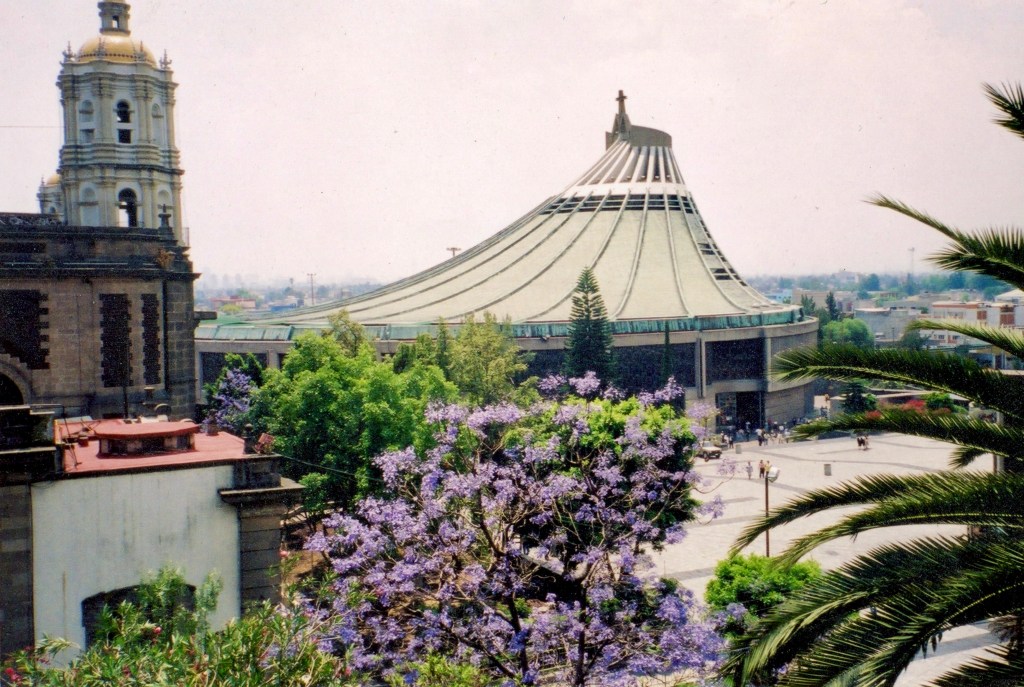
Tonight, six million people will fill the streets around Mexico City’s Guadalupe basilica (shown below). Many will have travelled on foot, by bicycle and in trucks and buses, to get there. Most sleep in the street. All expect to get in to the basilica to greet La Virgen on her feast day.

Inside, there will be a succession of Masses and celebrity stars in a televised variety show. What you don’t see on television is the flood of people whose focus is not on centre stage. And those who can’t get to Mexico City are celebrating across Mexico and increasingly, throughout the Americas and beyond.

It’s the confluence of different spiritualities around The Feast of Our Lady of Guadalupe. And there are different ways of telling the story. But let me give you a basic outline.

The Virgin Mary is believed to have appeared to an Indigenous man, Juan Diego, on three occasions in December 1531, 10 years after Spain’s conquest of the Aztec empire. She encountered him on a hill known as Tepeyac, on the north edge of Mexico City—formerly Tenochtitlan, the Mexica (or Aztec) capital). The hillside was associated with the worship of Tonantzin, a mother of gods in the Mexica faith.

Mary spoke to Juan Diego in Nahuatl, the language of the Aztecs that is still spoken by about three million people in central Mexico. She addressed him with an honorific title and asked him to tell the bishop that she wanted a church built on the site. When the bishop later asked Juan Diego for proof that she had made this request, Juan Diego returned to Tepeyac. Mary told him to gather roses in his cloak and to take them to the bishop.

When Juan Diego unrolled his cloak to reveal the roses to the bishop, the cloak itself was emblazoned with the image of Mary, dressed as a dark-skinned Aztec princess, standing in front of the sun and on top of a crescent moon.

In the apparitions, Mary called herself Tecuatlaxopeuh, a Nahuatl word which means “one who drives away those who eat us.” The Spanish called her Guadalupe, after a popular devotion to Mary in Estremadura, Spain.

“Flowers of life in the crude winter”

The message was understood to be an affirmation of the Indigenous people in the midst of their defeat and oppression. It’s another one of those stories (like that of Jesus born in a stable in Bethlehem under Roman occupation) that tell of God’s action at the margins, among the poor, away from power.

The hillside where Mary appeared, Tepeyac, is the focal point of popular religiosity in Mexico and all of the Americas, wrote Fr. Miguel Concha of the Dominican religious order in Mexico. (Fr. Miguel passed away in January 2023.)

“There is no greater moral and religious strength that unites so many people precisely because of what she represents,” he wrote in La Jornada newspaper Jan. 23, 1999.

“She is a Marian symbol, it’s true, but she has connotations that go beyond what the institutional church holds forth in its doctrines. Guadalupe is the product of the synthesis that the poor developed from what Christianity offers, bringing that together with the essence of the oldest indigenous religious traditions,” wrote Concha.

“To come today to Tepeyac to proclaim from here the commitment of the church in the face of the third millenium is to assume the trajectory of those who, like Juan Diego, are the bearers of the few flowers of life which still survive in this crude winter which is imposed on humanity.”

Images on the church in Santa Marta, Cabañas department, El Salvador: Guadalupe and Saint Oscar Romero.

Development and the faith of the people

Why is a blog about development dealing with Latin American celebrations of the Virgin Mary? Aside from being in the midst of the Advent and Christmas season, when Mary’s central role in the Jesus story is celebrated, it seems to me that a lot of development activities are carried out as (apparently) benevolent foreign interventions. People come from some place else to build a school. Experts lead an agricultural project. Funds are shared from North to South in support of some cause or other.

At their best, these activities represent cross-cultural cooperation. Southern partners make the key decisions; Northern partners are but a supporting cast; solidarity grows.

At their worst, zealous to promote a better pig or construction technique, foreign development workers (like bad missionaries) feel no need to understand local cultures or practices.

One time, we accompanied Doña Guadalupe on a visit to her huesera, a healer of bones and their aches. In small barrels, the huesera had a spectacular collection of different varieties of beans, in all their many colours—seed varieties disparaged by the agro-industrialists with their monocrops.

A bit of time spent in friendship and solidarity with Guadalupe showed me vividly how Indigenous people and small farmers are the keepers of seeds and of the wisdom and knowledge that we will need to survive the warm decades to come.

Haiti will get support for its police. What it needs is a new government.

by Jim Hodgson

Now that the United Nations Security Council (UNSC) has approved deployment of a multinational force to Haiti, Haitian politicians and civil society organisations (CSOs) and their allies abroad respond with an array of positions.

UN Security Council (Alterpresse)

A new transitional government is urgently needed, says Pierre Espérance of Haiti’s National Human Rights Defense Network (RNDDH). Writing in the New York Times, Espérance called for renewed negotiations among CSOs and politicians (none of whom are elected) towards change.

“The talks should specify what qualifications are required for an individual to join the transitional government — and, critically, what would be disqualifying, to avert yet another criminal takeover.

“It wouldn’t be an easy task. But a new government formed along these lines would begin to bring long-awaited accountability to the police, as well as branches of government like the judiciary. Gangs would not disappear, but they would eventually exert less power and lose some of the vast territory they now control.”

Haiti has a “transition council” named by the interim government of the unelected prime minister, Ariel Henry. Head of the council is Mirlande Hyppolite Manigat, a constitutional law professor, presidential candidate in 2010, and widow of a man who was one of the 1988 coup-era presidents. 

At a news conference held in the presence of Henry and government ministers, Manigat expressed concern over Haiti’s “accelerated tumble” and said she saw the UNSC’s decision as an “expression of will to take charge of the deplorable situation” in which the country lives. 

“The country is going badly,” Manigat said. “It’s our fault that the UNSC has adopted this resolution.” “Velvet glove, iron hand,” responded Gotson Pierre, founding editor of Alterpresse, of Manigat’s comments. “Ariel Henry, serait-il sous pression?” [Is Henry under pressure?]

James Beltis, a member of the Montana Accord, the group made up of CSOs and opposition politicians that has its own transition proposal, called authorization of the mission a “setback.”

“We seem to be stuck with the same solution we’ve been using for the past 30 years” (referring to military interventions in 1994 and 2004), he told the Washington Post. “From a political perspective, this appears to be support for the current government.”

Beltis was also cited by the Haitian Times: “There is no possibility for Montana [political parties] to cohabit with Ariel Henry while he remains as prime minister.”

Past foreign interventions in Haiti and especially the one that followed the removal in February 2004 of President Jean-Bertrand Aristide are remembered for sexual abuse by UN soldiers and the introduction of a cholera epidemic that infected 800,000 people and took almost 10,000 lives.

This time, emphasis is placed on support to the Haitian National Police (PNH). The force will be led by Kenya (which has its own policing issues), with support from Bahamas, Jamaica and Antigua and Barbuda. The mission would be reviewed after nine months and be funded by voluntary contributions, with the United States promising up to $200 million.

Global Affairs Canada (GAC) said this country is likely to deploy RCMP officers to Haiti to act as trainers in the multinational intervention, promising an added emphasis on preventing sexual violence. 

The RCMP will be “focused on technical training,” GAC’s Lisa Vandehei told the Senate Foreign Affairs Committee Oct. 5. She said they would probably train agents of the PNH in “very specialized” technical areas using a model where each trained agent would continue to teach other Haitian peers. Vandehei leads an inter-departmental task group on Haiti.

From Jan. 1 through Aug. 15 this year, at least 2,439 people had been killed and a further 902 injured. In addition, 951 people were  kidnapped. Meanwhile, ever-larger numbers of Haitians are choosing to leave any way they can. (UN’s Office of the High Commissioner for Human Rights) Headlines and photos about recent attacks from Alterpresse.

Will it work?

Kenyan police “don’t know the turf, don’t speak the language,” said Amy Wilentz, author of The Rainy Season: Haiti Since Duvalier and a professor at the University of California, Irvine. She told CBS News the mission was “unlikely to be a success.”

“First, it’s too small,” Wilentz said of the projected 10,000-person deployment. “There are an estimated 20,000 active gang members in Port-au-Prince, and they are heavily armed. So in combat, the Kenyans will be outmanned and perhaps outgunned.”

Other critics are even more severe. “It is not ‘solidarity’ with the people of Haiti to respond to the unconstitutional request formulated by a dictatorial government, put in place and maintained by the same ‘international community’ that now redoubles its support contrary to the legitimate demands of a huge range of Haitian social, political and humanitarian organisations,” says a new statement by Latin American CSOs in 17 countries, among them Jubileo Sur/Américas.

“We reject the new invasion of Haiti!” “For a Haiti that is dignified, sovereign and free of all occupation.” (Partial text of poster announcing the new Latin American civil society declaration.)

“It is to once again disregard the sovereignty and self-determination of the Haitian people with their demands and proposals to resolve this crisis generated by the same long-standing foreign intervention.

“It is not ‘support’, to continue to ignore the people of Haiti, ignoring their denunciations that link Ariel Henry, the current de facto government and its ‘international protectors’, led by the US, with the proliferation of the armed gangs that these same actors now intend to control through this new invasion.”

In comments made after the UNSC vote, several members of the council, including China and Brazil, reiterated the necessity of a strong Haitian government. 

“This force is being considered as just one instrument to help stabilize the security situation in the country,” said Brazil’s UN ambassador, Sérgio França Danese. “This is just a first step in what we hope will be the direction in terms of assuring those security considerations that will allow the political process to go forward.”

“It is a condition that is necessary but, of course, not enough.”

China’s U.N. ambassador Zhang Jun said that while Beijing “appreciates Kenya’s willingness” to lead the mission, “without a legitimate, effective, and responsible government in place, any external support can hardly have any lasting effects.”

The UNSC expanded a UN arms embargo to include all gangs, a measure China wanted. Haitian officials have said guns used by gangs are believed to be mostly imported from the United States. The embargo previously only applied to specific individuals.

Turning the world upside down: systemic change needed now

Photo: Granma.cu

by Jim Hodgson

In the face of deep inequality within and among the nations of the world, leaders of the so-called “less developed countries” find they must still appeal for basic fairness from their richer neighbours.

More than 75 years after the United Nations was formed, and almost that long since the first development programs were implemented (e.g., the Colombo Plan, 1950), and almost 60 years since the first gathering of the Group of 77 developing nations, leaders gathered last week in Havana and this week in New York to plead their case again.

Not that you would have read about the Havana meeting in mainstream media, but representatives from 114 countries attended the G77+China meeting in Havana. Among them were 30 heads of state or government, as well as senior officials from international organisations and agencies, including UN Secretary-General Antonio Guterres.

The meeting was held under the banner title, “Current development challenges: The role of science, technology and innovation,” but the talk was all about the systems of wealth and power that are rigged against developing countries.

In their final declaration Sept. 16, the G77 demanded fair “access to health-related measures, products and technologies” – a problem highlighted by “vaccine apartheid” during the Covid pandemic when richer countries had first access to vaccines. 

G77 called for an end to “existing disparities between developed and developing countries in terms of conditions, possibilities and capacities to produce new scientific and technological knowledge.”

They revived calls for a “new international economic order” and “new financial architecture,” including “through increasing the representation of developing countries in global decision and policy-making bodies which will contribute to enhance the capacities of developing countries to access and develop science, technology and innovation.”

Among the countries participating (including the host, Cuba) were several that have been harmed by sanctions that are usually imposed by wealthier countries to try to provoke changed behaviour by less powerful countries. Sanctions (referred to in the declaration with the UN Human Rights Council term “unilateral coercive measures”), together with external debt, inflation, displacement of peoples, inequality and “the adverse effects of climate change” are all among the “major challenges generated by the current unfair international economic order” and there is “no clear roadmap so far to address these global problems.”

Criticism of the existing international order carried over from the G77 meeting to the UN General Assembly, which met days later in New York.

“They don’t have the $100 billion to aid countries so that they can defend themselves against floods, storms and hurricanes,” said Colombian President Gustavo Petro, referring to the Loss and Damage Fund promoted at the COP climate negotiations to “new and additional” funding from donor nations.

Wars and climate change, he said, are related to that other unprecedented crisis: migration. “The exodus of people toward the north is measured with excessive precision in the size of the failure of governments. This past year has been a time of defeat for governments, of defeat for humanity.”

The political systems that we use to effect policy changes are failing to respond to the urgent needs of our time. Most politicians are beholden to the corporations and rich people who fund their political parties and perpetuate their hegemony. In four-to-six year electoral cycles, the deep changes needed to confront those problems are rarely undertaken. 

In Canada, think of the power that mining corporations have wielded to block meaningful investigation of human rights and environmental abuses by their subsidiaries overseas. Or the influence land speculators have over the Ontario government. Or the actions of oil, gas, coal and pipeline companies to stall meaningful action to cut greenhouse gas emissions. 

And then scale that up globally. Think of the ways pharmaceutical companies blocked access to HIV and AIDS medications until a global fund was found to pay them – and then pulled the same stunt over Covid vaccines. At the UN on Sept. 20, Guterres said time was running short for climate action thanks to the “naked greed” of fossil fuel interests.

What is delivered through Official Development Assistance and Sustainable Development Goals may be crumbs and band-aids. While necessary, those funds are not sufficient to counter instruments of power like corporations and their allies in the international financial institutions like the World Bank and the International Monetary Fund.

Political change is required to make the systems change.

As Xiomara Castro, president of Honduras, told the G77 in Havana: “The time has come to put an end to the backyards [using a U.S. term referring to its relationship to Latin America] because we are not pieces on a chessboard of those who are apologists for dependence. Our nations should not continue to suffer the mass privatization of their territories.”

Mafalda: But Liberty, you’ve put the map upside down!
Liberty: Upside down compared to what? Earth is in space where there is no up or down.
Liberty: That story that says the north has to be above is a psychological trick invented by those on the top to make those who are on the bottom continue to believe that we are the bottom. But, beginning today, conventional ideas are over!
Last panel, a voice: Where were you, Mafalda?
Mafalda: I don’t know, but a conventional idea has taken a blow.

(For that last line, Quino, the great Argentinian cartoonist who created Mafalda, wrote in the original Spanish version, “No lo sé, pero algo acaba de sanseacabarse” – the sense being that something has ended.)