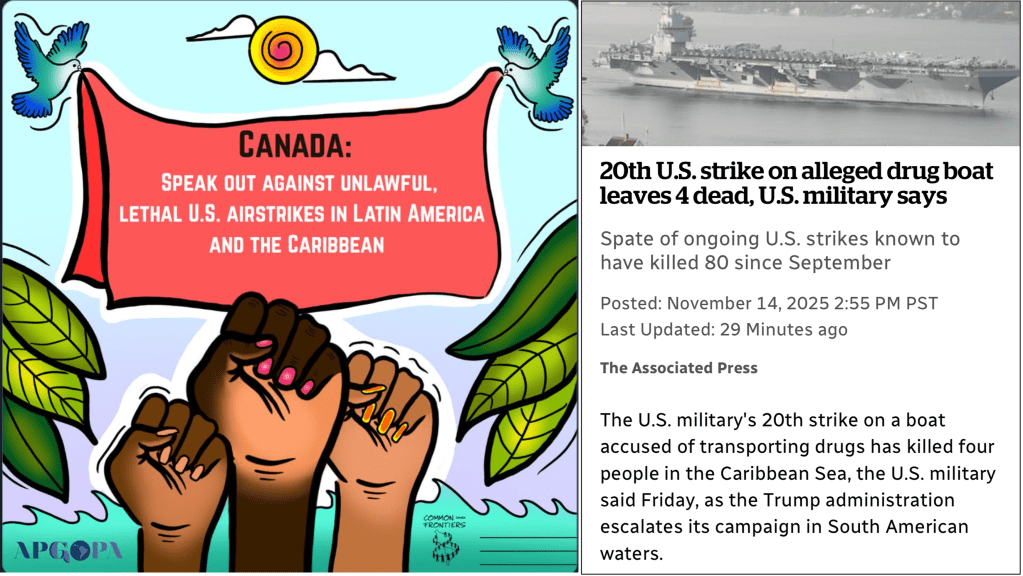
Canadians need to call on their government to speak out against illegal U.S. airstrikes on boats in the Caribbean and eastern Pacific, say two coalitions in which I have participated for nearly three decades.
Left: Calling on Canadians to act (Artwork by Harmeet Rehal); Right: AP news story on the 20th boat strike carried out by the United States since September.Another attack was reported a day later.
Common Frontiers and the Americas Policy Group sent a letter Nov. 13 to Foreign Minister Anita Anand, Trade Minister Maninder Sidhu, and Defence Minister David McGinty urging Canada to:
Speak out publicly and condemn the unlawful attacks and extrajudicial killings of civilians in the Caribbean and Pacific by the U.S. military;
Contribute to the promotion of peace and security in the region and join efforts to press the Trump administration to respect national sovereignty and uphold the rule of law;
Suspend participation in Operation CARIBBE to avoid the risk of Canadian complicity; and
Adhere to Canada’s obligations under the Arms Trade Treaty by removing regulatory exemptions that allow loopholes for the export of arms to the U.S. without oversight or human rights risk assessment.
Just a day earlier, Anand had told reporters that it was not her job to determine if the United States has breached international law when striking alleged drug boats in the Caribbean Sea.
“As Canada’s foreign minister, I hold responsibility for Canada’s compliance with international law—we are always seeking to comply with international law,” Anand said. “Regarding the question that you asked, I would say it is within the purview of U.S. authorities to make that determination.”
Her comment was soundly criticized by international law experts, including Ketty Nivyabandi, secretary-general of Amnesty International Canada’s English section. She told Hill Times that international law only works if it is upheld by all states.
“It is a collective responsibility to uphold international law. It is not up to a country to focus on itself and decide whether or not it is applying international law—in that case, nobody would,” she said. “What the United States is doing is truly making a mockery of international law. It is normalizing what are, in effect, extrajudicial killings.”
The attacks take place amidst months of arrests and deportations of Venezuelans in the United States; false allegations of Venezuelan state collusion with a criminal gang called Tren de Aragua; massive U.S. movement of troops and warships into the Caribbean; and conjecture about what the Trump regime intends to do. On Nov. 13, Defense Secretary Pete Hegseth posted on social media: “President Trump ordered action—and the Department of War is delivering. Today, I’m announcing Operation SOUTHERN SPEAR.”
Former CBC News correspondent Dan Rather cited the Washington Post in calling it the biggest military presence in the Caribbean in decades. And he added:
… a curious build-up if the stated goal is simply drug interdiction. Another explanation would be Trump wagging the dog, creating a diversion by manufacturing a crisis that he can then fix and allowing him to flex and crow about taking down the leader of a small country. Or it could be just about commandeering Venezuela’s oil.
Here below, from the Venezuela Solidarity Network, are some reasons to help stop a potential U.S. war against Venezuela:
Please write to your own Member of Parliament to express your views.
📍VANCOUVER, BC Rally & Info Tabling Friday, November 21, 5:00pm Vancouver Art Gallery – Robson Street Side Organized by Fire This Time Movement for Social Justice
📍OTTAWA, ON Saturday, November 22, 3:30pm U.S. Embassy – York and Sussex Organized by Alba Movimientos Ottawa
📍WINNIPEG, MB Sunday, November 23, 1:00pm River and Osborne Sponsored by Peace Alliance Winnipeg, Manitoba-Cuba Solidarity Committee, United in Action, Communist Party of Canada – Manitoba & Araucaria
In this decade of Donald Trump at centre-stage, it has been hard to choose a moment or an issue about which to react. The former reality TV star is an expert in deflection and distraction.
Yet some things (Israel’s genocide in Gaza is one) matter more than others. So too Trump’s threats against Venezuela.
Trump’s statement below defending extrajudicial executions shows again how little he values human life. He was responding to a question from a journalist on Oct. 23 about why he didn’t ask Congress for a declaration of war against drug cartels he claims are at war with the United States:
“Well, I don’t think we’re gonna necessarily ask for a declaration of war, I think we’re just gonna kill people that are bringing drugs into our country. OK? We’re going to kill them. You know? They’re going to be, like dead. OK?”
Over the past two months, Trump’s assassins have killed at least 43 people and sunk ten small boats in the Caribbean and along the Pacific coast of Colombia. As Greg Grandin has documented, when the U.S. withdraws from the rest of the world, it doubles down in this hemisphere.
This time, the United States isn’t even bothering with its usual lies as it moves from a decade of sanctions (“unilateral coercive measures”) to threats of war as it presses for regime change in Venezuela. Sanctions have had devastating effects in Venezuela, according to a study conducted by the Center for Economic and Policy Research and published in August in The Lancet Global Health.
Trump’s ire is mostly directed against Venezuela, which since 1998 has refused imperial orders about oil, medical care, governance, and individualistic notions of human rights. But he has plenty left over for Colombia and Mexico.
“He’s a thug” and an “illegal drug leader,” Trump said of Colombian President Gustavo Petro. And he said Mexico is governed by drug cartels, even while expressing respect for President Claudia Sheinbaum.
The text below is translated and lightly adapted from an Oct. 25 editorial in the Mexico City daily La Jornada.
Washington seeks war
The Trump administration is sending increasingly alarming signals about its determination to attack Venezuela to impose regime change and install a puppet administration. Trump uses a “combination of threats of armed action and economic extortion” to support right-wing politicians in Argentina, Brazil, Ecuador, El Salvador and now Bolivia “to facilitate the rise or consolidation of the far right throughout the hemisphere.”
On Oct. 24, his “War Department” announced the deployment of an aircraft carrier, the USS Gerald R. Ford, and its strike group to the U.S. Southern Command—that is, the southern Caribbean and northern South America. This entails the presence of the aircraft carrier itself, the 75 aircraft it carries, and the full range of necessary operations: three destroyers, a replenishment ship, a dry cargo ship, and a Coast Guard cutter. The Gerald R. Ford alone carries 4,600 military personnel, in addition to the crews of auxiliary vessels.
The argument that all these vessels are being deployed with the goal of “dismantling Designated Terrorist Organizations (DTOs) and countering narco-terrorism in defence of the homeland” doesn’t stand up to scrutiny. First of all, they could be deployed off the US coast, thereby reducing the cost of maintaining long supply chains and avoiding diplomatic friction.
The thousands of soldiers already sent to the Caribbean could have provided a much greater service to their homeland by monitoring land and air points of entry, where narcotics actually enter the United States. Instead of spending billions of dollars operating its fleets abroad, Washington could gain vast resources by combating money laundering within its own financial system, where authorities estimate that organized crime launders $300 billion annually. If traffickers were unable to collect and move the profits from their activities, they would be immediately paralyzed. But it is clear that the White House is not interested in the health of its citizens or the legality of the money circulating through its banks.
The bellicose tone of this escalation is so evident that even Brazilian President Luiz Inácio da Silva (Lula—who is not friendly to Venezuelan President Nicolás Maduro) criticized the U.S. bombing of boats in the Caribbean, noting that “if it becomes fashionable, everyone will believe they can invade someone else’s territory and do whatever they want,” thus turning the region into a lawless land.
Lula’s special advisor and former Foreign Minister Celso Amorim warned that external intervention, whether armed or through intelligence services, is not the way to decide who will govern Venezuela, a problem that concerns only Venezuelans. He also warned of the danger of setting South America ablaze and leading to the radicalization of politics throughout the continent. At the same time, Washington is making clear its longing to empower the Colombian oligarchy in Bogotá, always ready to follow its directives and make the Andean-Caribbean territory available to its troops and spy agencies.
In this regard, Trump escalated his attacks against President Gustavo Petro and imposed sanctions for “allowing drug cartels to flourish and refusing to stop this activity.” No evidence was presented, which is what happens in his constant diatribes against Mexico, Venezuela, and other nations whose governments protect their independence and sovereignty.
In South America, there is no war that justifies besieging the subcontinent with a series of attacks. But it becomes increasingly clear that the White House is determined to start a conflagration, no matter how absurd its pretexts.
The international community, and particularly Latin American and Caribbean societies, must join forces in rejecting Trump’s attempt to plunge the region into barbarism in order to divert attention from his own ineptitude and hand over vast amounts of money to the military-industrial complex, the only sector whose prosperity apparently interests the U.S. president.
…
Here’s a way to keep up with Trump’s threats and responses from Caribbean and Latin American political and social movement leaders. The Center for Economic Policy and Research (CEPR) has been a good source of information on U.S. intervention in the region for decades.
The UN Security Council adopted a resolution last week that authorizes deployment of 5,500 troops to Haiti to replace the understaffed and underfunded Multinational Security Support Mission (referred to as MMAS in Haiti). The new Gang Suppression Force (FRG) has a mandate to “neutralize, isolate, and deter” gangs, secure infrastructure, and support institutional stability.
On Aug. 26, UN Secretary General António Guterres warned that humanitarian efforts in Haiti are “shamefully overlooked and woefully underfunded.” On Sept. 30, Volker Türk, the UN high commissioner for human rights, welcomed creation of the FRG and said: “Efforts to restore security must be anchored in respect for human rights and go hand in hand with the reconstruction of the rule of law.”
Politico called the vote to create the FRG a “win” for the Trump administration. That alone should raise concern among the rest of us.
The UNSC decision came days after a police-directed drone attack on an alleged gang leader’s birthday party, where he was handing out presents to local children. At least eight children were killed.
Since June 2024, Haiti has been governed by a transitional council (CPT). Leadership rotates among a wobbly coalition from different sectors of Haitian society. It includes the civil society-led Montana Accord network (named for the hotel where their accord was signed). Earlier, the Montana group had offered a “passarelle” or series of steps for an interim government as a way to move to new elections. (The terms of all Haitian politicians expired in 2023.) The CPT might have been able to move forward on that process, but Haiti is afflicted by a rising tide of gang violence that some argue is at least partly driven by Haiti’s richest people.
In August, leadership of the CPT passed to Laurent Saint-Cyr, a former head of the American Chamber of Commerce in Haiti. At the same time, the prime minister is his fellow businessman Alix Didier Fils-Aimé.
To my suspicious mind, this means Haiti has returned to the same power structure that prevailed after 2011 under presidents Michel Martelly and Jovenel Moïse, and then the unelected leadership of Prime Minister Ariel Henry through early 2024 – men all backed by the United States, Canada, France and a powerful local oligarchy that has blocked every effort to ease Haiti’s inequality and to advance social goals, including education, health care, housing and public infrastructure.
(Bear with me, please: you can read more of my own analysis towards the end of this piece.)
First, the news
According to the UN, at least 1.3 million Haitians remain internally displaced due to violence, with 5.7 million facing food insecurity. About 3,100 people were killed in violent incidents between January and June this year, and at least 2,300 grave violations against children have been recorded.
The UNSC resolution to create the Gang Suppression Force (known as FRG in French: Force de Répression des Gangs) was proposed in August by Panama and the United States. The resolution passed Sept. 30 with 12 votes in favour and none against. Permanent Security Council members China and Russia, along with rotating member Pakistan, abstained from the vote.
It replaces the MMAS, created just two years ago by the UN to support Haitian police forces, but never adequately funded. The new force would raise the personnel ceiling from 2,500 in the current mission to 5,550 personnel will grow from 2,500 to 5,550 personnel, with a UN Support Office providing logistical support amidst Haiti’s intersecting security, humanitarian, and political crises. But it will not be answerable to any Haitian authority, not even the Haitian National Police.
Currently, it appears the new FRG would include the United States, Bahamas, Canada, El Salvador, Guatemala, Jamaica, and Kenya—in effect a reboot of the MMAS.
Memories of a previous UN intervention: UN trucks parked near Cap-Haïtien in February 2005 (Jim Hodgson photo).
Responses
Approval of the FRG was welcomed by the Caribbean regional group CARICOM, and the Organization of American States – even though the new OAS secretary-general, Albert Ramdin, had in June advocated dialogue with the gangs. That idea was rejected by the CPT.
The Canadian government had earlier announced contribute $60 million toward gang-suppression efforts in Haiti. Mark Richardson, a Global Affairs Canada director general for the Caribbean, recently told the House of Commons foreign affairs committee that it is “too early” to have conversations about whether Canadian troops would be part of the new UN mission.
After the UN vote, U.S. Ambassador Henry Wooster pressed the CPT to hold elections:
🕊️ Context: follows the UN Security Council’s green light for the deployment of the Gang Repression Force (FRG).
🇺🇸 U.S. position: call for a clear plan and timetable for free and credible elections in Haiti.
🧭 Stated objective: to prevent the transition from dragging on and to encourage the restoration of democratic institutions.
⚖️ Political challenge: Washington wants to link security stabilization to an inclusive and supervised electoral process.
🕰️ Next steps: consultations between the Haitian government and international partners on implementation of the FRG and of an electoral timetable.
More critical views are offered by the Haïti Liberté newspaper. One article describes the rationale offered by China and Russia for not vetoing the resolution. It adds that Guyana, Algeria, Sierra Leone, and Somalia sought to insert language that called for “full respect for the sovereignty and political independence of Haiti,” but their proposal was rejected by the U.S. Denmark, Greece, South Korea, and Slovenia “advocated for strengthening the text with language on compliance with international law, including international human rights law,” but “the US apparently consistently supplemented these additions with the qualifier ‘as applicable’.”
The same article quotes Haïti Liberté director Berthony Dupont questioning proposed use of the UN regular budget for operational and logistical support of this force.
“In the context of the [UN]’s financial crisis, caused largely by the irresponsible actions of its largest contributor [the U.S.], expecting significant funding to support a new initiative that exists only on paper, and which lacks a sustainable foundation and clear prospects, is naive, to say the least. Let us put it straight: if that contributor failed to provide the funds it promised for the MMAS, what guarantee do we have that anything will be different this time?”
In Port-au-Prince, the human rights group Collectif Défenseurs Plus told Alterpresse that it recognizes that “international assistance has become inevitable” in the face of an overwhelmed HNP and unprecedented violence. But it demands guarantees: accessible accountability mechanisms, zero tolerance for any human rights violations, and uncompromising support for Haitian institutions.
“The Haitian crisis is above all political,” the collective insists, warning that the FRG must not become a crutch for a power lacking legitimacy, but rather create a space for an inclusive transition and transparent elections.
Between hopes for restored security and fears of another international failure, the success of the FRG will depend as much on its ability to break the criminal grip as on the will of Haitian actors to rebuild a credible state. As the Defenders Plus Collective emphasizes, “security is a right, and so is sovereignty.”
How might Haiti be better served?
“While it is important to address the consequences of gang violence, influential foreign actors in Haiti should do more to address its root causes,” writesRoromme Chantal, a political science professor at l’Université de Moncton.
“To this end, research demonstrates that conflict resolution such as the one in Haiti should be approached in a manner that allows for the participation of local groups (official authorities, civil society representatives, grassroots organizations), providing them, if necessary, with the funding, logistical means, and technical capacity to implement carefully targeted programs.”
My thoughts
I find myself thinking again of anthropologist Michel-Rolph Trouillot. He wrote a book called State Against Nationin the years following the end of the Duvalier dictatorship. He argued that the Haitian state is relatively autonomous from the nation: all problems are turned into political problems, but the state – much less the political class – is not the same as the society. If we listen, we may find that the Haitian people have a project that is different from that imagined in the proposed solutions that focus too narrowly on the state. In another book, Silencing the Past, he argued that historical narratives are often silenced: even the truth about Haiti’s revolution, history’s most successful slave rebellion that made Haiti the “first nation to embrace an equity and human rights approach by permanently banning the slave trade from the first day of its existence.”
If anyone were listening, they might find that Haitians are more interested in communal solutions and local democracy. This would be something more akin to the “mandar obedeciendo” (to rule by obeying the bases, the grassroots) advocated by the Zapatistas in southern Mexico than whatever Haitian elites and their neoliberal allies abroad are proposing, which seems a lot like “duvalierisme sans Duvalier” – reproduction of a totalitarian state, a predator state: one that is safe only for the rich.





 Unwrapping Development