“Security for whom?” asks KAIROS after Canada cuts foreign aid

by Jim Hodgson

Canada’s newest cuts to foreign aid spending follow cuts by other wealthy countries (most notably the elimination earlier this year of the U.S. Agency for International Development). Beyond immediate impacts, these cuts point to a reshaping of sixty years of international cooperation for development.

Over the next four years, Canada will chop $2.7 billion from its aid budget. At the same time, at the behest of the Trump regime next door, it will increase military spending with $81.8 billion over five years.

In June, Canada announced its commitment to increase military spending: CodePink, Development and Peace, and CBC headlines.

Few analysts bring together the issues of development assistance, militarism and climate justice the way that the ecumenical coalition KAIROS Canada has in its statement on the budget:

Canada needs to decide what role it wants to play in the world. These issues are inseparable: climate justice, Indigenous sovereignty, migrant justice, gender equality and peacebuilding rise or fall together — and Canada’s future depends on advancing them as one interconnected project of justice. 

KAIROS added that it is concerned by the prospect of a scaled-up military-industrial complex in Canada. “Even today, arms components made in Canada are used against civilians in Gaza and other conflict zones due to loopholes that allow them to flow indirectly through allies, helping to further entrench global insecurity.” (Canadian-built military surveillance and targeting equipment was used in at least two of the U.S. attacks on small ships in the Caribbean Sea, as reported recently by another Canadian ecumenical coalition, Project Ploughshares.)

KAIROS said the government “could have introduced a wealth tax to tackle the historic wealth gap and fund real climate action. It could have ended subsidies for fossil fuel corporations. Instead, it cut public services, forcing job losses that fall hardest on women, Indigenous Peoples and racialized communities,” as the Canadian Centre for Policy Alternatives warns.

While there are no actual projections yet of where the foreign aid cuts will hit, the budget statement cites Canada’s spending on global health programs as an example, saying this has “grown disproportionately” in comparison to other countries.

“Any reductions to Canada’s global health investments will have devastating consequences for women and children around the world, while threatening the health, security and prosperity of Canadians,” said Charmaine Crockett of the Canadian Partnership for Women and Children’s Health (CanWaCH) in a joint statement with Cooperation Canada. “Canada’s decades of leadership in global health have always been about investing in a safer, more equitable world, because we know that when we turn our back on the world’s most marginalized people, we all suffer.”

The cut to Canadian aid, elimination of USAID, and reduced spending announced by Britain, Germany, Netherlands and others means that in total, G7 countries are trimming their aid budgets by nearly one-third, the steepest reduction since 1960, according to the Globe and Mail

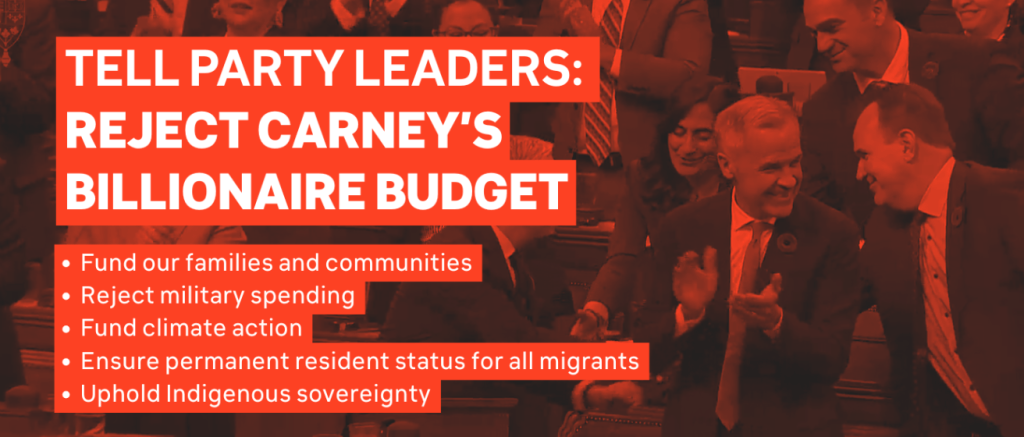
Several Canadian organizations (350.org Canada, World Beyond War, Migrant Rights Network, Council of Canadians, and the Canadian Association of Professional Employees) have come together in a letter-writing campaign to opposition leaders to encourage them to demand change before Parliament votes again on the budget.

Where to now with international development?

I want to share links to some articles that delve more deeply into the significance of what may become a shift away from a model in which rich countries of the Global North “donated” funds to impoverished countries of the Global South. The model has always been criticized as it promotes dependence and blocks systemic change. This is “big picture” stuff, very distant from issues of how to support refugees at border posts or funding for cooperative farming in Central America. (I am, as always, grateful to Brian Murphy for sharing these and other articles. You can follow him on Bluesky @murphyslog.bsky.social.)

First, “The end of the global aid industry,” by Zainab Usman. Usman proposes a focus on industrialization – what has worked for China and South Korea and is unfolding now in Vietnam and Thailand. Usman writes:

Part of the problem with the aid industry is that its benefits have been spread too thinly across a multitude of domains and not focused enough on productivity-enhancing sectors. To this end, advocates of global development should focus on enabling poorer countries to access cheap development financing for targeted investments in sectors that connect people, such as electricity, telecommunications, and mass transit. 

Second, “The geopolitics of international development (after foreign aid),” by Ken Opalo in An Africanist Perspective. Opalo examines a series of essays in Foreign Policy magazine’s Fall 2025 issue that all deal with development issues. Opalo sets his description of the decline of the foreign aid model in the context of a rising multipolarity that is matched by the “ongoing general decline of the authority and influence of Western states.”  

There’s no denying that the financial, intellectual, and institutional hegemony of Western countries significantly shaped development practice over the last 60 years. This era had both good and bad elements. The good elements included efforts to incentivize the modernization of economic management and policymaking in low-income countries (work that’s far from finished, and which has yielded some good results); while the bad elements included the fostering of aid dependence, cyclical faddism, reflexive policy extraversion, lack of elite ambition, and implicit support for a hierarchical world order that permanently placed low-income countries at the bottom of the global totem pole.
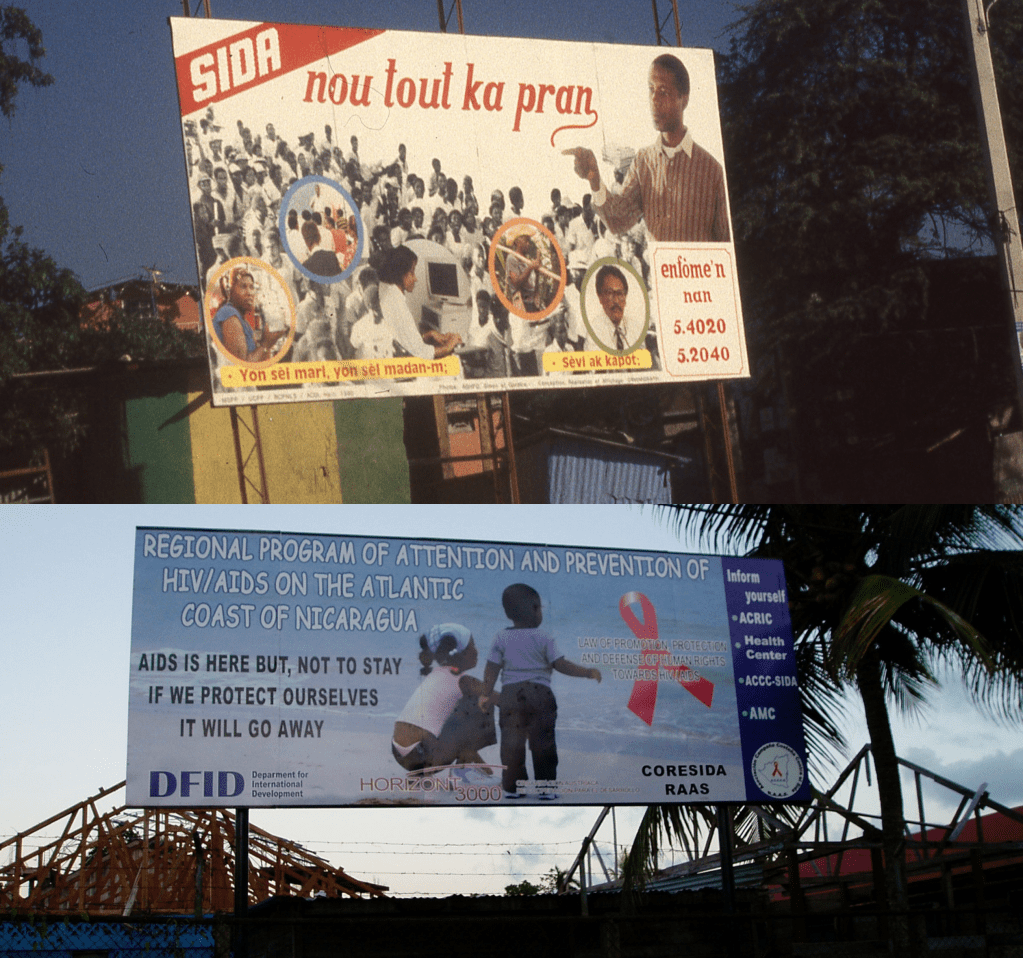
AIDS prevention education in decades past: Haiti in 1984 (top); Atlantic coast of Nicaragua in 2007 (below). Jim Hodgson photos.

Third, “Three ways to help the developing world survive the end of aid,” by Winnie Byanyima, Executive Director of UNAIDS, in The Guardian. Byanyima reminds us that developing countries are still drowning in debt and facing interest rates up to 12 times higher than wealthy countries. “Low- and middle-income countries now pay $4 to the richest in the global north for every $1 they receive in aid. Thirty-four of Africa’s 54 countries spend more on debt than on healthcare.” She adds:

  • Governments must relieve the “chokehold of sovereign debt.”
  • The richest need to pay their fair share: the wealth of billionaires soared by $2 trillion in 2024, but they paid an effective tax rate of just 0.3 per cent.
  • Governments need to treat lifesaving medicines not as commodities, but as global public goods. “This has been one of the great successes of the HIV response” (at least over the past 20 years, though not before—and threatened again with loss of U.S. funding this year).
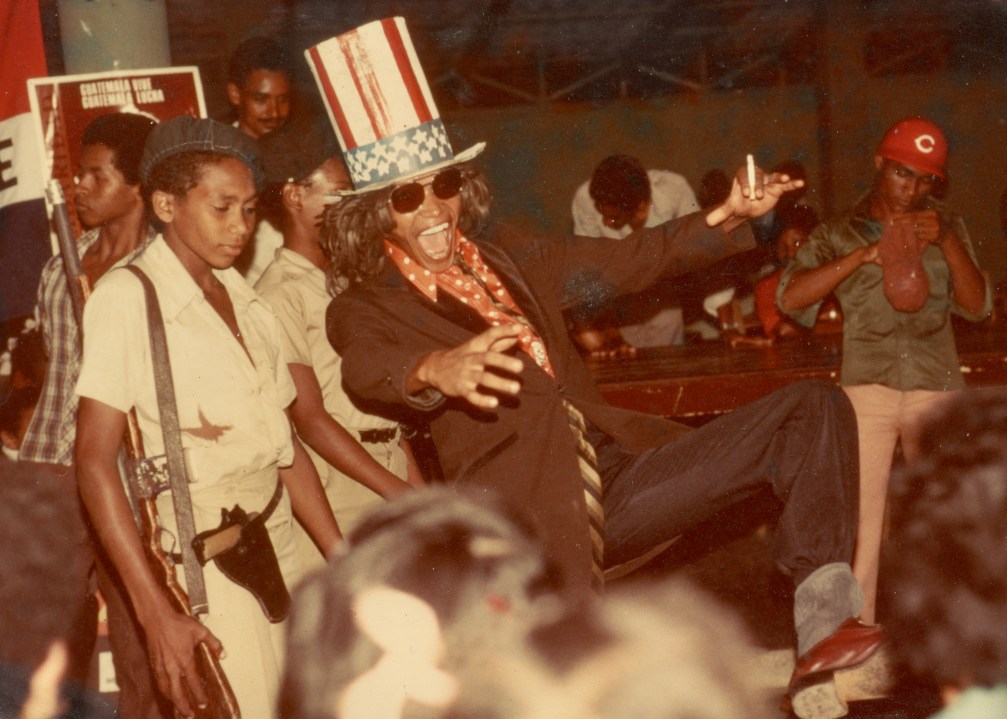
Trump revives “big stick” approach to Latin America

by Jim Hodgson

With all of my passion for justice and in the face of so many gross injustices, I can get paralyzed. And with Trump in power next door, there is always something new to distract us from what went before or from demanding freedom for captives or the release of the #EpsteinFiles.

Just today, he threatened Canada again. #ElbowsUp, still.

Yesterday, it was a plan to end Israel’s war in Gaza that even the New York Times admits “checks every box on Israel’s wish list.” It does nothing to strengthen Palestine or assist recovery after the genocide, and will impose a new, colonial-style authority on the people. 

Let’s step back for a moment.

Last week, I was going to write about Trump’s efforts to rescue his far-right cronies in Argentina and Brazil. Here’s a short version.

Argentina’s president, Javier Milei, faces a collapsing peso and political setbacks. Milei’s chainsaw approach to slashing government was a model for Trump and Elon Musk. U.S. Treasury Secretary Scott Bessent said Sept. 22 that Washington is ready to do “whatever is necessary” – from central bank swaps to direct peso purchases or buying Argentine debt through the Treasury’s Stabilization Fund. The moves are intended to ease political opposition to Milei that has grown as the economy collapses. Milei – already dependent on a $20 billion IMF package – sought U.S. support ahead of congressional elections in October. Investors have been pulling money out from Argentina since Milei’s party lost an election in Buenos Aires province on Sept. 7, provoking worry that he will soon lack legislative support to advance his agenda. 

Front-page of a Buenos Aires newspaper shows Trump managing the rescue plan for Argentina’s Milei. Right: response from Occupy Democrats.

Earlier, Trump imposed a 50% tariff on goods from Brazil, claiming that Brazil engages in unfair trade practices and that the government is engaged in a “witch hunt” against Trump’s ally, former president Jair BolsonaroBolsonaro was convicted earlier this month of attempting a coup after voters dumped him from office. He was sentenced to more than 27 years in prison, sparking Trump’s ire. The present Brazilian government called the U.S. move “a new attempt of undue interference in Brazilian internal affairs.”

When he spoke of the U.S. rescue of Argentina’s Milei, Bessent told reporters that the Trump administration hoped to solidify what it sees as a rightward shift in Latin American countries, including potentially Colombia. (Colombia is now government by a left-centre coalition led by President Gustavo Petro, who cannot succeed himself. His party is currently selecting a new candidate.) 

New and old threats

Bessent’s move came hours before Trump took centre stage at the United Nations General Assembly to press his MAGA-style policies on the rest of the world. 

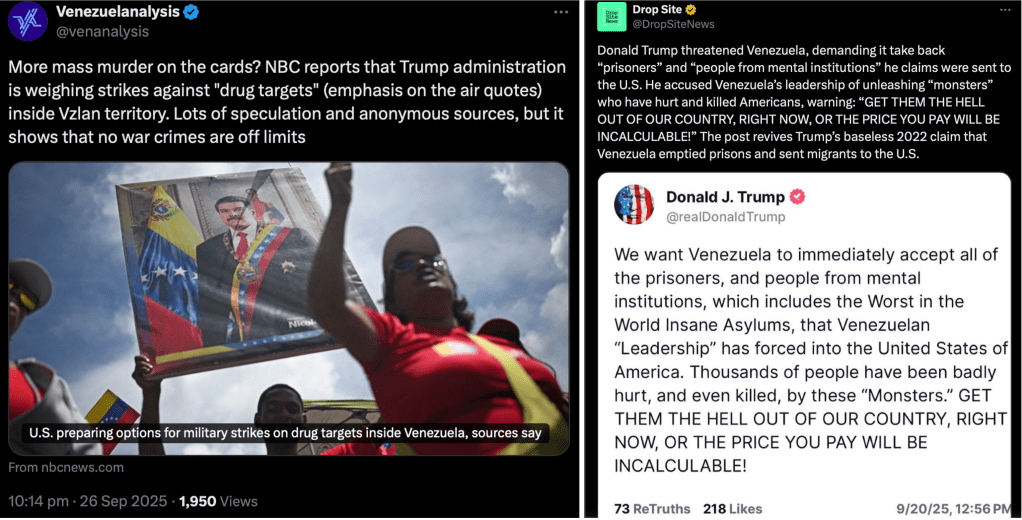
In the speech, Trump threatened to “blow out of existence” Venezuela’s president, Nicolás Maduro. Maduro responded with a plan to declare a state of external unrest to enable rapid mobilization in defence of Venezuela. He had earlier sent a letter to Trump, proposing direct talks. When asked about the letter, White House press secretary Karoline Leavitt, said it was “full of lies” and said the administration still views Maduro as an “illegitimate leader.”

Trump’s threat came after he moved warships into the south Caribbean and after recent attacks on Venezuelan fishing boats (alleged without evidence to be carrying drugs). Trump and his minions seem determined to revive the worst applications of U.S. foreign policy in Latin America, from the 19th-century Monroe Doctrine to Teddy Roosevelt’s “big-stick” diplomacy in the early 20th century.

A recent US government document revealed the Trump administration plans to redirect $1.8 billion in foreign aid toward a new “America First” strategy, Reuters news agency reported Sept. 24. It would give priority to neutralizing “Marxist, anti-American regimes” in Latin America. The report said $400 million would support activities to end illegal immigration to the US, counter China, and “confront the Marxist, anti-American regimes of Venezuela, Cuba and Nicaragua.” The document, known as a Congressional Notification, follows news that the upcoming National Defense Strategy will also pivot the U.S. away from a focus on adversaries like China and Russia to instead prioritize efforts in the Americas.

But not everyone serving Trump is onside with these approaches. On Sept. 29, the Washington Post reported that eight current and former officials have said there is a deep rift between the political appointees at the Pentagon and the military leaders there. Reflecting on the Post report, historian Heather Cox Richardson said that War Secretary Pete Hegseth “is withdrawing forces from Europe, reducing the concentration of power and consolidating commands abroad while focusing on using the military in the U.S. and neighboring countries.

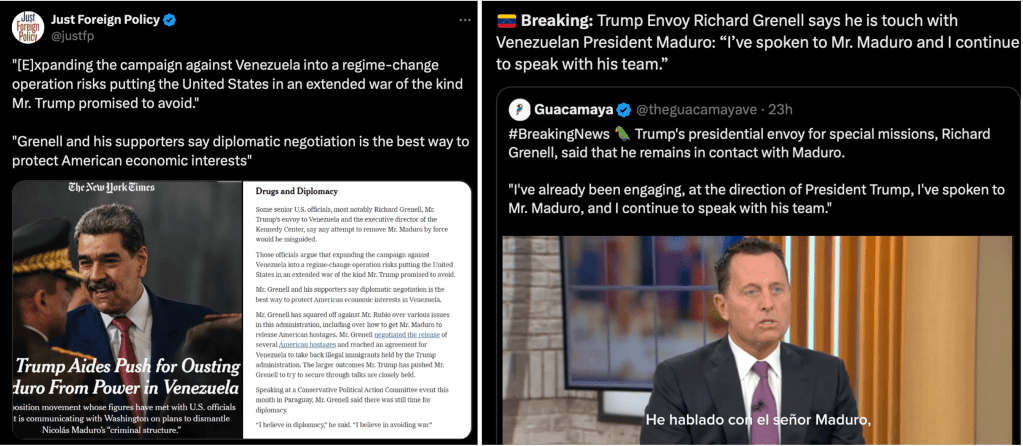
Among Trump administration opponents to use of force to provoke regime change in Venezuela is Richard Grenell, Trump’s special envoy to the country, said Drop Site News on Sept. 29. Grenell has successfully re-opened channels for export of Venezuelan oil to the United States. Grenell and his supporters say diplomatic negotiation is the best way to protect U.S. economic interests. Among those who oppose Grenell is U.S. Secretary of State Marco Rubio. 

Draw The Line for people, for peace, for the planet

Global Days of Action for systemic change on issues of debt, migration and ecology are set for Sept. 19-21. In Canada, several networks are focusing attention on Saturday, Sept. 20 – a National Day of Action.

With rallies, strikes, marches and gatherings, communities will mobilize across the country to demand that Prime Minister Mark Carney and the Canadian government pick a side: injustice, violence, and climate destruction – or a just and safe future for all of us.

For more information and to find an event near you, follow this link. Some of the Canadian organizations involved include the Climate Action Network, Migrant Rights Network and Indigenous Climate Action, among others. 

The campaign in Canada has these demands:

  • Put people over corporate profit. Fund our families and communities. “We refuse to accept poverty while the wealthy hoard billions.”
  • Refuse ongoing colonialism. Uphold Indigenous sovereignty. “Canada continues to enforce colonial violence through Missing and Murdered Indigenous Women, Girls, and Two-Spirit people, mass incarceration, child-welfare systems, the underfunding of services, and destructive development across Indigenous lands. … We refuse colonial violence and demand radical transformation away from capitalist systems, justice for MMIWG2S, the return of land to its rightful titleholders, and funding for Indigenous housing, languages, land-based economies, and Indigenous-led climate solutions.”
  • Stop blaming migrants. Demand full immigration status for all now! “Denied permanent status, migrants who grow food, build communities, and care for the sick face exploitation, wage theft and exclusion from services. Corporate elites scapegoat migrants to hide the real culprits: landlords, grocery monopolies, and bank CEOs profiting off our misery.”
  • End the war machine. Stand for justice and peace. “We demand an immediate two-way arms embargo on Israel, cancelling Canada’s plans to balloon its military budget, and a foreign policy based on diplomacy and peace-building.”
  • End the era of fossil fuels. Protect Mother Earth. “We demand Canada end all fossil fuel subsidies, kick fossil fuel companies and their lobbyists out of politics, make polluters pay, invest in a Youth Climate Corps and publicly-owned East-West electricity grid, and do its fair share globally by cancelling unjust debt and funding climate solutions in the Global South with grants, not loans.”

The global campaign focuses on systemic change

“All over the world, people and communities are fighting for survival, for their rights, for justice in the face of economic turmoil, ecological and climate catastrophes, political instability, vicious attacks on fundamental human rights, militarization, and, in places like Palestine and Sudan, genocide.”

This September, let us carry the following demands:

  • Change the System through an equitable and just transition towards a world that is in harmony with nature and centered on people – communities, workers, women, farmers, fishers, pastoralists, youth, children, indigenous peoples, migrants, refugees, people of color, LGBTQI*, and future generations
  • Phase out fossil fuels – fast, fair, feminist, and forever; Shut down polluters; Build renewable energy systems that work for people and planet; Shift from high-carbon agro-industrial farming to agroecology and sustainable, resilient food systems that prioritize healthy staple food production for domestic consumption and the right to food
  • Fund the future, not the crisis! Tax multinational corporations and billionaires; Cancel the debt; Deliver climate finance; Divest from war, fossil fuels, and harmful projects; Scale up quality public services; Support people and community-led solutions; Finance the transition to resilient, sustainable, and equitable economies. 
  • Reclaim the Commons for sustainable support for life; Respect and uphold the territories of Indigenous Peoples and Traditional Communities; Restore the health of ecosystems; Stop extractivism
  • Defend Human Rights and Reclaim Democracy; End war and genocide; Demilitarise and work for peace based on justice
  • End inequalities across countries and within countries: Democratize global economic and financial governance; Make trade, investments, and tax systems just and fair; Redistribute wealth and power; End colonialism, patriarchy, and racism; Build solidarity across peoples and nations