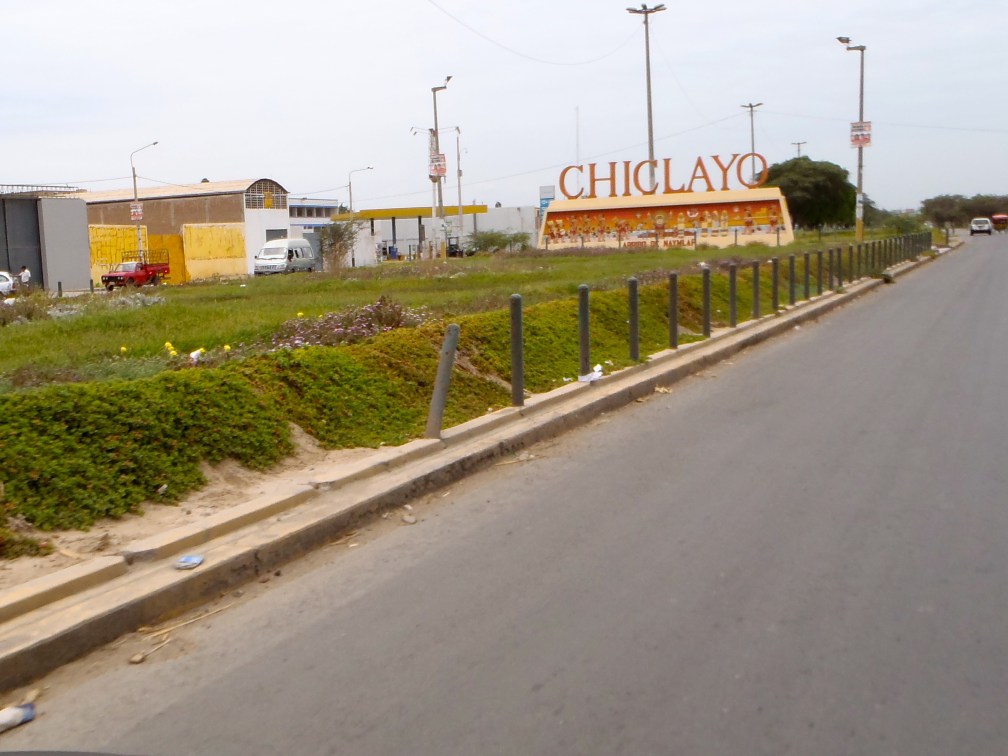
From bishop of Chiclayo to Pope Leo XIV

by Jim Hodgson

Like many who have worked in Latin America, I rejoiced when I saw that cardinal-electors chose Robert Francis Prevost, the former bishop of Chiclayo (Peru) to serve as Pope, the bishop of Rome. 

And as one who believes Catholic social teaching is not studied sufficiently, I was over the moon when I understood that Prevost had chosen to be called Leo XIV. The last Leo was Pope Leo XIII, who served from 1878 to 1903. He is respected as a pioneer of modern Catholic social teaching. In his famous 1891 encyclical Rerum novarum, Pope Leo outlined the rights of workers to a fair wage, safe working conditions, and the formation of trade unions.
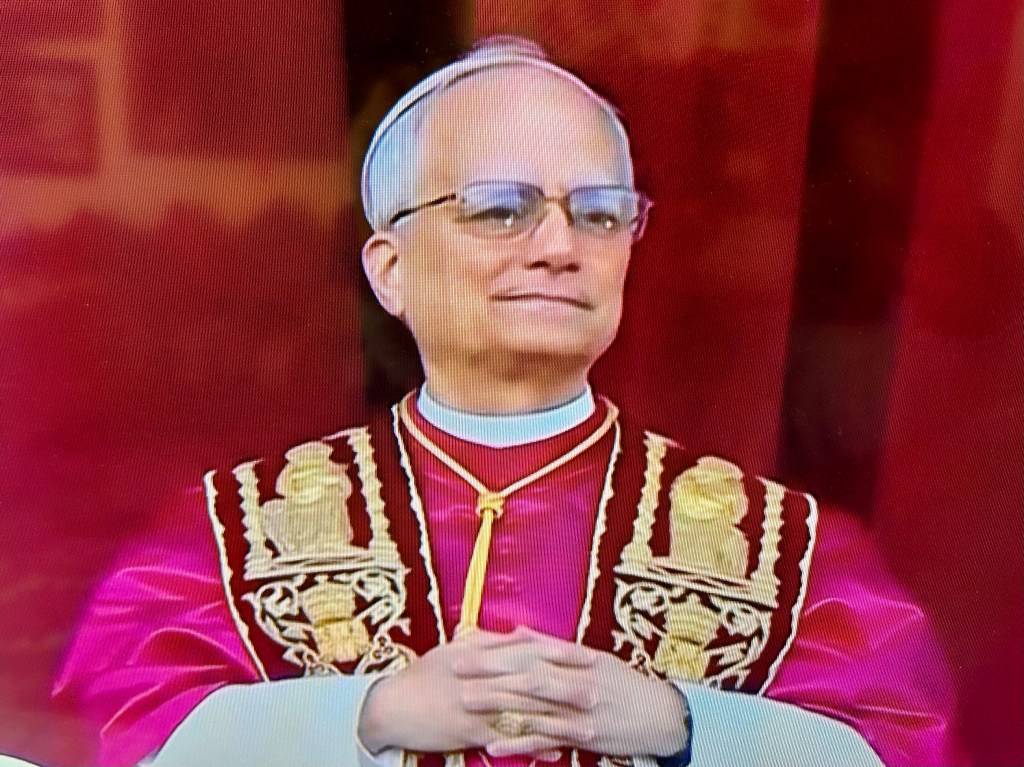
Yes, there are controversies over the selection of Prevost. 

Prevost talked negatively in 2012 about sexual and gender diversity. But in that same year, Archbishop Jorge Bergoglio (a year later Pope Francis) was still in Buenos Aires and fighting legal reforms promoted by the Kirchner-Fernández governments in favour of same-sex marriage. Jesuit Father James Martin, long an ally of LGBTQIA+ people, spoke positively about Prevost after being part of a table group with him during the Vatican’s Synod on Synodality.

There are allegations that Prevost did not pay sufficient attention to victims of clerical sexual harassment while bishop in Chiclayo. Tragically, it is hard to find any bishop, living or dead, who has adequately served survivors of clerical abuse. The real issue is making rules that are effective in making dioceses submit to civil authorities in cases of crime, and to take victims’ allegations seriously in all cases of harassment or abuse. Perhaps his proximity to scandal will help him and others take further steps toward justice for all victims of clerical abuse. 

Much has changed; more needs to change; and Leo XIV may be a step in the right direction. Let’s work toward full inclusion of—and leadership by—women and 2SLGBTQIA+ people.

The church in Chiclayo

Today, I found myself going back through decades of notes. Here is something I wrote during a visit to Chiclayo in 2017:

“Chiclayo has a new bishop who is more in the line of Pope Francis—a positive sign after many years of traditionalist Opus Dei bishops. The new bishop, my friends said, still needs some education around gender justice, but he’s pretty good on economic justice and on developing lay leadership. Social movements here have bloomed outside of the church, including the LGBTIQ and People Living with HIV and AIDS (PLWHA) movements.”

That conversation unfolded with members of Centro Esperanza, a United Church partner from 2006 to 2018. Their work had roots in progressive Christian base communities. It began with a focus on women, particularly those who were involved in community kitchens organized and run by women in impoverished neighbourhoods. Over time, activities expanded to include programs to prevent domestic violence, stimulate learning in early childhood, and gender justice education among high school students.

Several of my Canadian friends have worked in Chiclayo over the decades, beginning with members of the Scarboro Foreign Missionary Society. Their leadership is part of what shaped Chiclayo’s influence on its new bishop.

Catholic Social Teaching

And I went back through my notes on Catholic social teaching. One of the most complete—and still quite short—summaries is a presentation by Bill Ryan, a Canadian Jesuit and social activist. He was a general secretary of the Canadian Conference of Catholic Bishops (CCCB) during part of the time I worked with the Canadian Council of Churches.

In 2000, he spoke to the Coady International Institute at St. Francis Xavier University in Antigonish, Nova Scotia, on the development of Catholic social teaching. Some key points:

What is Catholic Social Teaching? It is a formula or a set of principles for reflection to evaluate the framework of society and to provide criteria for prudential judgment and direction for current policy and action.

  • The inherent human dignity of every person that makes them “sacred”—created in God’s image. This is the ultimate grounding for human rights.
  • The principle of human solidarity. Every person is radically social by nature and by nurture, destined to build up and share human community. The basic element of all creation is interconnectivity, interdependence, and relationships between and among all creatures. Without community we are not human.
  • The principle of subsidiarity. This principle balances the power between the individual and community. It calls for a pluralistic structuring of power in society. That is, human society is more than government; it is the thousands of voluntary and corporate associations that make up civil society. Decisions in society should be taken at the lowest competent level of society.
  • The neediest among us have a special claim on our care and compassion.
  • The common good: the social conditions that allow people to reach their full human potential and to realize their human dignity.
  • And remember that fidelity in relationships extends also to our caring for our “mother” earth.

All of this, it seems to me, is “teaching”—asserting principles, not doctrine.

Ryan said it was untidy, and it is. Church leaders, he said, attempt “to balance the maintenance needs of the church with those of its prophetic mission. What priority should they place on safeguarding unity in the church while preaching the prophetic preferential option for the poor?”

The process, he added, may become even more untidy as more conferences of bishops learn with their people how better to “read the signs of the times” and to “engage Christian communities in believing, preaching and acting on a preferential option for the poor.”

Pope Francis opened a process—“synodality”—for bishops to talk with their people. From his opening remarks, Pope Leo XIV seems determined to keep that door open.

The next morning, the new pope said Christians must offer witness in a world that prefers power, pleasure, and success to faith. Where Christians are “mocked, opposed, despised or at best tolerated and pitied” is where the Catholic Church’s “missionary outreach is most desperately needed,” he said in his first homily as leader of the world’s 1.4 billion Catholics.
Trans women in Mexico say: “They’re killing us”

by Jim Hodgson

In Mexico, the new year began with a series of highly-publicized murders and beatings of Trans women. The violence, sadly, is not rare: Mexico follows only Brazil with the highest numbers of murders of LGBTQIA+ people each year. The fact that they’re being talked about at all is what’s unusual.

Two of the women who were killed were active in party politics. A woman beaten by her fiancé is a well-known social media “influencer,” Paola Suárez. The incidents are reminders of the breach between much-improved legal protection for LGBTQIA+ people in most of Latin America, and the harsh realities of day-to-day life where many men still hold to old ways. More on that below.

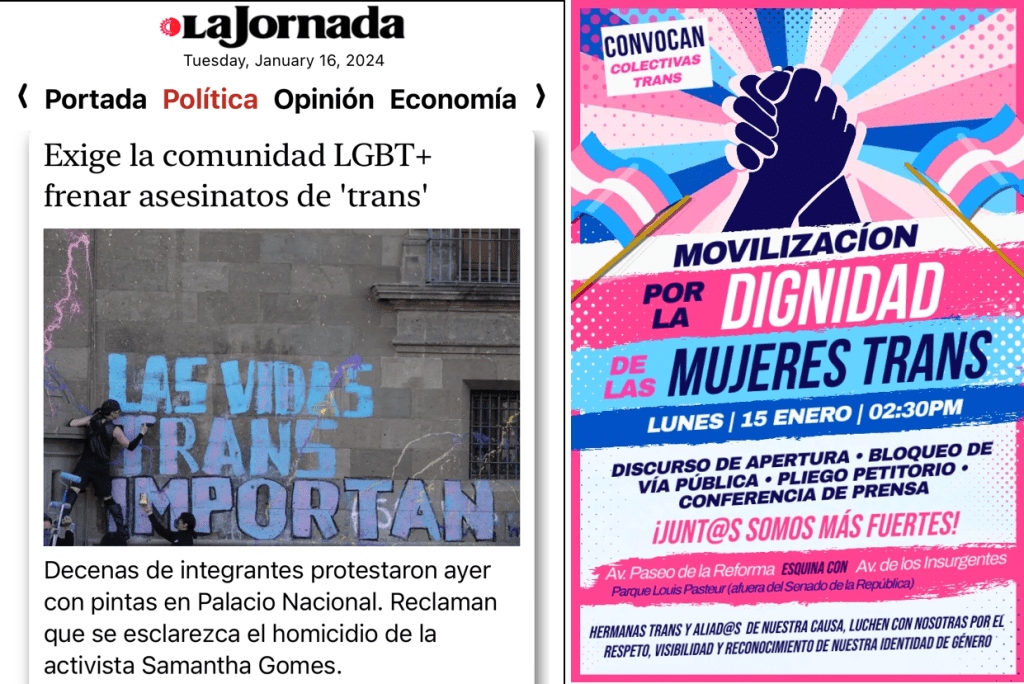
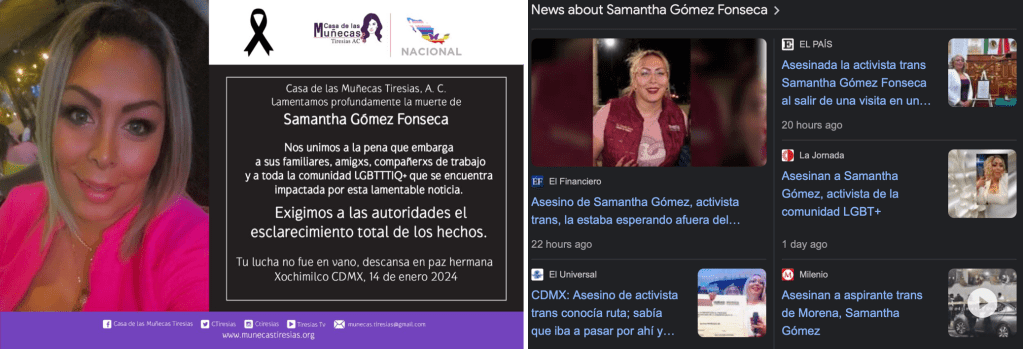
The assassination of Samantha Gómez Fonseca came the day before a planned march by Trans women in Mexico City.

Samantha Gómez Fonseca, 37, had launched a campaign for a seat in the national Senate as a member of the ruling MORENA (Movement for National Regeneration) party. She was shot and killed on Jan. 14 in the street after a prison visit in the Xochimilco area in the south end of Mexico City. 

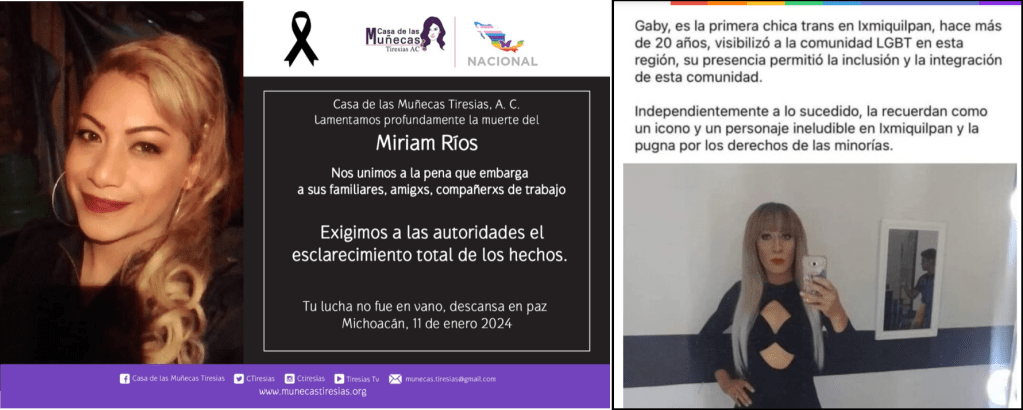
Miriam Noemí Ríos, part of the Citizens’ Movement party (MC) in Michoacan state, was shot and killed Jan. 11 in Zamora, Michoacan. She was a candidate for the municipal council in nearby Jacona. 

Miriam Ríos (left) is remembered in Michoacán state. In Hidalgo, Gaby is remembered as the first Trans woman to come out in Ixmilquilpan more than 20 years ago.

“What is going on in Mexico?” demanded Salma Luévano Lunaa Trans woman who is a member of the national Chamber of Deputies for the MORENA. 

“Why do we have four violent deaths of Trans women already this year? They’re killing us.

“This is what I am talking about when I say that hate speech is the entry point for hate crimes. For this, I demand justice for Samantha and all of my sisters. Enough. Not one more.” 

Luévano had been in the news just days early after President Andrés Manuel López Obrador had referred to her as “a man in a dress.” He apologized a day later, and she accepted the apology, but the incident still rankles among Trans activists. 

The words of the prophets are written on the walls of the National Palace: “Trans Lives Matter.” The graffiti was created during the Jan. 15 Trans mobilization.

Others killed in the first two weeks of the year included Gaby Ortiz, whose body was found beside a rural highway near Ixmiquilpan, Hidalgo. In Coatzalcoalcos, Veracruz, the bodies of Vanessa, a Trans woman and her partner (whose name is not given) were found in their home. The Arcoiris organization points to two more: a Trans woman whose name is not known found shot in the back and dead Jan. 13 in Tlaquepaque, Jalisco, and a person identified as 35-year-old Fabián Kenneth Trejo, who died Jan. 14 in the Álvaro Obregón area of Mexico City. 

“All of the victims, known and unknown, deserve justice,” said the Human Rights Commission of Mexico City in a statement Jan. 15. The commission called on authorities to investigate in ways that take seriously their gender identity and political activities “so that truth be known, leading to sanctions that are necessary for the transformation of the structural conditions that will allow LGBTTTIQA+ populations to live free from violence.”

From 2007 through 2022, a total of 590 Trans people were murdered in Mexico. That’s an average of 53 each year. 

Unfortunately, few violent crimes in Mexico result in criminal charges, especially if the victim is from a marginalised group. In July last year, Ulises Nava, the head of a sexual diversity unit at the University of Guerrero in Chilpancingo was shot and killed while attending a LGBTQIA+ conference in Aguascalientes. In November, Mexico’s first openly non-binary magistrate and prominent activist Ociel Baena was killed; the body of their partner, Dorian Herrera, was found at their side. Police have treated the crime as one of passion. But activists, including Salma Luévano, the member of the Chamber of Deputies cited above, are sceptical

“To be Trans is to transgress the social order,” say the authors of fascinating essay, International Borders and Gender Borders, about the experiences of Central American Trans people among the migrants who are passing northward through Mexico. Trans people, they write, “challenge the heteronormativity of social and religious ways of thinking and being,” with all of their patriarchal norms and values. That system imposes a “binary, heteronormative” set of rules that try to restrict “each person within parameters that dictate gender roles, sexual orientation, and the spaces and tasks that are designated for each biological sex.”

That essay brought to mind two writers whose work is available in English. Neither is Trans, but both helped to shape my own thinking about gender, borders and identities.

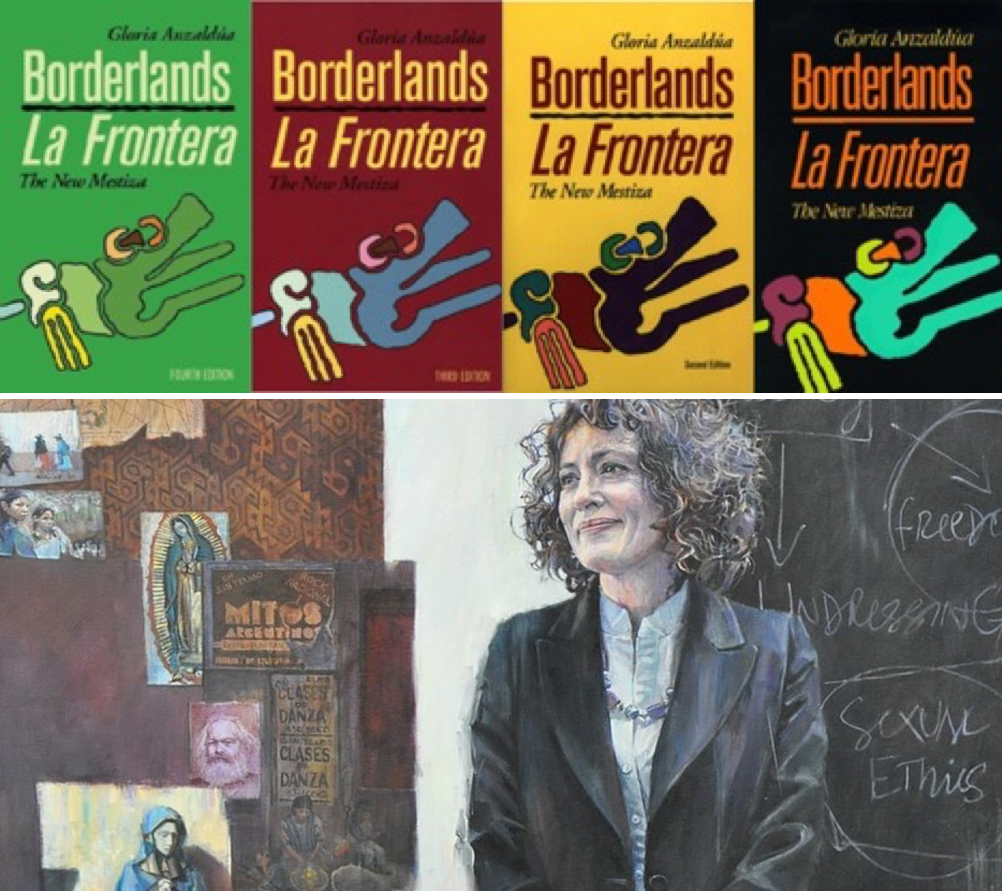
Borderlands (above); a portrait of Marcella Althaus-Reid by Scottish artist David Martin hangs in a classroom at New College School of Divinity at the University of Edinburgh.

When I was living in Cuernavaca in the late 1990s, friends recommended the work of the Chicana lesbian writer Gloria E. Anzaldúa (1942-2004), particularly Borderlands/La Frontera: The New Mestiza (1987). Born in Texas, she lived her life across the U.S. southwest. Some of her gems, retrieved from the internet (as my copy of the book is in Canada and I am in Mexico):

“Culture is made by those in power- men. Males make the rules and laws; women transmit them.”

And:

“This land was Mexican once,

was Indian always, 

and is. 

And will be again.”

I would also suggest reading work by or about Marcella Althaus-Reid (1952-2009), who challenged the foundations of patriarchal Christian theology with her “indecent theology.” A hint: “All theology is sexual theology.” Here’s a good introduction from Kittredge Cherry

Transformation in Mexico: a work in progress

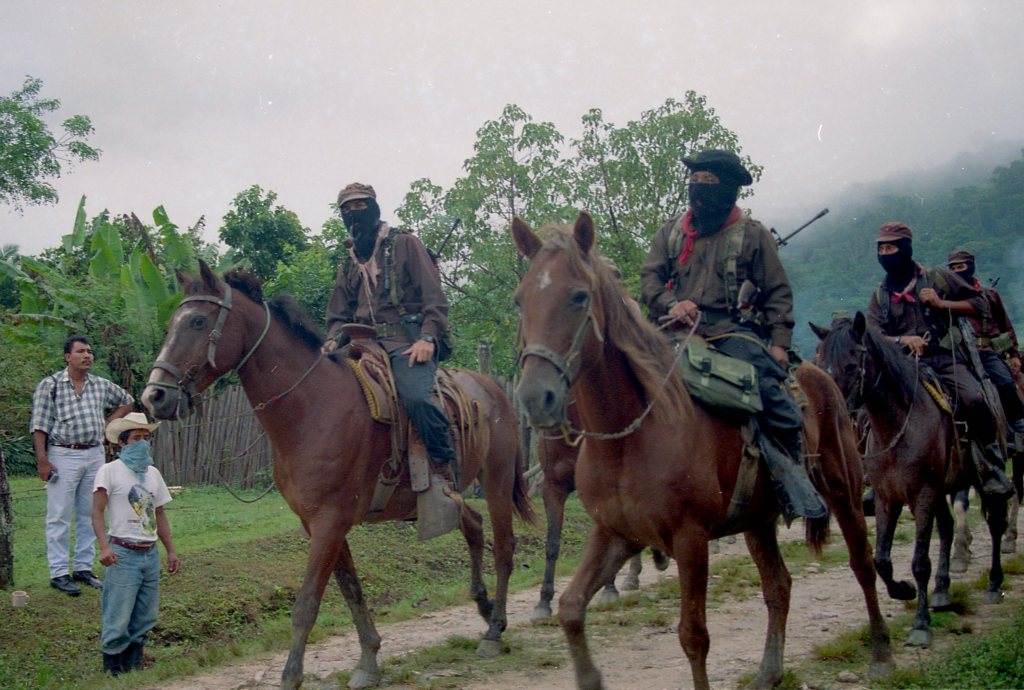
Zapatista leaders: Marcos and Moises in La Realidad, Chiapas, November 1996. Photo: Jim Hodgson

by Jim Hodgson

On Jan. 1, 1994, the same day that the North American Free Trade Agreement (NAFTA) came into effect, the Zapatista Army of National Liberation (EZLN) seized control of several cities in the highlands of Chiapas, Mexico’s southern-most state.

Within a few days, it was clear that the group was Indigenous-led and that it had a charismatic spokesperson in Subcomandante Marcos. The movement also had expectations of social transformation that extended beyond the immediate goal of improving the lot of the Maya people of the Chiapas highlands.

From mountains of southeast Mexico, the Zapatistas put forward a vision of a world where there is respect for diverse ways of being human and of organizing political life, where there might be diverse expressions of truth in the face of supposedly universal truths like the one offered by business elites about the all-powerful “invisible hand” of the free market. They invited us to imagine a world with room for all – “un mundo donde quepan muchos mundos.”

Headlines on Jan. 1, 1994: “Uprising in Chiapas,” “EZLN takes 4 cities in Chiapas”

The Zapatistas pressed for new ways of thinking about power – that leaders should obey their communities – and rejected the hegemony of political parties. The vision had a big impact on those who created the World Social Forum series of encounters that in turn have helped to transform politics in Latin America over the past quarter-century.

Zapatista communities established autonomy from other levels of government, and set about ruling themselves. In the words of a chronicler of social movements in Latin America, Raúl Zibechi, these processes “modify” how people relate to each other as they manage health, education, production, justice, celebrations, sports and art: more mutual, less expert-client, relationships.

Competing posters: Bishop Samuel Ruiz was a man “wanted” for “treason;” EZLN says, “The world that we want is one with room for many worlds.”

“Disorganized crime” and “remilitarization”

Thirty years on, the communities say they have to re-organize themselves in the face of violence between rival drug cartels – “disorganized crime,” the EZLN called them in a recent statement – that now afflicts Indigenous territories near the border with Guatemala and indeed across most of Chiapas. 

Forced displacement, said the Fray Bartolomé de Las Casas Human Rights Centre (known as Frayba), is among the most serious human rights violations in Chiapas today. In a new report launched in July, the San Cristóbal-based group said 16,755 people had been forced from their homes between 2010 and 2022. Frayba attributed the violence to actions by paramilitary groups that have afflicted the state for decades and to the newer criminal gangs, adding that the violence affects the Zapatista communities. At the same time, Frayba describes a “remilitarization” –more soldiers, more bases – in the area. 

Mexico’s Fourth Transformation

In 2018, Mexicans chose their new president, Andrés Manuel López Obrador (AMLO) on the same day as the people of Chiapas elected their new governor, Rutilio Escandón. Their party, the National Regeneration Movement (Morena), promotes a program of change they call the “Fourth Transformation” (4T), the previous three being the war of independence, the mid-19th-century liberal reforms of Benito Juárez, and the Mexican Revolution (1910 to 1917 – or through 1940, if you include the massive land reform led by Lázaro Cárdenas in the mid and late 1930s).  The 4T includes a security component: “abrazos, no balazos” (hugs, not shootings), the idea being to ensure that people have viable economic possibilities so that they do not turn to lives of crime.

More than five years into their respective administrations (and six months before the next elections), reviews are mixed. The old conservative parties loathe AMLO – “socialist!” “Chavista!” A more responsible critique comes from Indigenous people and sectors of the left that reject “neo-developmentalist” approaches that emphasize resource extraction and mega-projects for the sake of job creation – but again mostly benefit the traditional elites. Those criticisms were also levelled at all of the so-called “pink tide” governments that produced some changes over the past 25 years, but did not transform the systems of dependence on the export of natural resources. (This problem afflicts Canada too and in the face of climate change, requires urgent action.)

Despite promises, Mexico’s 4T government has not tried to implement the San Andrés Sakamch’en Agreement that was achieved in negotiations among Indigenous peoples and the government in 1996. Those talks, sparked by the EZLN-led rebellion and moderated by Bishop Samuel Ruiz, marked the first (and only) time that the government has negotiated face-to-face with Indigenous peoples. It was not a comprehensive peace deal, but rather the first step in a planned process to address Indigenous rights in Chiapas and beyond.

On June 2, 2024, voters will elect a new president and a new governor for Chiapas. These will be the sixth since the EZLN uprising. Over the years, the Zapatistas have used a variety of strategies to have an impact on Mexico’s political culture. They won’t be silent in the coming months.