“The narco conquest of Indigenous land is like all the other conquests”

In September 1987, during my first visit to Mexico, I took a train through the Sierra Tarahumara from Chihuahua city to Creel and then along the rim of the spectacular Copper Canyon (left) to Los Mochis on the Pacific coast in Sinaloa state. (Now the same trip is a fancier tourist excursion, the Chepe Express.)

The murders last month in the Sierra Tarahumara of Mexico’s Chihuahua state of two Jesuit priests sparked grief and tension among Indigenous people, the Catholic church and various levels of Mexican government. The priests were Javier Campos Morales, 79, and Joaquín Mora Salazar, 81, known respectively as Gallo and Morita. A third person killed with them, Pedro Heliodoro Palma, was described as a tourist guide. Their bodies were taken by the killers, who were said by police to be linked to the Sinaloa cartel.

Mexican Jesuits recognized “with humility” that in a country with more than 100,000 disappeared people, they were fortunate to recover the bodies of their brothers within 72 hours of their disappearance. “A search that was coordinated among three levels of government reflects intense attention and action are likely not accessible to the immense majority of families whose cases do not gain public attention.”

In the last 30 years, 70 Catholic priests have been murdered in Mexico, including seven during the current presidency of Andrés Manuel López Obrador (known as AMLO). The motives, wrote sociologist Bernardo Barranco in La Jornada, are multiple: theft, kidnapping, extorsion, passion and politics. I would add incidental contact with drug-traffickers who, in this case, seem to have been chasing someone who sought refuge in the church in Cerocahui, municipality of Urique, where the Jesuits have carried out ministry among the Rarámuri Indigenous people in the Sierra Tarahumara. 

In 2006, then-President Felipe Calderón launched a military-led offensive against the drug cartels in an attempt to curb their violent turf wars. Instead, the violence became worse. 

In the town of Creel, in southwest Chihuahua, on Aug. 16, 2008, gunmen opened fire on a group of young people who were participating in a barefoot family race. One of them was carrying his baby in his arms. Some of the youth were related to the town’s mayor but had no link to organized crime. Thirteen people, including the baby, died. 
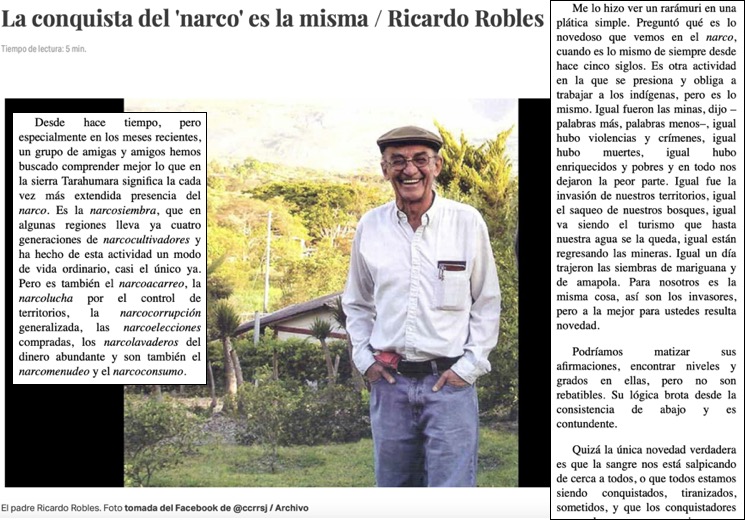
A few weeks later, Jesuit Fr. Ricardo Robles wrote

For a while now, but especially in recent months, a group of friends and I have been trying to better understand the significance of the evermore extended presence of the narco in the Sierra Tarahumara. It’s the narco-planting, that in some areas has seen four generations of narco-cultivators and has made this way of life become ordinary, indeed almost the only lifestyle now. But it is also the narco-transportation, the narco-struggle for control of territories, the generalized narco-corruption, including paid-for narco-elections, the abundant narco-money-launderers and the small narco-traffickers and narco-consumers

What is new in what we are seeing with the narco? A Rarámuri friend said it is the same thing they have seen for five centuries. “It’s another activity in which Indigenous people are pressured and obliged to work. It was the same with the mines,” he said. “There was the same violence and crime, the same deaths, the same enrichment and impoverishment and in everything we were left with the worst part. The same with the invasion of our territories, the same with the theft of our forests, the same with tourism that even takes our water, the same with the return of the mines. The same when one day they brought the planting of marijuana and poppies. For us it’s the same thing. This is how invasions are, but perhaps for you this seems new.”  

Perhaps all that is truly new is that now the blood is spattered on all of us, that we are all being conquered, tyrannized and forced to submit.

The Spanish conquistadores, hungry for gold and other precious minerals, arrived in the Rarámuri territory in 1589. The Jesuit religious order followed in 1608. They were expelled from the Spanish colony and 19th-century Mexico, but returned after 133 years in 1900 with the intention of educating the Indigenous people. La Jornada journalist Luis Hernández Navarro writes that after facing about 40 years of resistance, the Mexican Jesuits finally began to learn from the Rarámuri. By the 1960s, they had set aside their western notions and moved closer to the Rarámuri cosmovision. The Rarámuri converted the Jesuits “from being carriers of a doctrine into disciples, from being do-gooders into friends of the men and women of the Sierra Tarahumara, and companions in their secular resistance and defence of their freedom and autonomy.” Hernández adds that the two Jesuits killed in June had “accompanied the Rarámuri people who were subjects of their own history and not objects for colonization.”

In 2017, one of Hernández’s own La Jornada colleagues, Miroslava Breach, was murdered after documenting the expansion of organized crimes and its links with political institutions in Chihuahua. The image on the right is from the Committee to Protect Journalists. By the end of June, at least 10 journalists had been killed in Mexico this year.

At the funeral June 25 of the slain priests, Fr. Javier Ávila Aguirre, the Jesuit who serves at Creel, called on President López Obrador during his homily to look again at his approach to public security. “Our tone is peaceful but loud and clear. We call for actions from government that end impunity. Thousands of people in pain and without voice clamour for justice in our nation. Hugs are no longer enough to cover the bullets.”

In his daily news conference on June 30, the president responded: “Those expressions of ‘hugs are not enough.’ What would the priests have us do? That we resolve problems with violence? That we disappear everyone? That we bet on war?”

The point, however, made by human rights groups and some religious leaders, is that after nearly four years AMLO’s approach to the drug war has not produced a noticable reduction in violent attacks on civilians – or priests or journalists. While the president says he is working on the “causes of violence” – poverty, marginalization, exclusion – what people want is protection now. 

The issues raised by the Jesuits and human rights groups should not be seen as normal political attacks on an incumbent politician, but rather contributions in a search for real solutions. 

Bernardo Barranco, the sociologist-columnist cited above, told a La Jornada colleague in an interview that churches are present in places where the state is absent, and that they could have a mediating role. He pointed to the state of Guerrero where, for example, Bishop Salvador Rangel of Chilpancingo-Chilapa negotiated in 2018 with organized crime so as to end the assassination of local candidates and to permit the population to vote. 

Such conversations may not lead to solutions in every instance, but it’s clear that new ideas and less defensive dialogue are needed if Mexico is to find a way forward.

And North American narco-consumers need to say NO to illegal drugs, at least for the sake of solidarity with victims of narco-violence.
Option for the Poor: the Life and Witness of Bishop Juan Gerardi

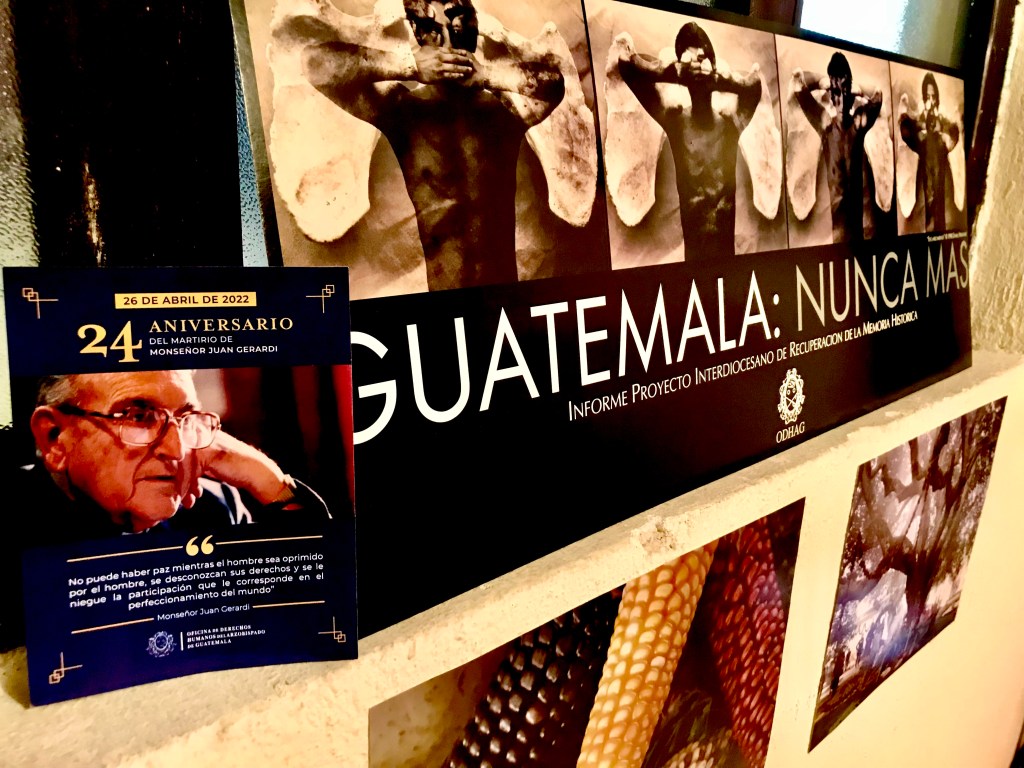
The “Nunca Más” (Never Again) poster has always fascinated me. The images are from the covers of the four volumes of the REMHI report. A young man is shown covering his mouth, his eyes, his ears and then finally shouting. His image is shown superimposed over an unchanging image of a pelvic bone (but it looks like the wings of an angel).

Jim Hodgson

After being away for three years, I have returned to Guatemala to join a small Breaking the Silence team that will be looking into just one of a myriad of land conflicts that continue to afflict this country’s most impoverished people. I’ll write more about that in days and weeks ahead. 

For now, I want to share some thoughts about the life and witness of Bishop Juan José Gerardi Conedera(1922-1998), a man that I never met but whose friends have influenced me for decades.

From deep inside my venerable laptop, I found notes that I prepared on April 24, 2004, the sixth anniversary of his presentation of the report of the Catholic Church’s three-year Recuperation of the Historic Memory (REMHI) project entitled, Guatemala: Nunca Más (Guatemala: Never Again).

Gerardi was born in the Guatemalan capital in 1922. His biography says that at age 12, he “insisted firmly” that he wanted to enter seminary and to become a priest. His ordination came at age 24 in 1946. Over the next 20 years, he served as parish priest in several small communities and thus came to know the lives of Indigenous people and small farmers. 

In 1967, he was named bishop of La Verapaz, a diocese that lacked economic resources but was rich in human resources. He worked with the Indigenous communities and organized courses for catechists, Indigenous pastoral accompaniment, and the movement of Delegates of the Word of God. Together, they organized liturgies in the Kekchi language.

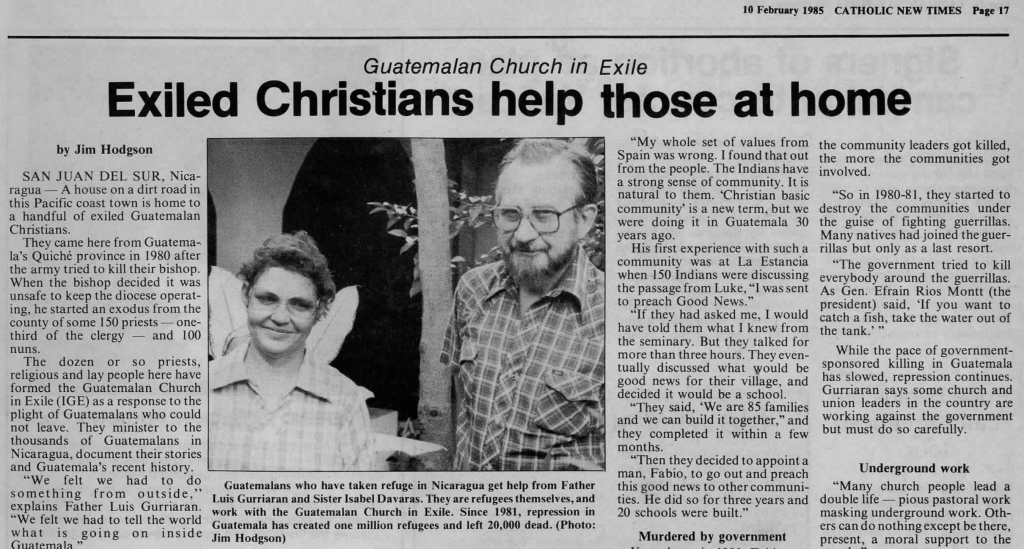
In 1974, he was named bishop of El Quiché, and that trajectory is better known. This was in the time that violence was increasing. In 1980, after the massacre of protesters in the Spanish embassy, military repression increased in all of Quiché. Violence against the priests and other pastoral agents of the diocese was so extreme that the decision was taken to close the work of the diocese. (See the image below of my 1985 article about the Guatemalan Church in Exile.)

Almost two decades later, he would present the REMHI report. After his own time in exile and return to Guatemala in 1982, he was named auxiliary bishop of the archdiocese of Guatemala in 1984, and that is where he worked to create the Office of Human Rights of the archdiocese (ODHAG), and where he began the work of REMHI.

Francisco Goldman’s excellent book (left) has been made into an equally-fine HBO documentary. On April 26, Cardinal Álvaro Ramazzini (white shirt, centre) led the march from the garage where Bishop Gerardi was murdered to the cathedral where he is buried. (Photo: La Hora).

Bishop Gerardi presented the report in the capital city’s Metropolitan Cathedral on April 24, 1998. This was 16 months after the peace accords had been signed, and in that context, the bishop said: 

“Within the pastoral work of the Catholic Church, the REMHI project is a legitimate and painful denunciation that we must listen to with profound respect and a spirit of solidarity. But it is also an announcement. It is an alternative aimed at finding new ways for human beings to live with one another. When we began this project, we were interested in discovering the truth in order to share it. We were interested in reconstructing the history of pain and death, seeing the reasons for it, understanding the why and how. We wanted to show the human drama and to share with others the sorrow and the anguish of the thousands of dead, disappeared and tortured. We wanted to look at the roots of injustice and the absence of values….

“Years of terror and death have displaced and reduced the majority of Guatemala to fear and silence. Truth is the primary word, the serious and mature action that makes it possible for us to break this cycle of death and violence and to open ourselves to a future of hope and light for all…. Peace is possible – a peace that is born from the truth that comes from each one of us and from all of us. It is a painful truth, full of memories of the deep and bloody wounds of this country. It is a liberating and humanizing truth that makes it possible for all men and women to come to terms with themselves and their life stories. It is a truth that challenges each one of us to recognize our individual and collective responsibility and commit ourselves to action so that those abominable acts never happen again.”

While the report does not claim to include all the violations committed during Guatemala’s 36-year civil war, it documents 55,000 violations of human rights. A little over 48 hours after the presentation, Bishop Gerardi was killed. Perhaps more than any other event, this assassination highlighted the fragile state of human rights and the peace process in Guatemala. 

One of those present in the Cathedral for the presentation was the Very Rev. Robert Smith, a former moderator of the United Church of Canada there on behalf of the Inter-Church Committee on Human Rights in Latin America. Bob wrote later about the great bells of the Metropolitan Cathedral ringing that day. He wrote that telling the truth about the genocide is essential to creating a new society: without this, “there can be no possibility of justice, healing or reconciliation.”

“Shockingly,” he added, “no more than five days later the great bells of the Metropolitan Cathedral were ringing again, this time as devastated Guatemalans followed the funeral casket…. Well, they can silence Bishop Juan Gerardi, beloved human rights defender and martyr. But they can’t un-ring the bells that barely a week ago celebrated the truth that some in the shadows of power do not want told. The sound of those bells – arrhythmic and at times discordant – is nonetheless the sound of un-utterable courage and unquenchable hope.”

In 1985, I wrote for Catholic New Times about the Iglesia Guatemalteca en Exilio — the Guatemalan Church in Exile — a group from Quiché that I met in San Juan del Sur, Nicaragua. Repression in the department had become so fierce that the Catholic diocese of Santa Cruz del Quiché (led then by Bishop Gerardi) had closed its churches and withdrawn its personnel. You can find a beautiful profile of Fr. Luis Gurriarán (in the photo above) here (in Spanish).

Fanning the fires of hope in Chiapas, still

There was one time when I was glad to see the riot place arrive: Sunday afternoon, February 19, 1995 in San Cristóbal de Las Casas, Chiapas. 

For more than a week, Maya Indigenous people of the Chiapas highlands had protected their cathedral, the seat of Bishop Samuel Ruiz. On that Sunday afternoon, the feared attack had become real as a larger group of about 400 “auténticos coletos” (denoting descendants of the European settlers in the city) hurled stones: the settlers saw the Indigenous people as interlopers, the ones who had no business in the heart of their city.

The defenders stood three deep in scraggly lines surrounding the cathedral. They held flowers. Men, women and children, old and young, Indigenous and Mestizo, Mexican and foreign, held marigolds, lilies and carnations and wore white ribbons across their chests as they faced the attack. They endured the attack, holding blankets over their heads and trying to duck the stones. The woman next to me whispered prayers and repeatedly blessed the rock-throwers: “God, forgive them.”

The mob tried for more than an hour to storm into the cathedral and the diocesan office next to it. Finally, the riot squad arrived and traced a line between the two groups. The people on the steps cheered; the mob dispersed. In the meantime, at least five people, including two reporters, had been injured. 

For 10 days, ever since Mexican President Ernesto Zedillo pledged to capture the leaders of the rebel Zapatista army (EZLN), the people of this diocese had maintained a vigil around the cathedral and diocesan office. That building also housed the National Mediation Commission (CONAI), chaired by Bishop Ruiz and in session at the time of the attack.

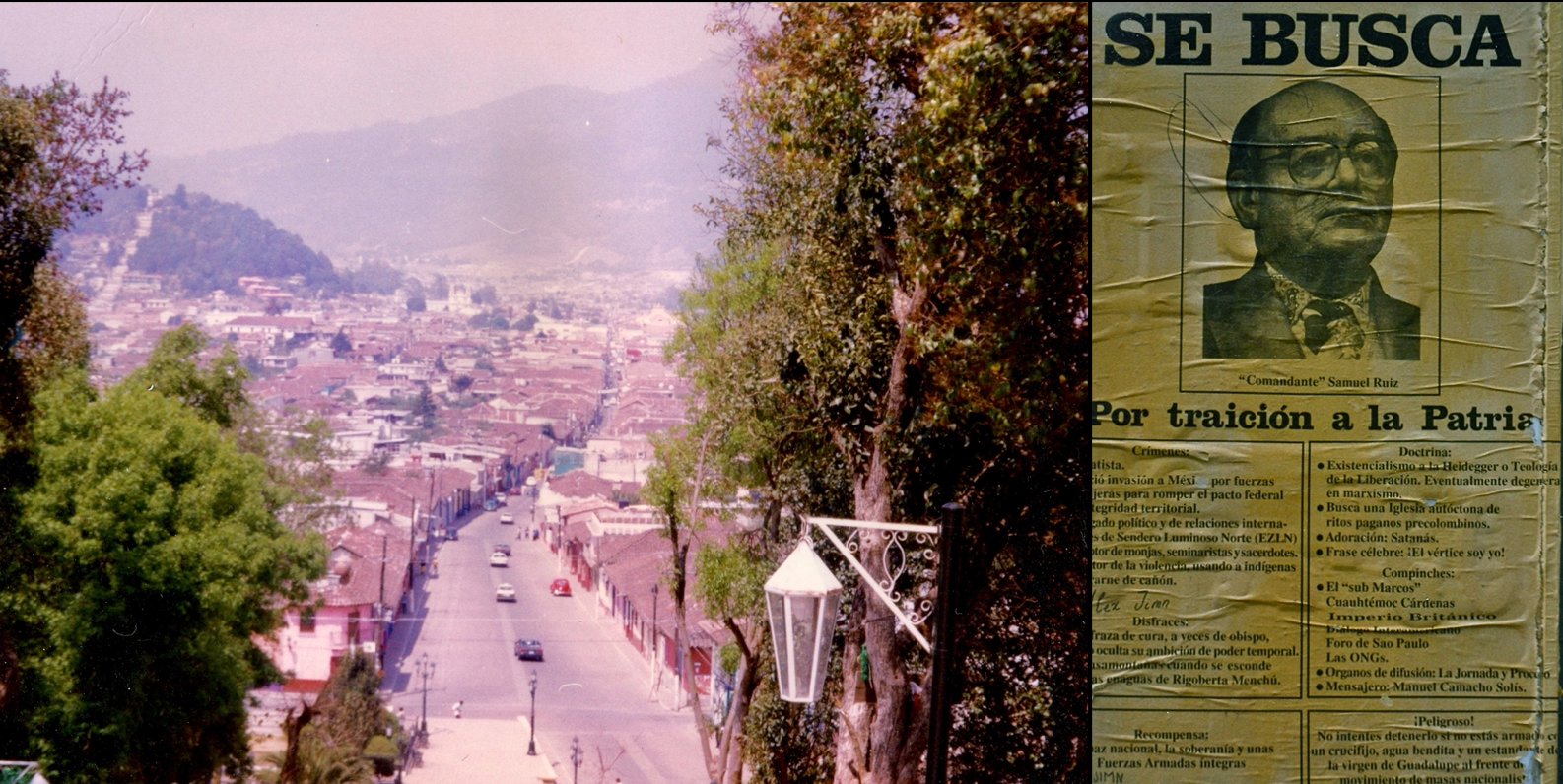
Left: a view of San Cristóbal de Las Casas. Right: a “wanted” poster that describes Bishop Ruiz variously as a traitor, existentialist, liberation theologian and Marxist – typical of the charges laid against him by his opponents over many years.

For more than a year, Ruiz had been at the centre of ecclesial and political controversies over his decades-long advocacy for and with Indigenous and impoverished people in Chiapas and his role as a mediator between the government and the Zapatistas. The EZLN uprising had begun on January 1, 1994, the day that the North America Free Trade Agreement (NAFTA) came into effect.

Zedillo failed to capture Zapatista leaders, but instead arrested people who worked for community development organizations (notably Jorge Santiago of DESMI, Economic and Social Development of Mexican Indigenous Peoples). His army also achieved what it considered to be better strategic positions near the Zapatista communities. 

Over the subsequent year, CONAI’s mediation work continued and bore fruit: on February 16, 1996, the government and EZLN representatives signed an Agreement on Indigenous Culture and Rights in San Andrés Sakamch’en. It was not a comprehensive peace deal, but rather the first step in a planned process to address Indigenous rights in Chiapas and beyond. “It was the first time in Mexican history that the state had sat down with Indigenous people to hear their demands,” wrote La Jornada columnist Magdalena Gómez recently. Later that year, the National Indigenous Congress (CNI) was created and continues its work today.

But from the government side, nothing happened! The first agreement has not been implemented; worse, the government negotiators essentially sabotaged a second round that was to address issues of democracy and justice, leading the EZLN to suspend the dialogue on September 4, 1996. It has not been renewed. The EZLN continues to press its cause in multiple public fora in Mexico and far beyond, and the communities persist in building a fairly successful example of Indigenous autonomy. 

Sadly, even the somewhat more progressive government of Andrés Manuel López Obrador, in power now for more than three years, has failed to move beyond what Gómez called “recycled, low-intensity, neo-Indigenous” policies of individual support and mega-projects without reference to the San Andrés Accords. 

A year ago, the Fray Bartolomé de Las Casas Human Rights Centre in San Cristóbal said the San Andrés Accords persist as a framework and reference for the people of Chiapas. “The people who struggle will continue to fan the fire of hope, and history will give an account of this, because despite the war of extermination, the construction of autonomy gives light and fire to women and men throughout the world.”

Parts of this post are adapted from two of my articles published in Catholic New Times, March 5 and 19, 1995.

“I give you a flower,” says a t-shirt from Yajalón, Chiapas.