Fanning the fires of hope in Chiapas, still

There was one time when I was glad to see the riot place arrive: Sunday afternoon, February 19, 1995 in San Cristóbal de Las Casas, Chiapas. 

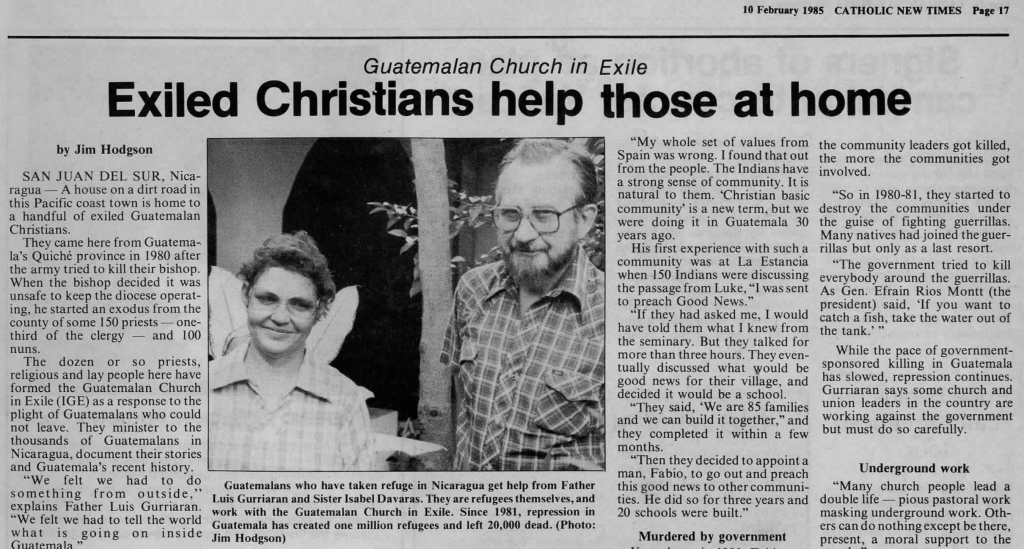
For more than a week, Maya Indigenous people of the Chiapas highlands had protected their cathedral, the seat of Bishop Samuel Ruiz. On that Sunday afternoon, the feared attack had become real as a larger group of about 400 “auténticos coletos” (denoting descendants of the European settlers in the city) hurled stones: the settlers saw the Indigenous people as interlopers, the ones who had no business in the heart of their city.

The defenders stood three deep in scraggly lines surrounding the cathedral. They held flowers. Men, women and children, old and young, Indigenous and Mestizo, Mexican and foreign, held marigolds, lilies and carnations and wore white ribbons across their chests as they faced the attack. They endured the attack, holding blankets over their heads and trying to duck the stones. The woman next to me whispered prayers and repeatedly blessed the rock-throwers: “God, forgive them.”

The mob tried for more than an hour to storm into the cathedral and the diocesan office next to it. Finally, the riot squad arrived and traced a line between the two groups. The people on the steps cheered; the mob dispersed. In the meantime, at least five people, including two reporters, had been injured. 

For 10 days, ever since Mexican President Ernesto Zedillo pledged to capture the leaders of the rebel Zapatista army (EZLN), the people of this diocese had maintained a vigil around the cathedral and diocesan office. That building also housed the National Mediation Commission (CONAI), chaired by Bishop Ruiz and in session at the time of the attack.

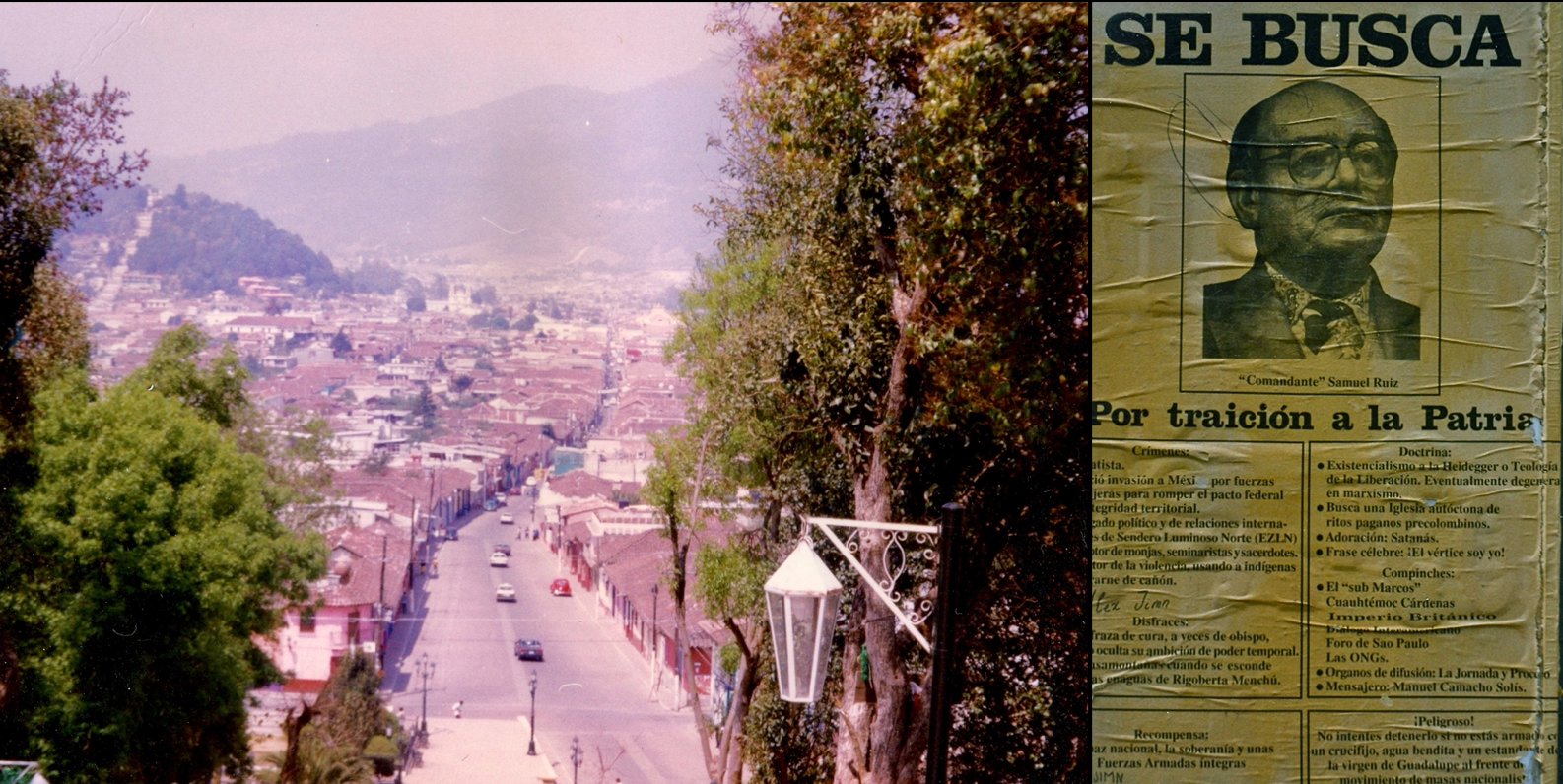
Left: a view of San Cristóbal de Las Casas. Right: a “wanted” poster that describes Bishop Ruiz variously as a traitor, existentialist, liberation theologian and Marxist – typical of the charges laid against him by his opponents over many years.

For more than a year, Ruiz had been at the centre of ecclesial and political controversies over his decades-long advocacy for and with Indigenous and impoverished people in Chiapas and his role as a mediator between the government and the Zapatistas. The EZLN uprising had begun on January 1, 1994, the day that the North America Free Trade Agreement (NAFTA) came into effect.

Zedillo failed to capture Zapatista leaders, but instead arrested people who worked for community development organizations (notably Jorge Santiago of DESMI, Economic and Social Development of Mexican Indigenous Peoples). His army also achieved what it considered to be better strategic positions near the Zapatista communities. 

Over the subsequent year, CONAI’s mediation work continued and bore fruit: on February 16, 1996, the government and EZLN representatives signed an Agreement on Indigenous Culture and Rights in San Andrés Sakamch’en. It was not a comprehensive peace deal, but rather the first step in a planned process to address Indigenous rights in Chiapas and beyond. “It was the first time in Mexican history that the state had sat down with Indigenous people to hear their demands,” wrote La Jornada columnist Magdalena Gómez recently. Later that year, the National Indigenous Congress (CNI) was created and continues its work today.

But from the government side, nothing happened! The first agreement has not been implemented; worse, the government negotiators essentially sabotaged a second round that was to address issues of democracy and justice, leading the EZLN to suspend the dialogue on September 4, 1996. It has not been renewed. The EZLN continues to press its cause in multiple public fora in Mexico and far beyond, and the communities persist in building a fairly successful example of Indigenous autonomy. 

Sadly, even the somewhat more progressive government of Andrés Manuel López Obrador, in power now for more than three years, has failed to move beyond what Gómez called “recycled, low-intensity, neo-Indigenous” policies of individual support and mega-projects without reference to the San Andrés Accords. 

A year ago, the Fray Bartolomé de Las Casas Human Rights Centre in San Cristóbal said the San Andrés Accords persist as a framework and reference for the people of Chiapas. “The people who struggle will continue to fan the fire of hope, and history will give an account of this, because despite the war of extermination, the construction of autonomy gives light and fire to women and men throughout the world.”

Parts of this post are adapted from two of my articles published in Catholic New Times, March 5 and 19, 1995.

“I give you a flower,” says a t-shirt from Yajalón, Chiapas.

Salvadorans remember peace accords, celebrate martyrs, dream of a different possible world

by Jim Hodgson

This is a historic week in El Salvador. January 16 was the 30th anniversary of the Peace Accords that ended the country’s long civil war. And this weekend, four Christian martyrs will be beatified – a step toward sainthood – by the Roman Catholic Church.

The commemorations take place in a political and social context that is not what we hoped for when we watched news coverage showing the government and the rebels sign the accords at the Chapultepec Castle in Mexico City in 1992. The president today, Nayib Bukele, has dismissed the Accords as a “farce.” The country is on the edge of insolvency; Bukele flirts with cryptocurrencies that no-one understands; between 200,000 and 300,000 people leave the country each year.

Sometimes looking at the past can offer some signs for the future, and that’s why the celebration of the lives and witness of the martyrs this weekend matters.

Beatification of the Servants of God, Saturday, Jan. 22. Celebrant is Cardinal Gregorio Rosa Chávez.

Best-know in the group is Father Rutilio Grande, a Jesuit priest who was driving with 15-year-old Nelson Rutilio Lemus and 72-year-old Manuel Solórzano, to the small town of El Paisnal to join the town’s celebration of the feast of St. Joseph when they were gunned down on March 12, 1977, in Aguilares, 33 km north of San Salvador. 

The fourth man celebrated is Father Cosme Spessotto, an Italian missionary priest of a Franciscan order who had served in El Salvador since 1950, and was murdered on June 14, 1980, as he prepared to celebrate an evening Mass in his parish church in San Juan Nonualco, La Paz department. Like other church leaders, including Saint Oscar Romero (the archbishop of San Salvador, slain March 24, 1980), he had denounced the crimes of the military junta in the 1970s including the murder of Fr. Rutilio, thus drawing threats against his own life.

Fr. Rutilio’s death came as El Salvador’s civil war was beginning. Over the next dozen years, at least 75,000 people were killed; about 8,000 more were made to disappear; a million people fled. In 1993, the United Nations Truth Commission report attributed at least 85 per cent of the killings to government security forces and related paramilitary death squads. 

Salvadorans recognize many martyrs, among them the four U.S. church women who were killed near the San Salvador airport in December 1980, and the six Jesuit priests, their housekeeper and her daughter who were killed in November 1989 at their home in the University of Central America (remembered in the photo above). May they all be recognized soon too! As James T. Keane wrote in America magazine this week, “We need more dangerous saints.” Photo: Jim Hodgson (2019).

It’s important to remember what the martyrs represent: a persistent witness to life as experienced by people long oppressed, marginalized, landless, impoverished, unemployed, violated on a daily basis. Their sacrifice amplifies the cry of the poor, and I believe influenced the negotiations that produced the Peace Accords in 1992.

The Peace Accords brought about a new legal regime in El Salvador. One of the negotiators for the Farabundo Martí Liberation Movement (FMLN) at Chapultepec was Nidia Díaz, who spoke recently with Jacobin magazine:

“All those laws that oversee the new institutions that are the product of the peace accords were made in COPAZ, the National Peace Commission. They weren’t a whim. In COPAZ, you had the FMLN and the government as parties, and, as observers, the Catholic Church and the UN and the parties that were in the legislature at that moment. All the laws — the law for the National Civil Police, the army, the Supreme Electoral Tribunal, the Human Rights Ombudsman, etc. — were made in COPAZ and sent to Congress. There was a debate process. 

“Now Bukele comes along and says, ‘I don’t agree with these responsibilities and powers,’ and he tries to annul the laws and the constitution. He’s dismantling the democratic process that permitted his very election.”

Rev. Miguel Tomás Castro speaks at a Romero memorial event, March 24, 2009. Photo: Jim Hodgson

Another prominent defender of the peace accords is Rev. Miguel Tomás Castro of Emmanuel Baptist Church (known by its Spanish acronym, IBE). Speaking with the newspaper Diario Co Latino this week, he said:

“There is a lot of criticism of the Peace Accords and an attempt to diminish their value. I think we have to commemorate them, and why not celebrate that the Accords put an end to the armed confrontation? Of course there are various sectors, particularly in the city of San Salvador, and perhaps in other cities where people did not live the intensity of the war as it occurred in other parts of the country. We saw so many people suffer, our brothers and sisters in those communities, places where the war was very harsh and caused greater damage: those people celebrated the end of the war with much joy. And that cannot be hidden.

“And there’s more than one reason that it is important to commemorate and to give thanks to God for the end of the armed confrontations: it’s to say to our sons and daughters that we do not believe in hatred or in confrontation. The Peace Accords give a place for us to say to our younger generations that we want peace, a peace that reaches everyone and a peace that is the hand of justice.”

He was asked what his message would be on this 30th anniversary of the Accords:

“We say that there are two things that we have not been able to accomplish since the Peace Accords. As churches, really there are two themes: on truth, because we have not been able to close the chapter on the Accords without knowing the facts behind the conflict. That’s important; the United Nations recognized it. The second is reconciliation, because you can’t talk about Peace Accords without reconciliation. The church in that has a great responsibility, but it is also an ethical, more and spiritual debt with our people.

“Supposedly we were to go towards reconciliation, but there was an agenda of priorities and the theme of reconstruction was in first place, when reconciliation should have been the principal theme. Apart from whether we lived a conflict or no, the call of God is to see each other as sisters and brother, to build a spirit of family nation, where everyone of us makes an effort so that all of us have lives of dignity. It’s humiliating that every day people leave because there are no conditions here for that life. Something is going wrong.”

The model of reconstruction imposed after 1992 resulted in shopping malls and fast-food restaurants, not sustainable and participatory development or comprehensive land reform.

Even in the face of the current crises in Central America – violence, migration, the impacts of climate change – what gets proposed derives from tired models from the past. Social movements have a different vision.

In the United Church’s Mandate magazine (summer 2020), I reported on a conversation with Miguel Tomás and youth peace-makers in his church:

What is to be done? Tolstoy, Lenin, John the Baptist and recent elections

Xiomara Castro, president-elect in Honduras. Right: “Long live the People in Resistance” – post coup graffiti.

Soon after my return to Canada from my first visit to the Dominican Republic in 1983, I saw Peter Weir’s brilliant film, In a Year of Living Dangerously. As a socialist option in Indonesia collapses through local intrigue and U.S. intervention, Linda Hunt’s character, Billy Kwan, asks obsessively: “What is to be done?”

In the wake of my encounters with Haitian cane-cutters and Dominican and Haitian activists, it became my question too.

Billy Kwan’s question alludes to Lenin’s 1902 manifesto that called for a new vanguard organization that would be dedicated to taking power. Lenin took his title from two earlier works by Russian authors. In 1863, Nicholas Chernyshevsky issued a manifesto that imagined a new social order. Twenty years later, Leo Tolstoy took the same title to offer a vision of the renewal of individual moral responsibility.

But the question actually comes from the Bible. In Luke 3:10—part of the lectionary readings in many churches this Sunday, Dec. 5, the second Sunday of Advent—the people ask John the Baptist: “What are we to do?” And John answered, “If you have two coats, give one to the person who has none; and if you have food, do the same.” 

Later, in Luke 12:16-21, the question appears in Jesus’ story about the rich fool: “There was a rich man and his land had produced a good harvest. He thought: ‘What shall I do? For I am short of room to store my harvest.’So this is what he planned: ‘I will pull down my barns and build bigger ones to store all this grain, which is my wealth. Then I may say to myself: My friend, you have a lot of good things put by for many years. Rest, eat, drink and enjoy yourself.’ But God said to him: ‘You fool! This very night your life will be taken from you; tell me who shall get all you have put aside?’ This is the lot of the one who stores up riches instead of amassing for God.”

Life is too short for the poor to wait for wealth to trickle across the greatest breach between rich and poor that this planet has ever known. While some of us in the North think we have the luxury of sitting back to see how things go—except that climate change seems to have finally got our attention—the impoverished must always take risks and try something new.

Since the election of Salvador Allende in Chile in 1970 and despite the coup led by Gen. Augusto Pinochet three years later, the left in power in Latin America has tried to govern according to the rules of liberal democracy, arguably without sufficient regard for the roles of money, foreign interference and private media companies.

Confronted by poverty, after “lost decades” of development, social movements in Latin America began to develop alternative policy approaches in the 1990s. Smart politicians paid attention and in one country after another—imperfectly, with lots of mistakes—the “formal democracies” of old began to be transformed.

That “pink wave” did not last. A military coups in Honduras and Bolivia, parliamentary coups (or “lawfare”) in Paraguay and Brazil, devastating impacts of U.S.-led (backed by Canada) sanctions in Venezuela, the power of money in Ecuador and petty corruption all weakened the drive for lasting change.

Left and centre: Chile’s election pits Gabriel Boric against José Antonio Kast. Right: the party of Nicolás Maduro won most regional elections in Venezuela. (Images from Página 12, Argentina)

A second progressive wave?

In October 2020, voters in Bolivia restored the “Movement for Socialism” (MAS) party to power just a year after the coup. In June, voters in Peru elected a rural teacher, Pedro Castillo, to be their president. In November, Venezuela’s ruling PSUV party won almost all state-governor races. Later in November, voters in Honduras chose Xiomara Castro, whose husband Mel Zelaya had been overthrown in a coup backed by the United States and Canada in 2009, to be their new president. 

The next test comes in Chile on Dec. 19, when a Pinochet-loyalist, José Antonio Kast, faces a centre-left candidate, Gabriel Boric, in a second-round run-off vote.

No country is the same as another, and specific issues pertain to each of the elections noted above. But the big loser in most of these votes is the United States, together with ever more deferential Canada. Latin Americans are again choosing leaders who do not have the interests of the United States at heart.