What is to be done? Tolstoy, Lenin, John the Baptist and recent elections

Xiomara Castro, president-elect in Honduras. Right: “Long live the People in Resistance” – post coup graffiti.

Soon after my return to Canada from my first visit to the Dominican Republic in 1983, I saw Peter Weir’s brilliant film, In a Year of Living Dangerously. As a socialist option in Indonesia collapses through local intrigue and U.S. intervention, Linda Hunt’s character, Billy Kwan, asks obsessively: “What is to be done?”

In the wake of my encounters with Haitian cane-cutters and Dominican and Haitian activists, it became my question too.

Billy Kwan’s question alludes to Lenin’s 1902 manifesto that called for a new vanguard organization that would be dedicated to taking power. Lenin took his title from two earlier works by Russian authors. In 1863, Nicholas Chernyshevsky issued a manifesto that imagined a new social order. Twenty years later, Leo Tolstoy took the same title to offer a vision of the renewal of individual moral responsibility.

But the question actually comes from the Bible. In Luke 3:10—part of the lectionary readings in many churches this Sunday, Dec. 5, the second Sunday of Advent—the people ask John the Baptist: “What are we to do?” And John answered, “If you have two coats, give one to the person who has none; and if you have food, do the same.” 

Later, in Luke 12:16-21, the question appears in Jesus’ story about the rich fool: “There was a rich man and his land had produced a good harvest. He thought: ‘What shall I do? For I am short of room to store my harvest.’So this is what he planned: ‘I will pull down my barns and build bigger ones to store all this grain, which is my wealth. Then I may say to myself: My friend, you have a lot of good things put by for many years. Rest, eat, drink and enjoy yourself.’ But God said to him: ‘You fool! This very night your life will be taken from you; tell me who shall get all you have put aside?’ This is the lot of the one who stores up riches instead of amassing for God.”

Life is too short for the poor to wait for wealth to trickle across the greatest breach between rich and poor that this planet has ever known. While some of us in the North think we have the luxury of sitting back to see how things go—except that climate change seems to have finally got our attention—the impoverished must always take risks and try something new.

Since the election of Salvador Allende in Chile in 1970 and despite the coup led by Gen. Augusto Pinochet three years later, the left in power in Latin America has tried to govern according to the rules of liberal democracy, arguably without sufficient regard for the roles of money, foreign interference and private media companies.

Confronted by poverty, after “lost decades” of development, social movements in Latin America began to develop alternative policy approaches in the 1990s. Smart politicians paid attention and in one country after another—imperfectly, with lots of mistakes—the “formal democracies” of old began to be transformed.

That “pink wave” did not last. A military coups in Honduras and Bolivia, parliamentary coups (or “lawfare”) in Paraguay and Brazil, devastating impacts of U.S.-led (backed by Canada) sanctions in Venezuela, the power of money in Ecuador and petty corruption all weakened the drive for lasting change.

Left and centre: Chile’s election pits Gabriel Boric against José Antonio Kast. Right: the party of Nicolás Maduro won most regional elections in Venezuela. (Images from Página 12, Argentina)

A second progressive wave?

In October 2020, voters in Bolivia restored the “Movement for Socialism” (MAS) party to power just a year after the coup. In June, voters in Peru elected a rural teacher, Pedro Castillo, to be their president. In November, Venezuela’s ruling PSUV party won almost all state-governor races. Later in November, voters in Honduras chose Xiomara Castro, whose husband Mel Zelaya had been overthrown in a coup backed by the United States and Canada in 2009, to be their new president. 

The next test comes in Chile on Dec. 19, when a Pinochet-loyalist, José Antonio Kast, faces a centre-left candidate, Gabriel Boric, in a second-round run-off vote.

No country is the same as another, and specific issues pertain to each of the elections noted above. But the big loser in most of these votes is the United States, together with ever more deferential Canada. Latin Americans are again choosing leaders who do not have the interests of the United States at heart. 

Fifty years of A Theology of Liberation

Jim Hodgson

My background is in journalism (not theology), but I made a sort of career at the intersections of journalism, religion and Latin America. I have been close to conversations about and actions deriving from liberation theology for about 40 years. I am a follower of Jesus formed in liberation theologies that I learned alongside sugar-cane cutters, Indigenous communities, queer and trans people—folks who struggle for liberation the world over. Theirs are the stories I try to share.

Liberation theology is a method of doing theology, not a topic, Elsa Támez has said. It begins with a situation of repression and God’s call to transform that situation. Theology then is a reflection on God’s action in history. In the mid-1980s, however, Pope John Paul II and his head of the Congregation for the Doctrine of the Faith, Cardinal Joseph Ratzinger (later Pope Benedict XVI), made liberation theology a topic of heated debate. As a young journalist, I covered that debate (see the items at the bottom of this post), but over time, I concentrated more on the stories of the people who worked for change.

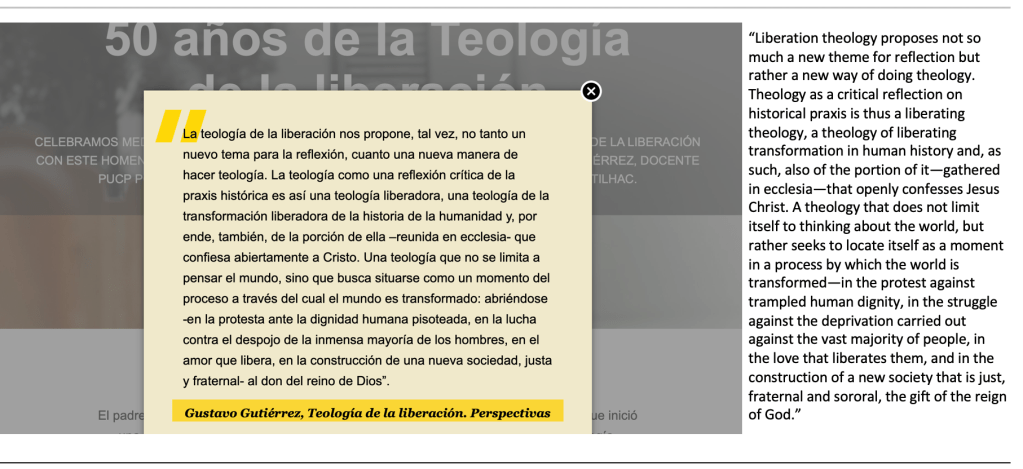
This year, we celebrate the publication 50 years ago of Teología de la Liberación, Perspectivas, the book that brought together a series of reflections on the practice of ministry, or the praxis of liberation, among the impoverished people of Latin America. The English translation, A Theology of Liberation (Orbis), appeared two years later. His second chapter is a critique of what was wrong with development in Latin America in the 1960s that remains valid today.

Image from the tribute to Gutiérrez on the website of the Pontificia Universidad Católica del Perú (PUCP).

The book’s author, the Peruvian priest Gustavo Gutiérrez, had been sharing his perspectives in conferences since the mid-60s, including in the summer of 1967 at the Faculty of Theology at the Université de Montréal.

He was never alone in those reflections, and others were working in similar or parallel veins. The African-American theologian James H. Cone published A Black Theology of Liberation in 1970 (Orbis). In Cuba during the 1960s, Sergio Arce developed a “theology in revolution,” which was about God in human history, especially in the revolution against poverty, exclusion and imperialism. In the 1960s and 70s, priests and other people of faith organized in new ways: Priests for the Third World in Argentina, the National Organization for Social Integration (ONIS) in Peru, the Golcanda group in Colombia, Christians for Socialism in Chile during the time of Salvador Allende.

Other contextual theologies emerged—Indigenous, feminist, womanist, queer, Minjung in South Korea—along with a wide spectrum of criticism, much of it helpful in adding “new subjects” that Gutiérrez had overlooked. But sometimes, the criticism was led directly to the persecution of the “church of the poor” and to countless murders and other violations of human rights. After the assassination in San Salvador in 1989 of six Jesuit priests, their housekeeper and her daughter, proponents of liberation theology spoke instead of Latin American theology, a situation that persisted until the election of Pope Francis in 2013.

From top left: Enrique Dussel, Elsa Támez, Frei Betto and Leonardo Boff. 
Bottom left: Chung Hyun Kyung, Miguel Concha. 
Dussel, born in Argentina and living in Mexico, is a philosopher and historian. Támez, born in Mexico, works with the Latin American Biblical University in Costa Rica and with Indigenus biblical translators. Frei Betto is best known for exploring political implications of liberation theology, and Boff is a leading proponent of ecological perspectives in theology: they are shown during a presentation at the first World Forum on Theology and Liberation, held in days ahead of the World Social Forum in Porto Alegre in January 2005.
In ecumenical circles, Chung is remembered for sparking good debate over Christian relations with other religions during and after the Canberra Assembly of the World Council of Churches in 1993. Concha is shown during a news conference by social movements during Pope John Paul II’s visit to Mexico City in 1999. Jim Hodgson photos.

Miguel Concha, a Mexican priest of the Dominican religious order and columnist at La Jornada, wrote on the occasion of the 40th anniversary of first publication of Gutiérrez’s book:

“Liberation theology is not limited to helping the poor individually. Nor is it reformist, trying to improve a situation but leaving intact the types of social relations and basic structures of an unjust society. Beyond moving ethically in the face of collective misery, it considers impoverished people to be subjects of their own liberation, valuing in them their awareness of their rights and capacity for resistance, organization and transformation of their situation.”

In these 50 years, I think the formal presentation of Gutiérrez’s method has become melded in our imaginations with other processes: 

  • the outcomes of the II Vatican Council and several meetings of Latin American bishops (CELAM), especially the articulation of the church’s “preferential option for the poor” at the CELAM conferences in Medellín in 1968 and in Puebla in 1979; 
  • the pastoral action of certain church leaders (Sergio Mendes Arceo, Hélder Câmara, Oscar Romero, Samuel Ruíz, the Argentinean Methodist Federico Pagura, among many others), whether they identified explicitly with liberation theology or not; 
  • a mix of popular education and base Christian community experiences; and the political action of movements like the Sandinista Front In Nicaragua in the 70s and 80s, or that which propelled Jean-Bertrand Aristide to the presidency of Haiti in 1990 and again in 2000.

During the last week of October, Fr. Gustavo, now 93 years of age, joined with scores of scholars and faithful for an online seminar to mark the anniversary. Videos of the presentations can be viewed (in Spanish) on the Facebook site of the Instituto Bartolomé de Las Casas.

I am appending here below parts of some to the articles I wrote in the mid-80s about the debates over liberation theology.

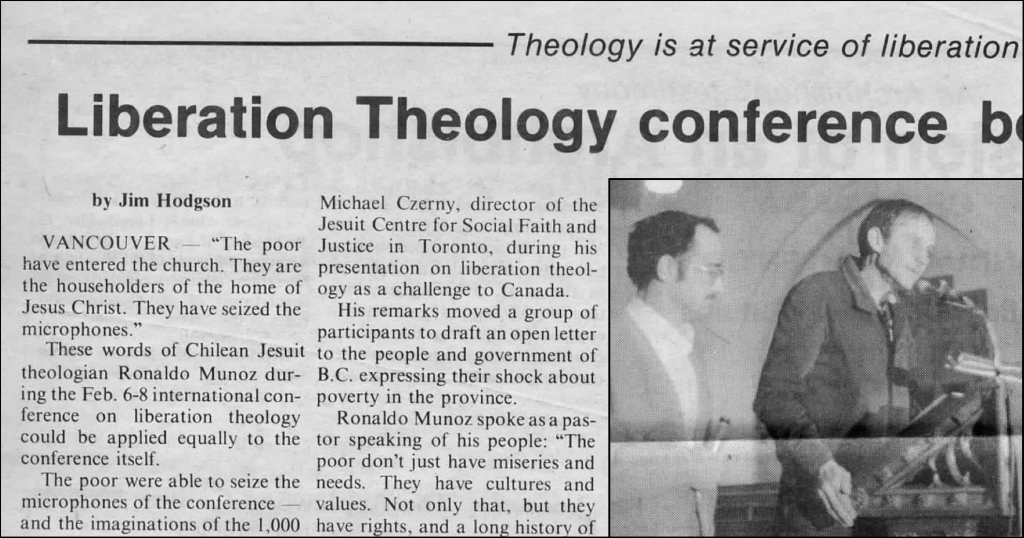
A thousand people attended a conference on liberation theology held at Simon Fraser University in February 1986. Among the speakers were Jesuit Fr. Michael Czerny (now a cardinal of the Roman Catholic Church) and Fr. Ronaldo Muñoz (not a Jesuit, but rather a priest of the Sacred Heart in Chile, who died in 2009). Muñoz said: “Liberation theology is telling of our experience of God in the context of our commitment to the struggle of the people: God in history, God in the Bible, in Jesus, in those who have been humiliated. The theologies of theologians, books, speeches, conferences in Vancouver, are in second place. Liberation theology seeks to be at the service of this struggle, this history of faith.”

Hélder Câmara (1909–1999) was the archbishop of Olinda and Recife, serving from 1964 to 1985. At the invitation of Youth Corps, a ministry of the archdiocese of Toronto, he participated events – “Circus of the Heart” and “Stories of the Heart” – in Toronto in 1985 and 1986. 
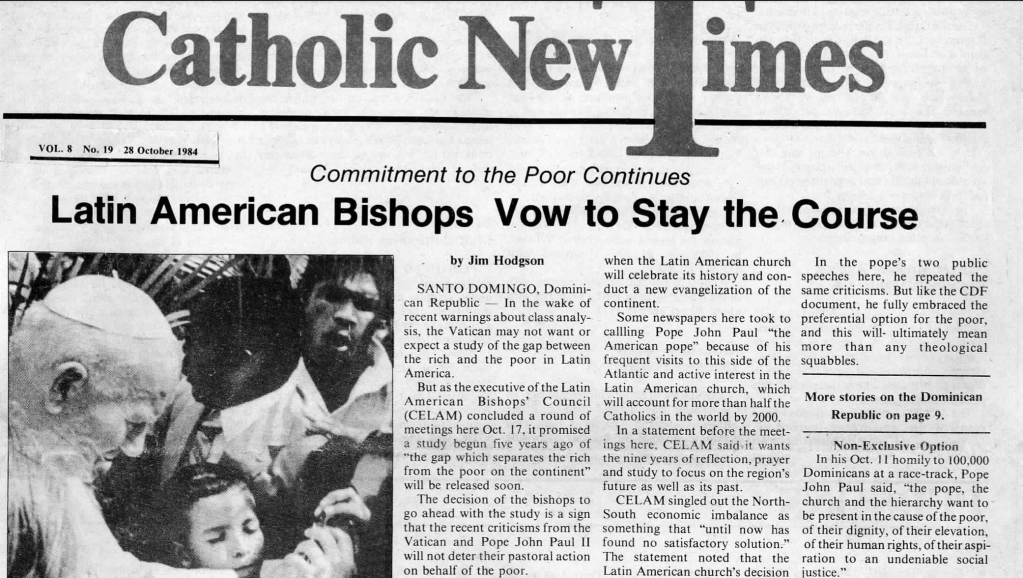
My first time “inside” the media bubble of accredited journalists on a papal visit. I remember the Vatican correspondents didn’t like me being on “their” bus around the Santo Domingo venues. Penny Lernoux (Cry of the People, 1980), Latin America correspondent of the National Catholic Reporter, took me under her wing to meetings with several of the more progressive Latin American bishops.

Vaccine equity: Release the patents!

For those of us concerned about global vaccine equity—“none of us is safe until we’re all safe,” the politicians keep saying—there was good news and bad news over the weekend.

Good news is that Pope Francis lent his powerful voice to those calling for fair access. “In the name of God,” he said Saturday to a world gathering of social movements, “I ask all the great pharmaceutical laboratories to release the patents. Make a gesture of humanity and allow every country, every people, every human being, to have access to the vaccines. There are countries where only three or four per cent of the inhabitants have been vaccinated.”

Bad news is that the World Trade Organization has again failed to agree to suspend intellectual property rights for COVID-19 vaccines. MoneyControl, a Mumbai-based financial news site, reported that further action on the patent waiver may not come until December, when trade ministers of all WTO member states will meet.

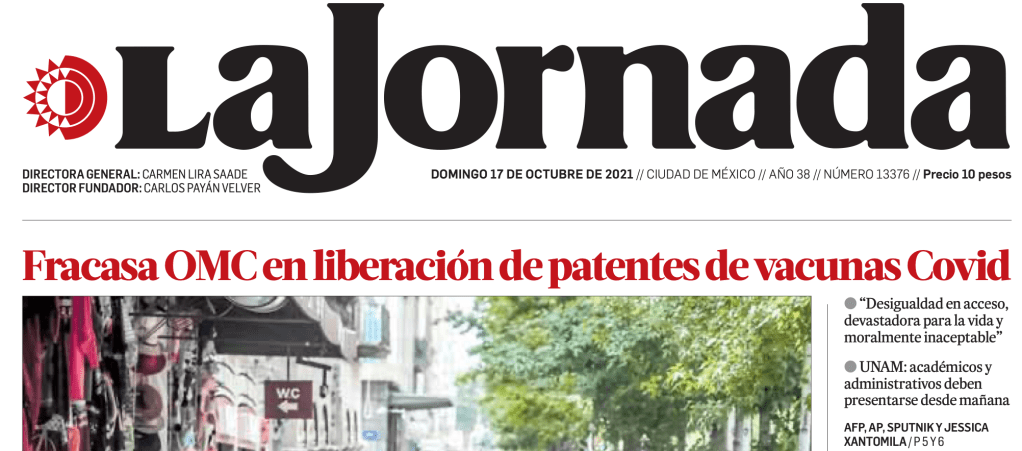
The WTO’s failure last week to “liberate” the COVID vaccines from patent protection was front page news in Mexico City, but got limited attention in English-language media.

More than 100 countries, led by India and South Africa, have demanded a temporary waiver of intellectual property rights for vaccine manufacturers. Such a waiver would suspend certain parts of the WTO Agreement on Trade-Related Aspects of Intellectual Property Rights (TRIPS) so that vaccines and testing technology for COVID-19 could be easily shared. It was the WTO’s “TRIPS Council” that failed to make any progress during meetings Oct. 13-14.

The WTO works by consensus: all 164 member states must agree to any change. MoneyControl said the lack of progress is due to opposition from the European Union and a handful of other rich countries, including Switzerland, Norway and the United Kingdom. “They have been emboldened by a noncommittal United States, despite the support of almost all WTO member nations. Since all WTO decisions have to be unanimous, there is nothing that can be done even if a single nation is unwilling,” a senior trade negotiator said. U.S. President Joe Biden said May 5 that he supported the waiver.

“AIDS drugs for every nation” was one of the cries heard at the International AIDS Conference in Toronto in 2006. Photo: Jim Hodgson  

I have written about this issue before and, indeed, the current fight to overcome the big pharmaceutical companies’ patent “rights” is an echo of the struggles in the first years of the new millennium to win access to antiretrovirals and other HIV and AIDS medications.  

Then as now, Canada has refused to support the TRIPS waiver. In May, 75 MPs from all parties sent a letter to Prime Minister Justin Trudeau in support of the COVID vaccine waiver. 

On Oct. 14, Vancouver MP Don Davies of the New Democratic Party spoke again about the struggle for vaccine equity. “We’ve seen the incredible impact that vaccines have had in the fight against COVID-19 in developed countries, and much of the research for COVID vaccines has been publicly funded,” he said.

“Yet many countries in the developing world have been unable to access vaccines due to global patent regulations. This is unacceptable not just from a humanitarian standpoint, but also a practical one, as we know that without a coordinated global vaccination effort, new COVID-19 variants will continue to develop.” 

Medical Xpress reports that COVID vaccination rates are on average 30 times higher in wealthier countries than in impoverished ones. For medical reasons, some countries are now rolling out third doses of vaccines while billions of people have yet to get access to a first dose.

The WTO director, Ngozi Okonjo-Iweala, has said the gap in vaccination rates between the haves and the have-nots was “devastating for the lives and livelihoods of Africans” and “morally unacceptable.”

Pope Francis took up the vaccine equity issue in the context of the fourth in a series of world gatherings of social movements. He said he would be a “pest”—“pedigüino,” in Spanish: one who asks too many questions—on vaccines, mining companies, debt cancellation and other issues. His calls: