Pope Francis apologized to the people of Mexico, and conservatives in Spain are furious

While Indigenous people in the northern part of this continent await an apology from Pope Francis for abuse suffered in church-run residential schools (next steps to come after a series of conversations in Rome in December), the Pope apologized to the people of Mexico for the violence committed by Spanish conquerors during the colonization and evangelization of the Americas.

In March 2019, Mexican President Andrés Manuel López Obrador had written to King Felipe of Spain and Pope Francis, urging them to apologise for the “abuses” of colonialism and the conquest. (This year, Mexico has been marking the 500th anniversary of the fall of the Mexica capital, Tenochtitlán, to the conquistadores, and the 200th anniversary of Mexico’s independence from Spain.)

The apology by Pope Francis to the people of Mexico came in response to the letter from López Obrador. While it was made public Sept. 27 by the Mexican bishops conference, it was dated Sept. 16 and issued from Basilica of St. John Lateran—the cathedral church of the bishop of Rome.
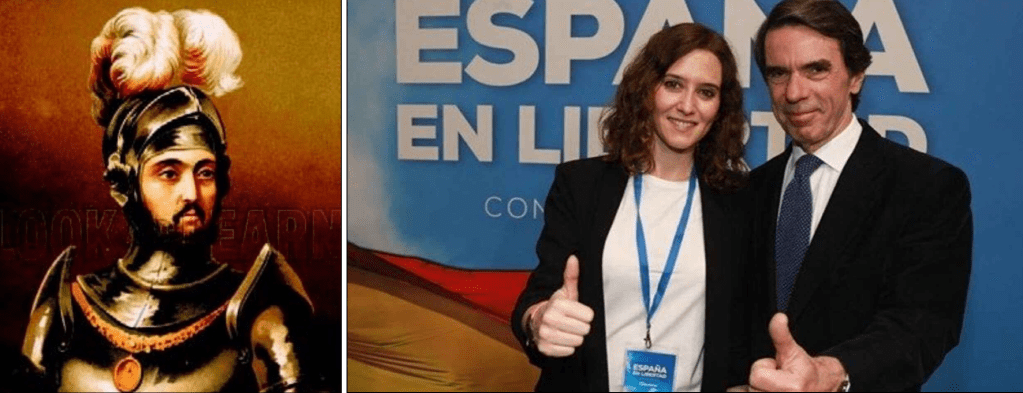
In 1511, Diego Colón, governor of the Spanish colony of Santo Domingo, was furious when a young priest denounced land-owners and colonial authorities for their treatment of the Taíno Indigenous people. Contemporary Spanish politicians (among them Isabel Díaz Ayuso and José María Aznar) were similarly angered by Pope Francis’s recent apology to the people of Mexico.

The apology, received calmly in Mexico, set off a furor among conservative politicians in Spain. 

José María Aznar, a former president of the Spanish government, made a series of racist jokes about López Obrador during a meeting in Seville of his Partido Popular. Another prominent PP politician, Isabel Díaz Ayuso, head of the Madrid regional government, told a U.S. audience that Spain had brought to Latin America nothing but “freedom, prosperity, peace, understanding.” Spain’s socialist government had earlier dismissed the call for an apology, saying “the arrival of the Spanish on Mexican soil 500 years ago cannot be judged in the light of contemporary considerations.”

The Spanish reactions brought to mind the fury of Diego Colon, son of Christopher Columbus and governor of the Spanish colony of Santo Domingo when, in December 1511, a young priest denounced the crimes of the land-owners and colonial authorities against the Taíno Indigenous nation.

A large statue of Antonio de Montesinos delivering his sermon faces the Caribbean Sea in Santo Domingo, Dominican Republic. The stone and bronze statue is 15 metres tall and was designed by Mexican sculptor Antonio Castellanos. It was donated to the Dominican people by the Mexican government and inaugurated in 1982 by the presidents of Mexico and the Dominican Republic. Photo: Jim Hodgson
A Robert Lentz icon of Bartolomé de Las Casas adorns the cover of Gustavo Gutiérrez’s biography.

Leaders of the Dominican religious order in Santo Domingo had chosen Antón Montesino (more commonly referred to now as Antonio de Montesinos), to deliver a message to land-owners and the colonial authorities. By then, the leaders of the Taíno people had already been killed. Tens of thousands more died from famine and disease. 

Drawing from gospel descriptions of St. John the Baptist (John 1:19b-28), Montesino spoke: 

“I am the voice of one crying in the wilderness. In order to make your sins known to you I have mounted this pulpit, I who am the voice of Christ crying in the desert of this island… Tell me, by what right or justice do you hold these Indians in such cruel and horrible slavery? By what right do you wage such detestable wars on these people who lived mildly and peacefully in their own lands, where you have consumed infinite numbers of them with unheard of murders and desolations? Why do you so greatly oppress and fatigue them, not giving them enough to eat or caring for them when they fall ill from excessive labours, so that they die or rather are slain by you, so that you may extract and acquire gold every day?… Are you not bound to love them as you love yourselves?” 

The young priest’s words sparked immediate anger. In the congregation that day was Diego Colón, the island’s governor and son of Christopher Columbus. Montesino could barely complete the celebration of Mass. Later in the day, Colón led a delegation to a meeting with the Dominican superior, Pedro de Córdoba, who told him the sermon was the responsibility of the entire community. 

A week later, on Dec. 28, Montesino preached again on the same themes. This time, Colón and others sent their protests to King Ferdinand V in Madrid. Over subsequent years, priests were recalled, studies were carried out, promises were made and broken—and the Taíno people continued to die. Worse, the colonial enterprise, based on slavery and ruthless exploitation, expanded throughout the hemisphere. By the time Hernán Cortés headed for Mexico and new genocides in 1519, between 80 and 90 per cent of the Taíno population on Hispaniola had died, and the pattern was being repeated in Cuba and Puerto Rico. 

Also present for Montesino’s homilies was a young priest who was also a land-owner, Bartolomé de Las Casas. As became his practice over the next 55 years, he wrote everything down. 

The Montesino sermon was a turning point for Las Casas. He came to see that Jesus Christ was being crucified again in the slaughter of the Indigenous people. He joined the Dominicans and dedicated his life to challenging the church and the Spanish empire of his day. In 1543, he was named bishop of Chiapas, but only spent about six months there before opposition from colonial land-owners forced him to carry his struggle to defend the Indigenous people to Rome and Madrid. 

Much of what we know about the impact of the colonialism on the original peoples of the Americas in the 16th century is from what he wrote in his History of the Indies, published in 1561. In his long life, he was able to correct errors: among them, failure to denounce slavery, particularly that of Africans. He later advocated that all slavery be abolished.

This year marks the 50th anniversary of the first publication in Spanish of Gustavo Gutiérrez’s A Theology of Liberation, the book that opened the door to subsequent decades of writing theology from the context—the ways people practice their faith in their real lives. 

In Las Casas, Gutiérrez found a model leader and writer who bore faithful witness to the struggles of his time. Gutiérrez wrote a lively biography: Las Casas: In Search of the Poor of Jesus Christ (Orbis, 1993).
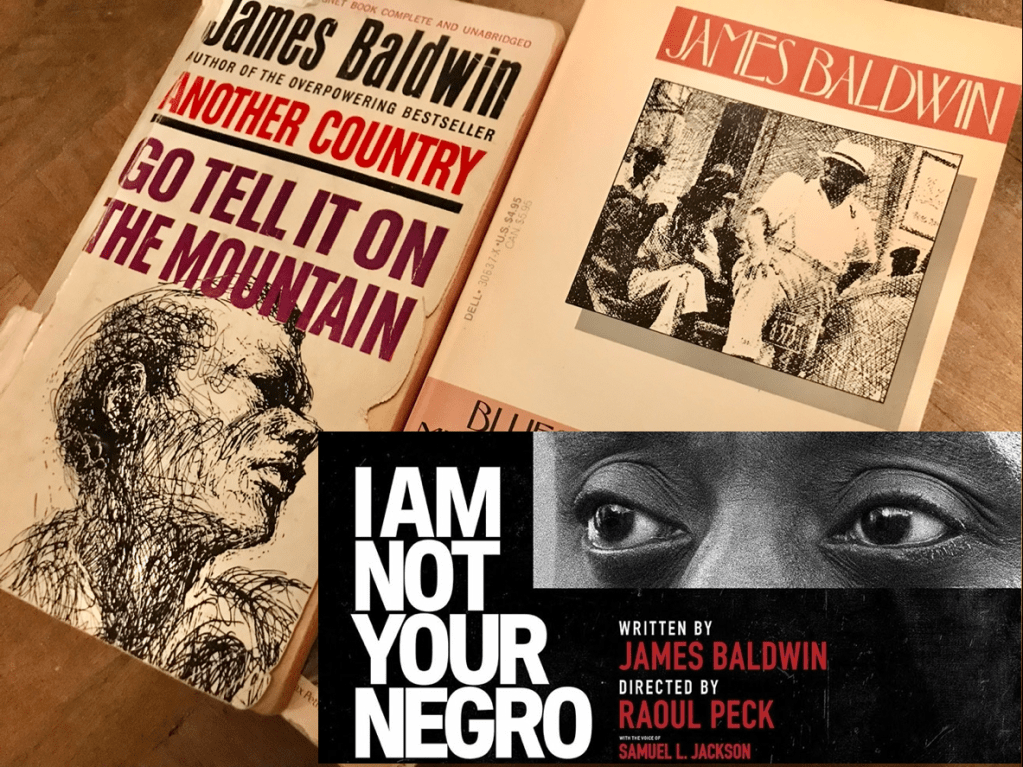
Cuba VI – James Baldwin, racism, imperialism and ourselves

In the 2010 interview when Fidel Castro apologized to gay Cubans for his government’s treatment of them in the 1960s, he asked, “Why hate the United States, if it is only a product of history?”

At the same time, we need to name what is going on. For the sake of describing the intersections of racism, sexism, homophobia and transphobia, and also economic, political and military power exercised in the world today, sometimes we talk about “Empire.” But there are moments, such as in discussions of Cuba (or in the wake of 20 years of war in Afghanistan), when we need to be more direct, and talk about imperialism: coercion and force used by stronger states against less advantaged peoples.

James Baldwin: “I attest to this: The world is not white; it never was white, cannot be white. White is a metaphor for power, and that is simply a way of describing Chase Manhattan Bank.”

For the gay African-American writer James Baldwin (1924-87), the way that the United States behaved abroad was tied to racism and homophobia at home. In an essay on Baldwin, the Indian writer and academic Prakash Kona wrote

“In sustaining the hegemony of powerful global elites who serve as engine for corporate capitalism America is guilty of keeping alive the notion of a civilization obsessed with its own sense of racial, moral and political superiority.”

To make his argument, Kona drew on Baldwin’s reflections on “American innocence” — “an innocence trapped in an unwillingness to take responsibility for one’s actions” that for Kona is most “clearly revealed than in their foreign policy in the third world.” That particular quality of “American innocence” is demonstrated perfectly by Dick Cavett in a question to Baldwin that opens Raoul Peck’s brilliant film, I am not your Negro (2016, currently streaming here). 

Peck again took up Baldwin’s themes in an essay in The Atlantic in 2000, saying that the people of the United States need to heed Baldwin’s words:

Why can’t we understand, as Baldwin did and demonstrated throughout his life, that racism is not a sickness, nor a virus, but rather the ugly child of an economic system that produces inequalities and injustice? The history of racism is parallel to the history of capitalism. The law of the market, the battle for profit, the imbalance of power between those who have all and those who have nothing are part of the foundation of this macabre play. He spoke about this not-so-hidden infrastructure again and again:

“What one does realize is that when you try to stand up and look the world in the face like you had a right to be here, you have attacked the entire power structure of the Western world.” And more pointedly: “I attest to this: The world is not white; it never was white, cannot be white. White is a metaphor for power, and that is simply a way of describing Chase Manhattan Bank.”

Cuba holds firm

While many other attempts to break free of U.S. hegemony over the Americas have been suppressed (Dominican Republic in 1963 and 1965; Chile in 1973; Honduras in 2009—to mention only a few examples) and others are under siege (Venezuela today), Cuba holds firm.

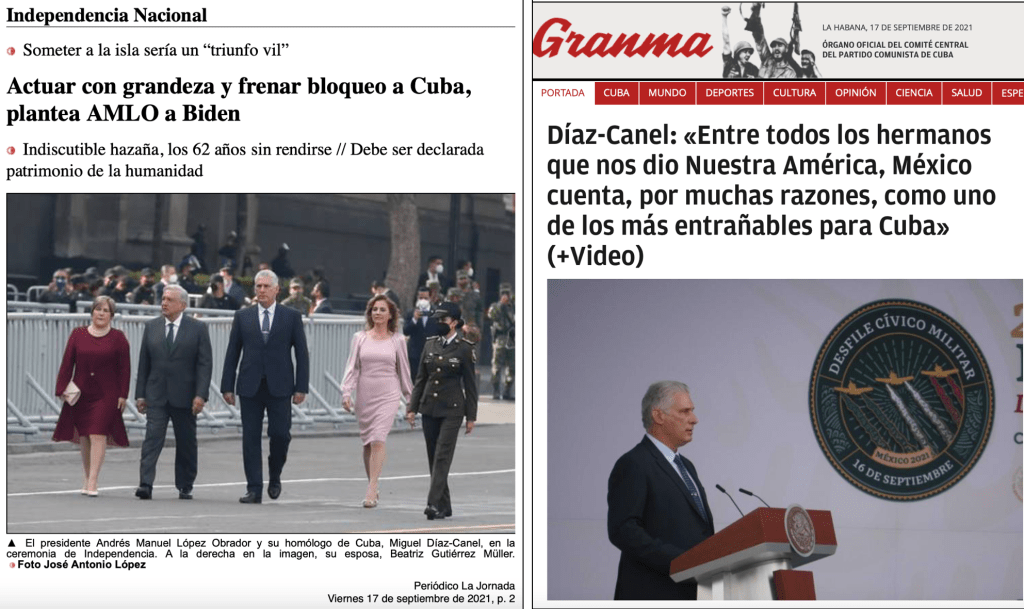
Yesterday (Sept. 16), Mexican President Andrés Manuel López Obrador welcomed his Cuban counterpart, President Miguel Díaz-Canel, to events marking the 211th anniversary of the beginning of Mexico’s fight for independence.
“I have said and I repeat: we can be in agreement or not with the Cuban Revolution and with its government, but to have resisted for 62 years without submission is an indisputable historical feat.”  Texts of their speeches (in Spanish).

Many of us from the global North get involved in the global South out of a partly-formed sense of solidarity or misguided charity. We only start to think about imperialism when we see that our goals of social justice or an end to poverty are blocked outright by U.S. imperialism (the history of invasions and coups) or by systemic oppression and exploitation (debt, banking and trade rules, etc.). Social movements find that their way towards liberation is blocked by systems imposed from the richer, Northern countries.

Their starting point in Latin America was usually the problem Gustavo Gutiérrez described: poverty—and then what to do about it. My starting point has been among various expressions of liberation theology, social gospel or the preferential option for the poor, and aligning myself with similarly-inspired actions. Hence my support for political options like those taken in Cuba, Venezuela, Bolivia and most recently (and still tentatively) Peru, and movements like the MST (landless people) in Brazil and the Zapatistas in Mexico. Those movements may not set out to be anti-imperialist, but to the extent that they are opposed by capitalism and its proponents, they must become anti-imperialist.

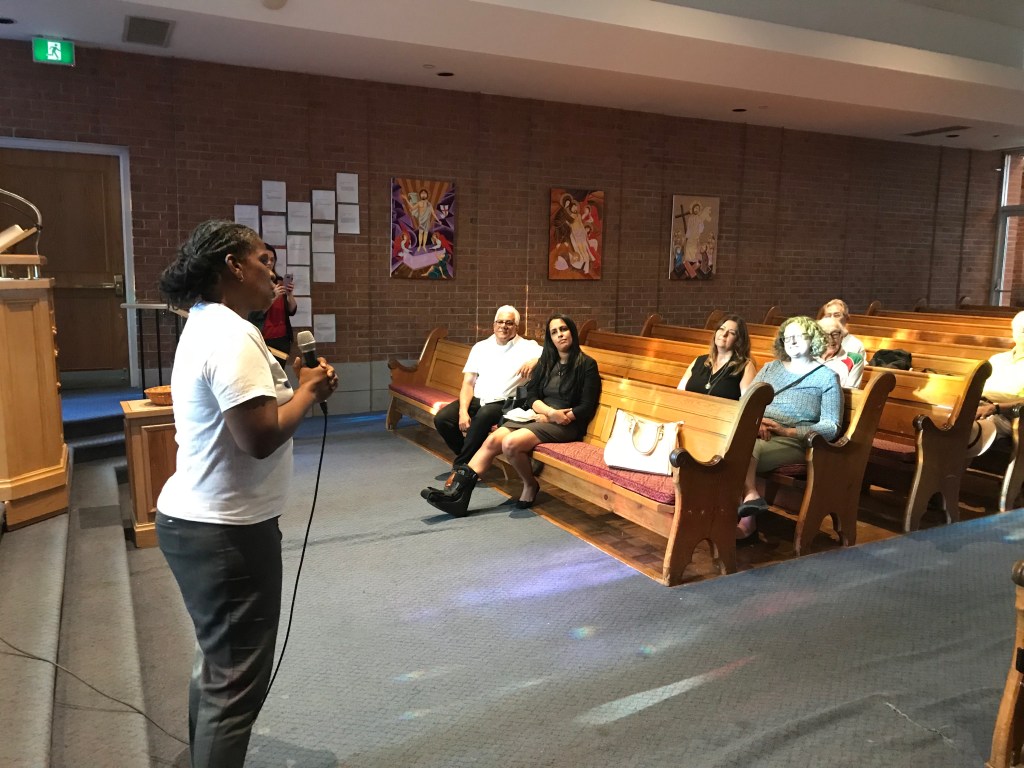
Gail Walker (left) of Pastors for Peace speaks to a gathering at College Street United Church in Toronto in July 2018.

By way of conclusion, some ways to connect with others who work in solidarity with people in Cuba.

Pastors for Peace and the larger coalition of which it is part, the Intereligious Foundation for Community Organization (IFCO), are based in New York City and led mostly by African-American and Latinx people. P4P has done a superb job of undercutting the US blockade of Cuba by simply breaking it: people go to Cuba in caravans, provide aid, and support US students to study medicine in Cuba. You can join their mailing list here for updates on Cuba.

In Canada, there are a variety of solidarity networks, including the Canadian Network on Cuba and the Canadian-Cuban Solidarity Association (CCFA) that promote friendship and share information. CUBAbility, a Toronto-based group, sends musical instruments and other aid. Some churches (notably The United Church of Canada) and trade unions work with partners in Cuba.

Cuba IV: Rethinking development in a revolutionary situation

“Peace + Friendship = Development”

My time in the Dominican Republic and Mexico had convinced me that most proponents of “development” failed to address the unjust structures in the world, including inequalities that have roots in colonial times. Development needed to be understood (as Gustavo Gutiérrez and others argued) in terms of liberation: a radical transformation of global systems of power and domination.

And so, once I had the opportunity to work among churches in Cuba, I was eager to learn about the practice of development in a revolutionary, socialist society.

In the years after the Cuban government’s rapprochement with organized religion in the early 1990s, some churches and especially their ecumenical agencies made major efforts to contribute to the overall well-being of Cuban society. Cuba was in its “special period” of adjustment to the loss of the Soviet Union as a major trade and aid partner. Cuban churches drew from their own creativity and resources from their global partners to assist.

Today, church-based development programs include strong emergency response capacity and training to manage small businesses and to produce and conserve food (including urban farming). Such training includes empowerment of vulnerable groups, notably farmers with disabilities and senior citizens.

Juan Carlos Cabrera, Sibanicú, Camagüey: a hearing-impaired participant in the CIC’s project with farmers who have disabilities.

The Cuban Council of Churches (CIC) has long supported a pastoral ministry among people living with disabilities. In recent years, that ministry began to focus on farmers with disabilities. You can hear from some of the families and learn about their work in a video I helped to make with The United Church of Canada in 2019. 

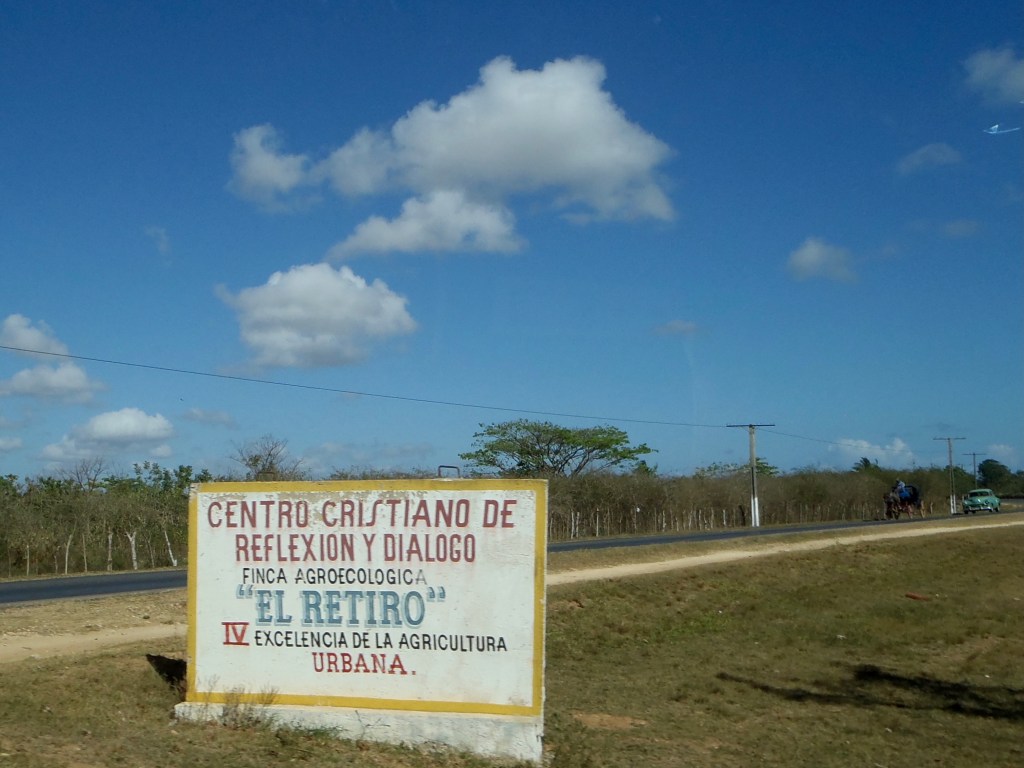
In Cárdenas (near Varadero in Matanzas province), the Christian Centre for Reflection and Dialogue (CCRD) has run a “meals-on-wheels” style program for people in need because of age or illness. Support goes beyond delivery of a daily meal, and includes (according to need) provision of clothing, laundry service, house-keeping, medication, and attention to health and hygiene. 

Much of the food used in that program (and in schools and hospitals around Cárdenas) is produced at CCRD’s 32-hectare farm, El Retiro. It is also a place for training of farmers in the area. You can read more about the farm and about agriculture in Cuba in an article by Gary Kenny (a friend and former staff colleague at the United Church).

CCRD’s farm: “development means that… everyone has a voice”

In conversations with CCRD staff in March 2018, the word “development” kept coming up. I asked them what the concept meant to them. At first, they did what I sometimes do: add an adjective (“community development” or “participatory development”) or an object (“development of capacities”). Eventually, they said: “that everyone has a voice.” And: “Participation means the extent to which people can participate in community, as persons; to express themselves, with their collective and individual interests.” 

In practical terms, that means holding fast to a vision of the common good that embraces all—even as the Cuban government opens the economy to small business initiatives. Tourists already know independent restaurants (paladares) and bed-and-breakfast places (casas particulares). But now there are beauticians, repair shops, and designers of fashion and everything else. In Cuba, they are called cuentapropistas: people who work on their “own account.”

At the same time, the government also encourages people to take up farming. But the new farmers need training in everything from bookkeeping to organic farming practice. This work is carried out in a decentralized way by the CIC together with CCRD and various NGOs and state agencies. Challenges include lack of machinery; ecological awareness; impacts of climate change (drought, hurricanes); market distortions (some hotels buy directly from farmers, bypassing public systems intended to ensure food security for all); and the risk of introduction of GM seeds. 

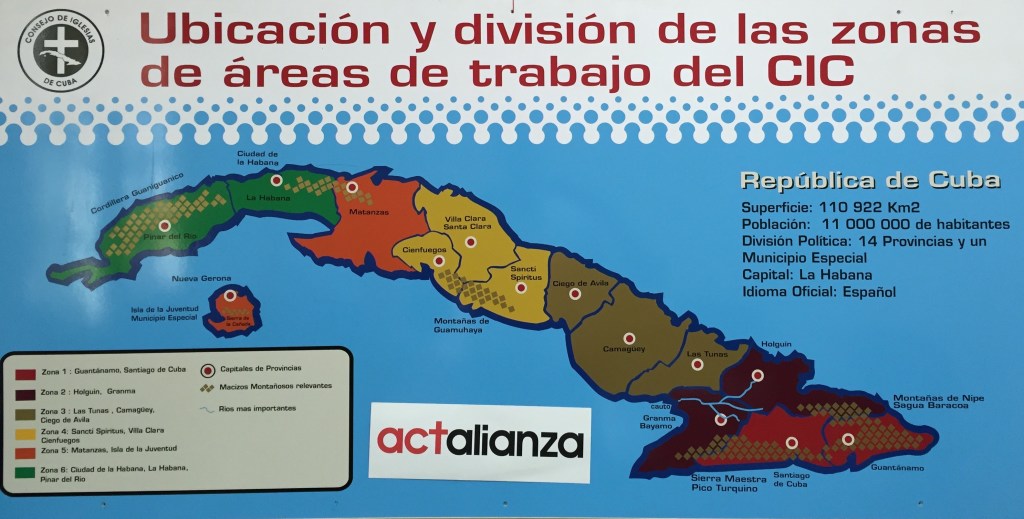
The Cuban Council of Churches’ areas of work.

As market systems evolve and while holding fast to that vision of the common good, CIC and CCRD are taking up concepts of “social and solidarity economies” and structures of cooperatives (as opposed to individual or competitive initiatives). These are not top-down programs, but initiatives hatched in networks across the country. The idea is to get people with different interests matched up with people who have capacity and experience within the same area, working with municipalities, churches and other non-governmental organizations. The networks come together without money for projects, but proposals can emerge from their work—which is what happened with the effort to support farmers with disabilities.

In Cuba and beyond, debates continue about development. We may have “sustainable development goals,” but does the practice change? Are we transforming systems and practicing liberation?

From their experience, Cuban church leaders and theologians contribute to the global ecumenical conversation that unfolds in the World Council of Churches and the ACT Alliance of 135 faith-based development and relief agencies.

In December 2010, Reinerio Arce (a former CIC president who was then serving as rector of the Evangelical Seminary of Theology in Matanzas) called for what he called “prophetic diakonia.” (Diakonia is a Greek word used in the New Testament to refer to service—every kind of service: helping people, serving at tables, and offering leadership in faith communities.)

“In our country the churches are playing a more active role serving the people in need at this moment when our economy is shifting increasingly; we need to build capacity for this task,” he said an interview with the WCC news service.

“God sends us out in mission to bring the good news to the poor and oppressed, in word and in deed. Faithful to this call, we try to serve human needs, focusing on the marginalized, the ‘least of these,’ not only by comforting them but also by addressing the root causes of their pain, sorrow and shortages. This ministry of prophetic diakonia seeks to confront the powers of this world that lead to violence, exclusion, death and destruction, and it calls for the transformation of unjust structures and practices into God’s kingdom of justice, with fullness of life for all and for creation.” 

In Matanzas on Oct. 4, 2016, we watched on TV (left) as Hurricane Matthew crossed southwest Haiti before moving on to eastern Cuba. Three days later, I joined CIC staff as they continued their emergency response (right), including provision of shelter in churches.