Cuba III: Churches emphasize the value of dialogue and mutual listening

When protests broke out on Sunday, July 11, President Miguel Díaz-Canel went to the streets of San Antonio de los Baños, southwest of Havana, to talk with protesters about their grievances—something the presidents of Colombia, Chile, Ecuador, Brazil, Guatemala and Haiti never did despite months of protests in their countries.
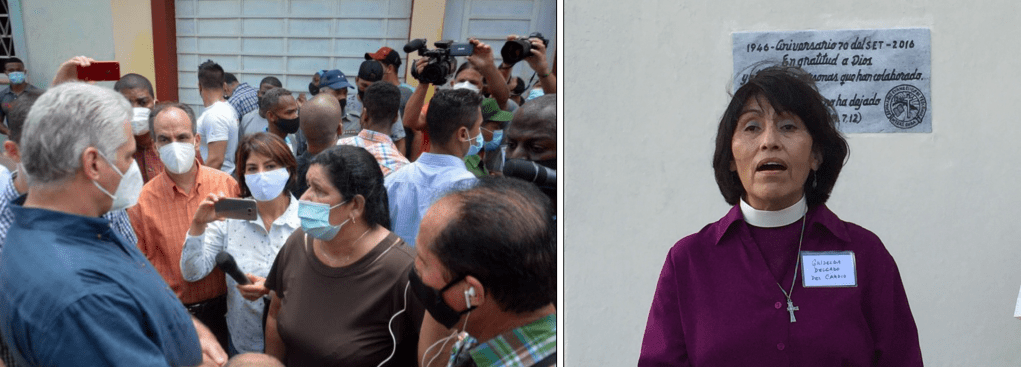
President Miguel Díaz-Canel hears from the people of San Antonio de los Baños on July 11 (Photo: Estudios Revolución). Right: Bishop Griselda Delgado of Cuba’s Episcopalian (Anglican) Church (Photo: Jim Hodgson)

In the wake of the protests, Cuba’s churches called for dialogue. The Catholic bishops warned against “a rigidity and hardening of positions” and encouraged “mutual listening.” The bishop of the Episcopalian (Anglican) Church, María Griselda Delgado, said: “There will always be divergences, diverse opinions, different thoughts; there is the richness and integrity of being a People. It is necessary to raise the value of dialogue to seek understanding.” (Several of the church statements are posted in English on a Facebook site related to the Presbyterian Church U.S.A.) On Aug. 6, the Cuban Council of Churches and leaders of its member churches met with President Díaz-Canel, along with the Student Christian Movement and other ecumenical groups.

Like many Canadians, I made my first visit to Cuba as a tourist. That was in 1992, at the height of the “special period” when Cubans faced hardship as a result of the collapse of the Soviet Union, and sought new ways to engage with the rest of the world. 

From 2000 to 2019, I had the privilege of visiting the country almost every year. For two decades on behalf of The United Church of Canada, I worked alongside Cuban churches and their ecumenical organizations (the Cuban Council of Churches, the Evangelical Seminary of Theology in Matanzas, the Christian Centre for Reflection and Dialogue in Cárdenas, and the Martin Luther King Memorial Centre in Havana).

Canadians visited Cuba; Cubans came to Canada. The relationships were lively: rooted in love and mutual respect, and not immune from political and religious controversies. We learned together and taught one another in formal and informal settings—academic exchanges (faculty and students), congregational twinning, and participation together in international settings (World Social Forum, Hemispheric Social Alliance, World Council of Churches, ACT Alliance, and others). And we worked with U.S. churches to help maintain and strengthen their ties with Cuban churches in the face of official U.S. hostility to Cuba. My occasional conversations with Cuban government staff and politicians were friendly and informative.

All of those efforts are about building bridges, sharing stories, promoting dialogue. We could even find common ground with the government of Canada’s “constructive engagement” policy approach to Cuba and, for many years, collaborate in official development assistance projects.

And so, I welcome the voices of those Cuban churches that work in favour of dialogue and realistic approaches to solving problems.

Theology in Revolution

For the Cuban churches, the years following the Cuban Revolution were challenging. The new government was suspicious of churches that had aligned themselves historically with the elites or that operated as “missions” that were dependent on U.S. support.  The government restricted religious activity. Many ministers and priests left the country, though there was more enthusiasm for the revolution among lay people. Atheism became official state policy and religious believers were discriminated against in employment and education.

View of Matanzas from the Evangelical Seminary of Theology (SET); Sergio Arce in 2007. (Photos: Jim Hodgson)

Some among those who stayed—or, as in the case of Presbyterian theologian Sergio Arce Martínez, returned—developed a “theology in revolution” in the 1960s. Arce was concerned not with a God “up there,” but rather with God “down here” as experienced in human history, especially in the revolution against poverty, exclusion and imperialism. Christians from other parts of the world attended the 1966 Tricontinental Congress in Havana, and then the Cultural Congress held in Havana in January 1968. That event was attended by several Catholic priests whose declaration was read aloud by Fidel Castro at the closing.

Elsewhere, other processes were underway: the Roman Catholic Church’s II Vatican Council (1962-65) and the meeting of Latin American bishops in Medellín in 1968; the growth of Christian base communities; Priests for the Third World in Argentina in 1966; the World Conference on Church and Society, held in Geneva in 1966, that identified the close relationship between peace and justice; and emergence of the National Organization for Social Integration (ONIS) in Peru in 1968, the Golcanda group in Colombia, also in 1968, and Christians for Socialism in Salvador Allende’s Chile in 1971. All of these currents—including the Cuban Revolution itself—influenced each other and played a role in the articulation of liberation theology by Gustavo Gutiérrez and others in the early 70s. The confluence of those processes, plus the Catholic Church’s articulation of the “preferential option for the poor” in the late 70s, and patient work by Christians in Cuba to overcome the revolutionary government’s early distrust of organized religion, resulted in the Communist Party’s decision in 1991 to drop its requirement that party members be atheists. More Cuban Christians began to attend worship and join churches.

Use and abuse of organized religion

The U.S. government has made no secret of its intent to use religious groups to subvert the Cuban Revolution. Most blatant in this regard was the May 2004 Report to President G.W. Bush by the Commission for Assistance to a Free Cuba, chaired by then-Secretary of State Colin Powell. The commission promised to use religious organizations in “building a free Cuba.” It also proposed to “differentiate the leadership of the Cuban Council of Churches” from its members (p.64). 

Read now, almost two decades later, the report is as ludicrous as other Orwellian lies from the Bush era, like the ones about weapons of mass destruction in Iraq or that Afghans would welcome foreign invaders. 

Even so, you can see the effects of the approach in the attacks today on the Cuban Council of Churches in responses to its social media posts. 

With graver consequences, networks of conservative Christians oppose gender equity, same-sex marriage and Trans rights as if they were attacks on the “traditional family.” Any criticism of the fundamentalist view draws charges from the U.S. government that Cuba is attacking religious freedom. (I’ll look at LGBTI rights in a future post.)

In facing the alignment of fundamentalist Christian religion with right-wing politics, Cuba is not alone. Across Latin America and beyond, many of these groups seek to use state power to impose their narrow moral agenda. I have written about this phenomenon previously (in the context of Colombia) here.

Next week: Unwrapping development, Cuban-style; LGBTI rights and inclusion; and something along the lines of “how to confront imperialism without losing your soul.”

Boston’s archbishop, Cardinal Sean Patrick O’Malley, met Sept. 9 with Cuban President Miguel Díaz-Canel, and with scientists who developed Cuba’s Covid vaccines.
Cuba II: Overcoming systemic discrimination, confronting imperialism

When considering Cuba today—and thinking beyond what you think you learned from Godfather II—it’s useful to consider what Cuba was like before Jan. 1, 1959. To do so, I went back to one of my venerable university text books, Modern Ideologies, by Max Mark (New York: St. Martin’s, 1973. p. 172):

  • U.S. interests owned 40 per cent of the sugar land, including seven of the ten largest plantations. Much of this land was acquired after the Spanish-American War. 
  • U.S. interests owned 54 per cent of the sugar mills and 90 per cent in the telephone companies, electric power supply and railways. 
  • The most depressed group was made up of people who lived in rural areas. In 1946, eight per cent of the farmers owned 71.1 per cent of the land that was owned by Cubans, while 39 per cent owned only 3.3 per cent.
  • The typical Cuban agriculturist was a landless day-labourer who worked for wages in supervised groups, employed for only a few months of the year.
  • Their lives were in sharp contrast with life in more cosmopolitan Havana, where 87 per cent of homes had electricity. In rural areas, only 7 per cent of dwellings were so equipped. 

I would add that before the 1959 revolution, 85 per cent of Cuba’s trade was with the United States.

Let’s go more deeply into the history of Cuba at the hands of the imperial powers: Spain and the United States. Despite losing most of its other Latin American and Caribbean colonies early in the 19thcentury, Spain had managed to hold onto Cuba until the Spanish-American War near the end of the century. A rebellion by African slaves in 1812 had been crushed. An independence struggle launched in 1868 failed after 10 years of fighting. Spain finally abolished slavery in Cuba in 1886. Another revolt, this one led by the writer José Martí, broke out in 1895.

The U.S. newspaper empires of Joseph Pulitzer and William Randolph Hearst competed against each other with sensationalistic stories of Spanish oppression in its remaining colonies, especially Cuba. In what is widely believed to have been an “inside job” to provide a pretext for war, the U.S. battleship Maine was blown up in the Havana harbour on Feb. 15, 1898. U.S. ships blockaded Cuba and land forces were deployed. By August, Cuba, Puerto Rico and the Philippines were all occupied by the United States. In a treaty at the end of the year, Spain conceded Cuba’s independence. Fierce resistance continued in Philippines for years afterwards, and the other former Spanish colonies of Puerto Rico and Guam remain in U.S. hands to this day. 

At first, the U.S. established a military government in Cuba. A new constitution in 1901 contained the Platt Amendment, which gave the United States the right to intervene in Cuban internal affairs. It also gave the U.S. a naval base at Guantánamo. 

Under President Franklin D. Roosevelt’s Good Neighbour Policy, the United States abrogated the amendment in 1934, but kept Guantánamo. For almost 20 years, the United States has operated an illegal prison camp for alleged terrorists at its Guantánamo base.

The stories of the struggle in the 1950s to rid Cuba of the dictator Fulgencio Batista—Fidel Castro’s raid on the Moncada barracks in 1953 and subsequent trial (“History will absolve me”); his return from exile in Mexico aboard the Granma in 1956 in the company of his brother Raúl and Ernesto “Che” Guevara; the guerrilla war waged from the Sierra Maestra mountains; the eventual triumph—are better known and well-told elsewhere, as are the tales of clashes with the United States (the “Bay of Pigs” invasion, the missile crisis).

What’s not as well-known are the early steps toward transformation, especially those that placed previously impoverished people—especially women and people of colour—at the centre of attention, a sharp break from “the discrimination inherent in patriarchal and segregationist societies.”

Key here was creation in 1960 of the Federation of Cuban Women (FMC) under the leadership of Vilma Espín as a space to drive and achieve many goals of the women’s movement (“the revolution within the revolution,” as Fidel called it): participation, pay equity, universal day care, reproductive rights, and paid maternity leave. For more than 60 years, Cuba has made consistent gains in health care and education, and shared its accomplishments with people in other developing countries around the world.

Across Latin America, impoverished people saw the triumph of the Cuban Revolution on Jan. 1, 1959, as a sign of hope. Across the region, protests against poverty and oppression grew in the 1960s, and armed rebellions began in many countries. On July 19, 1979, came the triumph of the Sandinista Front for National Liberation (FSLN) in Nicaragua. In most places, however, military force (with training and funding from the United States) crushed the revolts.

Latin American churches, meanwhile, were changing too. The old strategy of training elites in hope that they might show mercy to the poor was an obvious failure. Building from the methods of popular education, churches encouraged lay people to come together in “base Christian communities” (comunidades eclesiales de base—CEBs).

Theologians came to describe the reflection carried out by oppressed people on their processes of social and political change as liberation theology. When you talk with people in Mexico or El Salvador or Argentina about their inspiration for involvement in struggles for social change, many say it was through participation in the CEBs—or their parents’ participation.

In my next post, I will share more about the role of churches in contemporary Cuba.

When elites see their wealth threatened, they move heaven and earth

On Nov. 11, 1979, San Salvador’s Archbishop Oscar Romero preached on Mark 12:38-44, The Widow’s Offering: Jesus watched the crowd putting money into the treasury. Many rich people put in large sums. A poor widow came and put in two small copper coins, which are worth a penny. Then he called his disciples and said to them, “Truly I tell you, this poor widow has put in more than all those who are contributing to the treasury. For all of them have contributed out of their abundance; but she out of her poverty has put in everything she had, all she had to live on.” 

Colombia’s president sends more troops to Cali to try to quell a month of protests. The British magazine The Economist invites a resurgence of U.S. imperialism to thwart the Mexican president’s option for the poor. The six-decade-long U.S. blockade of Cuba is so severe that the country cannot obtain sufficient syringes to protect its population with the vaccines it has developed.

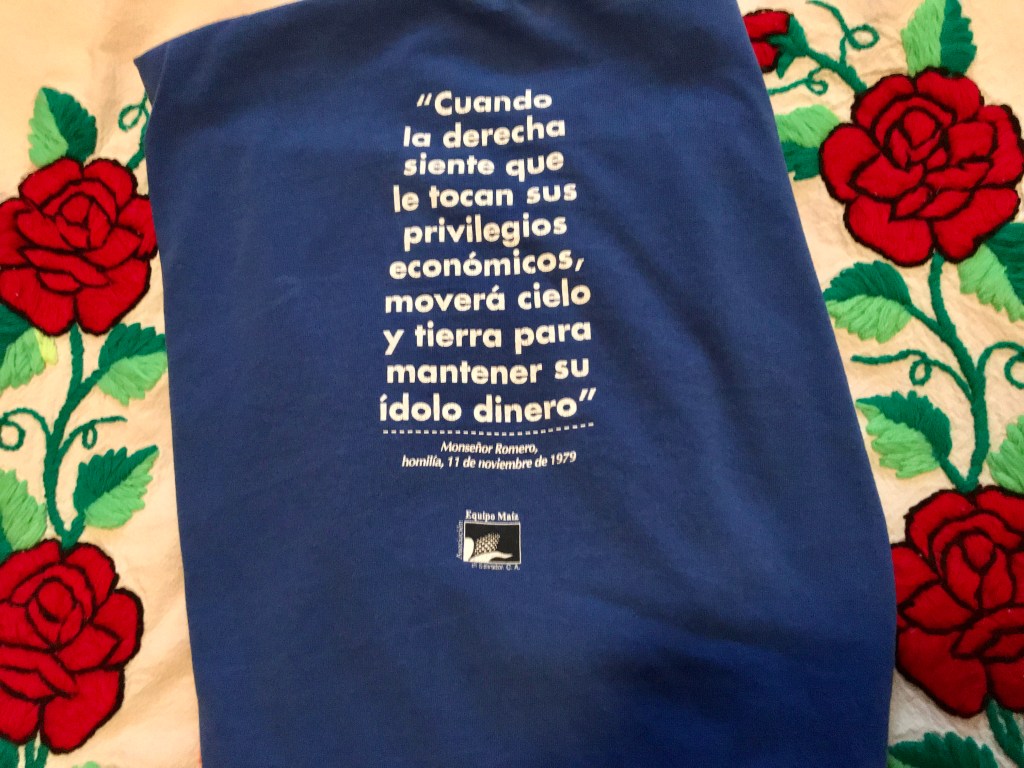
And I think of the words of St. Oscar Romero on Nov. 11, 1979, when he offered a warning about money when it becomes an idol:

It’s natural that when the right feels that their economic privileges are being threatened, they will move heaven and earth in order to maintain their idol of wealth.

Next Sunday, June 6, Mexicans and Peruvians head to the polls. In Mexico, these mid-term elections—the national legislature and many state and local races—are marred by violence: at least 35 candidates of various parties have been murdered. In Peru, it’s the second round of voting to elect a new president: from the left, Pedro Castillo stands a reasonable chance of defeating Keiko Fujimori, despite her powerful, rich supporters.

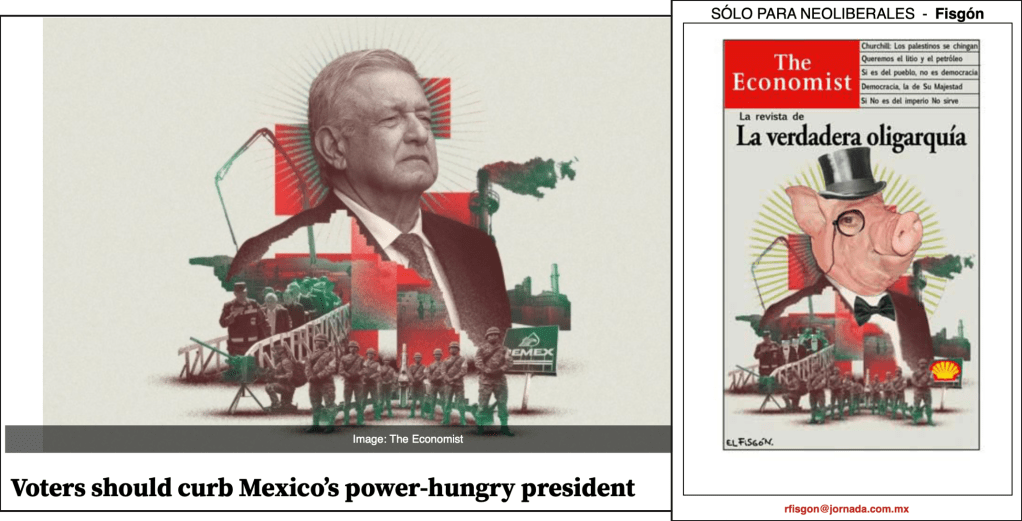
The Economist’s attack on Mexican President Andrés Manuel López Obrador (known by his initials as AMLO) in startling. There are reasonable grounds to debate this policy (the pandemic response) or that development plan (the tourist train in the Yucatán peninsula that is opposed by Indigenous people in the region), but The Economist argues that he is a populist comparable to Brazil’s Jair Bolsonaro, and that democracy is threatened:

Mr. López Obrador divides Mexicans into two groups: “the people”, by which he means those who support him; and the elite, whom he denounces, often by name, as crooks and traitors who are to blame for all Mexico’s problems. He says he is building a more authentic democracy. 

Left: Cartoon by Israel Vargas, The Economist, May 27, 2021. Right: cartoon by El Fisgón, La Jornada, May 29, 2021. (“The Economist: The magazine of the True Oligarchy.”)

It then goes further, suggesting that the United States get involved in Mexico’s internal affairs:

The United States needs to pay attention. Donald Trump did not care about Mexican democracy. President Joe Biden should make clear that he does. He must be tactful: Mexicans are understandably allergic to being pushed around by their big neighbour. But America ought not to turn a blind eye to creeping authoritarianism in its backyard. As well as sending vaccines, unconditionally, Mr. Biden should send quiet warnings.

So, what is a populist anyway? 

A Venezuelan friend who lives in Costa Rica, José Amesty, says populism is a term used by elites when they do not understand what is going on. I would refine that slightly and suggest that it is a term used by elites and technocrats to describe political movements that reject their narrow economic priorities—maintaining their own privileges—by putting social goals first. 

Amesty cites AMLO: “supporting the poor, supporting elderly adults, supporting youth: if that is to be populist, then add me to the list.” AMLO stands in the tradition of Lázaro Cárdenas, the revolutionary Mexican president who in the 1930s led a land reform that put half of the farming land in the hands of local community councils (ejidos) and who nationalized the petroleum industry.

Populism is one of the least useful terms in our political lexicon. I think we’re clearer when we use tags that are generally understood: left (social democrat, socialist, communist), centre (liberal), or right (conservative, traditional, elitist, militarist). Better yet: actually describe the content of political platforms. What does this candidate stand for? With whom do they stand? 

The government of Iván Duque in Colombia and the candidacy of Fujimori in Peru are projections of traditional elites trying to hold on to their power and economic privileges against diverse social and political movements that would empower people who have usually been locked out of power: the rural and urban poor, Indigenous and descendants of Africans, women and LGBTI people. 

In that sense, democracy in Latin America is not so much being threatened as it is still being invented.