Is Trump looking for war in the south Caribbean?

by Jim Hodgson

In this decade of Donald Trump at centre-stage, it has been hard to choose a moment or an issue about which to react. The former reality TV star is an expert in deflection and distraction.

Yet some things (Israel’s genocide in Gaza is one) matter more than others. So too Trump’s threats against Venezuela.

Trump’s statement below defending extrajudicial executions shows again how little he values human life. He was responding to a question from a journalist on Oct. 23 about why he didn’t ask Congress for a declaration of war against drug cartels he claims are at war with the United States: 

“Well, I don’t think we’re gonna necessarily ask for a declaration of war, I think we’re just gonna kill people that are bringing drugs into our country. OK? We’re going to kill them. You know? They’re going to be, like dead. OK?”

Over the past two months, Trump’s assassins have killed at least 43 people and sunk ten small boats in the Caribbean and along the Pacific coast of Colombia. As Greg Grandin has documented, when the U.S. withdraws from the rest of the world, it doubles down in this hemisphere.

This time, the United States isn’t even bothering with its usual lies as it moves from a decade of sanctions (“unilateral coercive measures”) to threats of war as it presses for regime change in Venezuela. Sanctions have had devastating effects in Venezuela, according to a study conducted by the Center for Economic and Policy Research and published in August in The Lancet Global Health.

Trump’s ire is mostly directed against Venezuela, which since 1998 has refused imperial orders about oil, medical care, governance, and individualistic notions of human rights. But he has plenty left over for Colombia and Mexico.

“He’s a thug” and an “illegal drug leader,” Trump said of Colombian President Gustavo Petro. And he said Mexico is governed by drug cartels, even while expressing respect for President Claudia Sheinbaum.

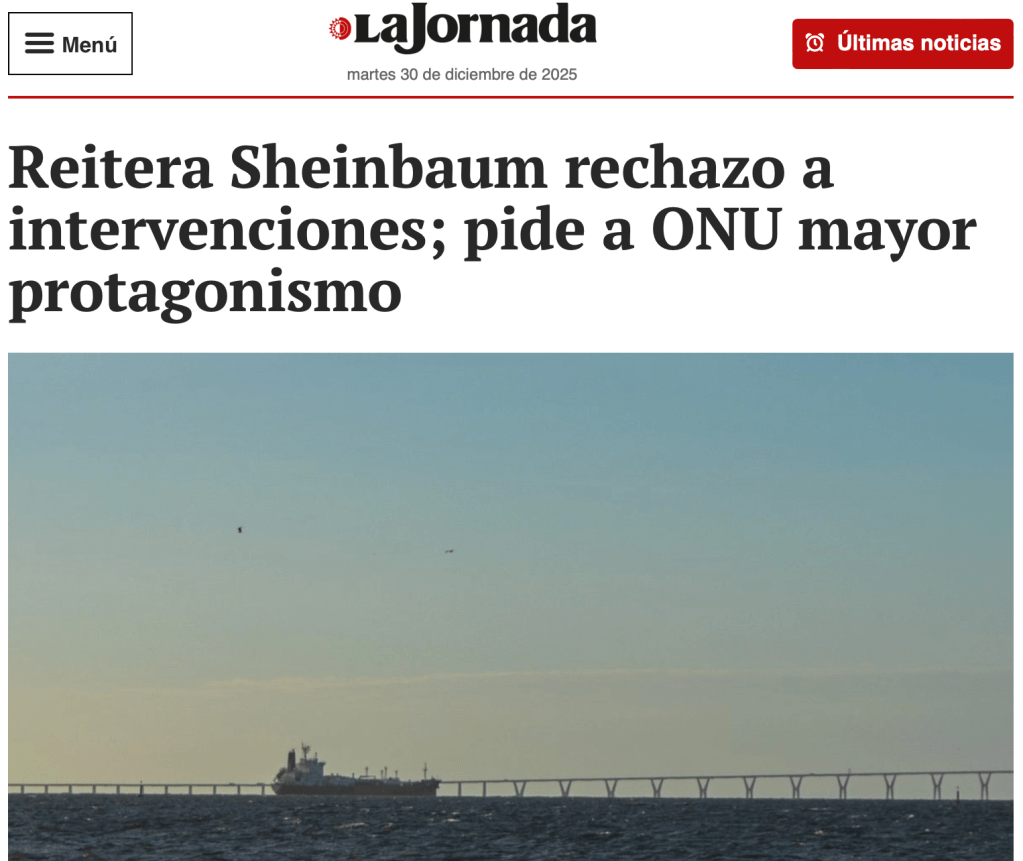
The text below is translated and lightly adapted from an Oct. 25 editorial in the Mexico City daily La Jornada.

Washington seeks war

The Trump administration is sending increasingly alarming signals about its determination to attack Venezuela to impose regime change and install a puppet administration. Trump uses a “combination of threats of armed action and economic extortion” to support right-wing politicians in Argentina, Brazil, Ecuador, El Salvador and now Bolivia “to facilitate the rise or consolidation of the far right throughout the hemisphere.”

On Oct. 24, his “War Department” announced the deployment of an aircraft carrier, the USS Gerald R. Ford, and its strike group to the U.S. Southern Command—that is, the southern Caribbean and northern South America. This entails the presence of the aircraft carrier itself, the 75 aircraft it carries, and the full range of necessary operations: three destroyers, a replenishment ship, a dry cargo ship, and a Coast Guard cutter. The Gerald R. Ford alone carries 4,600 military personnel, in addition to the crews of auxiliary vessels. 

The argument that all these vessels are being deployed with the goal of “dismantling Designated Terrorist Organizations (DTOs) and countering narco-terrorism in defence of the homeland” doesn’t stand up to scrutiny. First of all, they could be deployed off the US coast, thereby reducing the cost of maintaining long supply chains and avoiding diplomatic friction. 

The thousands of soldiers already sent to the Caribbean could have provided a much greater service to their homeland by monitoring land and air points of entry, where narcotics actually enter the United States. Instead of spending billions of dollars operating its fleets abroad, Washington could gain vast resources by combating money laundering within its own financial system, where authorities estimate that organized crime launders $300 billion annually. If traffickers were unable to collect and move the profits from their activities, they would be immediately paralyzed. But it is clear that the White House is not interested in the health of its citizens or the legality of the money circulating through its banks.

The bellicose tone of this escalation is so evident that even Brazilian President Luiz Inácio da Silva (Lula—who is not friendly to Venezuelan President Nicolás Maduro) criticized the U.S. bombing of boats in the Caribbean, noting that “if it becomes fashionable, everyone will believe they can invade someone else’s territory and do whatever they want,” thus turning the region into a lawless land. 

Lula’s special advisor and former Foreign Minister Celso Amorim warned that external intervention, whether armed or through intelligence services, is not the way to decide who will govern Venezuela, a problem that concerns only Venezuelans. He also warned of the danger of setting South America ablaze and leading to the radicalization of politics throughout the continent. At the same time, Washington is making clear its longing to empower the Colombian oligarchy in Bogotá, always ready to follow its directives and make the Andean-Caribbean territory available to its troops and spy agencies. 

In this regard, Trump escalated his attacks against President Gustavo Petro and imposed sanctions for “allowing drug cartels to flourish and refusing to stop this activity.” No evidence was presented, which is what happens in his constant diatribes against Mexico, Venezuela, and other nations whose governments protect their independence and sovereignty.

In South America, there is no war that justifies besieging the subcontinent with a series of attacks. But it becomes increasingly clear that the White House is determined to start a conflagration, no matter how absurd its pretexts. 

The international community, and particularly Latin American and Caribbean societies, must join forces in rejecting Trump’s attempt to plunge the region into barbarism in order to divert attention from his own ineptitude and hand over vast amounts of money to the military-industrial complex, the only sector whose prosperity apparently interests the U.S. president.

Here’s a way to keep up with Trump’s threats and responses from Caribbean and Latin American political and social movement leaders. The Center for Economic Policy and Research (CEPR) has been a good source of information on U.S. intervention in the region for decades. 

Karl Marx in the Rose Garden

By Jim Hodgson

I take my title today from a subhead in a column by Enrique Galvan Ochoa in the Mexico City daily La Jornada. I’ll translate and summarise from his text here:

Not even Karl Marx would dare to imagine such a spectacular coup against neoliberalism and globalization as that carried out by President Donald Trump with his explosion of tariffs to the whole world on April 2 in the Rose Garden of the White House. The cathedrals of capitalism tumbled, from Wall Street to all the other global stock markets. In just a week, investors fled in search of refuge for their money: in gold, government bonds—swallows in search of a nest. The blow from that unpredictable businessman installed in Washington will have lasting effects. And it will hit the poor as well as the rich.

With respect, I am not so sure that it was a blow against neoliberalism so much as its logical next step: away from unrestricted movement of capital and toward concentration of wealth in ever-fewer hands. 

But that’s my point: I’m not sure. Daily—this has been going on since Trump began his run for political office a decade ago—new opinion pieces land in my inbox, many of them making strong historical analogies. Is he trying to restore a golden age/Belle Époque—think of the 1870s through to the start of the First World War and the beginning of income tax—for oligarchic billionaires and their closest allies, the mere millionaires? 

I loved seeing the rapper Lizzo on Saturday Night Live this past weekend wearing a cropped t-shirt emblazoned TARIFFIED. On the right: Trump in a storm.

What to make of these tariff wars and consequent stock market losses? I find myself pushed to go deeper.

You don’t have to be a Marxist—I think here of sociologist Max Weber and Canadian social democrat Tommy Douglas—to see how societies (including the liberal ones) are divided between the dominant structures defended by the elites and the counter movements supported by those with fewer privileges. 

And you don’t have to be a Marxist to appreciate his writing. A passage in The Communist Manifesto describes how love and poetry, religion and community, are “drowned in the icy waters of selfish calculation.”  All of these are drowned so that personal worth becomes exchange value—you sell your labour—and numberless freedoms are abolished in favour of “that single, unconscionable freedom—Free Trade.” * 

We might be forgiven if we thought free trade was invented at the time of the great debates ahead of the North American Free Trade Agreement (NAFTA) in 1994, or the Canada-U.S. agreement in 1989, or the advent of the common market in Europe in the 1960s. Some might know that elections in Canada were fought and lost at the end of the 19th and early 20th centuries over various proposals for free trade with the United States: “No truck or trade with the Yankees!” cried the Conservatives in 1911, defeating the Liberals of Sir Wilfred Laurier. 

Just before Marx and his co-author Friedrich Engels published their Manifesto in 1848, debate raged in Britain over the “Corn Laws.” These were tariffs and other trade restrictions on imported food enforced between 1815 and 1846. Large land-owners wanted the tariffs kept high to keep out competition. Industrialists wanted them lowered because cheaper food meant they could pay workers less. (The industrialists won.) In a speech in Brussels in January 1848, Marx said protectionism was conservative and free trade was destructive. But he also saw that free trade in that context “hastens the social revolution” and thus merited his support. 

I like to say that I have been fighting free trade since 1848. But truth is the first time I wrote about the free trade debate was in 1986 (above).

My issue wasn’t so much having about rules for international trade—and we always press for protection for labour, the environment and human rights—as it was the protections that were built into the trade agreements for corporations (always referred to as “investors”). Under those waves of free trade deals, governments were blocked from protecting public health or the environment. Corporations would bring their complaints to an “investor-state” dispute resolution tribunal. Most times, the tribunals would rule in favour of the corporation and the state would be on the hook for the corporation’s imagined future earnings. Or they would succumb to the threat of the suit, as Panama is doing now in the face of a $20-billion suit.

Now that Trump has thrown away the rule book, it may seem that people like me are suddenly defending free trade. I think we’re defending the idea of at least having rules. Even as we fight specific battles (I think of the lawsuit brought by Canadian mining companies against El Salvador), we learned to live with economic integration: even after the havoc caused in Canada to industrial jobs and farmers after the 1989 FTA with the United States; even after U.S. abandonment of its industrial workers; and even after two million Mexican farmers were forced from their land and into the cities and across the border after NAFTA in 1994. 

But let’s not lose sight of longer-term objectives. In the face of this crisis in capitalism, what are the opportunities? The “social revolution” envisioned by Marx may be distant, but in these last 40 years, social movements have never ceased to uphold human rights broadly understood: economic, social, cultural and environmental. 

Manuel Pérez Rocha works now with the Institute for Policy Studies and writes an occasional column for La Jornada. (In the late 90s, we both worked with the Mexican Action Network on Free Trade, RMALC). Recently, he pointed to a long list of actions taken together by Mexican, Canadian and U.S. organizations. He continued: 

“Under Trump, we suffer from a savage neoliberalism that evades treaties, written rules, and multilateral organizations. He sees no friends and only enemies. The only laws are those of the strongest and ‘I’m in charge.’ Mexico must respond by demanding a thorough review of the USMCA [called CUSMA in Canada and T-MEC in Mexico], chapter by chapter, since its purpose and content are largely the same as those of NAFTA: to make Mexico an export platform to take advantage of cheap labour. Together with Canada, we must promote this review by generating spaces and resources for democratic participation, not only for business leaders but also for grassroots organizations in all three countries.”

Meanwhile, Charlie Angus continues his resistance campaign. (In the current federal election, he is not running again.) On April 14, he reminded his Substack readers of Rules for Radicals by Saul Alinsky.

Angus points to what Alinsky would say about our collective sense of loss over what is happening in the world today:

“Do one of three things. One, go and find a wailing wall and feel sorry for yourselves. Two, go psycho and start bombing – but this will only swing people to the right. Three, learn a lesson. Go home, organize, build power.”

* Karl Marx and Friedrich Engels (1848), The Communist Manifesto in Essential Works of Marxism (18th ed., 1979), New York: Bantam, p.15.

Dismantling USAID: Yes, No, Maybe?

In late 1980, more than a year after the triumph of the Sandinista Revolution, the administration of President Jimmy Carter was still funding infrastructure in Nicaragua through USAID. By November 1984, with President Ronald Reagan’s “Contra War” well underway, your future bloguista was amused by this left-over sign at a road rebuilt near Matagalpa.

by Jim Hodgson

Back on launch day of Trump 2.0, the president issued an executive order that suspended international aid programs for 90 days, including those of the U.S. Agency for International Development (USAID).

The move came with a lot of over-the-top rhetoric and outright lies: that USAID spent “$100 million on condoms to Hamas” and that it “bankrolled” the Politico digital news company. “It’s been run by a bunch of radical lunatics. And we’re getting them out,” Trump told reporters on the evening of Feb. 2.

There are, of course, dozens of issues about which to criticize the Trump regime. But this is a blog that sets out to unwrap development issues, so let’s get into it.

Congress established USAID in 1961 to bring together programs that were administering foreign aid. Focusing on long-term social and economic development, USAID disbursed about $72 billion in 2023, less than 1% of the U.S. annual budget. It is one of the largest aid agencies in the world. 

You’ll remember, of course, that the United Nations target for spending on Official Development Assistance is 0.7 per cent of gross domestic product. Only five countries meet or exceed that goal: Norway, Luxembourg, Sweden, Germany and Denmark. In 2023, Canada contributed 0.37 per cent of GDP; the United States contributed just 0.24 per cent, seventh lowest among 31 OECD countries

Trump’s order, carried out by his government efficiency hatchet-man, Elon Musk, chopped humanitarian programs around the world: famine relief in war zones; programs to stall malaria in 22 African nations; vaccinations in vulnerable areas; and access to medications by people living with HIV and AIDS. Several U.S. government websites also removed resources on HIV. (That also happened when Trump first took office in 2017).

Newsweek reported Feb. 6 that just months before Musk shut down USAID, the agency was investigating its relationship with Musk’s Starlink satellite company.

In days since the order, enough voices were raised in alarm to get funding for HIV and other essential medicines restored—though it wasn’t clear if that included preventative drugs like PrEP. For more than 20 years, PEPFAR (the President’s Emergency Plan for AIDS Relief) worked within and alongside the Global Fund to Fight AIDS, TB and Malaria and the Joint United Nations Program on HIV/AIDS (UNAIDS).

Also, a federal judge on Feb. 7 temporarily blocked the administration from placing 2,200 USAID employees on paid leave, siding with workers who argued Trump and Musk lack the authority to immediately dismantle an agency created by congressional legislation.

The Trump regime blames “migrants” for much of what supposedly ails the United States, but in this time of unparalleled worldwide migration of people, the USAID cuts hit the United Nations High Commissioner for Refugees and the International Organization for Migration (IOM)—two agencies that are critical in managing and measuring the flows of people.

No one should argue against humanitarian aid, although Musk and Republican members of congress who see empathy as a character flaw will do so. In a world still suffering from massive inequality, such aid is urgently needed. The U.S. Christian magazine Sojourners offered a strong defence of the humanitarian work of USAID.

What happens after the 90-day review? My guess is that some functions will be folded into the State Department and thus more susceptible to narrow political goals, like subversion of other countries’ governments. I feel badly for beneficiaries of the humanitarian programs and for many well-intentioned employees; not so much for the vast array of U.S.-based independent contractors who get rich from the misery of others.

Sheinbaum: “It’s better they close it”
As noted above, USAID was created in 1961—just two years after the triumph of the Cuban Revolution. There was no artifice: USAID was to counter the influence of Soviet Union. In recent years, USAID has been at the heart of U.S. challenges to the growing influence of China, which has a successful “Belt and Road” foreign aid program of its own.
My venerable Mac laptop computer tells me that I have 226 files that mention USAID. Almost all of the documents are about the ways that USAID is used as an instrument of U.S. foreign policy, especially its work alongside other U.S. institutions that promote—or subvert—democracy in other countries: the National Endowment for Democracy (NED), the International Republican Institute, the National Democratic Institute for International Affairs and even the Central Intelligence Agency.

USAID even had an Office of Transition Initiatives (OTI) that gained infamy in 2014 over its covert “Cuban Twitter” (ZunZuneo) social media program that was aimed at overthrowing the Cuban government was revealed by Associated Press. 

Sheinbaum (left): USAID must be transparent; in Mexico, it has funded the opposition. Right: USAID still in the headlines Feb. 8.

In her morning news conference on Feb. 4, Mexican President Claudia Sheinbaum, breaking away from the dispute over tariffs, lashed out at the overt political activity of USAID. “This agency has funded research projects and groups opposed to the government. That’s the case with Mexico.”
She mentioned an organization that she called, “Mexicans for Corruption.” (She was only half-joking: it’s Mexicans against Corruption. The group actively opposed her predecessor Andrés Manuel López Obrador’s effort to reform the judicial system, and it had support from USAID.) 
“And how is it that they get involved in politics, those agencies that are about aid. In that sense, if the United States wants to help with development, it should be transparent,” she continued.  “The truth is that there are so many things USAID does that in truth it is better they close it.”
In a similar vein, Colombian President Gustavo Petro said some U.S. help is not welcome and has to go. “Hundreds of immigration officials who guard our borders were paid by the United States. This aid is poison,” he said during a Feb. 3 cabinet meeting. “That should never be allowed. We are going to pay with our money.” In 2024, the agency paid nearly $385 million to Colombia.

Haïti chérie

Which brings me to Haiti, a country whose heartbreak I know well. For more than 45 years, it has been particularly afflicted by HIV and AIDS. The ongoing political crisis, worsened by uncontrolled activity by criminal gangs, continues to hamper relief efforts including support to people living with HIV and AIDS

Repeated U.S. interventions have made things worse. From 2011, with the presidencies of Michel Martellyand Jovenel Moïse and then the unelected leadership of Prime Minister Ariel Henry through early 2024, the United States and the local elites had the leaders they wanted: men close to the business sector who had close ties in the United States.

That fruitless model was finally shoved aside last June 11 with the installation of a transitional council (CPT). It’s wobbly but hope persists that it can finally organize new elections that produce leaders that Haitians want. A truth commission and an electoral council have been named.

In the meantime, the problem of gang violence is being addressed (though ineffectively) with the addition of the Multinational Security Support Mission (known as MMAS), led by police from Kenya and bolstered with police from El Salvador and Guatemala. Despite UN backing and many promises, it is underfunded and understaffed.

Feb. 4: U.S. aid to the security mission is frozen. Feb. 6: aid is renewed

A new blow came Feb. 4 when the UN announced that the shutdown of USAID meant funds for the MMAS were frozen. But two days later, U.S. Secretary of State Marco Rubio announced that MMAS would be protected despite the USAID cut, adding to speculation that Rubio, Musk and Trump are not all operating from the same playbook.

In the wake of the axing of USAID, the best piece that I have read about its activities in Haiti is by a long-time observer, Jake Johnston of the Center for Economic Policy and Research (CEPR). At the end of a Feb. 4 essay about the agency’s work in Haiti, he writes:

The term “aid” encompasses many different things: humanitarian assistance and development programming, contracts and grants, support to local organizations and multimillion dollar contracts to DC-area firms. 

There are many parts of the US foreign aid industry that can and should be stopped or significantly reformed. But that doesn’t mean that shutting down USAID, or making its assistance even more overtly political by placing it under the umbrella of the State Department, is going to be a good thing, either in the short or long term. 

The reality is that, where foreign assistance is least effective, it is largely because it is designed to promote US interests rather than address the needs of those ostensibly on the receiving end. The changes announced by the Trump administration are not likely to truly disrupt US soft power abroad. If anything, it will make political interventionism an even more explicit aim of US foreign assistance.