United States takes modest step towards easing its long embargo against Cuba

By Jim Hodgson

A modest step forward in the long struggle to end the failed U.S. embargo came this week when the United States removed Cuba from its short list of countries it alleges are “not cooperating fully” in its fight against terrorism. “This move… could well be a prelude to the State Department reviewing Cuba’s designation as a state sponsor of terrorism,” William LeoGrande, a professor at Washington’s American University, told Reuters.

Left: Reuters coverage. Right: As reported by CubaDebate – “State Department recognises the lie, but does not remove Cuba from the list of state sponsors of terrorism.” President Miguel Diaz-Canel told interviewer Ignacio Ramonet that many of Cuba’s economic woes begin with the U.S. blockade, tightened in 2021 with “the inclusion of Cuba in a spurious list determined at will by the U.S. government of countries that supposedly support terrorism.”

Until this week, the administration of President Joe Biden had made only minor reforms—easing some restrictions on travel and family remittances in May 2022—but had scarcely budged from the harsh measures taken by his predecessor, Donald Trump, much less attaining Barack Obama’s level of engagement.

It was just days just before the end of Trump’s administration in January 2021 that Cuba was added to the list of “state sponsors of terrorism” (SST)—because Cuba was hosting peace talks between the Colombian government and one of the guerrilla armies, the Ejército de Liberación Nacional (ELN). Despite occasional setbacks, the Colombian peace process moves forward slowly.

Biden’s new move comes after three years of non-stop advocacy by churches and other non-governmental organizations to end the embargo and to have Cuba removed from the SST list.

Efforts by churches, unions and other groups are driven by a sharp deterioration of the Cuban economy that is partly a consequence of the SST and other measures as banks and other corporations fear running afoul of the U.S. measures. The economic downturn is also related to reduced tourist visits to the country during the Covid pandemic and Cuba’s abandonment of its former two-currency system (one tied to the U.S. dollar, and the other that effectively subsidized local transactions).

In April 2023, an informal alliance of more than 20 Canadian churches, trade unions, development agencies and community solidarity groups wrote to Foreign Affairs Minister Mélanie Joly and to then-International Development Minister Harjit Sajjan to express alarm at the “deterioration of the Cuban economy and consequent impacts on the Cuban people.”

They called on the government to press the United States to ease sanctions and to remove Cuba from the SST list. They also asked that Canada “scale up its efforts to provide immediate food, medicines, and medical supplies to Cuba” (whether directly with the Cuban state or via NGOs and multilateral organizations). 

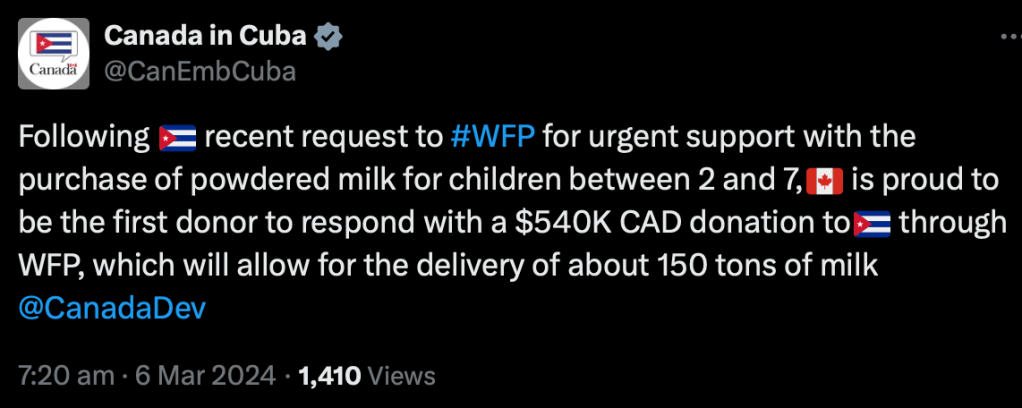
Canada has made some efforts, notably the announcement March 6 of a $540,000 contribution to the World Food Program to support provision of 150 tons of milk that will assist Cuban children. Canada’s response followed just two days after the Cuban government had made its first-ever request to WFP for food aid. Canada continues to fund the work of NGOs such as Oxfam and CARE Canada in Cuba.

The Canadian letter echoed earlier calls from Cuban and U.S. churches. In a joint letter sent Feb. 18, 2021, they asked Biden to to restore travel, remittances and trade with Cuba; to remove Cuba from the list of “state sponsors of terrorism;” to rescind Trump’s mandate to use extraterritorial provisions of the Helms-Burton law; and to rebuild U.S. diplomatic presence in Cuba. On March 13, 2023, more than 20 U.S. faith groups wrote to Biden to ask that Cuba be removed from the SST list.

The SST designation, along with Trump’s application of measures contained in the 1995 Helms-Burton Act, have extraterritorial impacts. Foreign-owned ships won’t dock in Cuba and foreign banks are reluctant to transfer funds for fear of running afoul of the U.S. laws. To understand better the impact of the SST in Cuba, please read a long report by the Washington Office on Latin America (WOLA).

The extraterritorial features of the Helms-Burton law provoked anger in Canada and Europe, but those features were effectively waived by Presidents Clinton, Bush and Obama. In April 2019, Trump revived them. Canada repeated its objection, and reminded Canadians that amendments in 1996 to Canada’s Foreign Extraterritorial Measures Act (FEMA) stipulate that any judgment issued under Helms-Burton “shall neither be recognized nor enforceable in any manner in Canada.”

But Canada, to my knowledge, has yet to say anything publicly about the SST list.

Meanwhile, churches, NGOs and solidarity groups continue to provide aid to Cuba, including in response to damage caused by Hurricane Ian in western Cuba in 2022 and after the oil storage facility fire in Matanzas in 2022. 

Vancouver-based CoDevelopment Canada is collecting material to send in a container to Cuban trade unions later this summer. 

The U.S. Cuba Normalization Coalition has a fact sheet about U.S.-backed attacks on Cuba. “Cuba has endured 64 years of a U.S. economic blockade.This intensified when President Trump unjustifiably put Cuba on a list of so-called State Sponsors of Terrorism (SSOT).President Biden has continued that listing. Companies worldwide that want to sell medicines or food to Cuba often can’t because their own bank refuses to accept Cuba’s payment under threat of enormous fines from the U.S.treasury for dealing with ‘terrorists’.”

Haitian claim for slavery reparations at the heart of a UN forum

by Jim Hodgson

A United Nations forum on the historic wrongs committed against people of African descent is building momentum in favour of an international tribunal on atrocities dating back to the transatlantic trade of enslaved people.

When the UN Permanent Forum on People of African Descent (PFPAD) held its third session in less than two years in Geneva in mid-April, African and Caribbean governments together with civil society organizations pressed forward with plans to create a tribunal that would be similar to that which oversaw the Nuremberg trials of Nazi war criminals after World War II.

Proponents say such a tribunal would help establish legal norms for international and historical reparations claims.

Supporters include many members of the Caribbean Community (CARICOM), made up of 15 member states, and the African Union (AU), which includes 55 states—and Antonio Guterres, the UN General Secretary. “We call for reparatory justice frameworks, to help overcome generations of exclusion and discrimination,” he said March 25.

Supporters argue that Western countries and institutions that continue to benefit from the wealth slavery generated should be held accountable, particularly given ongoing legacies of racial discrimination. Opponents say that contemporary states and institutions should not be held responsible for historical slavery.

The World Council of Churches was among faith-based and civil society organizations that came together at the PFPAD forum to examine what states and other actors may do to redress the historic exploitation and harms that Africans and people of African descent have suffered. (You can learn more here about global ecumenical efforts to overcome racism, discrimination and xenophobia.)

Righting the wrongs in Haiti

Given that Haiti’s claim for reparations is among the strongest, the voices of Haitian civil society groups and their diaspora counterparts were heard at the PFPAD forum. 

Those groups used the forum to put a spotlight on the crucial role that Haiti played in the struggle to end slavery. “To recognize the historic context is essential to understand the unique position of Haiti in the global struggle for justice and egality,” they said in a statement before the forum. Participating groups—including the Montana Accord network and of the Haitian-American Foundation for Democracy (HAFFD)—said they strongly approve calls for reparations to Haiti.

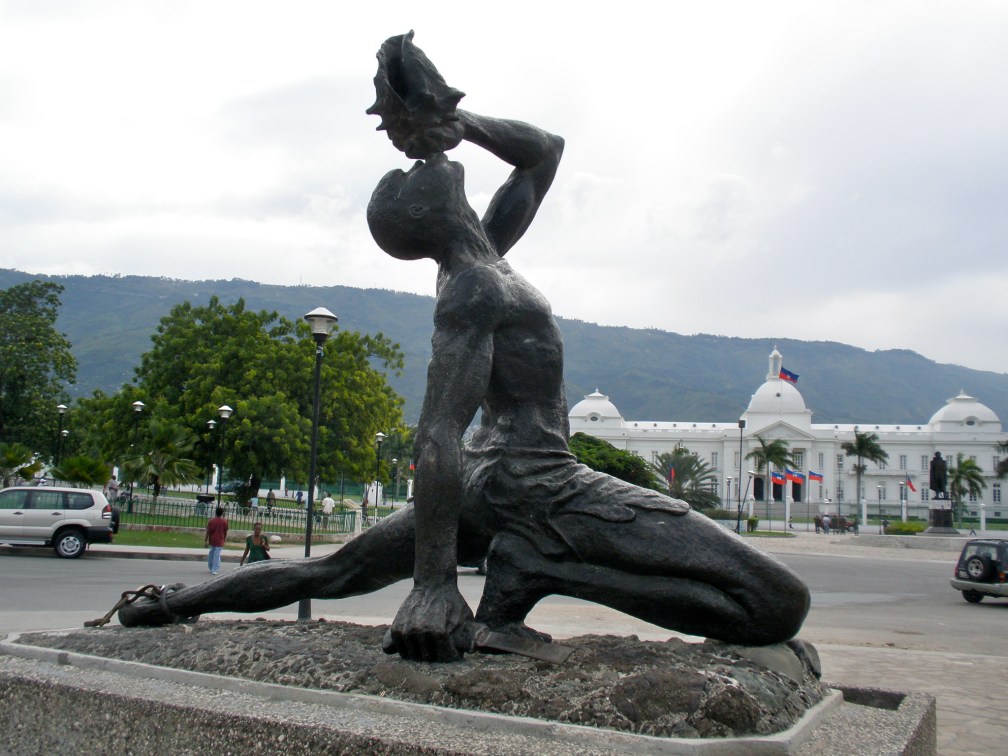
Le Marron Inconnu, and in the background, the National Palace before the 2010 earthquake.

Haiti was born as an independent nation in 1804 after the enslaved people revolted against their French colonial masters. The values of “liberté, égalité et fraternité,” expressed in the triumph of the French Revolution in 1789, resonated among slaves in Saint-Domingue, France’s richest colony. In 1804, the world’s first successful slave rebellion resulted in the birth of the Republic of Haiti. 

Beginning in 1825, France squeezed an “independence debt” from Haiti that adds up to at least $21 billion in today’s dollars. That estimate comes from The New York Times, but backers of the reparations claim say the amount is much higher.

“It’s $21 billion plus 200 years of interest that France has enjoyed so we’re talking more like $150 billion, $200 billion or more,” Jemima Pierre, professor of Global Race at the University of British Columbia, told Reuters.

Despite the obvious injustice of that debt, France continues to resist pressure to join in reparations. In August 2010, about 100 prominent academics, authors, and human rights activists signed on to an open letter to then-President Nicolas Sarkozy, arguing that the case for repayment was “morally, economically, and legally unassailable.” France dismissed the petition, pointing to its record of delivering other aid to Haiti and not addressing the legitimacy of the debt.

“What’s important is that it’s time that France recognises this and we move forward,” Haitian civil society activist Monique Clesca told Reuters. France, whose development agency has given hundreds of millions of dollars in aid to Haiti, has previously referred to a “moral debt” owed to Haiti.

Looking beyond the crises: A new agenda for peace

by Jim Hodgson

For years, I have gathered and often shared the stories of how people organize for a better future for their communities and the planet. A few days ago, I started gathering articles as they appeared about the ecological crisis.

And I am alarmed – though the rational part of my brain reminds me that I have long-known of the intersection of ecological disaster with civil conflict and war. 

In 1971, I was 13 when I attended my first demonstration. It was about peace and the environment: opposing the third in a series of U.S. nuclear tests at Amchitka in the Aleutian Islands between Alaska and Siberia. Again today, war and ongoing failure to respect ecology bring us closer to collapse. A previous test in 1969 gave rise to the Don’t Make A Wave Committee in Vancouver. The group became the global movement Greenpeace. (Photo: an old clipping from the Summerland Review, November 1971).

Addressing the UN General Assembly a week ago, Secretary General António Guterres pointed to the two canals most vital to world trade and management of supply chains.

Trade via the Panama Canal is down 36 per cent in the past month because of low water levels – a consequence of the climate crisis. 

Trade via the Suez Canal is down by 42 per cent, since the start of Houthi attacks on shipping in the Red Sea more than three months ago. Those attacks in turn are a foreseeable consequence of the excessive – many argue “genocidal” – Israeli response to the Hamas-led attack on Israeli civilians from the Gaza strip last Oct. 7.

The Pressenza news service reports this week that for the first time on record, the average global temperature exceeded 1.5 degree Celsius over a 12-month period, according to data from the Copernicus Climate Change Service (C3S). Last month was also the warmest January globally since C3S records began in 1950, with an average air surface temperature 0.7 degrees Celsius higher than the January average from 1991 to 2020.

Meanwhile, the Atlantic Ocean system of ocean currents may already be on course to collapse, according to a new report published Feb. 9 in the journal Science Advances. Such collapse could lead to further sea level rise and cause temperatures to plunge dramatically in Europe and rise in the southern hemisphere.

A new UN report shows that about 44 per cent of migratory species worldwide are declining in population. More than a fifth of the nearly 1,200 species monitored by the UN are threatened with extinction.

In Mexico, prolonged drought led to sharp drops in production of corn and avocados last year. Lack of rainfall has affected water reservoirs used for agriculture. Across the country, water storage is at 42.7 per cent of normal, and down 34.8 per cent from 2022. This is leading producers to plant less in the winter 2023-24 season. Images from La Jornada: (left) “corn production dropped 40 per cent because of the drought;” (centre) “Monarch butterflies occupy 59.3 per cent less surface area than the previous year because of climate impacts;” (right) “Industrial activity in Iztapalapa (the east side of Mexico City) could be paralyzed for lack of water.”

In January, Mexico’s national weather service reported that 2023 was the driest in 82 years, with just 21.1 per cent of normal rainfall. Last year also saw the largest amount of land afflicted by wildfires.

The Aqueduct Water Risk Atlas has published an interactive map where you look at drought risks in any part of the planet. Half of Mexico and large parts of the western United States are in red, along with most of northern Alberta. 

Raúl Zibechi, the Uruguayan observer of social movements in Latin America, published a column recently that examined these and other risks.

“We continue to be stuck in the minuteness (‘chiquitismo’) of consumerist and narcissist daily life,” he wrote – “the latest telephone or clothing; the football game where we are merely spectators; the electoral campaign that only entertains, but does not resolve anything profound. This is the strategic triumph of capitalism: taking us headlong toward collapse while we look at the screen, ignoring the destruction and massacre of life.”

Views from Corpus Christi, Texas, June 2007. (Photos: Jim Hodgson)

In the speech by António Guterres that I noted above, he denounced the wars and ecological destruction, and offered some signs of ways forward. He spoke of A New Agenda for Peace.

“Peace is a rallying cry,” he said. “It is a call to action.” And he went on to describe the actions that must be taken: ceasefires, negotiations, addressing causes of migration, protection of species, debt and development finance, real action on climate, and reform of UN systems including the Security Council.

“We must also make peace with the planet. Humanity has waged a war we can only lose: our war with nature,” Guterres said. “For my part, I can guarantee that I will never give up pushing for peace.”