From Bogotá, the Global South charges Israel with genocide

A two-day meeting this week in the Colombian capital ended with renewed commitment to pursue accountability for Israeli abuses in Gaza, including by preventing the transfer of weapons to Israel.
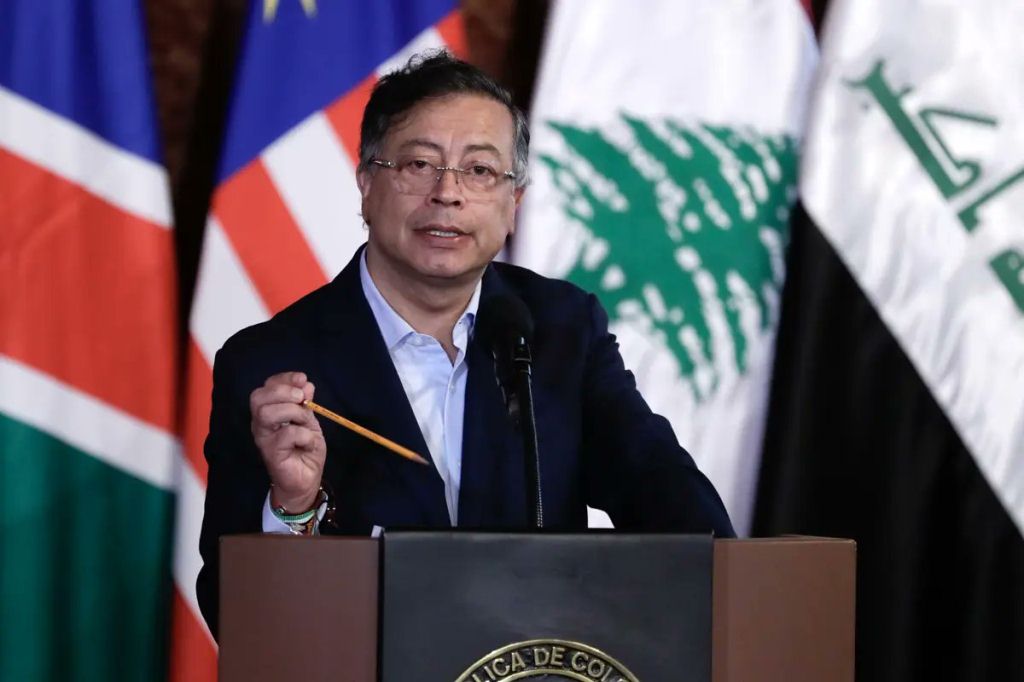
As the event drew to a close Wednesday (July 16), Colombian President Gustavo Petro (above) told participants, “Gaza is simply an experiment by the ultra-rich to show the impoverished people of the world how they will respond to humanity’s rebellion.”

Petro also distanced himself further from the North Atlantic Treaty Organization (NATO), which in 2022 had designated Colombia as a “non-member strategic ally.” 

“What are we doing in NATO, if its principal leaders are with the genocide?” he asked. “We must leave.”

A coalition known as The Hague Group organised the summit. It was born in January last year through the help of Progressive International (PI), an organization founded in 2020 to unite, organize, and mobilize progressive forces around the world. PI called the Bogotá meeting the “most ambitious multilateral action since the start of Gaza genocide 21 months ago.”

Jointly convened by the governments of Colombia and South Africa as co-chairs, the Hague Group also includes Bolivia, Cuba, Indonesia, Iraq, Libya, Malaysia, Namibia, Nicaragua, Oman and Saint Vincent and the Grenadines. At least 18 other countries, plus the United Nations and the World Council of Churches, sent representatives. Qatar and Egypt, which are overseeing negotiations between Hamas and the Israeli government, attended.
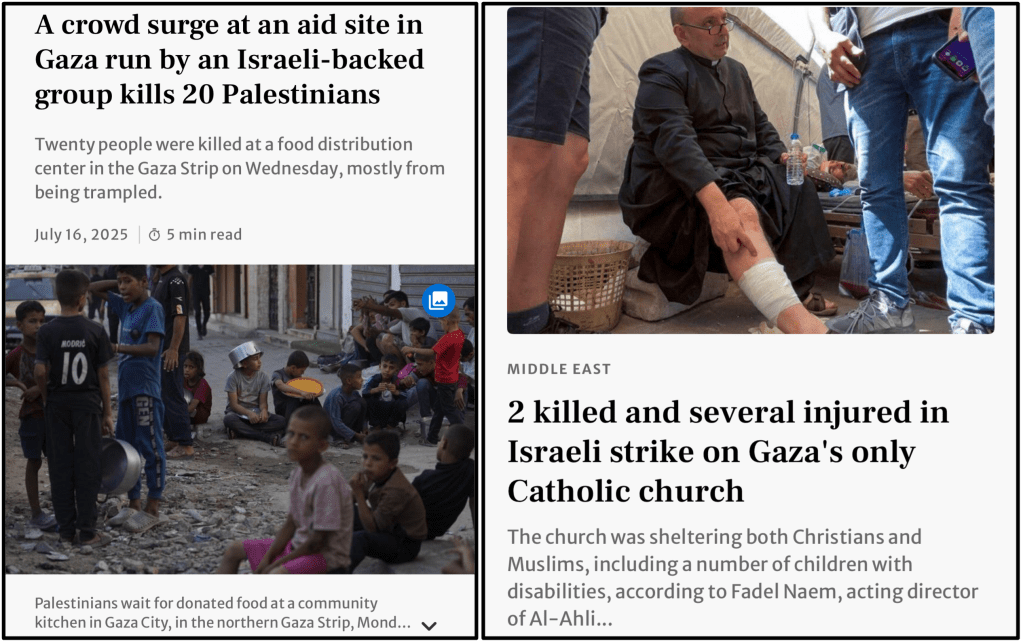
Israel’s offensive in Gaza has killed more than 58,000 Palestinians, according to Gaza’s Health Ministry, which has said women and children make up more than half of the dead. At least 90 were killed on Thursday (July 16), including those who were crushed at an Israeli-controlled food distribution site. Holy Family Church also came under attack, sparking criticism and new calls for peace from Pope Leo XIV and from the World Council of Churches.

During Tuesday morning’s opening event, various officials spoke, calling for an end to Israel’s attacks on Gaza. Colombia’s foreign minister, Rosa Yolanda Villavicencio, said during her morning address that Israel’s attacks constitute an unequivocal “genocide.”
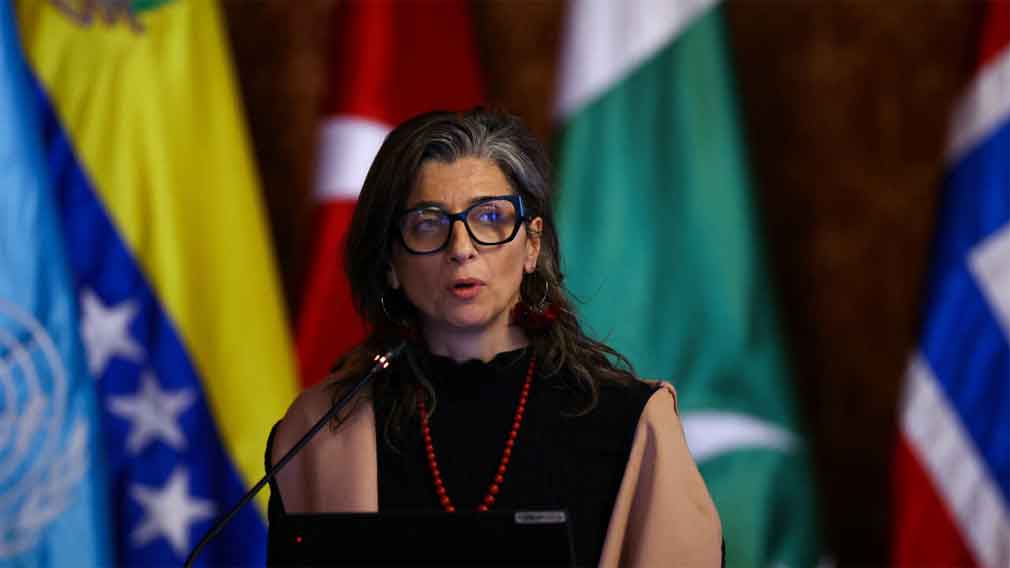
Another key participant was Francesca Albanese (above), the U.N. special rapporteur for the Palestinian Territories. She denounced the inaction of the international community. She accused the West of justifying Israeli actions as the “right to defense” and said the vetos in the U.N. Security Council “protect war crimes” carried out in the sight of all.

“Palestine has changed global consciousness, drawing a clear line between those who oppose genocide and those who accept it or are part of it,” she said. Albanese was recently sanctioned by the US for her outspoken criticism of Israel’s actions.

“We believe in protagonism, not supplication,” said Varsha Gandikota-Nellutla, the executive secretary of The Hague Group. “Today marks an end to the era of the impunity and the beginning of collective state action by governments of conscience.”

The group members committed to implementing six measures immediately through their domestic legal and administrative systems to break the ties of complicity with Israel’s campaign of devastation in Palestine. They set September 20 as a date for other states to join them, coinciding with the 80th U.N. General Assembly. Consultations with capitals across the world are now ongoing.

“We hereby announce the following measures,” the Joint Statement on the Conclusion of the Emergency Ministerial Conference on Palestine reads, “to be adopted based on states’ domestic legal and legislative frameworks:”

  • Prevent the provision or transfer of arms, munitions, military fuel, related military equipment, and dual-use items to Israel…
  • Prevent the transit, docking, and servicing of vessels at any port…. in all cases where there is a clear risk of the vessel being used to carry arms, munitions, military fuel, related military equipment, and dual-use items to Israel
  • Prevent the carriage of arms, munitions, military fuel, related military equipment, and dual-use items to Israel on vessels bearing our flag… and ensure full accountability, including de-flagging, for non-compliance with this prohibition.
  • Commence an urgent review of all public contracts, to prevent public institutions and funds from supporting Israel’s illegal occupation of the Palestinian Territory and entrenching its unlawful presence.
  • Comply with obligations to ensure accountability for the most serious crimes under international law, through robust, impartial and independent investigations and prosecutions at national or international levels, to ensure justice for all victims and the prevention of future crimes.
  • Support universal jurisdiction mandates, as and where applicable in national legal frameworks and judiciaries, to ensure justice for victims of international crimes committed in the Occupied Palestinian Territory.

“These 12 states have taken a momentous step forward,” said Albanese about the joint statement. “The clock is now ticking for states—from Europe to the Arab world and beyond—to join them.”

The full joint statement is here.

Complete text of Albanese’s remarks is here.

“Cuba does not live in peace. Cuba lives with permanent aggression.”

The Mexico City daily newspaper, La Jornadapublished an interview May 9 with Cuba’s vice-minister of external relations, Carlos Fernández De Cossío.

Cuba’s lack of peace, he emphasized, is caused by Washington’s policies against the people of Cuba, characterized by economic coercion with the blockade. He warned that while practically the whole world has been the object of tariff threats by the administration of Donald Trump, “towards Cuba, the onslaught is already underway, and only military aggression is lacking” to complete the siege.

In the face of new global geopolitics, with Trump in power, he warned that the White House now attacks several countries: “you see this in Panama, Greenland, Canada;” the focus could also be the progressive governments elsewhere in Latin America.

“There are threats against several governments, and the United States will attempt, through force, economic pressure, and other methods, to influence the political processes of our countries. Venezuela is a country under attack. It’s evident that the region faces that reality….  The absence of armed conflict does not mean living in peace.” He also said that there is pressure on nations in the hemisphere to adopt measures to “reduce the ‘harmful influence’ of China.”

Over the past two-and-a-half years, I have worked with my former colleagues at The United Church of Canada, other churches, several trade unions and international development organizations to draw attention to the impact of U.S. sanctions (“the blockade”) on the Cuban people. Now that Canada’s new cabinet ministers are confirmed, we’ll likely launch a new call to “take action” in solidarity with Cuba.

Fernández de Cossío was in Mexico City for meetings May 8 with Mexico’s External Relations department (SRE) to talk about migration issues. 

With a long career in diplomacy, Fernández de Cossío has served as director for the United States in the Cuban foreign ministry. He also served as ambassador in Canada (2004-05) and South Africa, and was Cuba’s representative in the peace process between the government of Colombia and the Revolutionary Armed Forces of Colombia (FARC).

He said spaces like the Community of Latin American and Caribbean States (CELAC) are key to creating a counterweight to Washington. “They must move beyond declarations and formality. Getting there is not easy.” What follows is a lightly-edited translation of his interview with La Jornada writers, Emir Olivares and Arturo Sánchez Jiménez.

Migration challenges

Q: What are the challenges to the region from the new anti-migration policies of Trump?

R: If the great gap between the industrialized, developed countries and the countries in processes of development is not reduced, it’s natural that there will be a growing flow from the south toward the north to seek better living conditions. That goes on in Africa, in Asia and in our continent, where the flow toward the United States, whether it be regular or irregular. The reality varies by each country.

Q: And for Cuba?

R: The case of Cuba is unique. The United States has applied a dynamic against it that both pushes and pulls migration, whether regular or irregular. Washington’s official policy is economic coercion. The blockade, aimed at depressing and making living conditions as difficult as possible, provokes a migration drive.

Furthermore, since the 1960s, Cuban immigrants have been privileged, regardless of how they cross the border, by sea or by land. They are assimilated, granted refugee status, protected, and provided with employment. Additionally, there is the Cuban Adjustment Act, which means that regardless of how they entered the United States, Cuban migrants can acquire residency within one year of arriving in the United States. No citizen of any other country in the world has that privilege. If Washington does not put an end to this reality, the irregular flow will continue.

Q: What do you think of the U.S. propaganda shared in mass media and internet platforms against migration, headed by the secretary of homeland security, Kristi Noem?

R: It’s media opportunism that seeks support in the population. They unfairly criminalize all immigrants. To a certain extent, society has been polarized since its inception, with cultural and racial prejudices. And it’s not difficult for these politicians to try to stir up those feelings to promote a policy of rejecting immigrants and blaming them for many of the problems: drug use, unemployment, crime, and social polarization. If some migrants participate in crime and social unrest, it’s because these phenomena already exist in the United States.

Historically, the United States has believed that Cuba belongs to them, but in reality, it is an inability to accept that Cuba is, and has the right to be, a sovereign state.

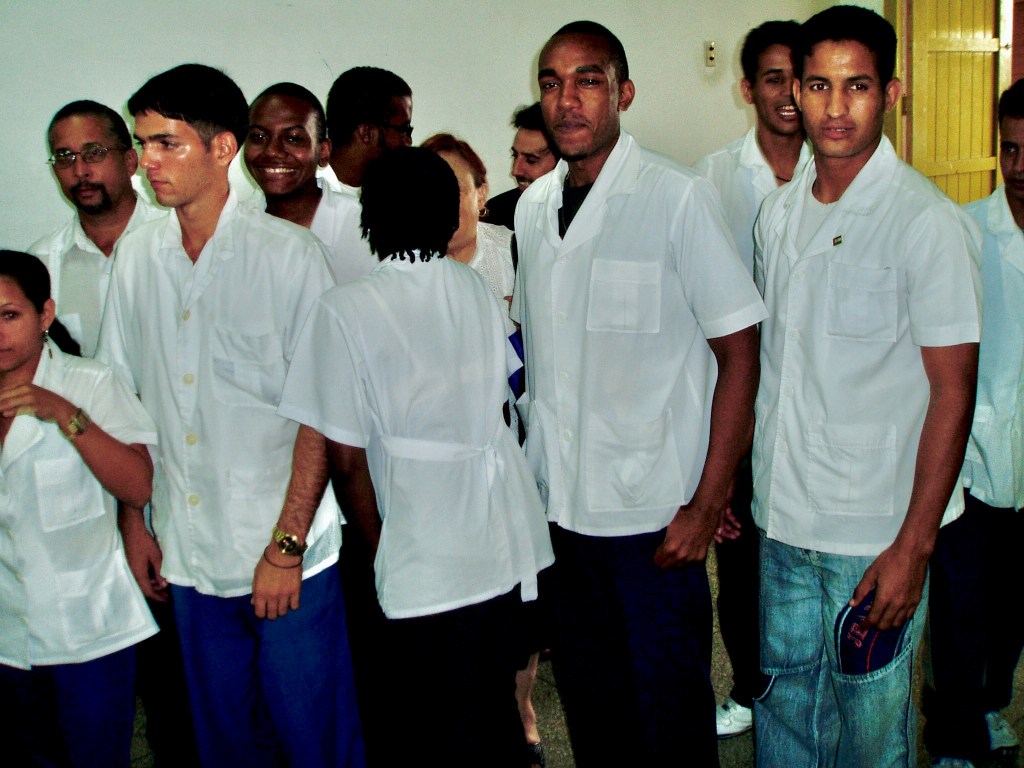
Medical students at the University of Medical Sciences in Matanzas come from around the world. (Photo: Jim Hodgson, 2007)

Campaign against the health brigades

Q: The campaign against Cuba’s medical brigades is within these new coercive measures?

R: Yes. Since February, they have threatened that countries that continue medical cooperation programs with Cuba, their officials and family members will lose their visas and their ability to travel to the United States. Today, around 60 nations have these programs. They provide care to thousands of people. It is a historic project, for which Cuba has been praised by governments, several UN secretaries-general, and even a US president (Barack Obama).

The campaign seeks two things: to discredit this symbol of the success of Cuban society, since one of the priorities of anti-Cuban sectors is to prevent recognition of Cuba’s successes. The second is to cut off a legitimate source of income obtained from agreements with countries that are more favourable (such as Mexico), although historically these are services for which not a cent has been received.

Q: Do Trump’s new geopolitics bring additional pressures to the hemisphere?

R: It’s part of the US government’s hostile and imposing behavior toward the region, and it’s a challenge not only for Cuba but for the entire region. There’s pressure to adopt measures to reduce “China’s harmful influence.” We find it absurd. In a recent congressional hearing, they showed alleged Chinese military bases in Cuba (they used to say they were Russian, during the Cold War). They presented images of what could have been a soccer field or a rice field to say: “This is evidence that there are Chinese military bases in Cuba,” but there wasn’t a single military officer there, no one from the Pentagon or the CIA, from the institutions that are supposed to bear witness to this.

There’s threatening behavior that tries to impose their will on the hemisphere. We saw this in Panama. We see it in Greenland (even though it is not part of the region) and with Canada. It’s a challenge for us all and it’s dangerous.

Q: What have been the errors of the revolutionary regime?

R: Fidel Castro once said that the biggest mistake was thinking that anyone knew how to build socialism and that it would be easy to do so. In Cuba, specific errors may have been made in some aspects of economic policy, in elements of social policy, but it’s very difficult to judge if one takes into account the challenges posed by the aggression of a power like the United States.

Q: Are the ideals of Martí, Castro and others still valid?

R: The ideas of Martí, Fidel, Marx, Engels, Lenin and other Marxists remain relevant and continue to shape our thinking. The challenge we face with youth is enormous, due to the communication influence that large corporations have exerted, a monopoly that is difficult to break. This, combined with a very depressed economic situation, has a serious and dangerous impact on the population. We are working with this; we accept it as a challenge, a very great challenge facing Cuban society.

Disappointment and fury in the wake of failed climate talks—and hope for the road ahead

by Jim Hodgson

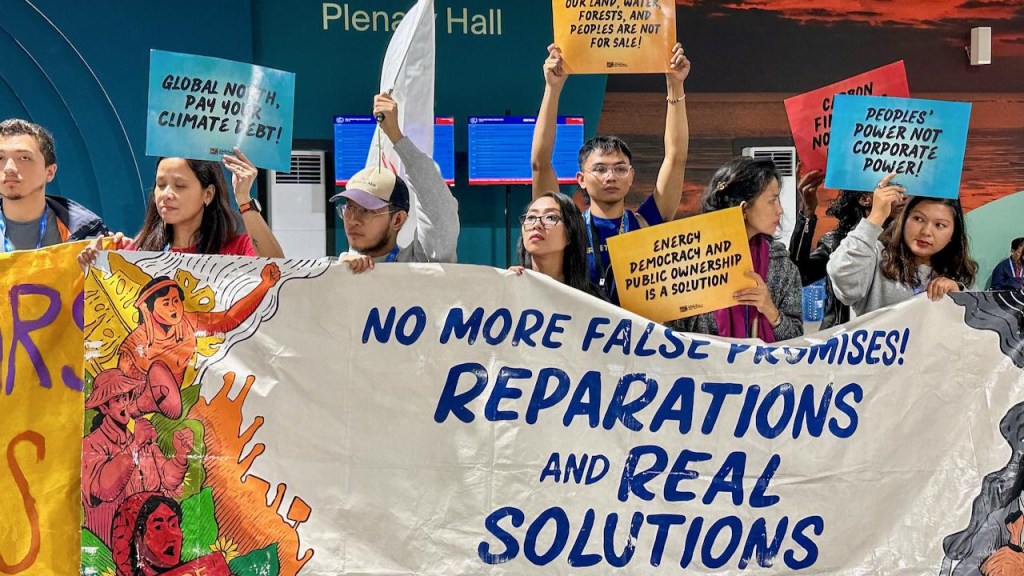
“I am infuriated to come home to the aftermath of six typhoons that have struck the Philippines in the space of just four weeks with basically zero gains from COP29,” said Patricia Mungcal, a young climate advocate who serves as humanitarian manager with the National Council of Churches in the Philippines. 

“I will be telling thousands of Filipino families who were devastated by these strong typhoons that world leaders have left us to suffer the heaviest impacts of the climate crisis and disregarded our demands for finance and reparations. This failure to address loss and damage is a grave disregard of our human dignity and rights. We charge this failure of COP29 to the moral bankruptcy of the rich, polluting nations.”

News from Philippines and (right) Patricia Mungcal (screenshot from WCC video)

At the recent climate conference in Baku, Azerbaijan, world leaders failed miserably in their response to the climate crisis and its consequences. Of the $1.3 trillion of climate finance that independent experts estimate will be required annually by 2030, the UN climate conference agreed to provide just $300bn every year – by 2035 (Progressive International newsletter, Dec. 3).

Meanwhile, governments around the globe (including Canada) are still ploughing billions of dollars into fossil fuel subsidies to shelter citizens from higher energy costs, but that comes with a fiscal burden and impedes the goal of reducing overall use.

And Philippines had six typhoons. In the Canadian Rockies, Jasper townsite burned—just days after I had written about climate disasters in British Columbia.

What is to be done?

More often now, we are seeing the connection between the climate crisis and the growing indebtedness of the so-called “highly indebted poor countries” (HIPC). And proposals for a new international financial architecture are once again getting attention. 

In June, Pope Francis pressed leading economists and world finance ministers to support new mechanisms to ease foreign debt, lamenting that “poorly managed globalization” has deprived millions of people of a “dignified future.”

Ecological debt and foreign debt are two sides of the same coin that mortgages the future,” the pope said. “For this reason, dear friends, the Holy Year of 2025, to which we are heading, calls us to open our minds and hearts to be able to untie the knots of the ties that strangle the present, without forgetting that we are only custodians and stewards, not masters.”

The focus of this Jubilee Year is gaining ecumenical and inter-faith support. In Canada, KAIROS will lead a Canadian Ecumenical Jubilee campaign, in step with global debt relief efforts. “These are inspired by the Jubilee tradition from the Book of Leviticus. Rooted in faith, Jubilee calls for the release of debts, liberation from servitude, and the return of seized lands—principles that resonate deeply in today’s world,” says KAIROS. This campaign aims to:

  • Cancel unjust debts. 
  • Establish a UN-led mechanism for debt resolution. 
  • Prevent future cycles of crippling debt.

The 2025 meeting of G7 (leaders of the richest countries) will be held June 15-17 in Kananaskis, Alberta (southwest of Calgary).

Confronting threats to the living planet.” Photo: Valter Muniz, WCC)

A “Manual for Mutiny”

The global Progressive International network, meanwhile, is presenting a Program of Action on the Construction of a New International Economic Order. It speaks of a “polycrisis”—the combination of the “old crises of debt, dependency and under-development” combined now with “an accelerating crisis of climate to threaten not only the developmental prospects of the South—but also, in the case of many small island states, their very existence.”

The Program of Action offers nearly three dozen measures across five broad sections: to leverage the South’s natural wealth, labor power, and collective voice in order to extract concessions from Northern partners; to bolster the sovereign development agenda by building Southern alternatives to Northern institutions; and to pool Southern knowledge, resources, and ingenuity in service of a whole that is greater than the sum of its parts.

To that, I would add: Systemic failure demands system change.

What you can do

Keep an eye on KAIROS, of course, and on Development and Peace-Caritas Canada for ways to get involved in the new Jubilee campaigns.

I also want to share with you some suggestions from Katharine Hayhoe, a Canadian atmospheric scientist whose research focuses on understanding the impacts of climate change on people and the planet.

“For climate action to happen at scale, conversations have to move beyond international summits to what’s happening in our communities, our workplaces, and our organizations. And there, change isn’t something we wait for. It’s something we catalyze,” she wrote after COP29.

She suggests starting conversations “about climate solutions where you work or study. Ask what your organization is already doing, and what more it could do—and share that with people around you, particularly those who can make decisions.”

That will be especially important as Canadians vote in a federal election in 2025, and as one party opts for simplistic slogans over serious conversations about climate policy.