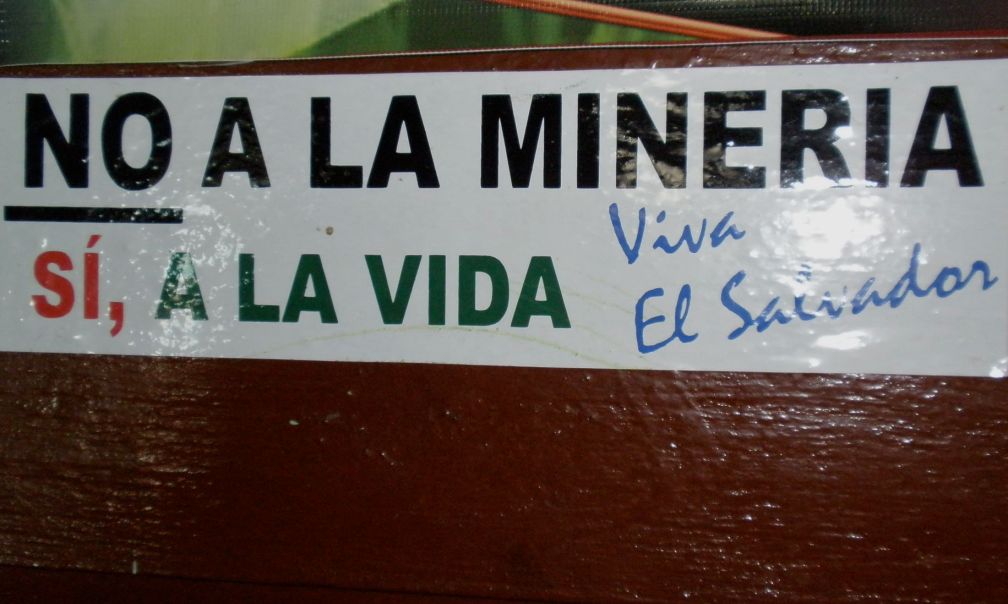
No to mining, Yes to life

Family members of the ‘Santa Marta 5’ file legal complaint over delay in final ruling

by Jim Hodgson

After four postponements in delivering the final written ruling to confirm the acquittal of the defendants, family members of five anti-mining leaders in El Salvador have filed an official complaint against the judges who provided only a verbal not-guilty verdict after trial five months ago.

The defendants are people that I have known for nearly 25 years through their involvement in the Santa Marta Association for Economic and Social Development (ADES).

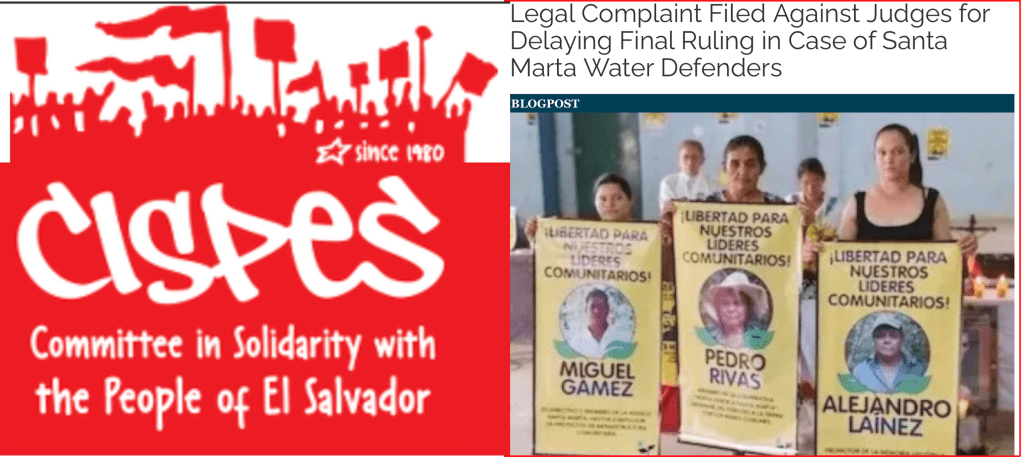
The text that follows is a based on a text published this week by the Committee in Solidarity with the People of El Salvador (CISPES), supplemented by other media reports.

The complaint against the judges was filed with the Judicial Investigation Directorate of the Supreme Court of Justice (CSJ) Jan. 20, 2026, and adds to a series of public actions undertaken by the families, organizations, and human rights groups to demand the definitive closure of the judicial process against the water defenders. They had previously been part of a successful struggle to stop a gold mine from re-opening in the northern part of Cabañas department.

The Santa Marta 5 were arrested Jan. 11, 2023, and charged in connection with the alleged disappearance of a woman during El Salvador’s civil war. The charges were widely denounced as political persecution: the community leaders had been sounding the alarm over indications that the Nayib Bukele government was seeking to overturn El Salvador’s 2017 ban on metal mining, the first and only in the world. 

They were imprisoned for eight months while awaiting trial and subsequently placed under house arrest, a measure that was granted only after pressure from national and international human rights organizations and elected officials.

In December of 2025, El Salvador’s legislature, dominated by Bukele’s New Ideas party, did in fact overturn the law prohibiting mining in the country.

The defendants were acquitted of all charges in October 2024. The Attorney General appealed the decision, and in November 2024, the Cojutepeque Criminal Chamber overturned the dismissal of the charges and allowed a retrial in a new jurisdiction.

When the second trial concluded in September 2025, the San Vicente Sentencing Court reached the same conclusion in its oral ruling, acquitting the defendants of criminal charges. But the court has since delayed delivering its final written ruling four times, unjustifiably prolonging the judicial process and leaving the case without definitive closure.

On Jan. 9, the judges once again postponed the delivery of the written ruling until Jan. 30, a decision that the families believe could constitute a delay of justice in violation to the principle of “prompt and fair justice” and keeps a process indefinitely open that already has two acquittal rulings.

In the document they submitted to the CSJ, the families of the defendants requested an investigation into the delays as they have prevented the sentence from becoming final. Without a written ruling, the procedural deadlines for either a possible appeal or the definitive closure of the case cannot commence.

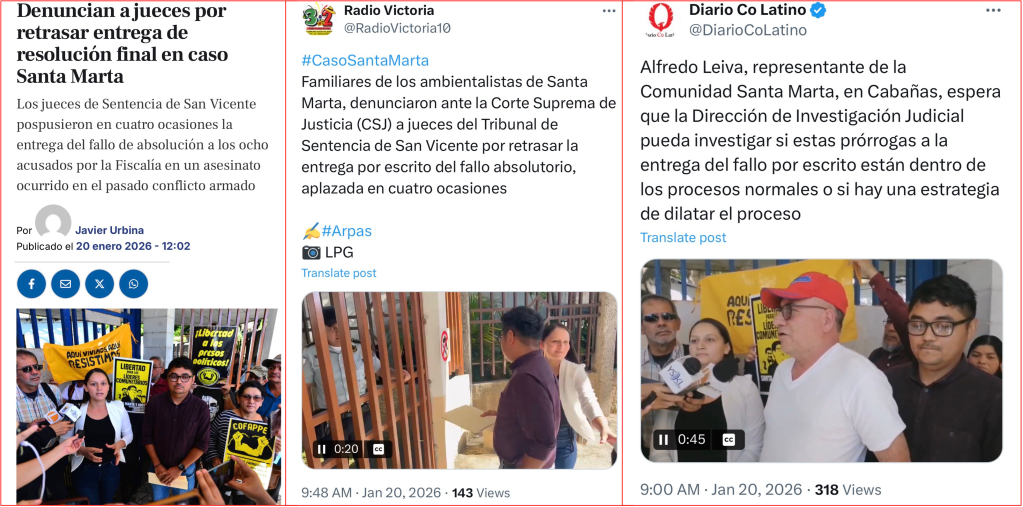
Media and social media coverage of the new legal complaint.

Milton Rivas, son of Pedro Antonio Rivas, one of the defendants, explained to the media that the judges “have been delaying the final ruling” and that the complaint filed seeks to demand justice for his family members. “We are not asking for anything, nor have we come to beg for anything; we have come to demand justice, because it is unacceptable that it takes them about five months to submit a document that they could have delivered the same day the hearing ended,” he declared.

Social movements, human rights groups, community representatives, and family members of the defendants denounced the court’s stall tactic during a press conference on Jan. 13. Rivas, joined by community leader Alfredo Leiva, stated that the failure to deliver the written ruling has both prolonged the legal uncertainty and kept the defendants, their families, and the community in a constant state of anxiety.  “This delay keeps our family members in a situation of constant anguish and constitutes a denial of justice,” they declared.

A representative of the University Movement for Critical Thought also warned of a broader context of increasing persecution and criminalization in the country. Currently, at least 38 human rights, environmental, labour, and political activists remain imprisoned, while human rights defenders and community journalists continue to report receiving threats, police harassment, and intimidation campaigns against them.

“We demand an immediate end to [this] persecution and respect for the right to defend the environment, to inform, and to organize,” the organizations stated, issuing an urgent call to Salvadoran society and the international community to remain vigilant given the risk of additional arbitrary arrests targeting critical voices and community organizing efforts.

Finally, they reported that a permanent vigil is being held in front of the Metropolitan Cathedral in San Salvador every day at six in the evening as a peaceful act of protest and a demand for justice, freedom, and respect for human rights.

"Another World is Possible," World Social Forum, Porto Alegre, Brasil (2005)

The old order is dead. Let’s make a new, more just order.

by Jim Hodgson

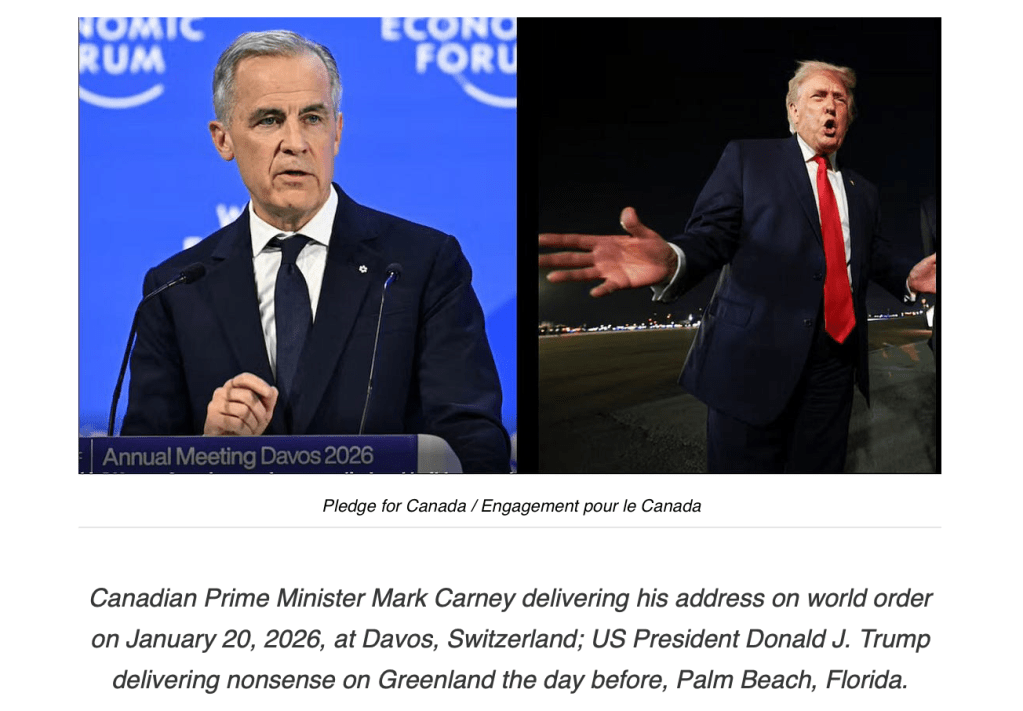
It was too much to hope that the well-heeled audience at Davos would boo Donald Trump from the stage a day after they had offered Mark Carney a standing ovation. But by the end of Wednesday, it seemed that the wall of resistance to any U.S. take-over of Greenland was successful, and the president backed down. An important victory.


Still, “la rupture de l’ordre mondial” of which Carney spoke remains. And he’s right: we shouldn’t mourn it. The international financial institutions invented in 1944 at Bretton Woods, New Hampshire, gave overwhelming power to the rich countries of the Global North. 

And the United Nations system that followed, with a veto given to each of the five most powerful countries, has protected their interests – even in the face of overwhelming contrarian votes in the UN General Assembly. Think, for example, of the annual vote to end the cruel U.S. blockade of Cuba.

That order was designed by the nations that existed at the end of World War II, especially the colonial or neo-colonial states of Europe and the Americas. Most of the Caribbean, Africa and large parts of south Asia were still under colonial rule. That order imposed and perpetuated a Global North-based order on all the new nations that were born in the 25 years or so after the war: the majority of nations that exist today.

And that order, at least in the eyes of three of the five veto-holders, effectively imposed capitalism as a synonym for democracy. The United States and its allies were satisfied with a sort of formal democracy, a certain alternance between parties of the right and centre-right, and if that failed, then a military government was a useful interlude until the real order could be re-established and markets were safe. 

Canada would “go along to get along,” as Carney admitted. 

Just as it did less than three weeks ago when the United States bombed Venezuela and kidnapped its president. And just as it has for more than two years over Israel’s genocide in Gaza.

In his speech, Carney seemed to offer a vision of capitalism without the now-erratic United States. It’s still reliant on resource extraction, military spending, and massive capital investment.

But if we are all to grow and thrive, we must demand more. We require an end to practices that exploit social inequities and our shared ecology. 

Alternatives

Because of the paths on which my life has taken me, one that is especially close to my heart is the call from the Indigenous people of Zapatista communities in southern Mexico for “a world with room for all” – “un mundo donde quepan muchos mundos.” But other visions come from other places, including three decades of gatherings of the World Social Forum.

More than 50 years ago, the majority world united behind a vision of economic decolonization, sovereign development, and international cooperation across areas such as debt, trade, finance, and technology. That vision became known as the New International Economic Order (NIEO) and was adopted by the UN General Assembly. But, power relations being what they are, it was never implemented. (Progressive International put together a set of reflections that trace its history and update the proposals for the 21st century.)

In March last year, the World Council of Churches and several global communions of churches repeated their call for a New International Financial and Economic Architecture (NIFEA). “It is immoral that over a billion people – half of them children – subsist in poverty whilst billionaires increased their wealth by over 15% in 2024 to US$15 trillion. It is outrageous that the richest 10% of the global population receives more than half of global income, whereas the poorest half earns merely 8.5% of it,” they said in a statement.

They expressed deep concern about “a rapidly escalating climate and biodiversity emergency that jeopardises livelihoods and poses an existential threat to all life.” It notes that “several tipping points are close to being crossed or have already been crossed, leading us to recognise that we may be beyond a point of no return.”

The old order is dead. The time in which we are living demands we do better.

Labour, development NGOs demand Canada condemn U.S. boat attacks in Caribbean

By Jim Hodgson 

Canadians need to call on their government to speak out against illegal U.S. airstrikes on boats in the Caribbean and eastern Pacific, say two coalitions in which I have participated for nearly three decades. 

Left: Calling on Canadians to act (Artwork by Harmeet Rehal); Right: AP news story on the 20th boat strike carried out by the United States since September. Another attack was reported a day later.

Common Frontiers and the Americas Policy Group sent a letter Nov. 13 to Foreign Minister Anita Anand, Trade Minister Maninder Sidhu, and Defence Minister David McGinty urging Canada to: 

  • Speak out publicly and condemn the unlawful attacks and extrajudicial killings of civilians in the Caribbean and Pacific by the U.S. military;

  • Contribute to the promotion of peace and security in the region and join efforts to press the Trump administration to respect national sovereignty and uphold the rule of law;

  • Suspend participation in Operation CARIBBE to avoid the risk of Canadian complicity; and

  • Adhere to Canada’s obligations under the Arms Trade Treaty by removing regulatory exemptions that allow loopholes for the export of arms to the U.S. without oversight or human rights risk assessment.

Just a day earlier, Anand had told reporters that it was not her job to determine if the United States has breached international law when striking alleged drug boats in the Caribbean Sea. 

“As Canada’s foreign minister, I hold responsibility for Canada’s compliance with international law—we are always seeking to comply with international law,” Anand said. “Regarding the question that you asked, I would say it is within the purview of U.S. authorities to make that determination.”

Her comment was soundly criticized by international law experts, including Ketty Nivyabandi, secretary-general of Amnesty International Canada’s English section. She told Hill Times that international law only works if it is upheld by all states. 

“It is a collective responsibility to uphold international law. It is not up to a country to focus on itself and decide whether or not it is applying international law—in that case, nobody would,” she said. “What the United States is doing is truly making a mockery of international law. It is normalizing what are, in effect, extrajudicial killings.”

The attacks take place amidst months of arrests and deportations of Venezuelans in the United States; false allegations of Venezuelan state collusion with a criminal gang called Tren de Aragua; massive U.S. movement of troops and warships into the Caribbean; and conjecture about what the Trump regime intends to do. On Nov. 13, Defense Secretary Pete Hegseth posted on social media: “President Trump ordered action—and the Department of War is delivering. Today, I’m announcing Operation SOUTHERN SPEAR.”

Former CBC News correspondent Dan Rather cited the Washington Post in calling it the biggest military presence in the Caribbean in decades. And he added: 

… a curious build-up if the stated goal is simply drug interdiction. Another explanation would be Trump wagging the dog, creating a diversion by manufacturing a crisis that he can then fix and allowing him to flex and crow about taking down the leader of a small country. Or it could be just about commandeering Venezuela’s oil.

Here below, from the Venezuela Solidarity Network, are some reasons to help stop a potential U.S. war against Venezuela:

Please write to your own Member of Parliament to express your views.

Join actions across Canada for the No War on Venezuela Days of Action, November 15-23:

📍VANCOUVER, BC
Rally & Info Tabling
Friday, November 21, 5:00pm
Vancouver Art Gallery – Robson Street Side
Organized by Fire This Time Movement for Social Justice 

📍OTTAWA, ON
Saturday, November 22, 3:30pm
U.S. Embassy – York and Sussex
Organized by Alba Movimientos Ottawa

📍WINNIPEG, MB
Sunday, November 23, 1:00pm
River and Osborne
Sponsored by Peace Alliance Winnipeg, Manitoba-Cuba Solidarity Committee, United in Action, Communist Party of Canada – Manitoba & Araucaria

The Canada-Wide Peace and Justice Network (CWPJN) encourages members and all antiwar and peace organizations to register their actions at https://unac.notowar.net/no-war-on-venezuela-action-registration and with the CWPJN at canadapeaceandjustice@gmail.com
For updates visit: tinyurl.com/Hands-Off-Venezuela